Electrocardiogram Part 3: Common Cardiac Arrhythmias
 Note
Note Call Kai
 Learn
Learn Practice Test
 Spaced Repetition
 Match
Match Flashcards
 Knowt Play
1/23

Earn XP
Description and Tags
This set of vocabulary flashcards covers common cardiac arrhythmias including bradyarrhythmias, berbagai types of AV blocks, and various forms of tachycardia as described in the lecture.
Name | Mastery | Learn | Test | Matching | Spaced | Call with Kai | Chat |
|---|
No analytics yet
Send a link to your students to track their progress
24 Terms
Holter monitor
A wearable ECG recording device.
Bradyarrhythmias
Arrhythmias that occur due to slowed or absent SAN depolarization or AVN conduction.
Sinus bradycardia
A depression of SAN depolarization often caused by high vagal tone or anesthetic/analgesic administration.
Respiratory sinus arrhythmia
A normal condition in dogs and horses where SAN discharge varies based on the respiratory cycle, featuring an increased heart rate on inspiration and a decreased heart rate on expiration.
SAN arrest
The complete failure of the SAN to depolarize, which can occur with sick sinus syndrome (SSS).
Sick sinus syndrome (SSS)
A condition where the SAN failure leads to the AVN taking over as an auxiliary or emergency pacemaker, resulting in a slower heart rate and no P waves on an ECG.
Atrioventricular (AV) block
An arrhythmia where the atrial action potential is not propagated to the ventricles, causing the atria and ventricles to beat at different, unsynchronized rates.
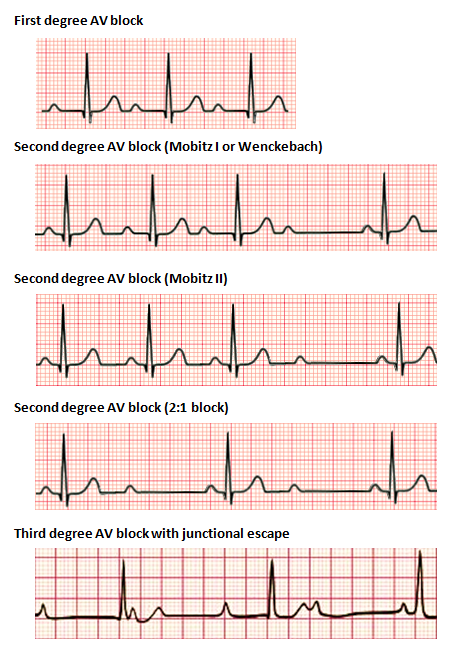
1st degree AV block
The mildest form of AV block where the SAN impulse is more slowly propagated by the AVN, leading to a prolonged PR interval.

2nd degree AV block
A block where the AV node transmits some, but not all, atrial action potentials, resulting in some P waves not being followed by a QRS complex.

Mobitz type I
A subclassification of 2nd degree AV block, also called Wenckebach phenomenon, characterized by a progressively prolonged PR interval before a blocked P wave.

Mobitz type 2
A usually pathologic form of 2nd degree AV block not related to vagal tone, considered high grade or advanced if the P to QRS ratio is greater than 3:1.

3rd degree AV block
Also known as complete heart block, where no impulses from the SAN are conducted through the AVN and ventricles beat at an escape rate of spontaneous AVN depolarization.
Tachyarrhythmias
Arrhythmias that occur due to rapid SAN depolarization or the presence of an ectopic pacemaker.
Ectopic pacemaker
A region of abnormal cardiac muscle in the atria, ventricles, SAN, AVN, or conduction pathway that depolarizes spontaneously and independent of the SAN.
Supraventricular tachycardia
A general term used to describe sinus, atrial, and junctional tachycardia.
Sinus tachycardia
A condition where the SAN depolarizes at an elevated rate, often due to increased sympathetic tone from excitement, exercise, or physiologic stress.
Atrial tachycardia
A progression of atrial premature complexes (APCs) caused by an ectopic pacemaker in the atrium depolarizing independent of the SAN.
Atrial flutter
A very rapid atrial tachycardia where the AVN conducts some but not all impulses, protecting the ventricular rate through slowed transmission.
Atrial fibrillation (Afib)
Continuous random atrial depolarization resulting in no effective atrial contraction and an ECG featuring a fibrillating baseline with F waves instead of P waves.
Junctional tachycardia
An arrhythmia caused by an ectopic pacemaker located in the AVN or the first part of the AV bundle.
Ventricular premature complex (VPC)
Also known as a premature ventricular contraction (PVC), where ectopic foci in the ventricle depolarize without atrial depolarization, creating a wide and bizarre shape on the ECG.
Ventricular tachycardia (VT)
An arrhythmia defined by more than 3 sequential VPCs.
Accelerated idioventricular rhythm
A benign form of VT with a rate typically less than 200beats/min, often secondary to systemic diseases like trauma or gastric dilatation and volvulus.
Ventricular fibrillation
A fatal arrhythmia that often causes sudden death and involves a predisposition to complete loss of coordinated ventricular contraction.