šŸ–Øļø Lecture 4: Eukaryotic Transcription Initiation

0.0(0)
studied byStudied by 0 people
0.0(0)
full-widthCall with Kai
learnLearn
examPractice Test
spaced repetitionSpaced Repetition
heart puzzleMatch
flashcardsFlashcards
GameKnowt Play
Card Sorting

1/14

encourage image

There's no tags or description

Looks like no tags are added yet.

Study Analytics
Name
Mastery
Learn
Test
Matching
Spaced
Call with Kai

No study sessions yet.

15 Terms

1
New cards

Transcription Initiation at Eukaryotic Promoters

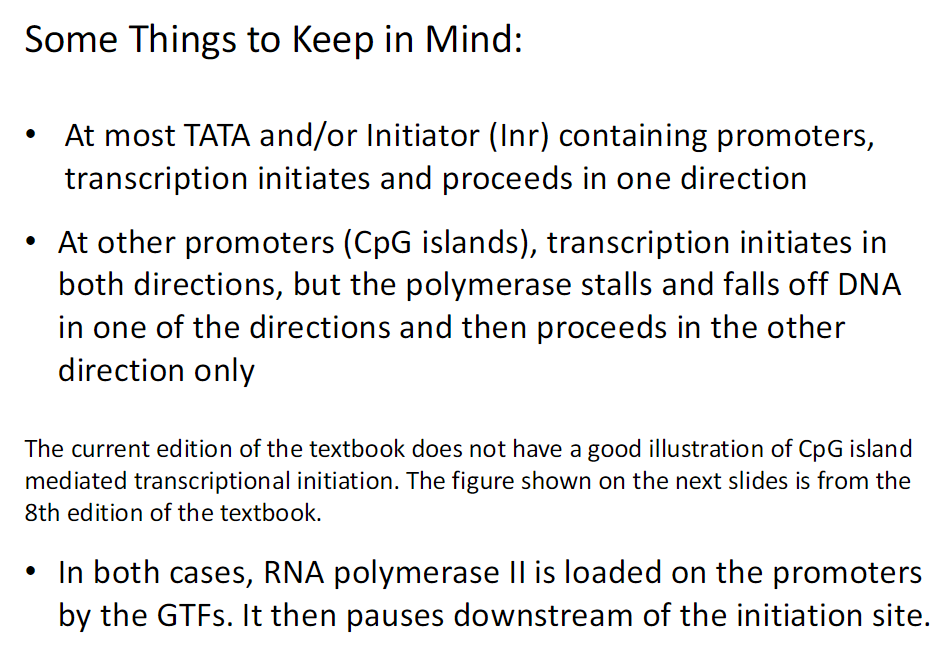
Some Things to Keep in Mind
ā€ƒAt most TATA and or Initiator Inr containing promoters
ā€ƒā€ƒTranscription initiates and proceeds in one direction

ā€ƒAt CpG island promoters
ā€ƒā€ƒTranscription initiates in both directions
ā€ƒā€ƒPolymerase stalls and falls off in one direction
ā€ƒā€ƒTranscription proceeds in the other direction only

Textbook Note
ā€ƒCurrent textbook has no good CpG island initiation figure
ā€ƒFigure shown is from the 8th edition

RNA Polymerase II
ā€ƒLoaded onto promoters by GTFs
ā€ƒPauses downstream of the initiation site
<p><strong>Some Things to Keep in Mind</strong><br>ā€ƒAt most TATA and or Initiator Inr containing promoters<br>ā€ƒā€ƒTranscription initiates and proceeds in one direction</p><p>ā€ƒAt CpG island promoters<br>ā€ƒā€ƒTranscription initiates in both directions<br>ā€ƒā€ƒPolymerase stalls and falls off in one direction<br>ā€ƒā€ƒTranscription proceeds in the other direction only</p><p><strong>Textbook Note</strong><br>ā€ƒCurrent textbook has no good CpG island initiation figure<br>ā€ƒFigure shown is from the 8th edition</p><p><strong>RNA Polymerase II</strong><br>ā€ƒLoaded onto promoters by GTFs<br>ā€ƒPauses downstream of the initiation site</p>
2
New cards

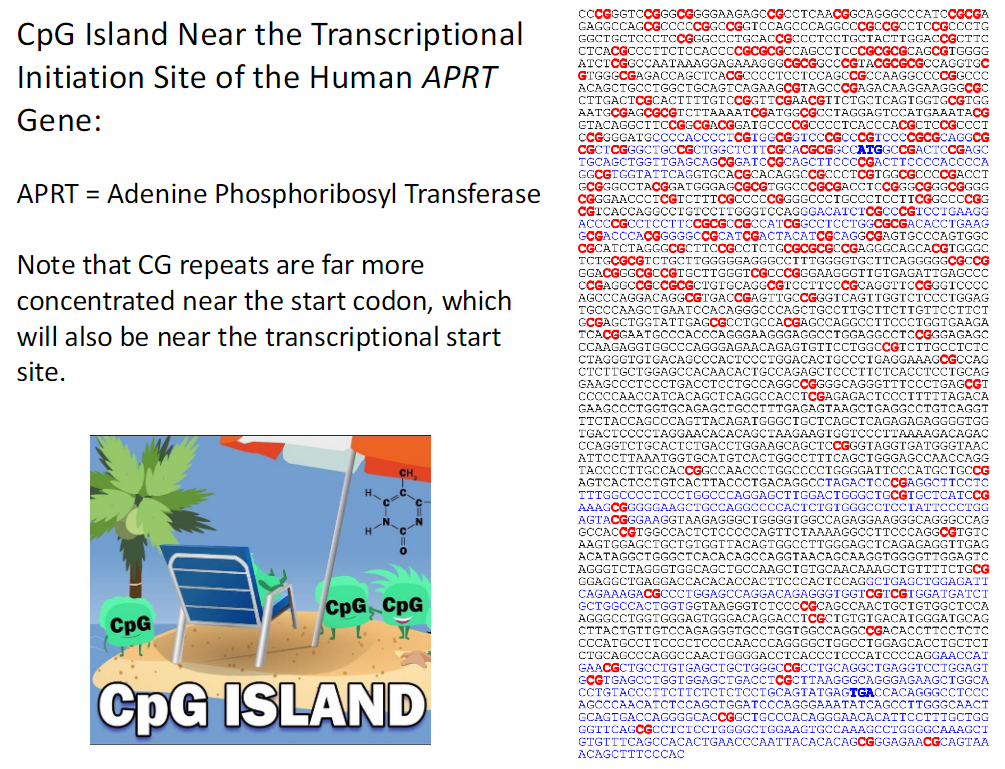
CpG Island Near the Transcriptional Initiation Site of the Human APRT Gene

APRT Gene
ā€ƒAPRT stands for Adenine Phosphoribosyl Transferase

CpG Island Location
ā€ƒCpG islands are located near the transcriptional initiation site
ā€ƒCG repeats are highly concentrated near the start codon

Relationship to Transcription
ā€ƒThe start codon is located close to the transcription start site
ā€ƒHigh CG density is associated with transcription initiation
<p><strong>APRT Gene</strong><br>ā€ƒAPRT stands for Adenine Phosphoribosyl Transferase</p><p><strong>CpG Island Location</strong><br>ā€ƒCpG islands are located near the transcriptional initiation site<br>ā€ƒCG repeats are highly concentrated near the start codon</p><p><strong>Relationship to Transcription</strong><br>ā€ƒThe start codon is located close to the transcription start site<br>ā€ƒHigh CG density is associated with transcription initiation</p>
3
New cards

CpG Islands and Gene Transcription

CpG Island Promoters
ā€ƒCpG islands occupy the promoters of about 70 percent of vertebrate genes
ā€ƒThese genes are often essential
ā€ƒThey are transcribed at a low but constant rate

Chromatin Features
ā€ƒCpG rich DNA contains fewer nucleosomes
ā€ƒFewer nucleosomes make DNA easier to transcribe

Transcription Initiation
ā€ƒAt CpG islands transcription initiates at any position within the island
ā€ƒInitiation site is not precisely defined
ā€ƒTranscription initiates in both directions
ā€ƒTranscription proceeds only toward the Open Reading Frame ORF
ā€ƒORF is the DNA region that codes for protein

Textbook Note
ā€ƒDeamination and stability of methylated C in CpG islands in mammals is not important for this class
<p><strong>CpG Island Promoters</strong><br>ā€ƒCpG islands occupy the promoters of about 70 percent of vertebrate genes<br>ā€ƒThese genes are often essential<br>ā€ƒThey are transcribed at a low but constant rate</p><p><strong>Chromatin Features</strong><br>ā€ƒCpG rich DNA contains fewer nucleosomes<br>ā€ƒFewer nucleosomes make DNA easier to transcribe</p><p><strong>Transcription Initiation</strong><br>ā€ƒAt CpG islands transcription initiates at any position within the island<br>ā€ƒInitiation site is not precisely defined<br>ā€ƒTranscription initiates in both directions<br>ā€ƒTranscription proceeds only toward the Open Reading Frame ORF<br>ā€ƒORF is the DNA region that codes for protein</p><p><strong>Textbook Note</strong><br>ā€ƒDeamination and stability of methylated C in CpG islands in mammals is not important for this class</p>
4
New cards

Bi Directional Transcription at CpG Islands

Experimental Approach
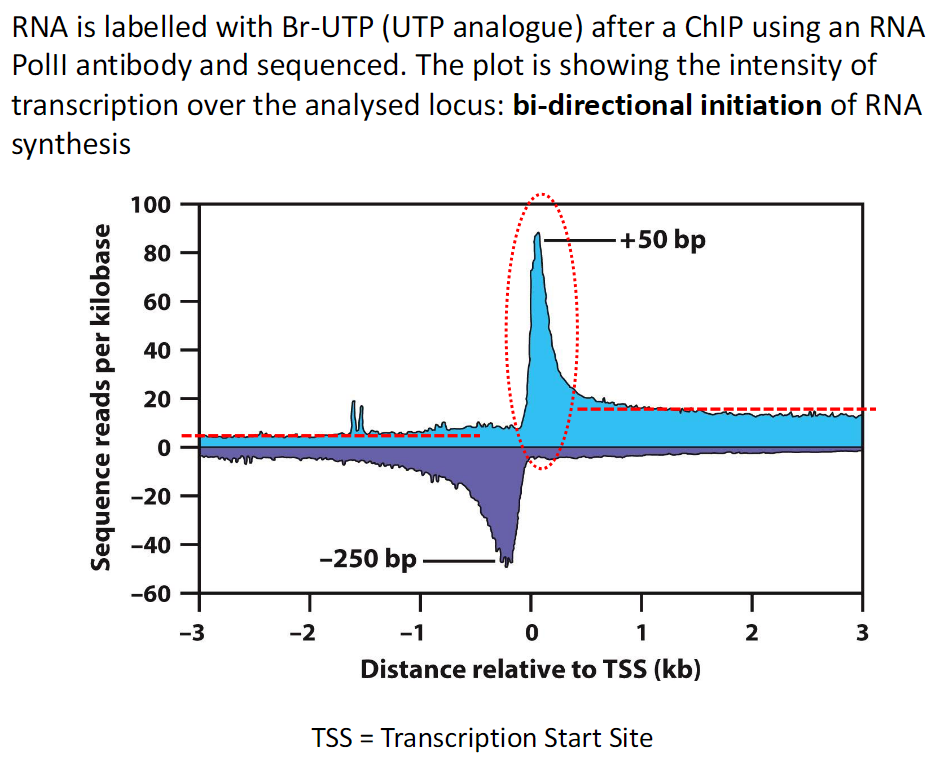
ā€ƒRNA is labeled with Br UTP
ā€ƒBr UTP is a UTP analogue
ā€ƒLabeling is done after ChIP using an RNA Pol II antibody
ā€ƒRNA is then sequenced

Results
ā€ƒPlot shows intensity of transcription across the analyzed locus
ā€ƒRNA synthesis initiates in both directions

Key Term
ā€ƒTSS means Transcription Start Site

<p><strong>Experimental Approach</strong><br>ā€ƒRNA is labeled with Br UTP<br>ā€ƒBr UTP is a UTP analogue<br>ā€ƒLabeling is done after ChIP using an RNA Pol II antibody<br>ā€ƒRNA is then sequenced</p><p><strong>Results</strong><br>ā€ƒPlot shows intensity of transcription across the analyzed locus<br>ā€ƒRNA synthesis initiates in both directions</p><p><strong>Key Term</strong><br>ā€ƒTSS means Transcription Start Site</p>
5
New cards

Meaning of the Results

Transcript Peaks
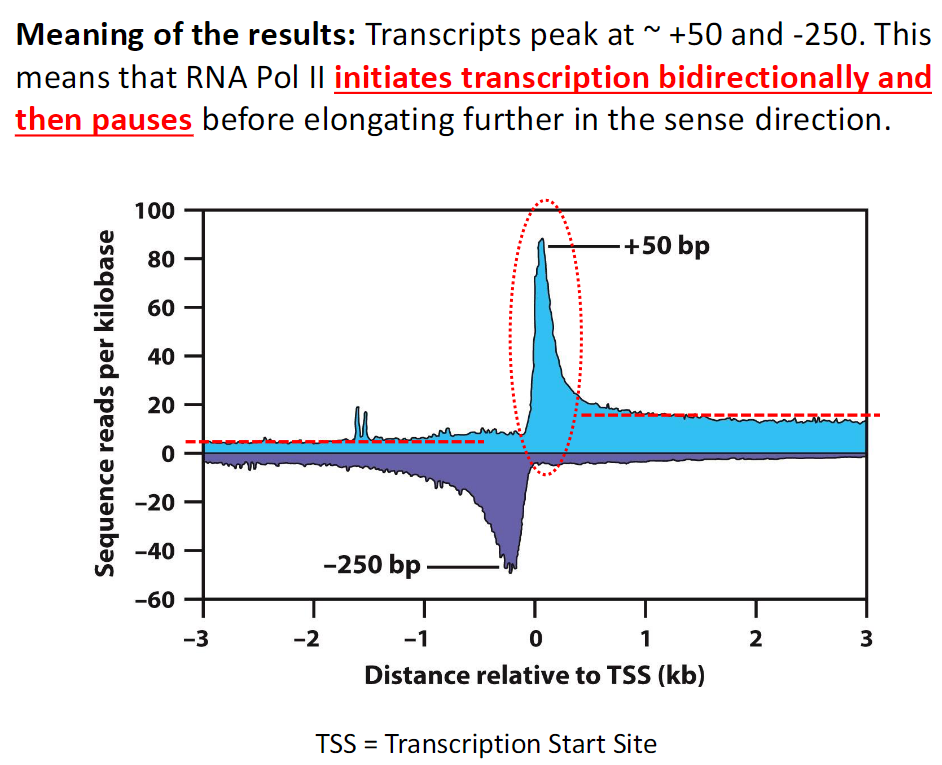
ā€ƒTranscripts peak at approximately +50 and āˆ’250

Interpretation
ā€ƒRNA Pol II initiates transcription in both directions
ā€ƒRNA Pol II then pauses before elongating further in the sense direction

Key Term
ā€ƒTSS means Transcription Start Site

<p><strong>Transcript Peaks</strong><br>ā€ƒTranscripts peak at approximately +50 and āˆ’250</p><p><strong>Interpretation</strong><br>ā€ƒRNA Pol II initiates transcription in both directions<br>ā€ƒRNA Pol II then pauses before elongating further in the sense direction</p><p><strong>Key Term</strong><br>ā€ƒTSS means Transcription Start Site</p>
6
New cards

Meaning of the Experiment

CpG Island Transcription
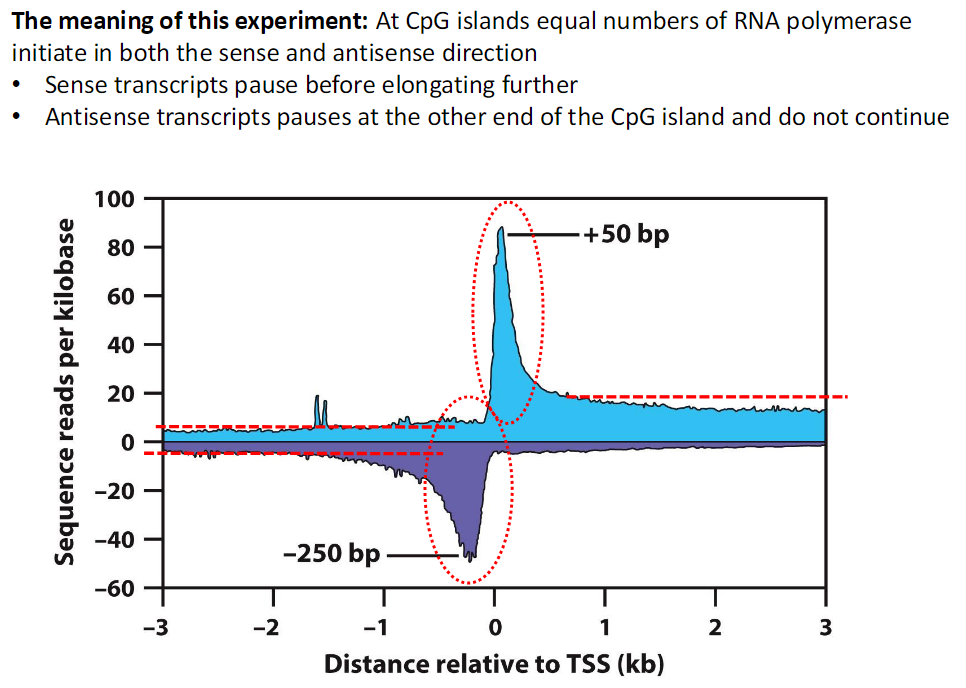
ā€ƒAt CpG islands equal numbers of RNA polymerase initiate in both sense and antisense directions

Sense Direction
ā€ƒSense transcripts pause before elongating further

Antisense Direction
ā€ƒAntisense transcripts pause at the opposite end of the CpG island
ā€ƒThey do not continue transcription

<p><strong>CpG Island Transcription</strong><br>ā€ƒAt CpG islands equal numbers of RNA polymerase initiate in both sense and antisense directions</p><p><strong>Sense Direction</strong><br>ā€ƒSense transcripts pause before elongating further</p><p><strong>Antisense Direction</strong><br>ā€ƒAntisense transcripts pause at the opposite end of the CpG island<br>ā€ƒThey do not continue transcription</p>
7
New cards

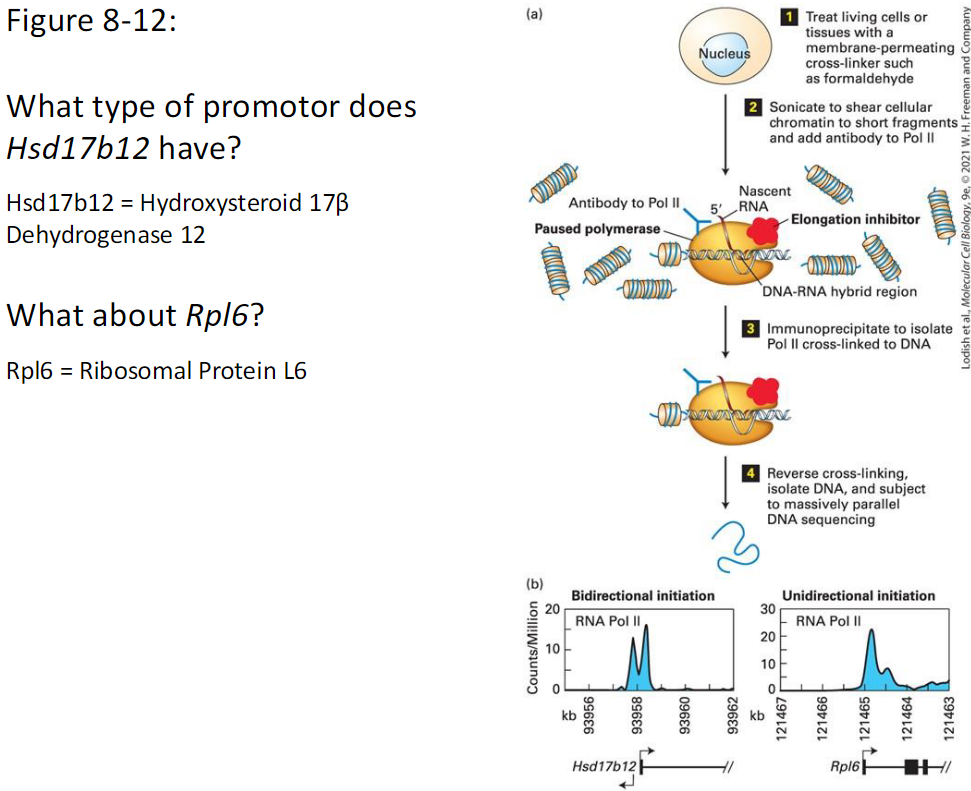
Figure 8-12 Promoter Type Analysis

Genes Shown
ā€ƒHsd17b12: Hydroxysteroid 17β Dehydrogenase 12
ā€ƒRpl6: Ribosomal Protein L6

Question
ā€ƒWhat type of promoter does Hsd17b12 have
ā€ƒWhat type of promoter does Rpl6 have

Experimental Overview
ā€ƒCells treated with formaldehyde to cross-link DNA and proteins
ā€ƒChromatin sheared by sonication
ā€ƒAntibody to RNA Pol II added
ā€ƒPaused polymerase and nascent RNA captured
ā€ƒPol II–DNA complexes immunoprecipitated
ā€ƒCross-links reversed
ā€ƒDNA sequenced

What the Figure Shows
ā€ƒRNA Pol II signal across each gene
ā€ƒDirection of transcription initiation is visible

Interpretation
ā€ƒBidirectional initiation → CpG island promoter
ā€ƒUnidirectional initiation → TATA or Inr promoter
<p><strong>Genes Shown</strong><br>ā€ƒHsd17b12: Hydroxysteroid 17β Dehydrogenase 12<br>ā€ƒRpl6: Ribosomal Protein L6</p><p><strong>Question</strong><br>ā€ƒWhat type of promoter does Hsd17b12 have<br>ā€ƒWhat type of promoter does Rpl6 have</p><p><strong>Experimental Overview</strong><br>ā€ƒCells treated with formaldehyde to cross-link DNA and proteins<br>ā€ƒChromatin sheared by sonication<br>ā€ƒAntibody to RNA Pol II added<br>ā€ƒPaused polymerase and nascent RNA captured<br>ā€ƒPol II–DNA complexes immunoprecipitated<br>ā€ƒCross-links reversed<br>ā€ƒDNA sequenced</p><p><strong>What the Figure Shows</strong><br>ā€ƒRNA Pol II signal across each gene<br>ā€ƒDirection of transcription initiation is visible</p><p><strong>Interpretation</strong><br>ā€ƒBidirectional initiation → CpG island promoter<br>ā€ƒUnidirectional initiation → TATA or Inr promoter</p>
8
New cards

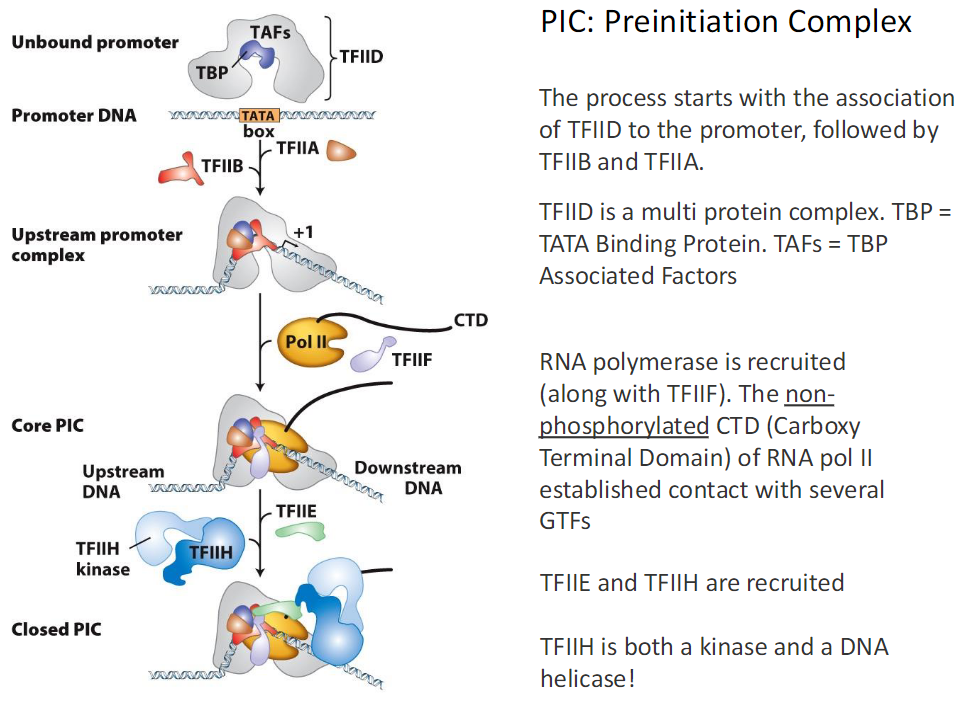
Assembly of Pre-Initiation Complex on TATA-Containing Promoters

Promoter Elements
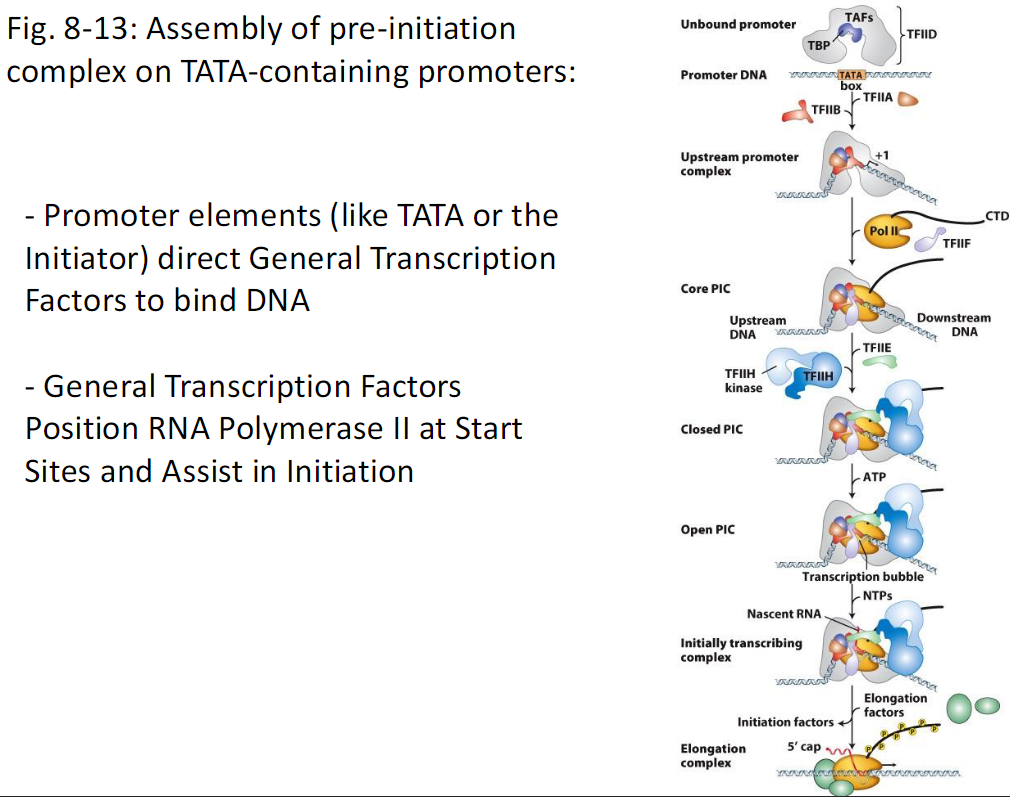
ā€ƒPromoter elements such as the TATA box or Initiator direct General Transcription Factors to bind DNA

Unbound Promoter
ā€ƒPromoter DNA contains a TATA box
ā€ƒTFIID binds first
ā€ƒā€ƒTFIID contains TBP and TAFs
ā€ƒā€ƒTBP binds the TATA box

Upstream Promoter Complex
ā€ƒTFIIA and TFIIB bind to stabilize TBP on DNA
ā€ƒThis forms the upstream promoter complex

Core Pre-Initiation Complex Core PIC
ā€ƒRNA Polymerase II binds with TFIIF
ā€ƒā€ƒPol II contains a CTD tail
ā€ƒTFIIE and TFIIH bind
ā€ƒUpstream and downstream DNA are positioned
ā€ƒThis forms the closed PIC

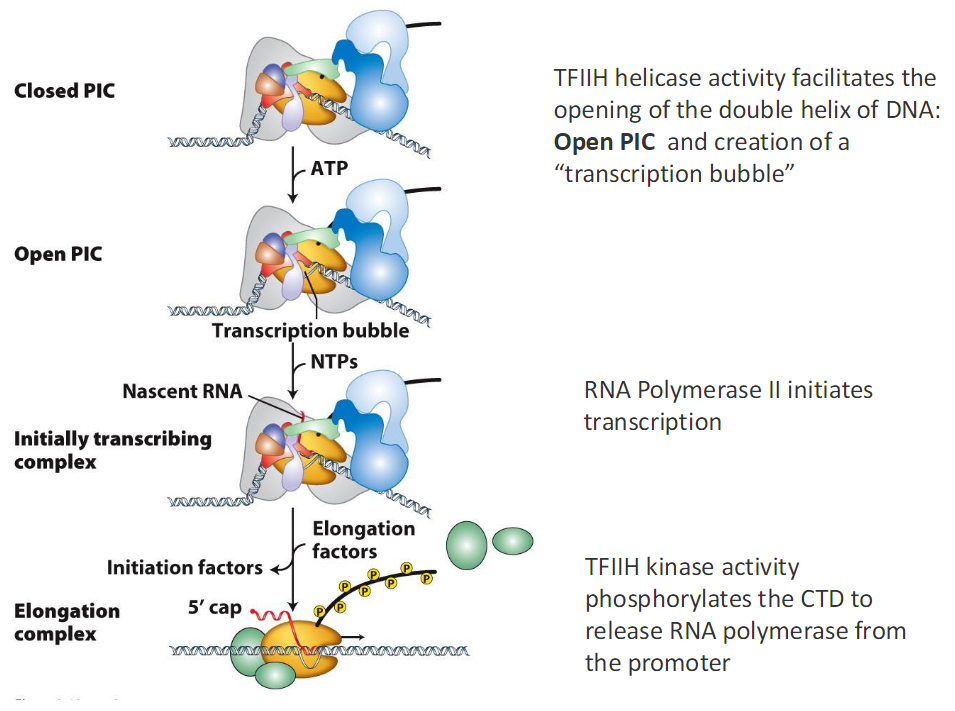
Open Pre-Initiation Complex Open PIC
ā€ƒTFIIH uses ATP
ā€ƒDNA is unwound forming a transcription bubble

Initially Transcribing Complex
ā€ƒNTPs are added
ā€ƒNascent RNA is synthesized
ā€ƒInitiation factors are present

Elongation Complex
ā€ƒRNA Polymerase II escapes the promoter
ā€ƒElongation factors associate
ā€ƒ5′ cap is added to the RNA

<p><strong>Promoter Elements</strong><br>ā€ƒPromoter elements such as the TATA box or Initiator direct General Transcription Factors to bind DNA</p><p><strong>Unbound Promoter</strong><br>ā€ƒPromoter DNA contains a TATA box<br>ā€ƒTFIID binds first<br>ā€ƒā€ƒTFIID contains TBP and TAFs<br>ā€ƒā€ƒTBP binds the TATA box</p><p><strong>Upstream Promoter Complex</strong><br>ā€ƒTFIIA and TFIIB bind to stabilize TBP on DNA<br>ā€ƒThis forms the upstream promoter complex</p><p><strong>Core Pre-Initiation Complex Core PIC</strong><br>ā€ƒRNA Polymerase II binds with TFIIF<br>ā€ƒā€ƒPol II contains a CTD tail<br>ā€ƒTFIIE and TFIIH bind<br>ā€ƒUpstream and downstream DNA are positioned<br>ā€ƒThis forms the closed PIC</p><p><strong>Open Pre-Initiation Complex Open PIC</strong><br>ā€ƒTFIIH uses ATP<br>ā€ƒDNA is unwound forming a transcription bubble</p><p><strong>Initially Transcribing Complex</strong><br>ā€ƒNTPs are added<br>ā€ƒNascent RNA is synthesized<br>ā€ƒInitiation factors are present</p><p><strong>Elongation Complex</strong><br>ā€ƒRNA Polymerase II escapes the promoter<br>ā€ƒElongation factors associate<br>ā€ƒ5′ cap is added to the RNA</p>
9
New cards

Unbound Promoter and Closed Pre-Initiation Complex

Unbound Promoter
ā€ƒPromoter DNA contains a TATA box
ā€ƒā€ƒConsensus shown as ΄΄΄ΛΛΑ TATA ΄΄΄
ā€ƒTFIID binds first
ā€ƒā€ƒTFIID is a multi protein complex
ā€ƒā€ƒTBP means TATA Binding Protein
ā€ƒā€ƒTAFs are TBP Associated Factors

Early Factor Binding
ā€ƒTFIIB binds after TFIID
ā€ƒTFIIA binds to stabilize the complex
ā€ƒThis forms the upstream promoter complex

RNA Polymerase II Recruitment
ā€ƒRNA Polymerase II is recruited with TFIIF
ā€ƒPol II contains a CTD
ā€ƒā€ƒCTD means Carboxy Terminal Domain
ā€ƒCTD is non phosphorylated at this stage
ā€ƒNon phosphorylated CTD contacts several GTFs

Core Pre-Initiation Complex Core PIC
ā€ƒTFIIE and TFIIH are recruited
ā€ƒTFIIH functions as a kinase and a DNA helicase
ā€ƒUpstream and downstream DNA are positioned
ā€ƒThis state is called the Closed PIC

Key Term
ā€ƒPIC means Pre-Initiation Complex

<p><strong>Unbound Promoter</strong><br>ā€ƒPromoter DNA contains a TATA box<br>ā€ƒā€ƒConsensus shown as ΄΄΄ΛΛΑ TATA ΄΄΄<br>ā€ƒTFIID binds first<br>ā€ƒā€ƒTFIID is a multi protein complex<br>ā€ƒā€ƒTBP means TATA Binding Protein<br>ā€ƒā€ƒTAFs are TBP Associated Factors</p><p><strong>Early Factor Binding</strong><br>ā€ƒTFIIB binds after TFIID<br>ā€ƒTFIIA binds to stabilize the complex<br>ā€ƒThis forms the upstream promoter complex</p><p><strong>RNA Polymerase II Recruitment</strong><br>ā€ƒRNA Polymerase II is recruited with TFIIF<br>ā€ƒPol II contains a CTD<br>ā€ƒā€ƒCTD means Carboxy Terminal Domain<br>ā€ƒCTD is non phosphorylated at this stage<br>ā€ƒNon phosphorylated CTD contacts several GTFs</p><p><strong>Core Pre-Initiation Complex Core PIC</strong><br>ā€ƒTFIIE and TFIIH are recruited<br>ā€ƒTFIIH functions as a kinase and a DNA helicase<br>ā€ƒUpstream and downstream DNA are positioned<br>ā€ƒThis state is called the Closed PIC</p><p><strong>Key Term</strong><br>ā€ƒPIC means Pre-Initiation Complex</p>
10
New cards

Closed PIC to Elongation

Closed PIC
ā€ƒTFIIH uses ATP
ā€ƒTFIIH helicase activity opens the DNA double helix

Open PIC
ā€ƒDNA opening creates a transcription bubble

Initially Transcribing Complex
ā€ƒNTPs are added
ā€ƒNascent RNA is synthesized
ā€ƒRNA Polymerase II initiates transcription
ā€ƒInitiation factors are present

CTD Phosphorylation
ā€ƒTFIIH kinase activity phosphorylates the CTD
ā€ƒPhosphorylation releases RNA Polymerase II from the promoter

Elongation Complex
ā€ƒElongation factors associate
ā€ƒRNA synthesis continues
ā€ƒ5′ cap is added to the RNA

<p><strong>Closed PIC</strong><br>ā€ƒTFIIH uses ATP<br>ā€ƒTFIIH helicase activity opens the DNA double helix</p><p><strong>Open PIC</strong><br>ā€ƒDNA opening creates a transcription bubble</p><p><strong>Initially Transcribing Complex</strong><br>ā€ƒNTPs are added<br>ā€ƒNascent RNA is synthesized<br>ā€ƒRNA Polymerase II initiates transcription<br>ā€ƒInitiation factors are present</p><p><strong>CTD Phosphorylation</strong><br>ā€ƒTFIIH kinase activity phosphorylates the CTD<br>ā€ƒPhosphorylation releases RNA Polymerase II from the promoter</p><p><strong>Elongation Complex</strong><br>ā€ƒElongation factors associate<br>ā€ƒRNA synthesis continues<br>ā€ƒ5′ cap is added to the RNA</p>
11
New cards

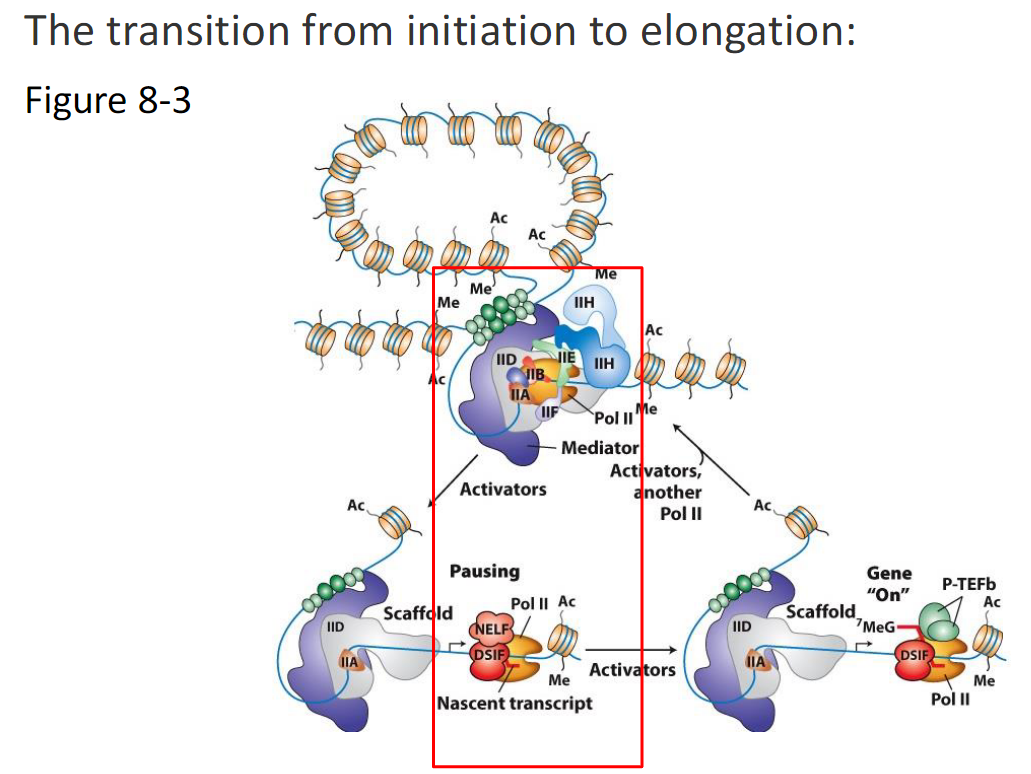
Transition from Initiation to Elongation (Figure 8-3)

Initiation State
ā€ƒRNA Polymerase II assembles with General Transcription Factors
ā€ƒMediator and activators are present
ā€ƒPol II begins transcription
ā€ƒNascent transcript is produced

Pausing
ā€ƒRNA Polymerase II pauses shortly after initiation
ā€ƒPausing is stabilized by NELF and DSIF
ā€ƒPolymerase remains near the promoter

Release from Pausing
ā€ƒP-TEFb is recruited
ā€ƒP-TEFb phosphorylates factors associated with Pol II
ā€ƒNELF dissociates
ā€ƒDSIF becomes a positive elongation factor

Elongation
ā€ƒRNA Polymerase II transitions into productive elongation
ā€ƒElongation factors associate
ā€ƒAdditional Pol II molecules can initiate
ā€ƒGene is transcriptionally on

Scaffold
ā€ƒSome General Transcription Factors remain at the promoter
ā€ƒThis scaffold allows repeated rounds of transcription
<p><strong>Initiation State</strong><br>ā€ƒRNA Polymerase II assembles with General Transcription Factors<br>ā€ƒMediator and activators are present<br>ā€ƒPol II begins transcription<br>ā€ƒNascent transcript is produced</p><p><strong>Pausing</strong><br>ā€ƒRNA Polymerase II pauses shortly after initiation<br>ā€ƒPausing is stabilized by NELF and DSIF<br>ā€ƒPolymerase remains near the promoter</p><p><strong>Release from Pausing</strong><br>ā€ƒP-TEFb is recruited<br>ā€ƒP-TEFb phosphorylates factors associated with Pol II<br>ā€ƒNELF dissociates<br>ā€ƒDSIF becomes a positive elongation factor</p><p><strong>Elongation</strong><br>ā€ƒRNA Polymerase II transitions into productive elongation<br>ā€ƒElongation factors associate<br>ā€ƒAdditional Pol II molecules can initiate<br>ā€ƒGene is transcriptionally on</p><p><strong>Scaffold</strong><br>ā€ƒSome General Transcription Factors remain at the promoter<br>ā€ƒThis scaffold allows repeated rounds of transcription</p>
12
New cards

Elongation Factors and Polymerase Pausing

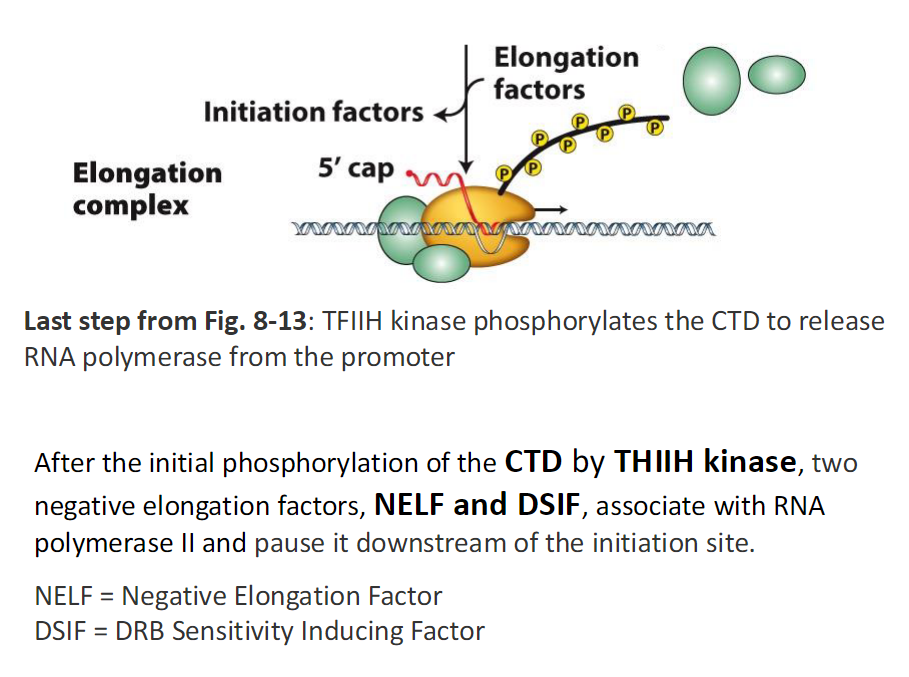
Last Step of Initiation (Fig 8-13)
ā€ƒTFIIH kinase phosphorylates the CTD
ā€ƒPhosphorylation releases RNA Polymerase II from the promoter

CTD Phosphorylation
ā€ƒInitial phosphorylation of the CTD occurs by TFIIH kinase
ā€ƒThis marks the transition away from the promoter

Early Elongation and Pausing
ā€ƒAfter CTD phosphorylation RNA Polymerase II moves downstream of the initiation site
ā€ƒTwo negative elongation factors bind
ā€ƒNELF associates with RNA Polymerase II
ā€ƒDSIF associates with RNA Polymerase II
ā€ƒThese factors pause the polymerase

Elongation Complex
ā€ƒElongation factors are present
ā€ƒInitiation factors dissociate
ā€ƒ5′ cap is added to the nascent RNA

Key Terms
ā€ƒNELF means Negative Elongation Factor
ā€ƒDSIF means DRB Sensitivity Inducing Factor
<p><strong>Last Step of Initiation (Fig 8-13)</strong><br>ā€ƒTFIIH kinase phosphorylates the CTD<br>ā€ƒPhosphorylation releases RNA Polymerase II from the promoter</p><p><strong>CTD Phosphorylation</strong><br>ā€ƒInitial phosphorylation of the CTD occurs by TFIIH kinase<br>ā€ƒThis marks the transition away from the promoter</p><p><strong>Early Elongation and Pausing</strong><br>ā€ƒAfter CTD phosphorylation RNA Polymerase II moves downstream of the initiation site<br>ā€ƒTwo negative elongation factors bind<br>ā€ƒNELF associates with RNA Polymerase II<br>ā€ƒDSIF associates with RNA Polymerase II<br>ā€ƒThese factors pause the polymerase</p><p><strong>Elongation Complex</strong><br>ā€ƒElongation factors are present<br>ā€ƒInitiation factors dissociate<br>ā€ƒ5′ cap is added to the nascent RNA</p><p><strong>Key Terms</strong><br>ā€ƒNELF means Negative Elongation Factor<br>ā€ƒDSIF means DRB Sensitivity Inducing Factor</p>
13
New cards

Release into Productive Elongation

P-TEFb Kinase
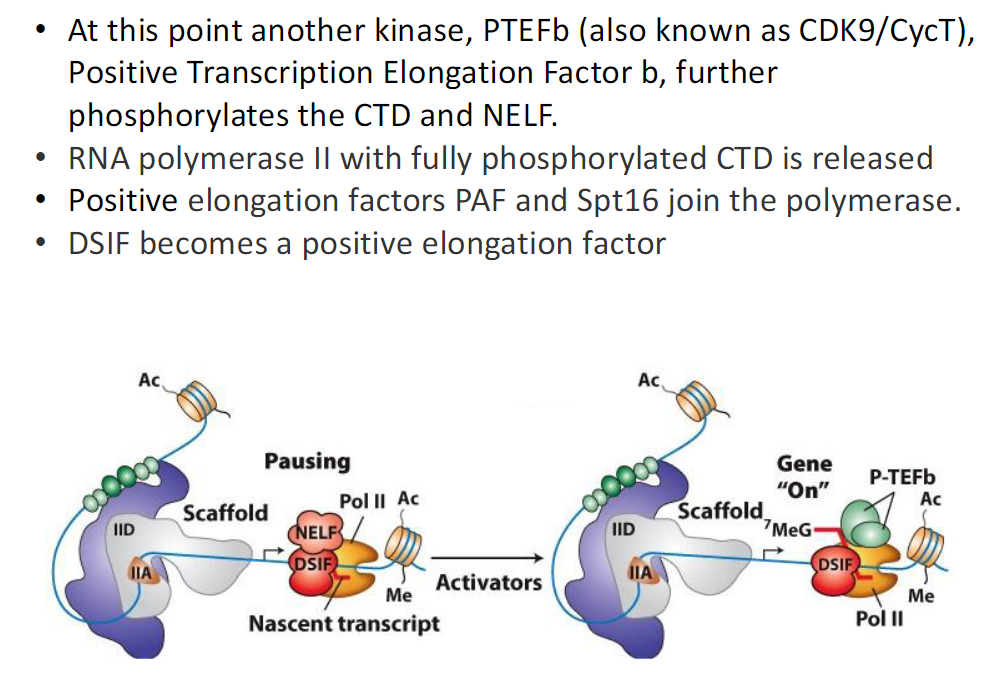
ā€ƒAnother kinase P-TEFb also called CDK9 Cyclin T
ā€ƒP-TEFb means Positive Transcription Elongation Factor b

Further Phosphorylation
ā€ƒP-TEFb further phosphorylates the CTD of RNA Polymerase II
ā€ƒP-TEFb also phosphorylates NELF
ā€ƒRNA Polymerase II with fully phosphorylated CTD is released

Elongation Factor Switch
ā€ƒNELF dissociates from the polymerase
ā€ƒDSIF switches from negative to positive elongation factor

Positive Elongation Factors
ā€ƒPAF joins the polymerase
ā€ƒSpt16 joins the polymerase

Gene Activation
ā€ƒRNA Polymerase II moves into productive elongation
ā€ƒNascent transcript continues to grow
ā€ƒGene is transcriptionally on

Promoter Scaffold
ā€ƒSome General Transcription Factors remain at the promoter
ā€ƒThis scaffold allows additional Pol II to initiate
<p><strong>P-TEFb Kinase</strong><br>ā€ƒAnother kinase P-TEFb also called CDK9 Cyclin T<br>ā€ƒP-TEFb means Positive Transcription Elongation Factor b</p><p><strong>Further Phosphorylation</strong><br>ā€ƒP-TEFb further phosphorylates the CTD of RNA Polymerase II<br>ā€ƒP-TEFb also phosphorylates NELF<br>ā€ƒRNA Polymerase II with fully phosphorylated CTD is released</p><p><strong>Elongation Factor Switch</strong><br>ā€ƒNELF dissociates from the polymerase<br>ā€ƒDSIF switches from negative to positive elongation factor</p><p><strong>Positive Elongation Factors</strong><br>ā€ƒPAF joins the polymerase<br>ā€ƒSpt16 joins the polymerase</p><p><strong>Gene Activation</strong><br>ā€ƒRNA Polymerase II moves into productive elongation<br>ā€ƒNascent transcript continues to grow<br>ā€ƒGene is transcriptionally on</p><p><strong>Promoter Scaffold</strong><br>ā€ƒSome General Transcription Factors remain at the promoter<br>ā€ƒThis scaffold allows additional Pol II to initiate</p>
14
New cards

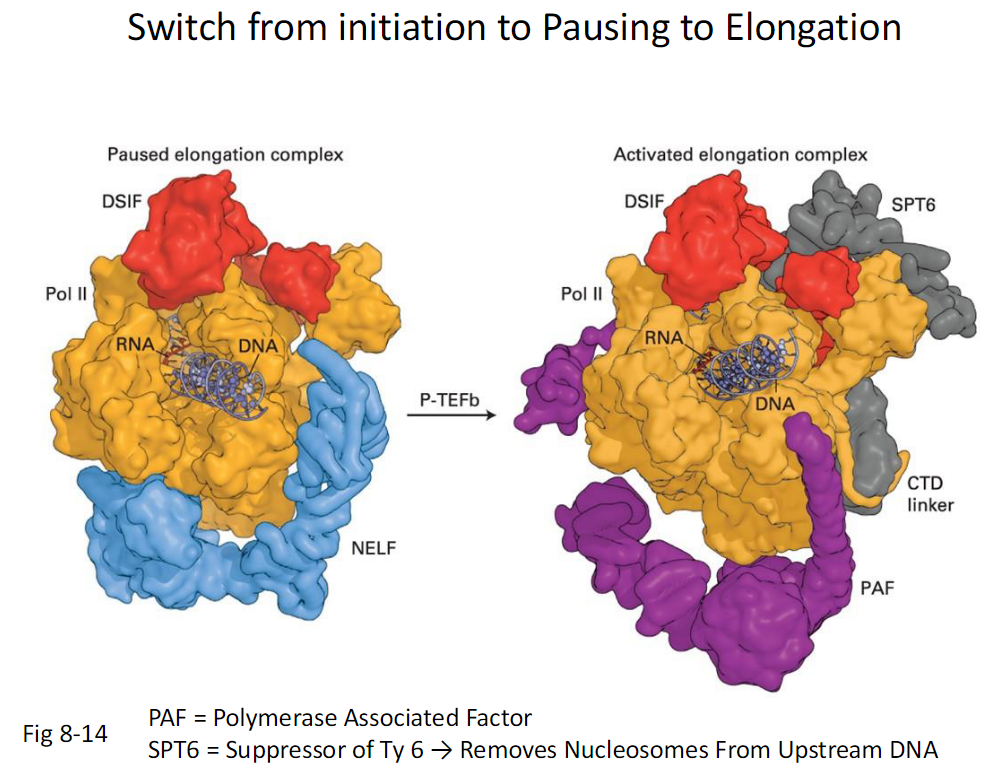
Switch from Initiation to Pausing to Elongation (Fig 8-14)

Paused Elongation Complex
ā€ƒRNA Polymerase II is paused
ā€ƒDSIF is associated
ā€ƒNELF is associated
ā€ƒCTD is not fully phosphorylated

Activated Elongation Complex
ā€ƒP-TEFb acts on the complex
ā€ƒCTD is further phosphorylated
ā€ƒNELF dissociates
ā€ƒDSIF remains and functions positively

Additional Elongation Factors
ā€ƒPAF associates with RNA Polymerase II
ā€ƒSPT6 associates with RNA Polymerase II
ā€ƒSPT6 removes nucleosomes from upstream DNA

Key Terms
ā€ƒPAF means Polymerase Associated Factor
ā€ƒSPT6 means Suppressor of Ty 6

<p><strong>Paused Elongation Complex</strong><br>ā€ƒRNA Polymerase II is paused<br>ā€ƒDSIF is associated<br>ā€ƒNELF is associated<br>ā€ƒCTD is not fully phosphorylated</p><p><strong>Activated Elongation Complex</strong><br>ā€ƒP-TEFb acts on the complex<br>ā€ƒCTD is further phosphorylated<br>ā€ƒNELF dissociates<br>ā€ƒDSIF remains and functions positively</p><p><strong>Additional Elongation Factors</strong><br>ā€ƒPAF associates with RNA Polymerase II<br>ā€ƒSPT6 associates with RNA Polymerase II<br>ā€ƒSPT6 removes nucleosomes from upstream DNA</p><p><strong>Key Terms</strong><br>ā€ƒPAF means Polymerase Associated Factor<br>ā€ƒSPT6 means Suppressor of Ty 6</p>
15
New cards

HIV Transcriptional Elongation and Viral Latency (Fig 8-15)

Early Transcription
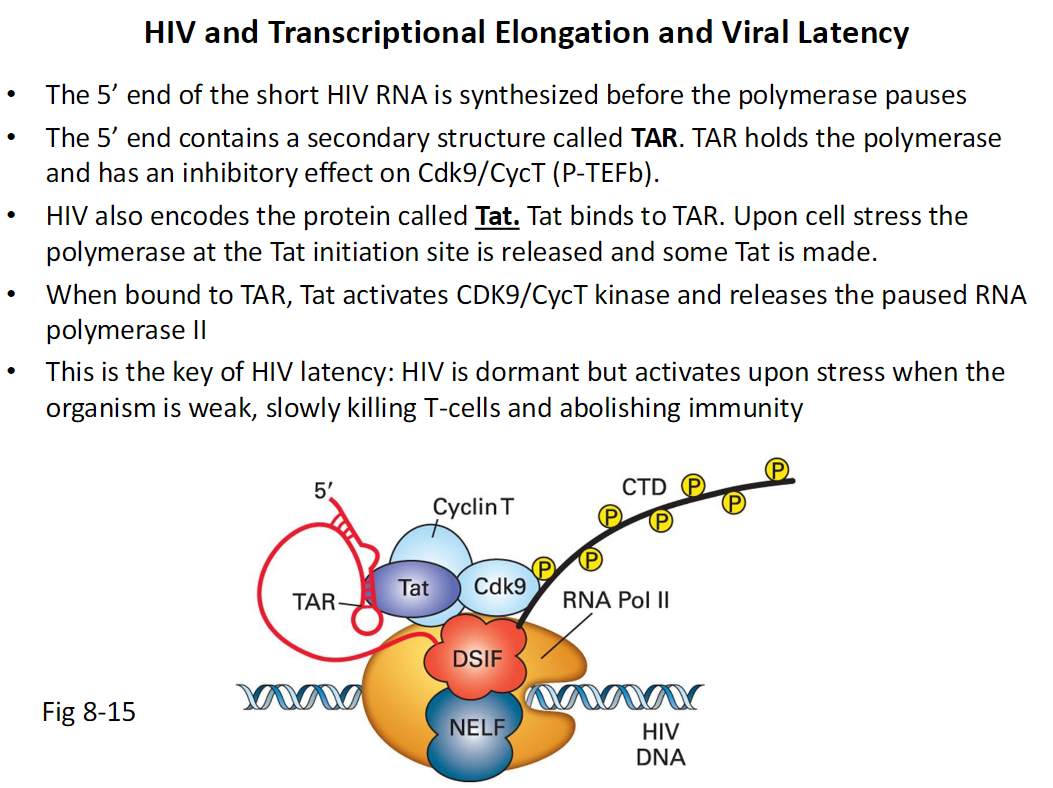
ā€ƒThe 5′ end of a short HIV RNA is synthesized
ā€ƒRNA Polymerase II pauses shortly after initiation

TAR Structure
ā€ƒThe 5′ end contains a secondary RNA structure called TAR
ā€ƒTAR holds the paused polymerase
ā€ƒTAR inhibits Cdk9 Cyclin T also called P-TEFb

Tat Protein
ā€ƒHIV encodes a protein called Tat
ā€ƒTat binds to TAR
ā€ƒUnder cell stress paused polymerase is released
ā€ƒThis allows some Tat protein to be produced

Release of Pausing
ā€ƒTat bound to TAR activates CDK9 Cyclin T kinase
ā€ƒActivated P-TEFb releases paused RNA Polymerase II

Viral Latency
ā€ƒHIV remains dormant when polymerase is paused
ā€ƒStress activates transcription
ā€ƒActivated virus kills T cells and abolishes immunity
<p><strong>Early Transcription</strong><br>ā€ƒThe 5′ end of a short HIV RNA is synthesized<br>ā€ƒRNA Polymerase II pauses shortly after initiation</p><p><strong>TAR Structure</strong><br>ā€ƒThe 5′ end contains a secondary RNA structure called TAR<br>ā€ƒTAR holds the paused polymerase<br>ā€ƒTAR inhibits Cdk9 Cyclin T also called P-TEFb</p><p><strong>Tat Protein</strong><br>ā€ƒHIV encodes a protein called Tat<br>ā€ƒTat binds to TAR<br>ā€ƒUnder cell stress paused polymerase is released<br>ā€ƒThis allows some Tat protein to be produced</p><p><strong>Release of Pausing</strong><br>ā€ƒTat bound to TAR activates CDK9 Cyclin T kinase<br>ā€ƒActivated P-TEFb releases paused RNA Polymerase II</p><p><strong>Viral Latency</strong><br>ā€ƒHIV remains dormant when polymerase is paused<br>ā€ƒStress activates transcription<br>ā€ƒActivated virus kills T cells and abolishes immunity</p>