M2.2 - WATER: Reaction Medium of the Cell
 Call Kai
 Learn
Learn Practice Test
 Spaced Repetition
 Match
Match Flashcards
 Knowt Play
1/33

There's no tags or description
Looks like no tags are added yet.
Name | Mastery | Learn | Test | Matching | Spaced | Call with Kai | Chat |
|---|
No analytics yet
Send a link to your students to track their progress
34 Terms
bent/ Vshaped
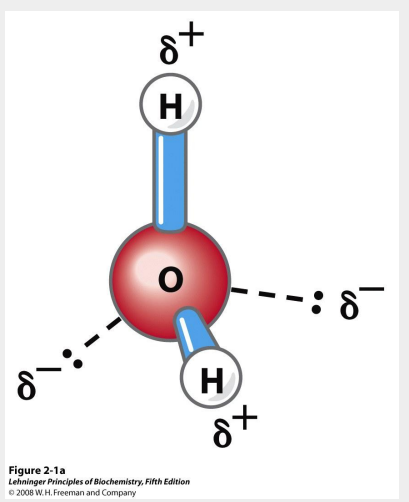
molecular geometry: ____________
has four electron groups around oxygen which are nearly tetrahedral in arrangement
electronegative O and 2 H atoms forms a dipole
water is a polar molecule
hydrogen
bent structure of water is important in _____________ bonding
water can serve both as a H-donor and acceptor
potential to form 4 H bonds per water molecule
high
high
high
high
high
liquid
solvent
Unique Properties of Water allows water to sustain life on Earth
__________ cohesion
__________ adhesion
__________ surface tension
__________ specific heat
__________ heat of vaporization
__________ at room temperature
excellent __________
hydrophobic exclusion
cohesion
adhesion
High Cohesion and Adhesion of Water
___________ – “act of sticking together”
___________– “act of sticking to something”
due to the ability of water molecules to form H-bonds
Cohesion; Adhesion
High ___________ and ___________ of Water
important for the transport of water from roots to other parts of a plant
direction is against the pull of gravity
major component of plant cell walls is cellulose which can form H-bonds with water molecule
surface tension
_______________ – a measure of the resistance of a substance to increase its surface area
due to high cohesion of water molecules
Surface Tension
High ______________ of Water
importance
cause things/animals denser than water to float
allows formation of water droplets
specific heat
Moderation of Temperature by Water
by absorbing heat from warmer air and releasing that heat to cooler air
due to high ______________ of water
– amount of heat per unit mass required to raise the temperature by 1 °C
for water: 1 cal/ g-°C
faster
breakin; absorbs
slower
formation; releases
Moderation of Temperature by Water
for water to have an increase in T, its molecules should move __________ (due to increase in KE)
causes __________ of H-bonds which ___________ heat
for water to have a decrease in T, its molecules should move __________(due to decrease in KE)
causes __________ of H-bonds which ____________heat
gradual
internal body
Moderation of Temperature by Water
importance:
regulate the rate of change in air’s temperature especially near oceans
__________ instead of sudden
regulation of organism’s ______________ temperature
Evaporative Cooling
heat of vaporization
__________________
process at which as liquid evaporates, the liquid surface that remains behind cools down
due to high __________________ of water
– amount of heat needed to turn 1 g of liquid into a vapor without a rise in temperature of the liquid
for water: 540 cal/g at 25 °C
Evaporative Cooling
_____________________ of Water
due to the presence of a hydrogen bonding network between water molecules, a high input of energy is required to transform 1 gram of liquid water to water vapor
Evaporative Cooling
_____________________ of Water
importance
sweating
evaporation of water at the surface of leaves
four
3.4
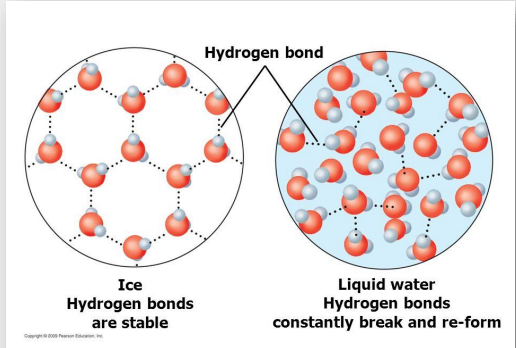
Floating of Ice on Liquid Water
in ice, water molecules form a maximum of _______ H-bonds, creating a regular crystal lattice
in liquid water, water molecules form an average of _______ H-bonds with each other
fewer
less
insulation
Floating of Ice on Liquid Water
ice crystal is spacious as it has __________ molecules than in equal volume of liquid water
ice is _________ dense than water
importance:
floating ice forms a layer of _____________ on tops of lakes and seas
helps life to survive on Earth (example: marine organisms)
dielectric constant
Excellent Solvent
as polar solvent, water readily dissolves other polar compounds and salts via
due to high __________________ of water
– measure of the ability of a solvent to keep opposite charges apart
oppositely; dipoles
hydration

Excellent Solvent
ions attracts the ___________ charged ends of the resulting water _________
ions are surrounded by water molecules (__________)
attenuates coulombic forces between ions
amphiphiles
Hydrophobic Effect
for ___________, water tends to hydrate its hydrophilic portion and to exclude its hydrophobic portion
Hydrophobic Effect • 1. presence of amphiphiles disrupt H-bonding between water molecules • water molecules surround each amphiphile molecule • not favored because of the resulting highly-ordered structure (decrease in entropy of the system)