Basics of Research Methods 1-10
 Studied by 3 people
 Call Kai
 Learn
Learn Practice Test
 Spaced Repetition
 Match
Match Flashcards
 Knowt Play
1/87

There's no tags or description
Looks like no tags are added yet.
Name | Mastery | Learn | Test | Matching | Spaced |
|---|
No study sessions yet.
88 Terms
Experimental Design
Helps us to determine causality (cause and effect)
Standardization
Everything in the experiment stays the same.
Between-Subject Design
Different participants test each condition. One group does Condition A, a completely different group does Condition B .
Within-Subjects Design
The same participants undergo all conditions. The same person does Condition A, then later does Condition B .
Carryover
The effect of the first condition is still there. (e.g., the alcohol from Condition 1 is still in their system during Condition 2).
Pre-test Sensitization
Taking the test early might tip the participant off to what the study is about, changing their behavior.
Factorial Design
Using two or more independent variables at the same time. E.g. alcohol AND gender
Experimenter Bias
The researcher’s own gender, race, or expectations can unintentionally influence the data.
Demand Characteristics
Participants figure out the hypothesis (cues in the room, instructions) and try to be "good subjects" by acting how they think they should.
Matched Pairs
A solution for Between-Subjects designs where participants are paired based on specific traits (like age or weight) to ensure groups are equal, rather than relying solely on randomization
Counterbalancing Effect
A solution for Within-Subjects designs to prevent order effects. Half the participants perform the conditions in one order (A then B), and the other half do the reverse (B then A).
Placebo Effect
When a participant improves simply because they believe they received effective treatment, even if they received a fake one
Double-Blind Experiment
An experiment where neither the participant nor the researcher knows who is receiving the real treatment vs. the placebo. This prevents researcher bias and placebo effects.
Population
The entire group you want to observe and draw conclusions for. (e.g., "All university students in Hungary").
Sample
Selected from the units
Representative Sample
A sample that accurately reflects the demographics (age, gender, ethnicity) of the population.
Random Sampling
A method where every member of the population has an equal chance of being picked. This is the best way to get a representative sample.
Direct Observation
Watching and recording behavior objectively (e.g., with a stopwatch or camera).
Observer Effect
People act differently when being watched.
Observer Bias
Researchers see what they expect to see
Questionnaires / Surveys
Participants self-report their attitudes or behaviors.
Social Desirability Bias
People fake good to look better.
Psychological Tests
Standardized measures of traits (e.g., IQ, personality).
Case Studies
In-depth investigation of a single individual. Might be hard to generalize the findings.
Mean
The average
Median
The middle score
Mode
The most frequent score
Variability
How spread out is the data.
Correlation Coefficient (r)
Measures the strength of a relationship between two variables. Can be Positive or Negative. It does not imply CAUSATION.
Induction
Moving from specific Data (observations) to form a general Theory.
Deduction
Moving from a general Theory to specific Hypotheses (predictions) that can be tested with data.
Theory / Թեորեմ
A system of interrelated ideas used to explain a set of observations. A good theory must be testable. Sleep facilitates the consolidation of memory
Hypotheses
A specific, tentative statement about the relationship between two or more variables. It is a prediction from a theory.
Variable
Any measurable condition, event, characteristic, or behavior that is controlled or observed in a study.
Identify the Research Question
Start with an initial observation or question.
Formulate a Hypotheses
Translate a theory into a testable prediction. You must define variables clearly (Operational Definition).
Select Research Design
Choose the method (Experiment, Case Study, Survey, etc.).
Data Collection
Start the study and gather information.
Analyze Data
Use statistics to interpret the results.
Publication
Report findings in a scientific journal for peer review.
Replication
Other researchers try to repeat the study to see if the results hold true.
Correlational / Descriptive Research Design
describing behavior or finding links between variables (e.g., Case Studies, Surveys, Naturalistic Observation).
Experimental Research Design
Manipulating a variable to see if it causes a change in another.
Independent Variable
The variable you change/manipulate.
Dependent Variable
The variable you measure (the outcome)
Experimental Group
The ones that get the treatment,
Control Group
The ones that do not get the treatment (for comparison)
Psychological Ethics
Moral principles guiding a psychologist’s general conduct or practice.
Research Ethics
Moral principles specifically guiding researchers from the start to the end of a study.
Ethical Dilemma
A conflict between different principles of moral conduct.
Ethical Codes
Principles, requiring researchers to consider circumstances (a "no harm" approach). Two people can interpret a situation differently and still be ethical.
Maximizing Benefit, Minimising Harm
Research must serve a beneficial purpose while avoiding harm to participants, whether social, financial, or psychological.
Respect for people’s rights, autonomy, and dignity
Researchers must respect participants' privacy, autonomy, and diversity (age, gender, culture). They must avoid biases and clearly explain the aim and procedures.
Scientfic Value
Research must contribute to knowledge. Poorly designed research is unethical because it is a waste of resources
Integrity (բարեվարքություն)
Researchers must be honest, accurate, and trustworthy.
Justice
Everyone should have equal access to the benefits of psychology, no biases.
Informed Consent
An agreement to participate in research with full knowledge of the context and the participant's rights.
Anonymity
No personal data (names, birthdates) is collected. The participant cannot be identified.
Confidentiality
Data is collected but kept private and not published in an identifiable way.
Voluntary Participation
Participants can refuse to take part or withdraw at any stage, even after the research is finished.
Deception
The act of convincing of one or many recipients of untrue information.
Naturalistic Observation
form of involuntary participation where subjects are observed in their natural environment without knowing it. It is ethical only if they cannot be identified and the information is public.
Debriefing
The process of informing participants after a study about its true purpose, methods, and any deception used.
Physiognomy
The early, unscientific practice of judging a person's character or personality based solely on their outward appearance (face, body).
Phrenology
The pseudoscience claiming that "bumps" on the skull correspond to specific brain functions and personality traits.
James McKeen Cattell
The psychologist who coined the term "Mental Test" and emphasized the need for large sample sizes to get accurate data.
Alfred Binet
He moved testing away from sensory tasks (reaction time) to "Higher Mental Processes" (reasoning/judgment) to identify children with learning difficulties.
Army Alpha
The group intelligence test designed for literate soldiers during WWI.
Army Beta
The group intelligence test designed for illiterate or non-English speaking soldiers during WWI (using mazes/pictures).
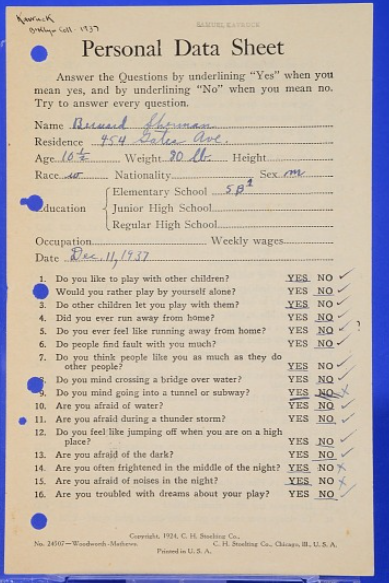
Woodworth Personal Data Sheet
The first formal personality test, designed to screen WWI soldiers for "shell shock" (emotional instability)
Projective Tests
Assessments like the Rorschach or TAT that use ambiguous stimuli (inkblots, pictures) to reveal unconscious conflicts and motives.
Rorschach test
Projective psychological test where people describe what they see in inkblots, revealing hidden thoughts and emotions.
Thematic Apperception Test (TAT
Shows people pictures and asks them to make up stories, which reveal their underlying motives, feelings, and conflicts.
Big Five (OCEAN)
The five main dimensions of personality: Openness, Conscientiousness, Extraversion, Agreeableness, and Neuroticism.
Chronological Age
Actual age
Mental Age
The age level at which an individual performs intellectually.
Authority
Believing something because an "expert" or figure of power said so (teachers, parents, politicians).
Empiricism
Learning through direct observation and experience.
Confirmation Bias
The tendency to seek out and focus on information that supports one’s existing beliefs, while ignoring or discounting contradictory evidence.
Belief Perseverance
The tendency to stubbornly hold on to a belief even when strong counter-evidence shows it to be false.
Availability Heuristics
A mental shortcut where people judge how likely or common something is based on how easily examples come to mind.
Anchoring Heuristics
The First information we have about the case determines our views and thinking on the case.
Post-Hoc
Objectivity
Representing real truth despite your opinion.
Determinism
The scientific assumption that events (and human behavior) have logical causes and do not just happen randomly.
Discoverability
The belief that we can actually find and understand these causes using scientific methods.
Pseudopsychology
Any claim or practice that looks scientific (uses jargon) but lacks evidence, reliable methods, or scientific support.