Nuclear Physics
 Call Kai
 Learn
Learn Practice Test
 Spaced Repetition
 Match
Match Flashcards
 Knowt Play
1/49

There's no tags or description
Looks like no tags are added yet.
Name | Mastery | Learn | Test | Matching | Spaced | Call with Kai | Chat |
|---|
No analytics yet
Send a link to your students to track their progress
50 Terms
Describe the structure of an atom
An atom is a positively charged nucleus surrounded by negatively charged electrons.
Where is the majority of the mass in an atom
the Nucleus
Describe the model of Dalton 1803
Every particle of a substance eg water or hydrogen are identical. These particles have different masses and combine and rearrange themselves in chemical reactions
Simplified: Atoms are the smallest building block
All atoms of the same element are the same
Why was Daltons model introduced
Due to evidence from chemical reactions
Describe Tomsons model of an atom 1904
The model regarded the atom as a positively charged sphere through ehich the negatively charged electrons were distributed in sufffiecienet numbers to make the atom electrically neurtal
Simplified:
Positive atom
Negative electrons can be removed
Explains +/- ions
Why was Thomsons model (plum pudding model) introduced
As they discovered the electron
Describe Rutherford's model of the atom 1911
He said that there was a small dense positive nucleus. And most of the atom is empty space
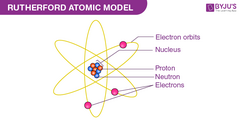
Why was Rutherfords model of the atom introduced
Due to the Alpha-scattering experiment
Descibed Bohr's modele of the atom 1913
Atoms have a small, positively charged central nucleus and electrons orbiting in at specific fixed distances from the nucleus.
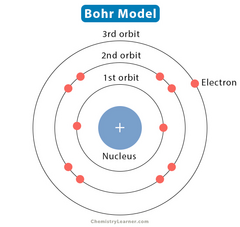
Why was Bohrs model introduced
to excplain emission spectra
Describe the Alpha scattering experiment
Conducted by Geiger and Marsden-->Alpha particles were fired at a gold foil, and it was expected that they would all go though the foil or only be partially deflected, instead some were deflected more than expected, and some bounced completely back. This showed that there was a concentrated positive charge in the center of atoms
What what can be interpreted from the alpha acattering experiment
1. There is a nucleus containing all the positive charge and most of the mass of the atom
2. The nucleus is very small and most of the atom is empty space
What is the size of a Hydrogen atom
10^-10m across
But molecules can be much bigger up to about 10nm
What is an element
All atoms of a partiular element have the name number of protons
Isotope
An isotope of an element has the same number of protons but different number of neutrons. These behave chemically in the same way as each other since they have the same number of electrons but some isotopes may be radioactive
Ion
An atom that has become charged by either gaining or losing an electron
Proton number
the number of protons in the nucleus
Nucleon number
The number of protons and neutrons in the nucleus

Why are some materials Radioactive
In some isotopes the combination of neutrons and protons makes the nucleus unstable
Some occur naturally other anre amn-made
The atom ecats to become more stable by emitting gamma radiation and Kinetic energy
This not achemical change it takes place inside the nucleus of an atom, it is not affected by any physical or chemical changes
What would you use to detect radiation
A Geiger counter
What are the 4 types of radiation
Alpha
Beta
Gamma
Neutron
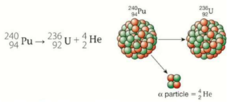
What is alpha decay
It occurs in nuclides that are too heavy
The heavy nuclide will emit 2 protons and 2 neutrons or 4/2 He
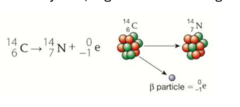
What is Beta Decay
Happens in nuclides hat have too namy neutrons, one of those neutrons turns into a proton and an electron
What is Gamma decay
Occurs when the nucleus has too much energy. Nothing changes but the substance has less energy
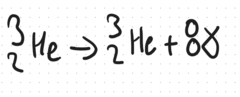
What is neutron emmision
If a nuclei has Too many neutrons atoms can decay by shedding a neutron
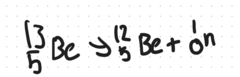
Is Radioactive decay random and why
Random: Radioactive decay is random because we can never tell which nucleus will decay.
What does the term activity mean
IS the rate (Emissions per second) at which radiation is emitted from a radioactive material
Measured in Becquerel (Bq)
What does the term Half-Life mean
Is the time taken for the activity of a sample to drop by half
The shorter the Half-Life the greater the activity, but the sample decays away Much quicker
How to find the Half-Life fron an activity-time graph
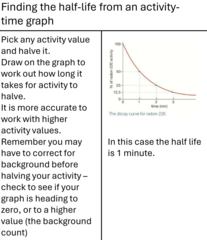
How to calculate the net decline after a given number of half-lives
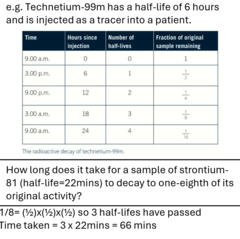
What are the properties of alpha radiation
Type of particle
Ionising power
Range in air
Material that shield
It is a helium-4 particle
With a high ionizing power
And a very small range in air--> 2-4 cm
Can be stoped by Paper

What are the properties of beta radiation
Type of particle
Ionising power
Range in air
Material that shield
Fast electron
-1 charge
Medium ionising power
30-50cm range in air
Stopped by 3mm of aluminium

What are the properties of gamma radiation
Type of particle
Ionising power
Range in air
Material that shield
It is the highest frequency EM wave with 0 charge
Low ionising power
Very large/infinite range in air
Stopped by 3-5cm of lead

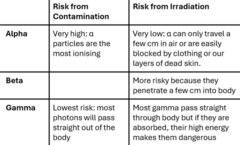
what is Irradiation
Irradiation happens when a person or object is exposed to readiation emmited by radioactive materal
Irradiation stops as soon as the source is removed or shielded
What is contamination?
When the radioactive source itself enters your body or gets on your skin
Risks of Contamination and Irradiation in different types of radiation
What are the main sources of background radiation
Radon gas roughly 50%
Rocks
Cosmic rays
Foods
WHat does being exposed to radiation lead to
The ionisation of living cells. This can damage DNA which leads to cell death,mutation and possibly cancer
What are some saftey precautions when using radioactive materials
Shield sources e.g. lead lined boxes
Use tongs
Wear gloves and aprons
How can Radiation be measured
In mSv
Why is no dose of radiation safe
As a single ionisation could ause cancer however the risk is significantly lower
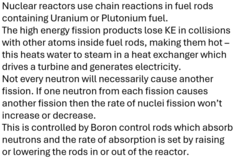
What is nuclear Fission
Is the process of splitting one large nuclei into two maller nuclei, energy is released in the form of KE and gamma radiation
What is nuclear Fusion
Is the proces of fusing two small nuclei to form one large nuclei, energy is released in the form of KE and Gamma radiation
Chain reactions in nuclear Fission
- only one extra neutron is required to induce a uranium-235 nucleus to split by fission
- during the fission, it produces two or three neutrons which move away at high speed
- each of these new neutrons can start another fission reaction, which again creates further excess neutrons
this is a chain reaction
Why is nuclear fusion hard
As it takes a lot of energy to bring the nuclei very close together.
And the temperature must be over 100 million degrees Celcius
Benefits of Pusion power stations
Lots of hydrogen fuel available in water
Produces helium which is safe
Lots of energy is released from each fusion event
Problems with Fusion power stations
very hard to give Hydrogen nuclei enough enrgy to voercome electrostatic repulsive forces
Need temperatures of over 100 million degrees
It is hard to contron and sustain reaction
Explain Nuclear power stations using fission
Where does some of the mass go in nuclear fusion
to energy
What are some uses of nuclear radiation
AS medical tracers
gamma emitters are used as alpha and beta would not escape the body to be detected they would be absorbed and cause damage
Radioactive dating
We use radioactive decaysd to date fossils and rocks
TO control thickness of a substance eg metal foil
IF the foil got too thick the count would go down and if it was too thin the count would go up helping monitoring the thickness of materials
Beta radiation is used as alpha would be completely blocked by the foil and gamma would pass right through
Sterilization
Food and medical equipment can be sterilized by irradiating them with nuclear radiation
Gamma rays are used as the ionize microbes leading to their death, Alpha or Beta would not penetrate the container of the food so Gamma radiation is used