Casa 06A-5.4 Aircraft Rivets
 Call Kai
 Learn
Learn Practice Test
 Spaced Repetition
 Match
Match Flashcards
 Knowt Play
1/79

There's no tags or description
Looks like no tags are added yet.
Name | Mastery | Learn | Test | Matching | Spaced | Call with Kai |
|---|
No analytics yet
Send a link to your students to track their progress
80 Terms
What does the designation MS20470-AD4-4 represent, and why are standardised rivet specifications important?
It is a military standard rivet with fully defined material and dimensional specifications available to both manufacturers and producers. Standardisation allows aircraft to be built reproducibly and economically.
What are the three most common aircraft hardware specification organisations and their abbreviations?
AN (Air Force-Navy), NAS (National Aerospace Standard), MS (Military Standards).
What defines a rivet?
A fastener that achieves its clamping action by having one end mechanically upset.
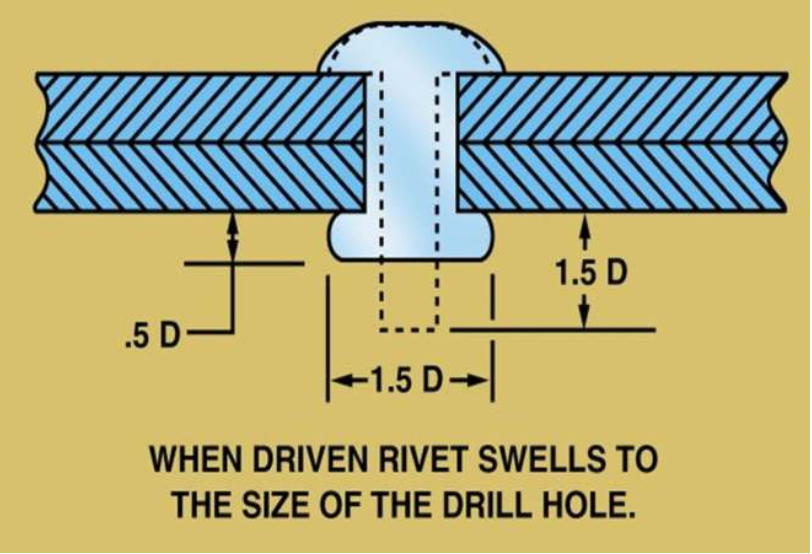
What type of Rivet is this?
This is an example of a solid-shank rivet
What happens to a solid-shank rivet when driven, and why does this matter?
It expands to fill the hole, increasing its cross-sectional area, bearing strength, and shear strength — making it stronger after installation than before.
What are the two rivet coding systems used in aviation?
Air Force-Navy (AN) and Military Standards 20 (MS20).
What does the second part of a rivet code describe?
Head style. For example, 470 is universal head and 426 is countersunk.
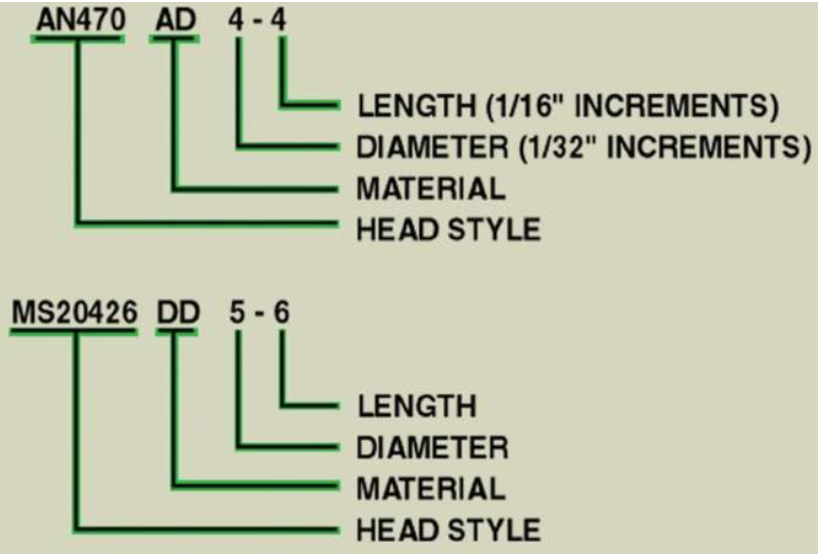
What does the third part of a rivet code represent?
A one- or two-letter code indicating the rivet alloy material.
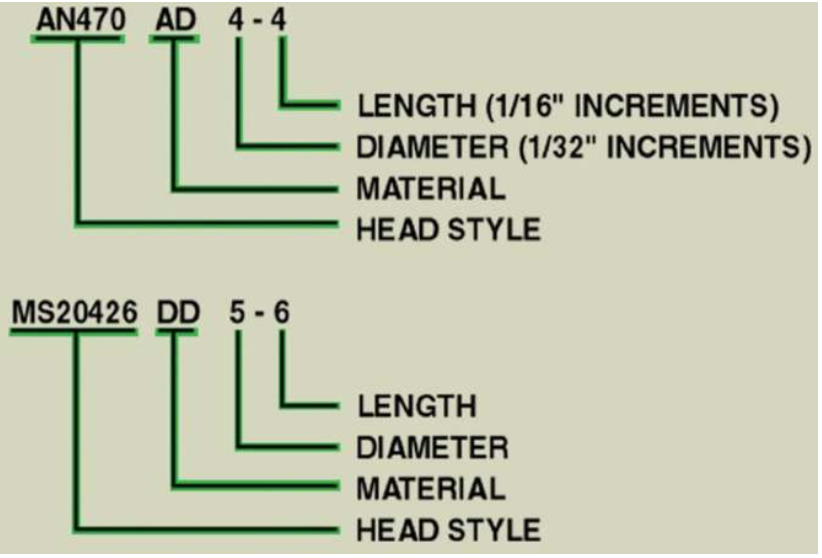
How is shank diameter indicated in a rivet code?
In 1/32-inch increments.
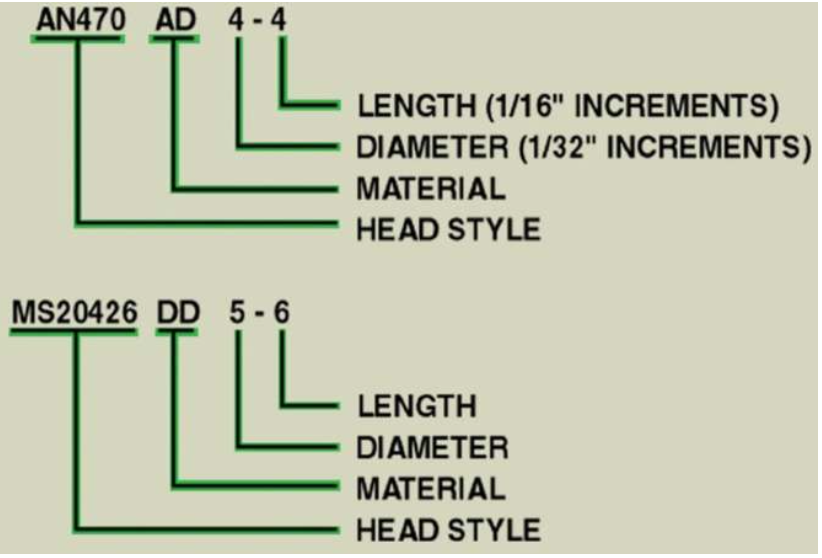
How is rivet length indicated in a rivet code?
In 1/16-inch increments.
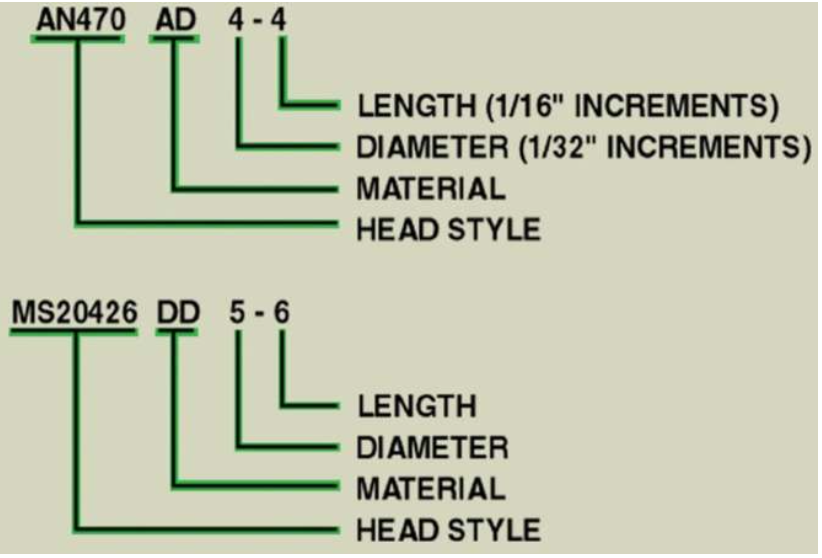
In the code MS20470-AD4-4, what does each section tell you?
MS20 = Military Standards system. 470 = universal head. AD = alloy material. 4 = 4/32 inch (1/8 inch) shank diameter. 4 = 4/16 inch (1/4 inch) length.
Identify this rivet: AN470-DD5-6
AN = Air Force-Navy. 470 = universal head. DD = 2024 aluminium alloy. 5 = 5/32 inch diameter. 6 = 6/16 inch (3/8 inch) length
Identify this rivet: MS20426-AD3-5
MS20 = Military Standards. 426 = countersunk head. AD = 2117 aluminium alloy. 3 = 3/32 inch diameter. 5 = 5/16 inch length
Identify this rivet: AN470-B4-8
AN = Air Force-Navy. 470 = universal head. B = 5056 aluminium alloy. 4 = 4/32 inch (1/8 inch) diameter. 8 = 8/16 inch (1/2 inch) length
What information does a rivet part code convey, in order?
Numbering system (AN or MS20), head style, alloy material, shank diameter in 1/32-inch increments, and length in 1/16-inch increments.
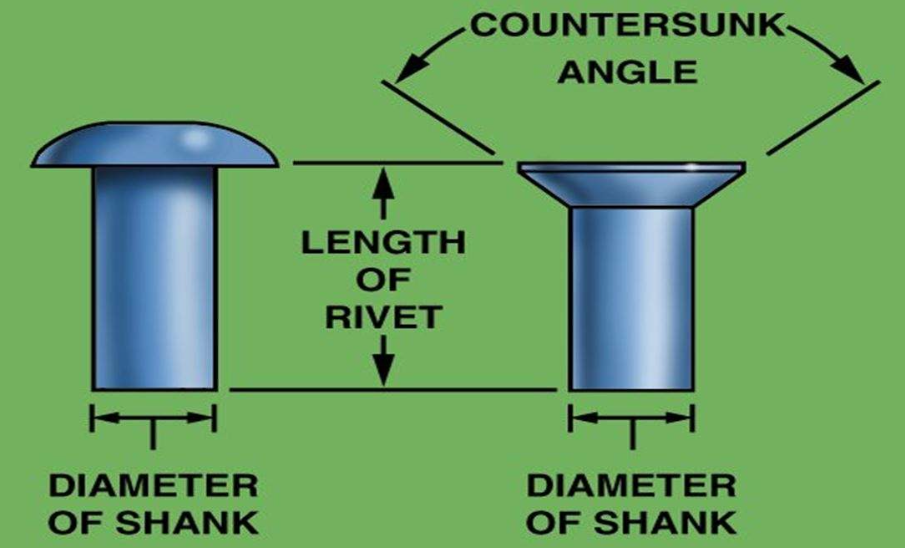
Where is the rivet length measured from?
Rivet length is measured from the top of the manufactured head to the end of the shank.
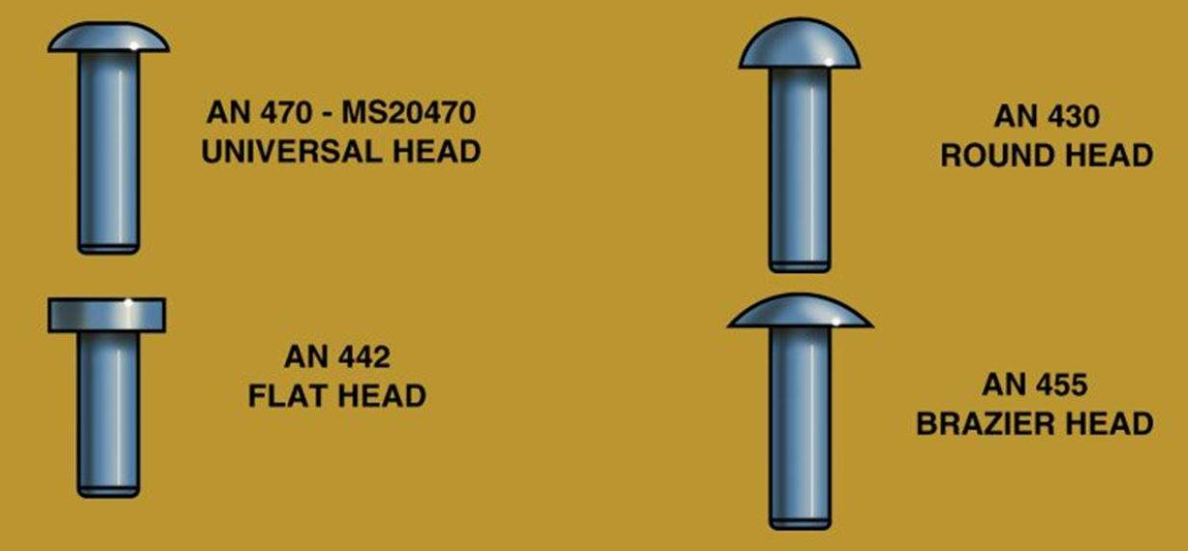
What are the 5 types of rivet heads?
Universal head, (Dome head; round head, flat head, brazier head), Countersunk
Why are countersunk rivet joints generally weaker than universal head joints?
Material is cut away to accommodate the countersunk head, and if the hole isn't countersunk or dimpled correctly the gusset may not contact the rivet head directly.
What is the purpose of AN426 countersunk rivets?
To streamline aerofoils and allow smooth airflow over wings and control surfaces.
What is the difference between countersinking and dimpling?
Countersinking cuts away metal in the top sheet to match the rivet head shape. Dimpling mechanically dents the sheets to accommodate the rivet head without removing material.
What determines whether countersinking or dimpling is used?
Sheet thickness and rivet size.
What type of material are most rivets made of?
Most rivets are made of aluminium alloy, but the type can be identified from the mark on the head itself.
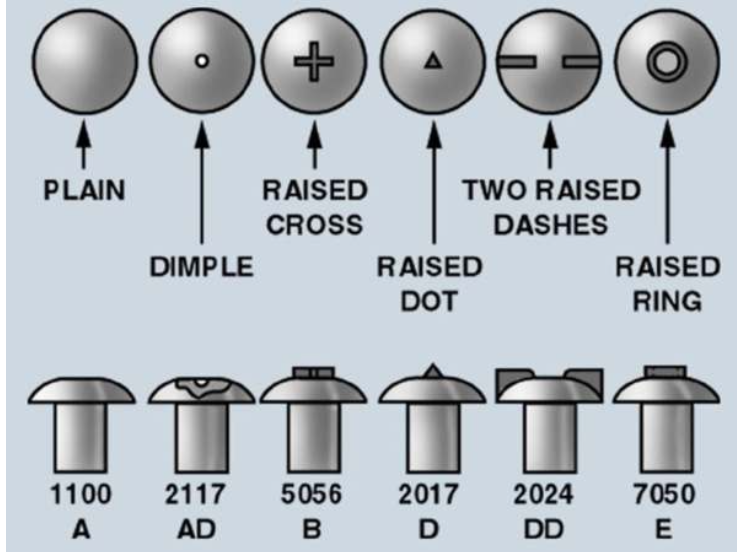
What is the alloy designation letter for 1100 aluminium rivets?
A
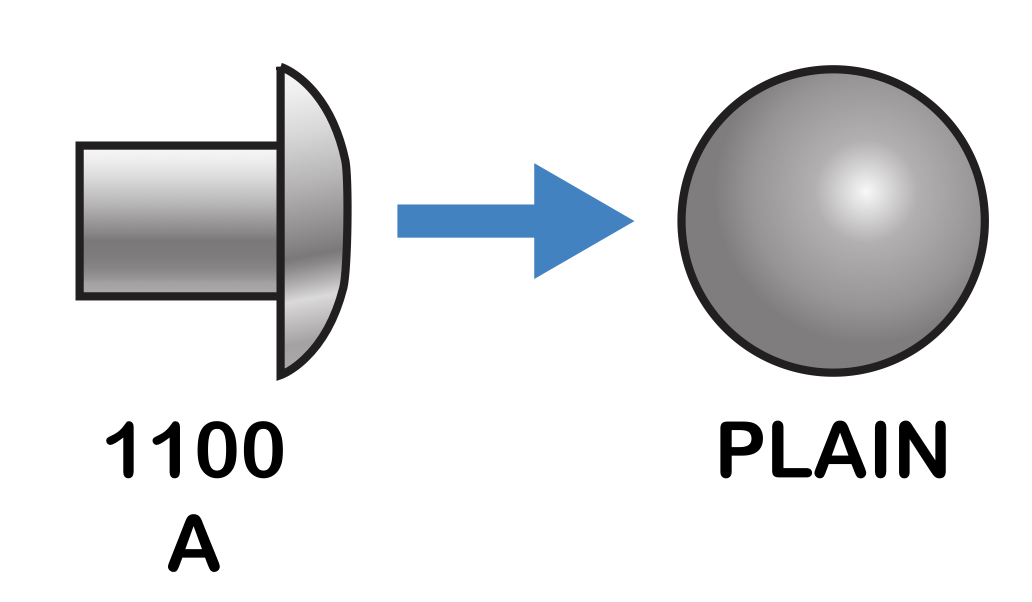
How is a 1100 (A) rivet identified by head marking?
No marking on the head
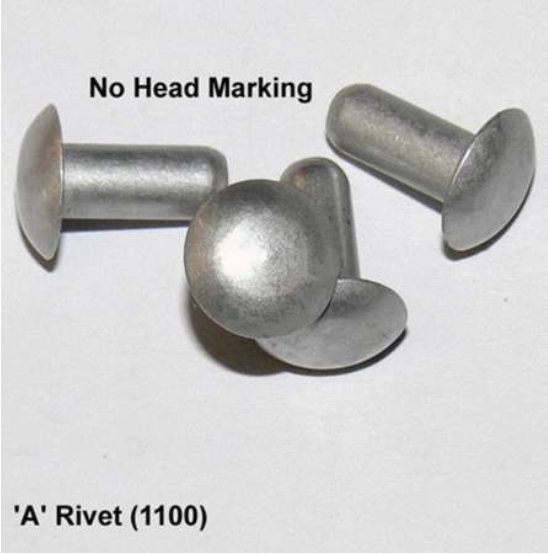
What are 1100 (A) rivets used for?
Non-structural assemblies such as fairings, engine baffles and furnishings.
How are 1100 (A) rivets driven?
Cold. Shear strength increases slightly as a result of cold-working.
What is the alloy designation letter for 2117 aluminium rivets?
AD
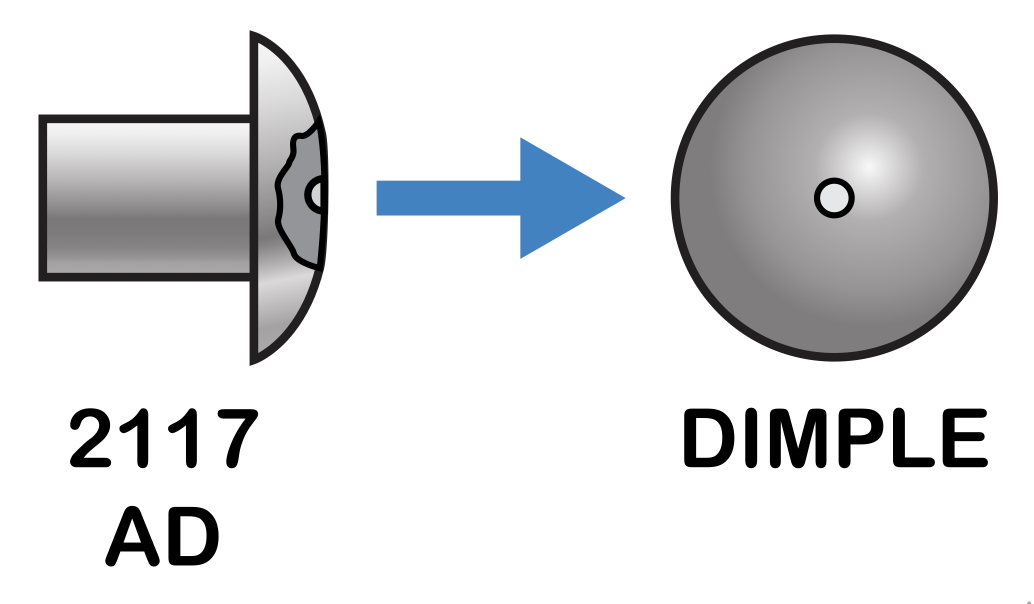
How is a 2117 (AD) rivet identified by head marking?
A dimple in the centre of the head.
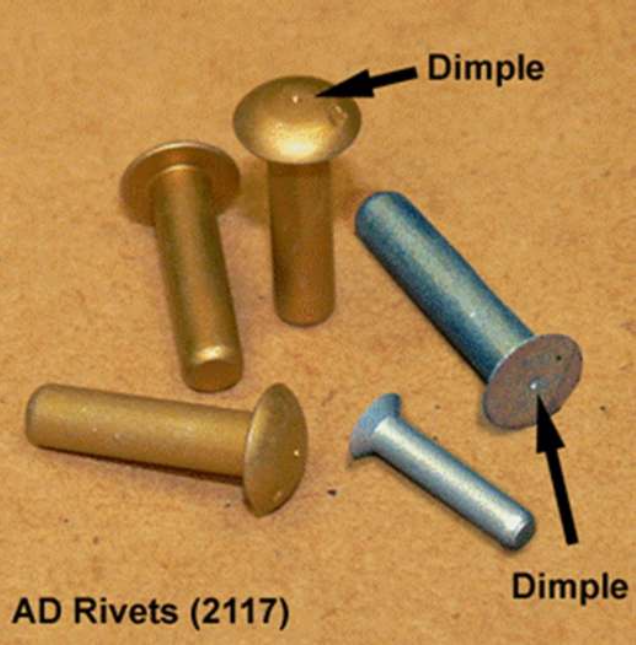
What are 2117 (AD) rivets used for?
The most widely used rivet for manufacturing and maintenance of modern aircraft.
Why are 2117 (AD) rivets called field rivets?
They require no heat treatment before driving, making them convenient for field use.
What is the alloy designation letter for 5056 aluminium rivets?
B
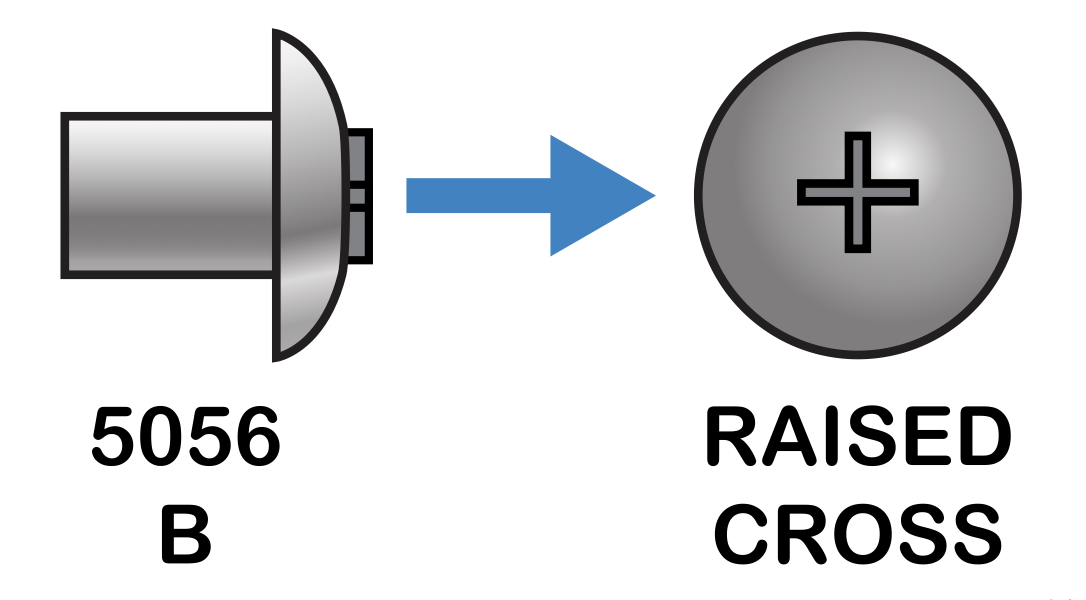
How is a 5056 (B) rivet identified by head marking?
A raised cross on the head.
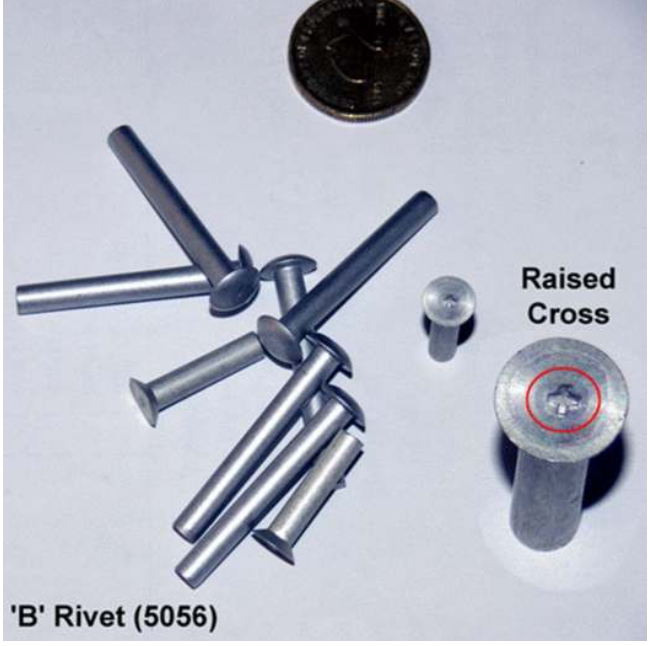
What are 5056 (B) rivets used for?
Riveting magnesium structures to avoid dissimilar metal corrosion.
What is the alloy designation letter for 2017 aluminium rivets?
D
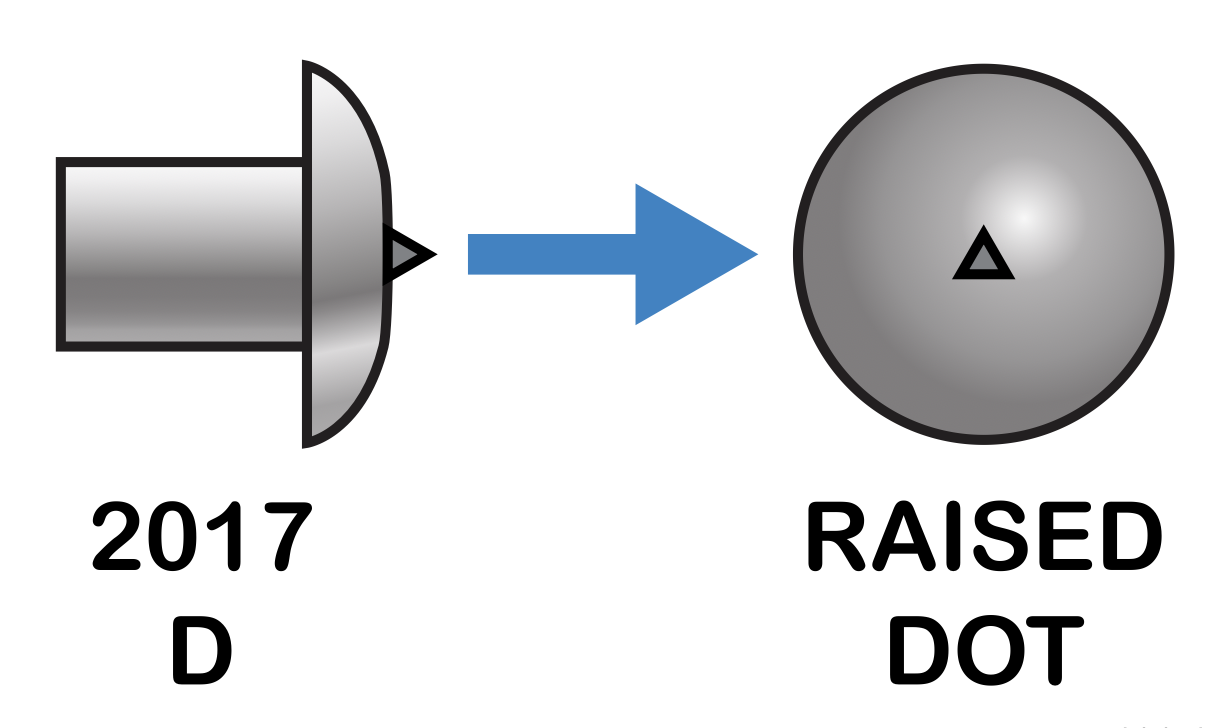
How is a 2017 (D) rivet identified by head marking?
A raised dot in the centre of the head.
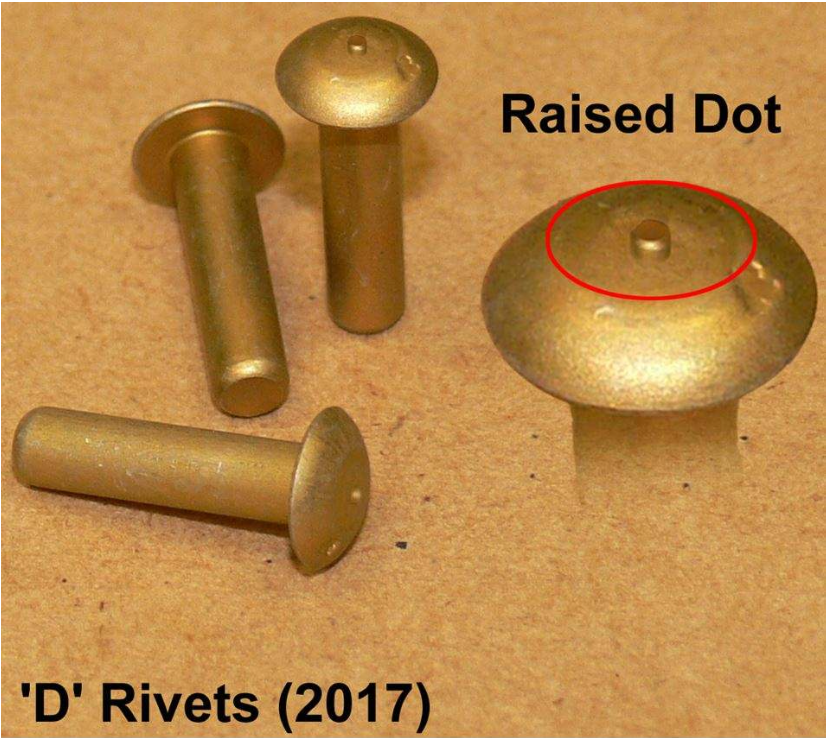
What are 2017 (D) rivets used for?
General aircraft construction. Extremely hard, must be heat treated before use.
Why are 2017 (D) rivets called icebox rivets?
They must be stored in a freezer after heat treatment to remain soft enough to drive. They harden at room temperature.
What is the driving time limit for 2017 (D) rivets after removal from refrigeration?
Within 1 hour.
What is the alloy designation letter for 2024 aluminium rivets?
DD
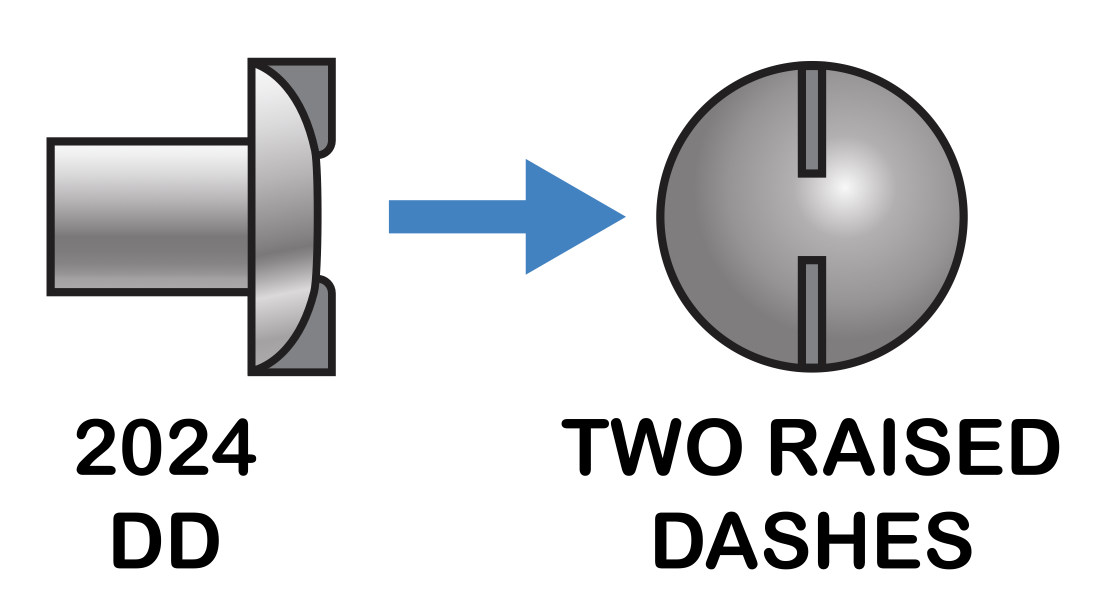
How is a 2024 (DD) rivet identified by head marking?
Two raised dashes on the head.
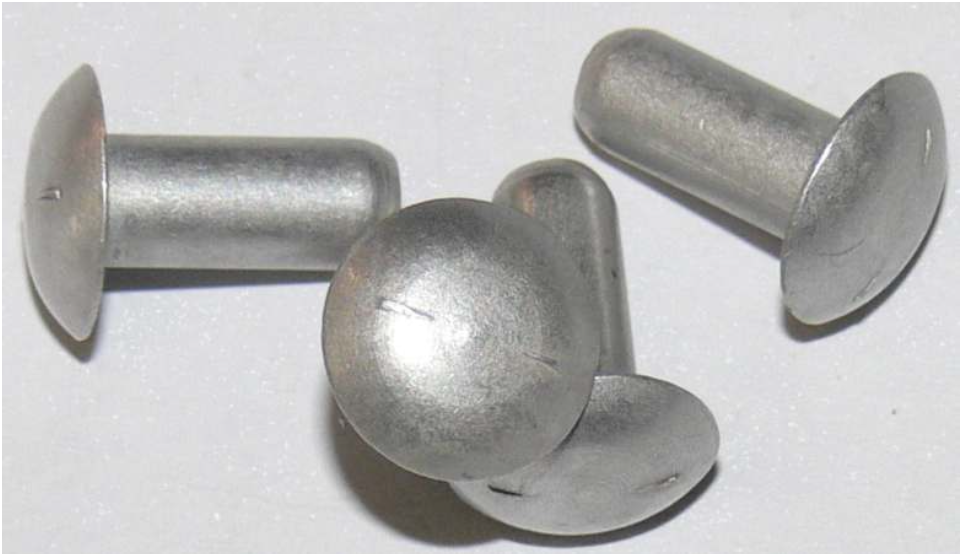
Why are 2024 (DD) rivets called icebox rivets?
Like D-rivets, they must be stored cool until ready to drive as they harden at room temperature.
What is the driving time limit for 2024 (DD) rivets after removal from refrigeration?
Within 10 to 20 minutes.
What is the alloy designation letter for 7050 aluminium rivets?
E
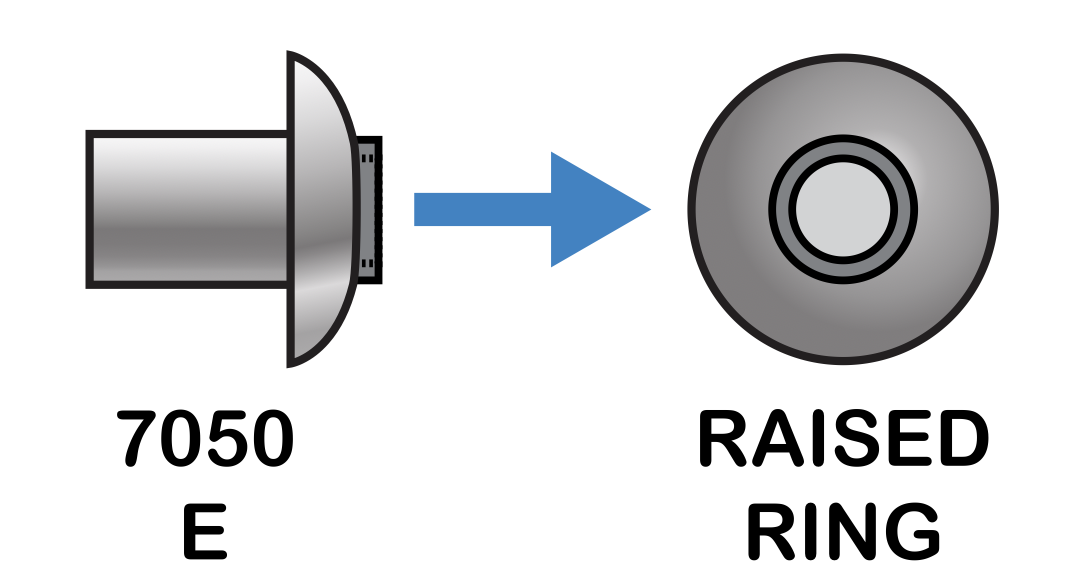
How is a 7050 (E) rivet identified by head marking?
A raised circle on the head.
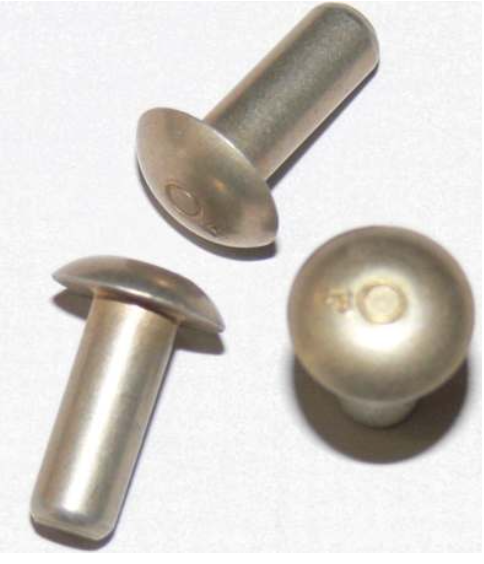
What are 7050 (E) rivets used for?
Can replace DD rivets in some applications. Major alloying element is zinc, precipitation heat-treated.
What is the alloy designation letter for corrosion-resistant steel rivets?
F
How is a corrosion-resistant steel (F) rivet identified by head marking?
No marking on the head.
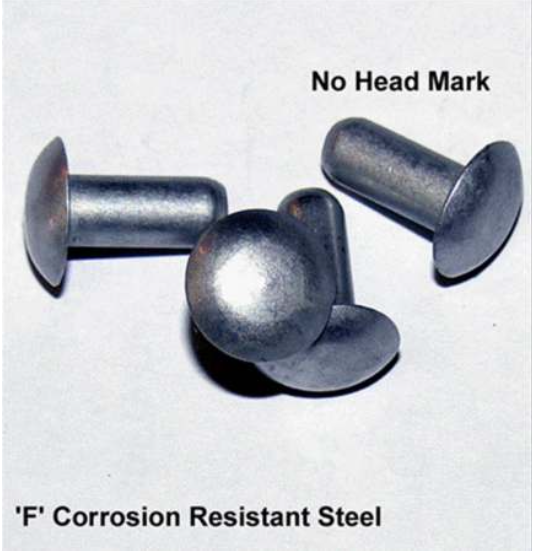
What are corrosion-resistant steel (F) rivets used for?
Fastening stainless steel sheets in applications such as firewalls and exhaust shrouds.
What is the alloy designation letter for Monel rivets?
M
How is a Monel (M) rivet identified by head marking?
Two recessed dimples in the head.
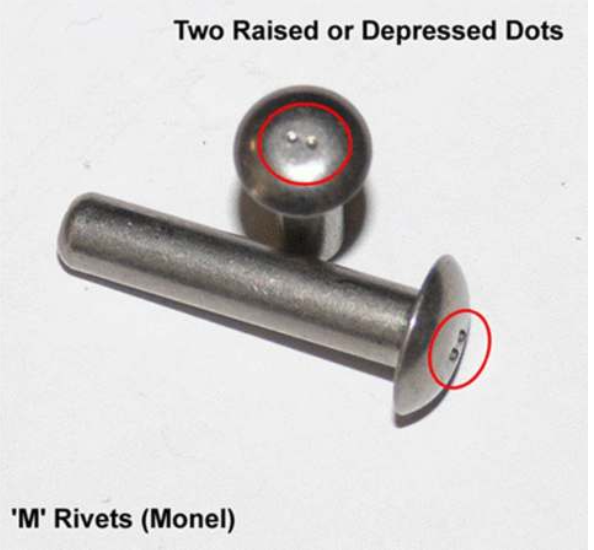
What are Monel (M) rivets used for?
Used in place of corrosion-resistant steel rivets when their slightly lower shear strength is acceptable.
What is natural ageing in rivet heat treatment?
When an alloy is allowed to cool at room temperature. Can take several hours or several weeks.
What is precipitation heat treatment and what are its other names?
An accelerated ageing process using slightly elevated temperature over an extended period. Also known as artificial ageing and precipitation-hardening.
What is the advantage of precipitation heat treatment over natural ageing?
It achieves the required hardness in a shorter time by applying controlled elevated temperature rather than waiting for natural cooling.
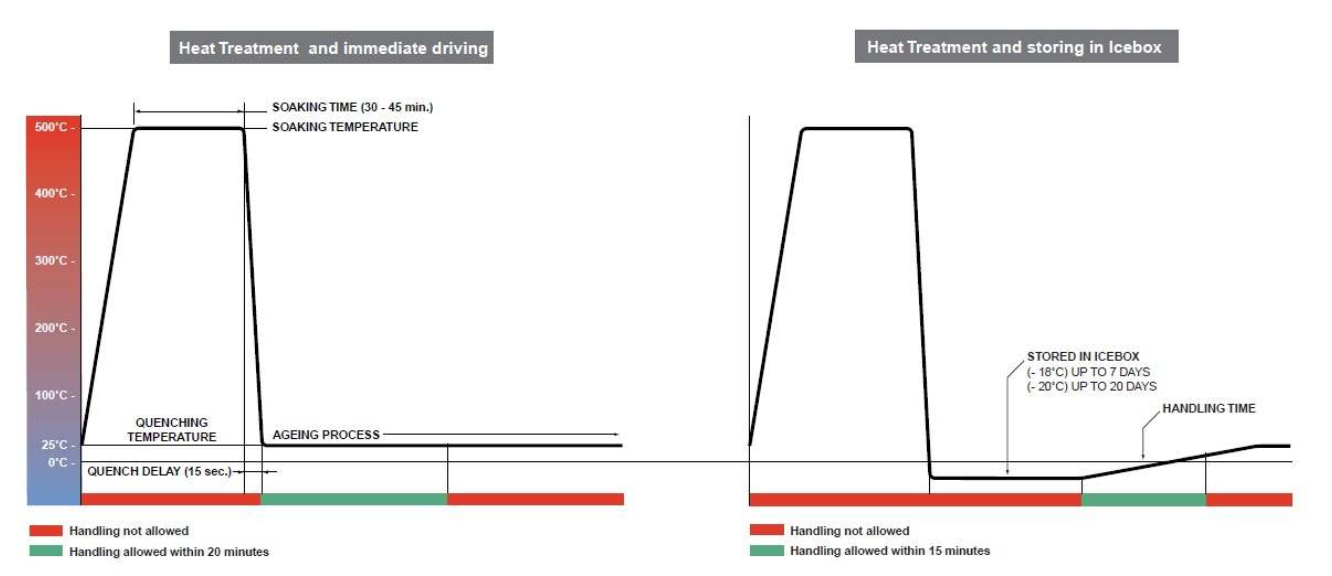
What are differences in rivet immeditate drive or storing in icebox after heat treatment
Icebox has a handling time whereas immediate driving does not
What is the main advantage of blind rivets over solid-shank rivets?
They can be installed with access to only one side of the work.
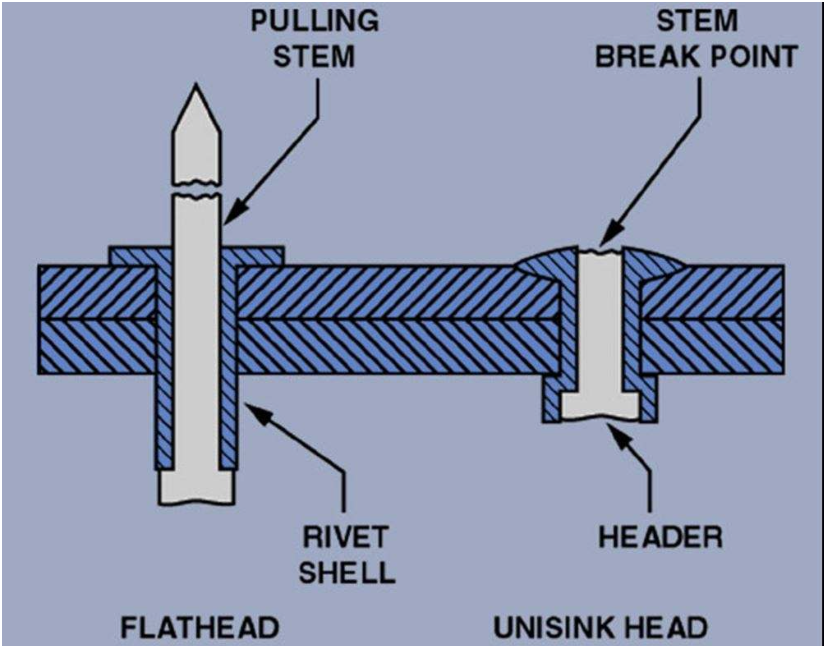
What are the two original styles of Cherry friction-lock rivets?
Hollow-shank pull-through and self-plugging. The pull-through type is no longer common.
What are the two head styles available for Cherry friction-lock rivets?
Universal and 100° countersunk.
What are the three standard diameters for Cherry friction-lock rivets?
1/8, 5/32, and 3/16 inch.
How does a friction-lock rivet work?
The mandrel stem is pulled until it forms a bucktail on the blind side. A built-in weak point shears and the stem breaks off. The projecting stem is cut close to the rivet head and filed smooth.
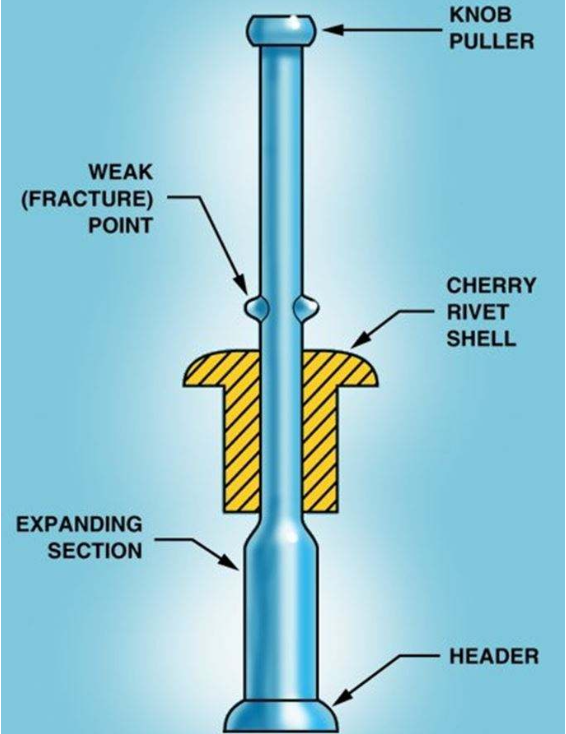
What are the two components of a friction-lock rivet assembly?
A shell and a mandrel (pulling stem).
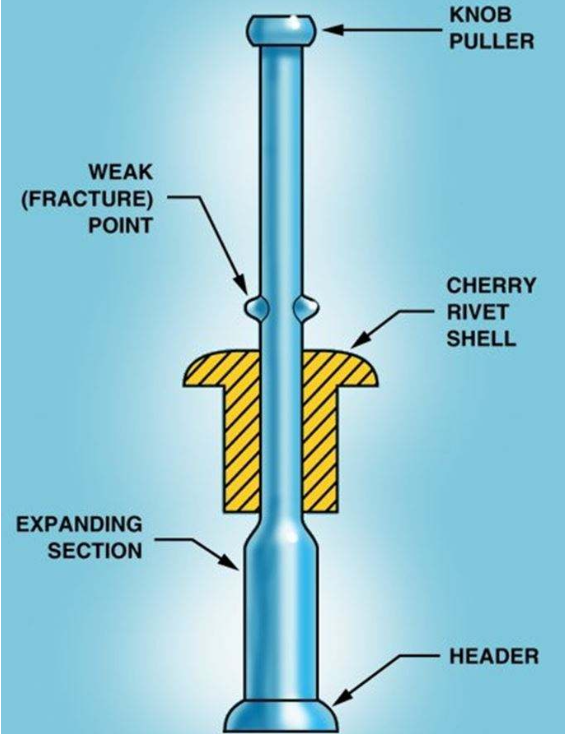
Why were mechanical-lock rivets developed?
To prevent the centre stem falling out due to vibration during aircraft operation, unlike friction-lock rivets whose stems can shake loose.
What are the three types of mechanical-lock rivets?
Huck-Lok, Olympic-Lok, and CherryMAX.
Why are Huck-Lok rivets generally limited to manufacturers and large repair facilities?
They require expensive specialist tooling for installation.
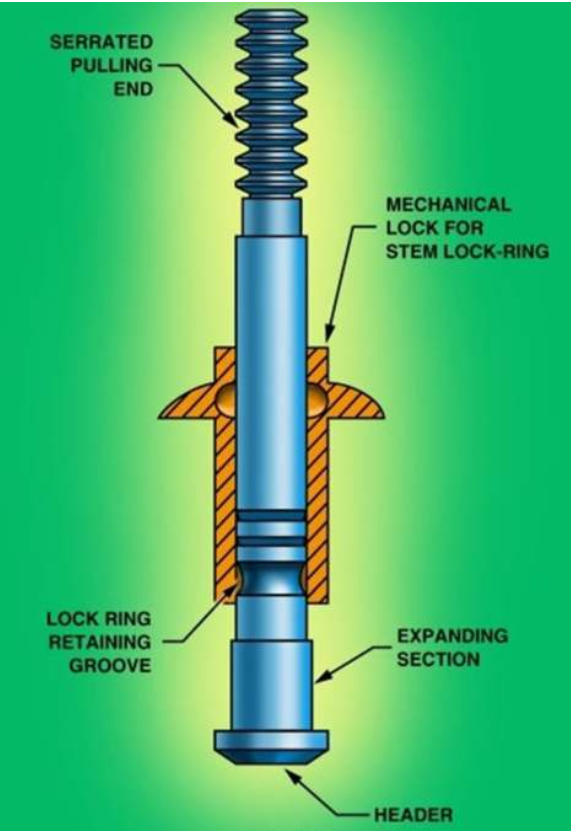
How does the Olympic-Lok locking mechanism work?
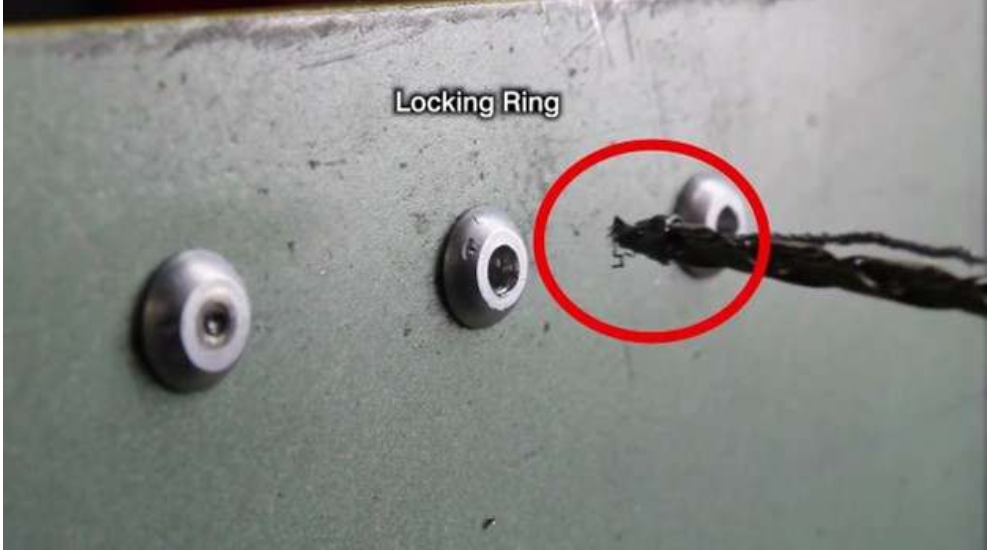
A lock ring stowed on the head slips down the stem during installation, locking the centre stem to the outer shell.
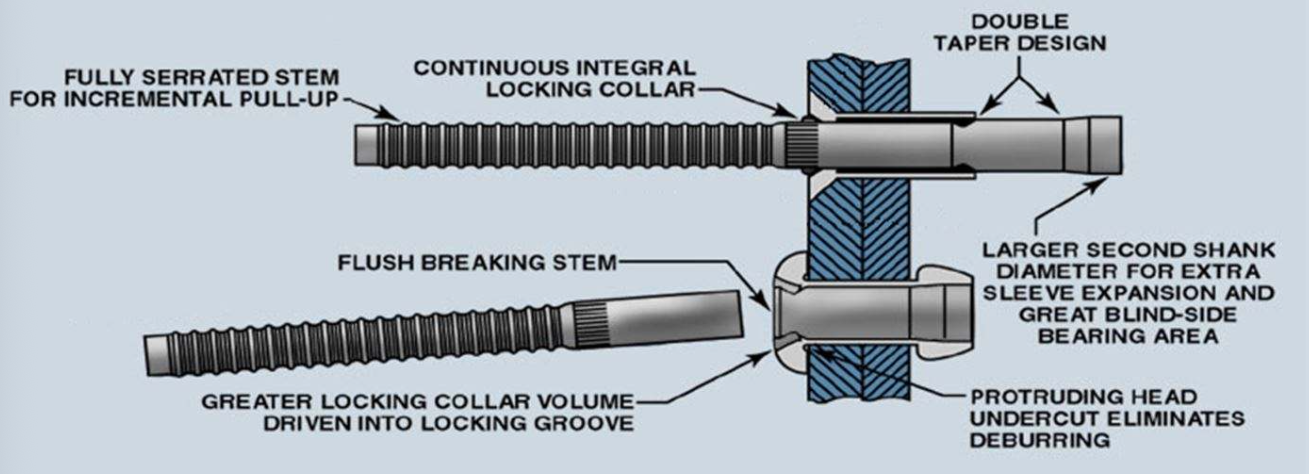
What head styles are Olympic-Lok rivets available in?
Universal, 100° flush, and 100° flush shear.
What is the economic advantage of the CherryMAX system?
One size puller installs all sizes of CherryMAX rivets.
What are the five main parts of a CherryMAX rivet?
Pulling stem, driving anvil, safe-lock locking collar, rivet sleeve, and bulbed blind head.
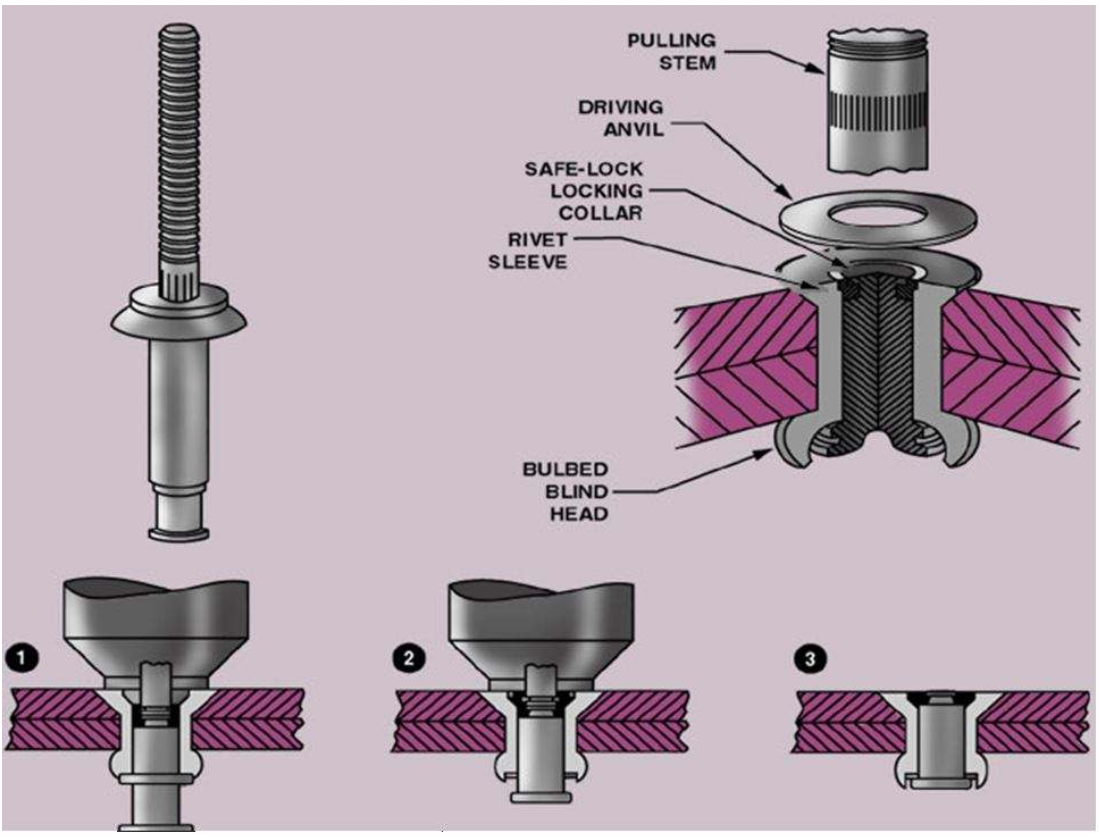
What diameters are CherryMAX rivets available in?
1/8, 5/32, 3/16, and 1/4 inch, plus oversize versions of each.
How does a Hi-Shear rivet differ from a standard AN bolt?
Same strength characteristics, but secured by a crushed collar instead of a nut.
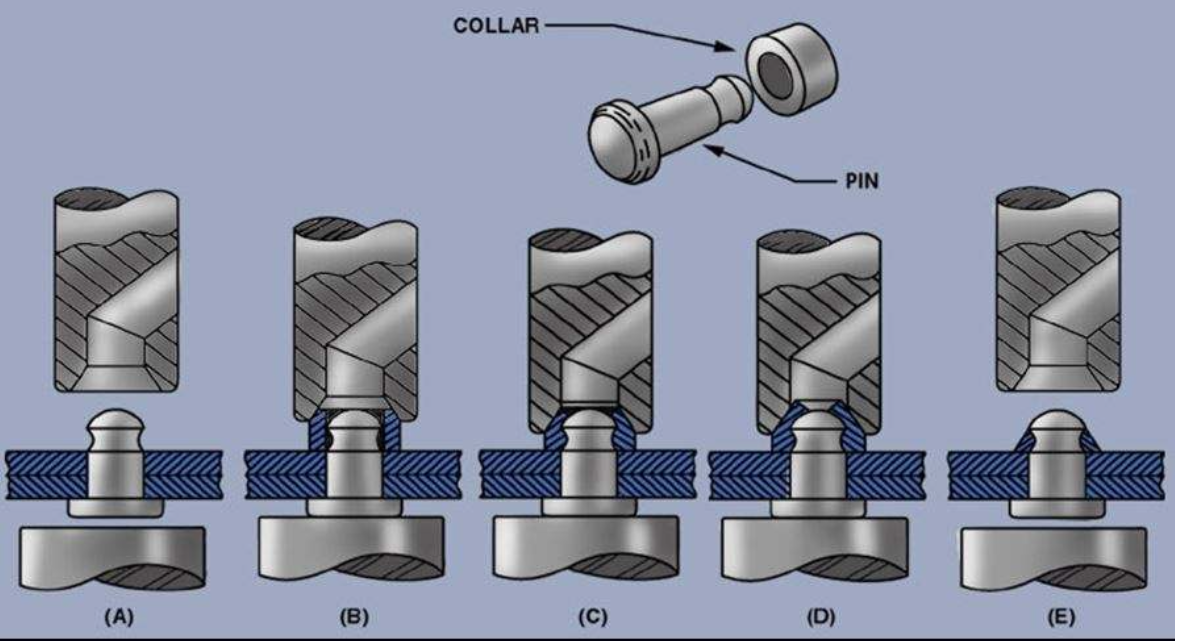
What head styles are Hi-Shear rivets available in?
Flat and countersunk.
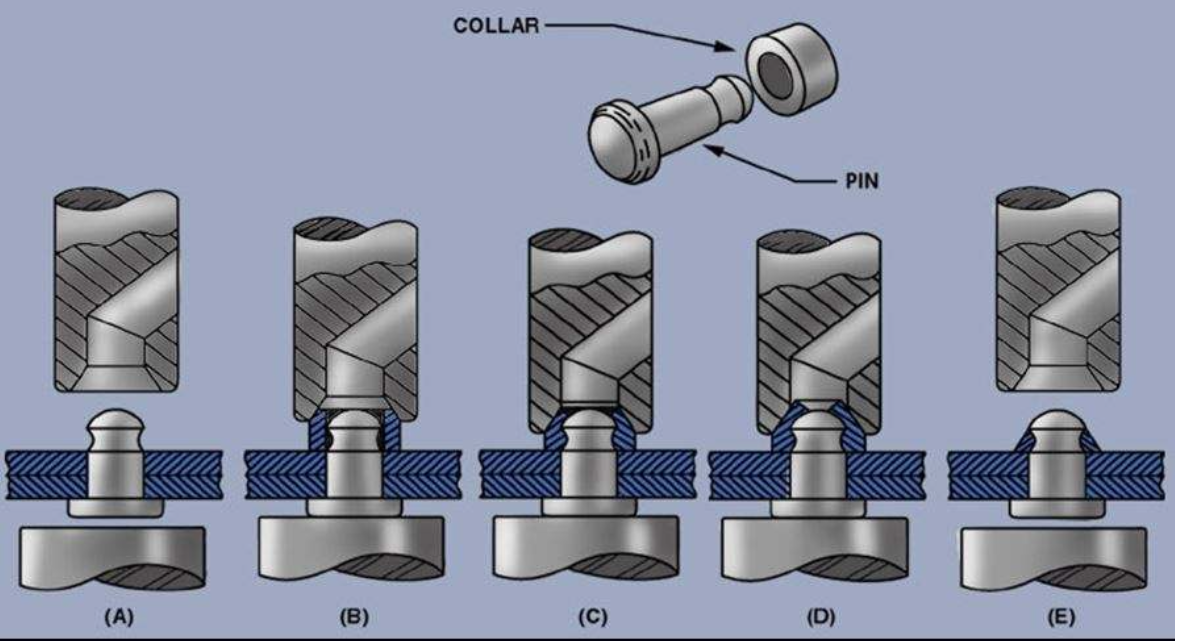
Why do special fasteners not suffer the same dimensional change as AN bolts when installed?
They are secured by a collar squeezed into position rather than a screwed nut, so they are not under the same tensile loads that cause bolt shanks to stretch and decrease in diameter.
What materials are Hi-Lok bolts manufactured from?
Titanium, stainless steel, steel, and aluminium.
How does a Hi-Lok collar installation finish?
Once tightened to the correct torque, the wrenching device shears off, leaving only the locking collar.
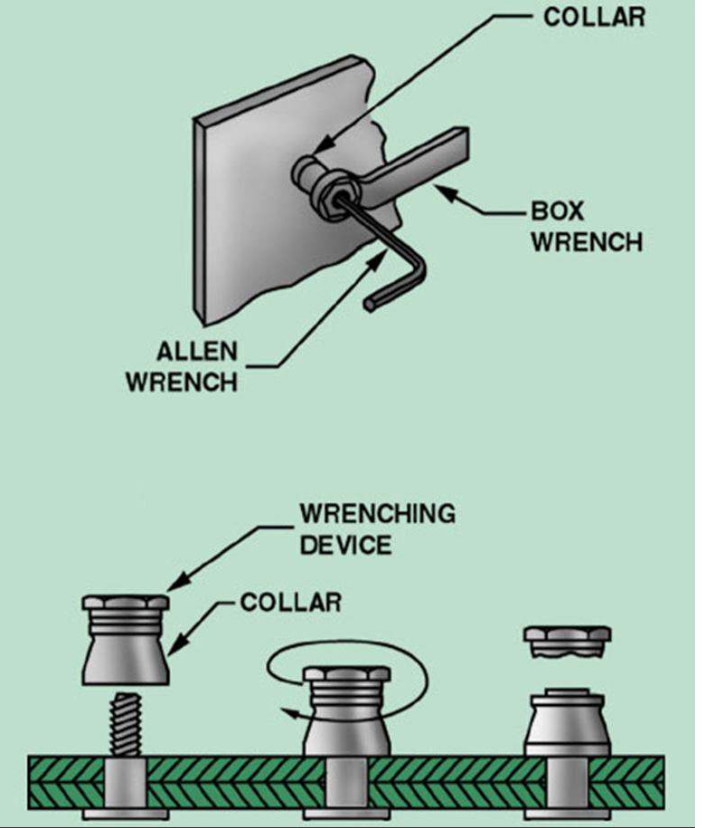
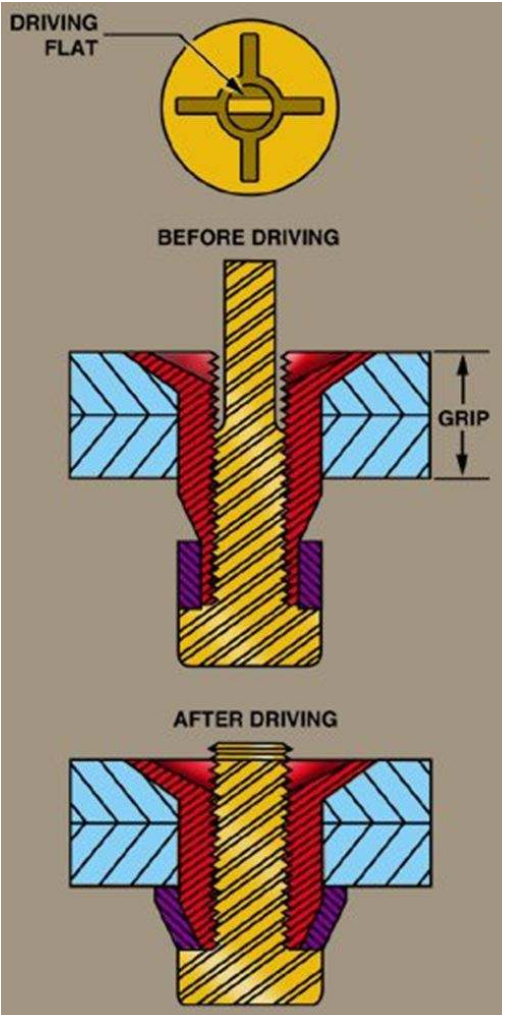
Where are Jo-Bolts used?
Close-tolerance holes where strength is high but physical clearance prevents use of standard AN, MS or NAS bolts.
How does a Jo-Bolt form its blind head?
As the bolt is screwed up through the nut, it forces a sleeve over the tapered outside of the nut, forming a blind head on the inside of the work. The driving flat then breaks off.
What is the general process for removing special fasteners?
Remove the washer-nut or locking collar with a box end wrench or vise-grips, then tap the remaining fastener out with a mallet.
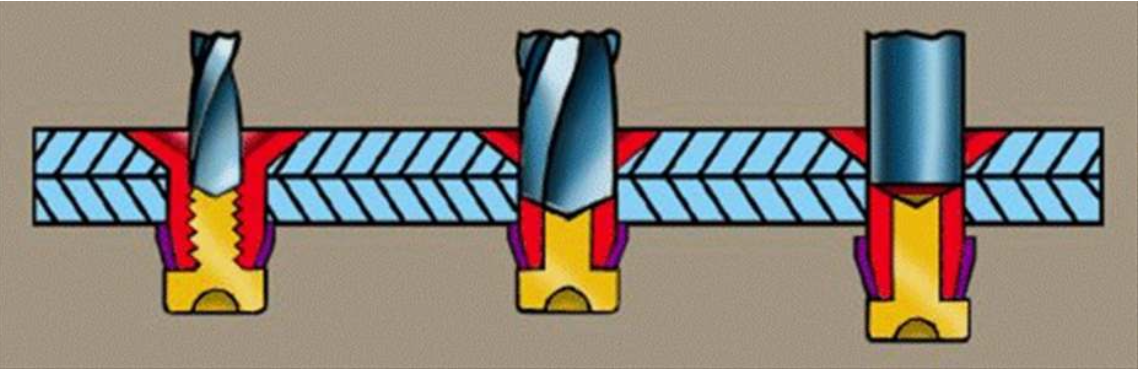
How is a flush-type Jo-Bolt removed?
Drill a pilot hole slightly deeper than the inside of the nut head, drill to pilot hole depth with a shank-sized bit, then drive out the remainder with a pin punch.
What makes CherryMAX removal more difficult than other fasteners?
The locking collar is made from hard material that is difficult to drill.
What is the step-by-step process for removing a CherryMAX rivet?
Linish the head to the depth of the locking collar, punch out the stem, drill to head depth with one size smaller drill, break the head off with a parallel punch, then punch the sleeve out of the hole.