Microbiology - Ch. 2 Chemical Principles - flashcards
 Call Kai
 Learn
Learn Practice Test
 Spaced Repetition
 Match
Match Flashcards
 Knowt Play
1/143

There's no tags or description
Looks like no tags are added yet.
Name | Mastery | Learn | Test | Matching | Spaced | Call with Kai | Chat |
|---|
No analytics yet
Send a link to your students to track their progress
144 Terms
What are the characteristics of inorganic compounds?
Small, simple molecules that usually lack carbon. Examples: H₂O, O₂, salts, acids & bases.
What are the characteristics of organic compounds?
Large, structurally complex; always contain carbon (minimum requirement); held together by covalent bonds.
What is the minimum requirement for a compound to be considered organic?
It must contain carbon and hydrogen (at least one hydrogen).
What type of bond holds organic compounds together?
Covalent bonds.
What are the 4 most common elements in organic compounds?
C, H, O, N (Carbon is the minimum requirement)
What is a "carbon skeleton"?
A chain of carbon atoms that forms the backbone of an organic compound.
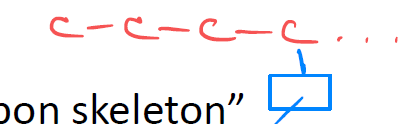
What are functional groups?
Groups of atoms that bind to the carbon skeleton of an organic compound.
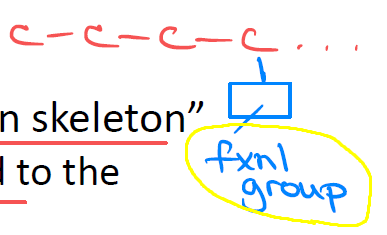
What determines what kind of organic compound is formed?
Which functional group is present/attached to the carbon skeleton.
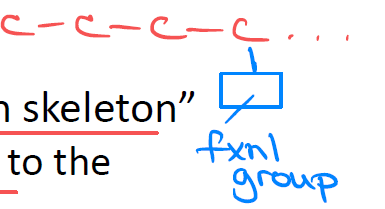
What does R- mean? for example R-NH2
It means carbon chain, placeholder for the functional group, whatever’s attached determines
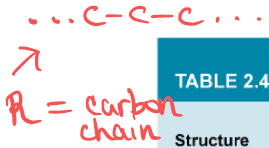
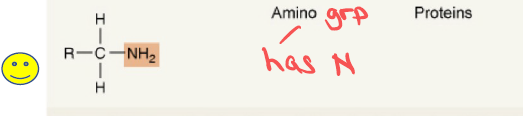
What functional group has the structure R–NH₂, what element does it contain, and where is it found?
Amino group — contains nitrogen (N) — found in proteins.
What functional group has the structure R–COOH and where is it found?
Carboxyl group — found in organic acids, lipids, and proteins.

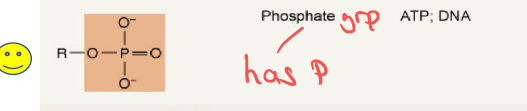
What functional group contains phosphorus (P) and where is it found?
Phosphate group — found in ATP and DNA.
What functional group has the structure R–OH and where is it found?
Hydroxyl (Alcohol) group — found in lipids and carbohydrates.

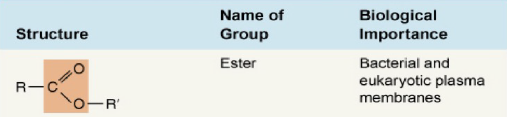
What functional group is found in bacterial and eukaryotic plasma membranes?
Ester group.
What functional group is found in Archaeal plasma membranes?
Ether group.

What functional group is involved in energy metabolism and protein structure?
Sulfhydryl group (R–C–SH).

What functional group is found in reducing sugars like glucose?
Aldehyde group.

What functional group is associated with metabolic intermediates?
Ketone group.

What functional group is associated with DNA and energy metabolism?
Methyl group.

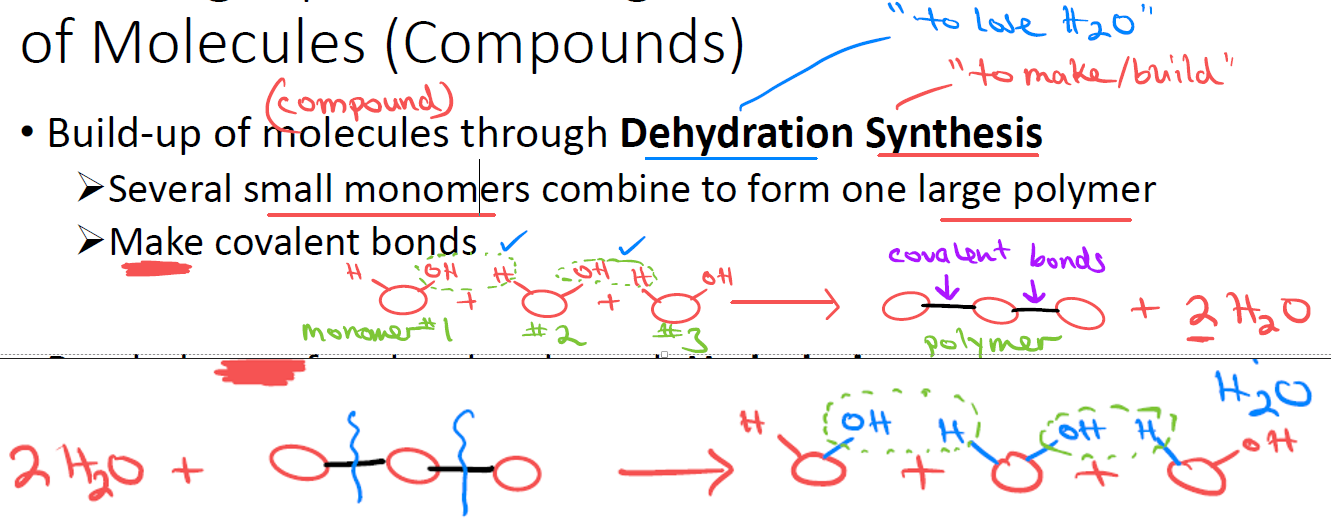
What does Dehydration Synthesis mean literally?
Dehydration = “To lose H2O”
Synthesis = “To make/build”
What happens during Dehydration Synthesis?
Several small monomers combine to form one large polymer — covalent bonds are made and H₂O is released.

What does Hydrolysis mean literally?
"To break down" using H₂O to break the covalent bond between monomers, splitting a polymer back into its individual pieces.
What happens during Hydrolysis?
One large polymer breaks down into several small monomers — covalent bonds are broken and H₂O is used as input.
What is the relationship between Dehydration Synthesis and Hydrolysis?
They are opposites/antagonists.
Dehydration Synthesis: small monomers → polymer + H₂O released.
Hydrolysis: polymer + H₂O input → monomers.
What are carbohydrates made of?
Carbons, hydrogens, and oxygens. (C6,H12,O6)
What are the building blocks (monomers) of carbohydrates?
Monosaccharides (sugar monomers).
What suffix do carbohydrates usually end in?
"-ose"
Glucose — monosaccharide
Fructose — monosaccharide
Galactose — monosaccharide
—
Sucrose — disaccharide (table sugar; glucose + fructose)
Lactose — disaccharide (milk sugar; glucose + galactose)
Maltose — disaccharide (malt sugar; glucose + glucose)
—
Dextrose — another name for glucose
—
Starch — polysaccharide (plant energy storage)
Glycogen — polysaccharide (animal/human energy storage)
What are the 3 major groups of carbohydrates classified by size?
Monosaccharides, Disaccharides, Polysaccharides.
What are monosaccharides also called and how many carbon atoms do they contain?
"Simple sugars" — contain 3-7 carbon atoms.
What are two physical characteristics of monosaccharides?
Sweet tasting and water-soluble.
What is the key function of monosaccharides?
Provide a quick source of energy for living cells (ex: glucose for humans).
What role do monosaccharides play in relation to larger carbohydrates?
They serve as building blocks for large, complex carbohydrates.
What are 3 examples of monosaccharides?
Glucose
Deoxyribose
Fructose
Galactose
What is a disaccharide and how is it formed?
Made when 2 monosaccharides join via dehydration synthesis, forming a covalent bond called a glycosidic bond.
What is the specific name of the covalent bond formed between 2 monosaccharides?
Glycosidic bond.
What is the key function of disaccharides?
Provide structural component for bacterial cell walls.
What are 3 examples of disaccharides?
Sucrose — disaccharide (table sugar; glucose + fructose)
Lactose — disaccharide (milk sugar; glucose + galactose)
Maltose — disaccharide (malt sugar; glucose + glucose)
What does "poly" mean and what are polysaccharides made of?
"Many/several" — consist of tens or hundreds of monosaccharides joined through dehydration synthesis.
What are the 2 key functions of polysaccharides?
1. Long-term energy source. 2. Structural component for plant cell walls (cellulose).
What are 3 examples of polysaccharides and what are they all polymers of?
Starch, glycogen, and cellulose — all polymers of glucose.
Where is starch found and what is its function?
Found in plant cells — long-term energy source.
Where is glycogen found and what is its structure?
Found in human/animal cells — branched chains of glucoses — long-term energy source.
Where is cellulose found and what is its function?
Found in plant cells — structural component of plant cell walls.
What elements are proteins made of?
C, H, O, N, and sometimes S.
Carbon
Hydrogen
Oxygen
Nitrogen
Sometimes Sulfur
Why are proteins the most diverse organic compound?
Because there are many protein shapes → many protein functions.
What is the big picture relationship between protein structure and function?
Protein structure (shape) → determines protein function.
What are structural proteins and give an example?
Proteins that provide structural support. Ex: Keratin — reinforces skin (physical barrier to infection).
What are transporter proteins and give examples?
Proteins in the cell membrane that transport substances. Ex: protein channels and protein carriers.
What are enzymes?
Proteins that speed up chemical reactions.
What are antibodies?
Proteins involved in the immune response.
What are bacterial toxins?
Poisonous proteins made by some bacteria.
What are the building blocks of proteins?
Amino acids (AA).
How many amino acids are there total?
20.
What are the 4 things attached to the central carbon of every amino acid?
1. Amino group 2. Carboxyl group 3. Hydrogen 4. Side group (R group)
What is the R group of an amino acid and how many are there?
The side group — varies for each amino acid. There are 20 different R groups, one for each amino acid.
What makes one amino acid different from another?
The R group (functional group) — it varies for each specific amino acid.
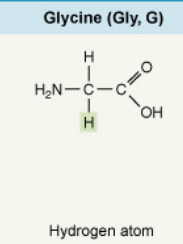
Glycine (Gly, G) — R group/side group?
Hydrogen atom
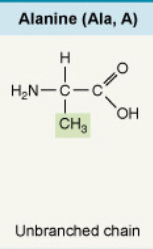
Alanine (Ala, A) — R group/side group?
Unbranched chain
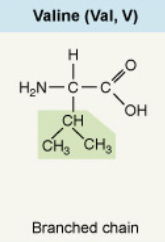
Valine (Val, V) — R group/side group?
Branched chain
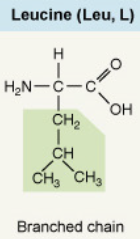
Leucine (Leu, L) — R group/side group?
Branched chain
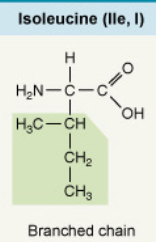
Isoleucine (Ile, I) — R group/side group?
Branched chain
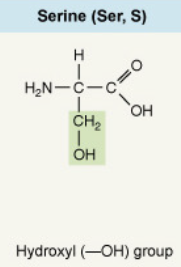
Serine (Ser, S) — R group/side group?
Hydroxyl (–OH) group
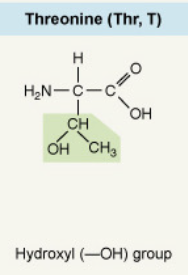
Threonine (Thr, T) — R group/side group?
Hydroxyl (–OH) group
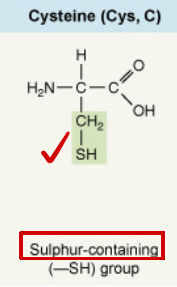
Cysteine (Cys, C) — R group/side group?
Sulfur-containing (–SH) group
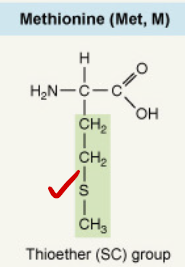
Methionine (Met, M) — R group/side group?
Thioether (SC) group
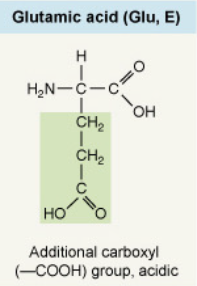
Glutamic acid (Glu, E) — R group/side group?
Additional carboxyl (–COOH) group, acidic
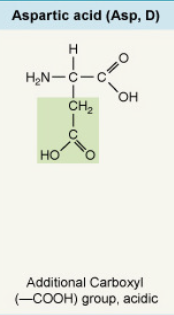
Aspartic acid (Asp, D) — R group/side group?
Additional carboxyl (–COOH) group, acidic
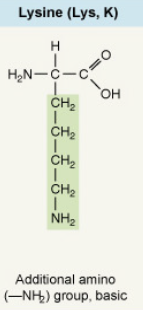
Lysine (Lys, K) — R group/side group?
Additional amino (–NH₂) group, basic
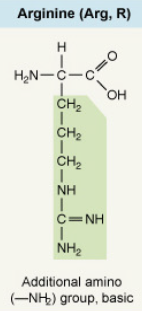
Arginine (Arg, R) — R group/side group?
Additional amino (–NH₂) group, basic
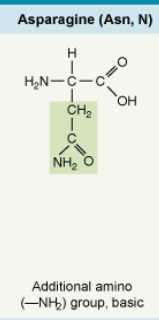
Asparagine (Asn, N) — R group/side group?
Additional amino (–NH₂) group, basic
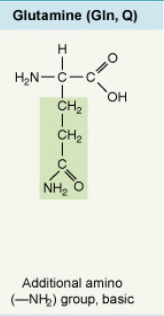
Glutamine (Gln, Q) — R group/side group?
Additional amino (–NH₂) group, basic
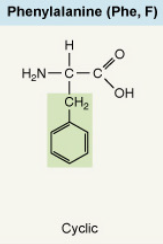
Phenylalanine (Phe, F) — R group/side group?
Cyclic
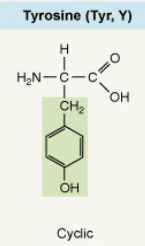
Tyrosine (Tyr, Y) — R group/side group?
Cyclic
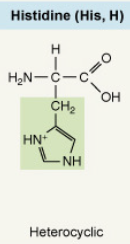
Histidine (His, H) — R group/side group?
Heterocyclic
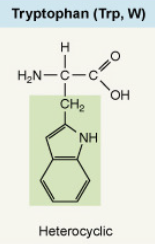
Tryptophan (Trp, W) — R group/side group?
Heterocyclic
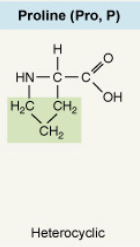
Proline (Pro, P) — R group/side group?
Heterocyclic
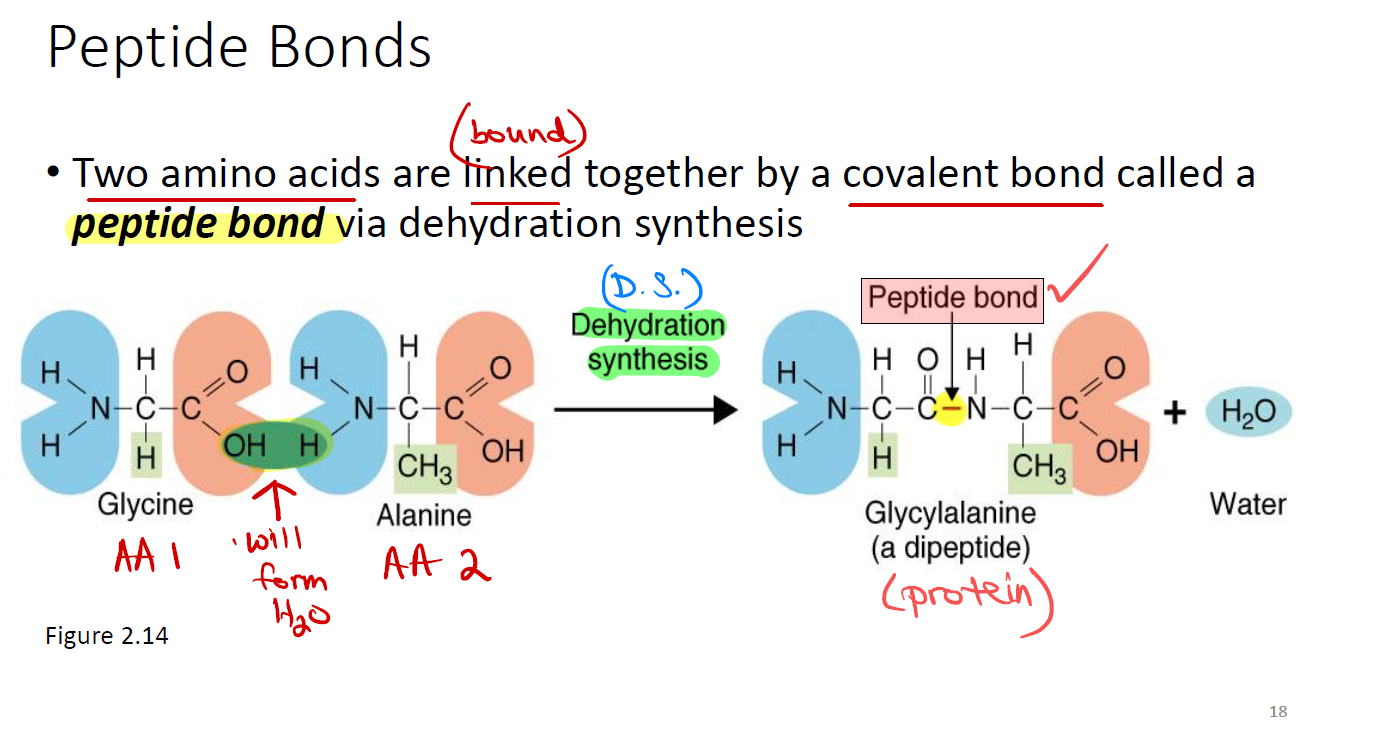
What is the specific covalent bond that links two amino acids together, how is it formed, and what is it analogous to in carbohydrates?
Peptide bond — formed via dehydration synthesis (H₂O released) — analogous to the glycosidic bond in carbohydrates.
Peptide bond = links amino acids → forms proteins.
Glycosidic bond = links monosaccharides → forms carbohydrates.
What is the big picture of protein structure?
Protein structure (shape) determines protein function.
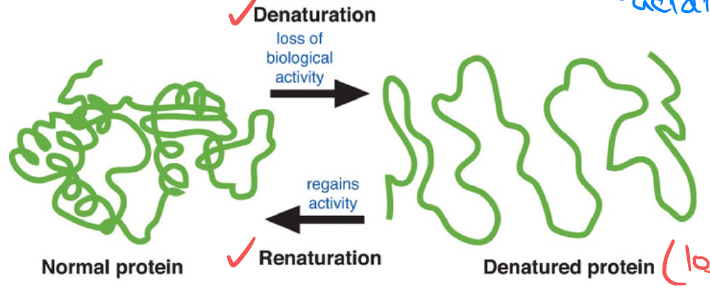
What is denaturation?
When a protein loses/changes its shape (structure) → it loses/changes its function.
What conditions cause denaturation?
Harsh/hostile environments such as high temperatures and low pH (acidic); may be permanent.
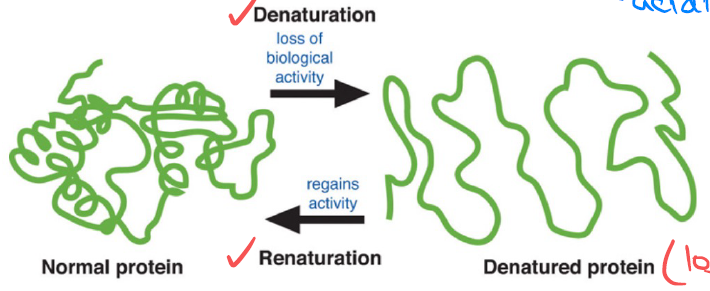
What is renaturation?
When a denatured protein regains its shape and activity.
What are the 4 levels of protein structure in order?
1° Primary → 2° Secondary → 3° Tertiary → 4° Quaternary
What is the general progression as you go from 1° to 4° protein structure?
The protein goes from simple shape → simple function to complex shape → complex function.
What is the primary (1°) structure of a protein?
A sequence of amino acids forming a polypeptide chain/strand — linear shape with no folds or bends.
Simple structure → simple function.
What bonds hold the primary structure together?
Peptide bonds (covalent bonds) between amino acids.
What is another name for the primary structure?
Polypeptide chain or strand. (linear shape chain/strand)
What is the secondary (2°) structure of a protein?
When the primary (linear) amino acid chain folds and coils into a helix or pleated sheet — due to hydrogen bonds (weak bonds).

What type of bond causes the secondary structure to fold and coil?
Hydrogen bonds (weak bonds).
What are the two shapes of secondary protein structure?
Helix (lots of coils) and pleated sheet (lots of folds — several strands connected via H bonds).
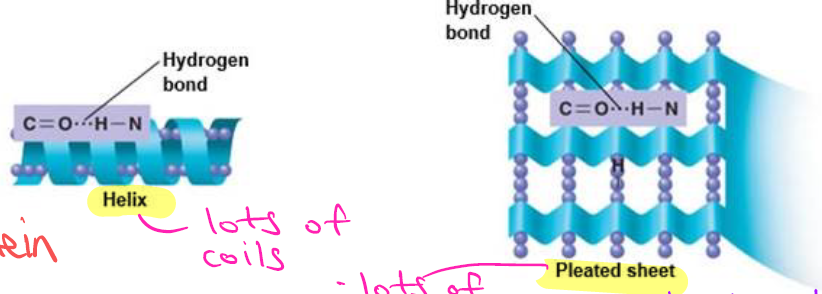
Give an example of each secondary structure shape.
Helix → hair protein.
Pleated sheet → skin protein.
What is the tertiary (3°) structure of a protein?
When the helix or pleated sheet folds irregularly into a 3D shape, forming disulfide bridges, hydrogen bonds, and ionic bonds between amino acids in the chain.

What is an example of a complex lipid besides phospholipids and glycolipids?
Waxes
What are the 3 types of bonds that form in tertiary structure?
Disulfide bridges, hydrogen bonds, and ionic bonds.
What is a disulfide bridge and where does it form?
A fold that forms between 2 sulfur-containing amino acids that are far apart (NOT between neighboring AAs).
What shape does the tertiary structure acquire?
A 3D shape.
What is the quaternary (4°) structure of a protein?
Two or more polypeptide chains (proteins/subunits) bound to each other — bulky and complex shape → complex functions.
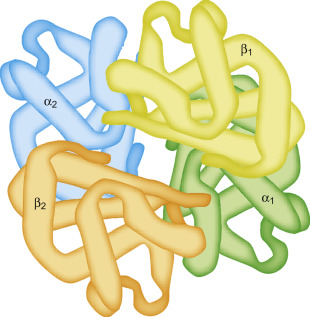
What are 3 examples of quaternary structure proteins and what do they have in common?
Hemoglobin, antibodies, and enzymes — all have complex functions.
What are the building blocks of lipids?
Triglycerides.
What are the 3 classes of lipids?
Simple Lipids
Complex Lipids
Steroids & Sterols
What are simple lipids also known as?
Fats or triglycerides.