1) Microvascular Fluid Dynamics
 Call Kai
 Learn
Learn Practice Test
 Spaced Repetition
 Match
Match Flashcards
 Knowt Play
1/31

There's no tags or description
Looks like no tags are added yet.
Name | Mastery | Learn | Test | Matching | Spaced | Call with Kai | Chat |
|---|
No analytics yet
Send a link to your students to track their progress
32 Terms
How do solutes and gases cross capillary walls?
Simple diffusion
What are the 2 main routes across capillary endothelium?
Through endothelial cells (transcellular)
Between cells (paracellular)
What determines whether a substance uses transcellular vs paracellular route?
Lipid solubility
How do O₂ and CO₂ cross capillary walls? What mainly determines the transport of O₂ and CO₂ across capillaries?
Method: lipid-soluble diffusion
determined by Pressure gradient & SA
How do water, ions, glucose, and amino acids cross capillaries?
paracellular pathways (b/c they’re not lipid-soluble)
Can proteins cross continuous (non-fenestrated) capillaries?
No b/c they’re too large, they can only cross via fenestrated & discontinuous (sinusoidal) capillaries
What are the major determinants of fluid movement across capillaries?
Osmotic pressure
Hydrostatic pressure
When is osmotic pressure greatest?
when solute can’t cross the semi-permeable membrane
What does osmotic pressure depend on?
# of molecules on each side of the membrane (not size)
How does membrane permeability affect osmotic pressure?
↑ permeability → ↓ osmotic pressure
Why do proteins create high osmotic pressure in capillaries?
too large to cross continuous capillaries (tight junctions)
What is colloid (oncotic) osmotic pressure?
pressure created from proteins or sugars
What’s the difference between filtration vs absorption?
Filtration = pressure-driven fluid movement OUT of capillaries
Absorption = pressure-driven fluid movement INTO capillaries
What determines how much fluid moves for a given pressure difference?
Hydraulic conductance- water permeability of the capillary wall
What is Starling Equation?
FLOWnet(Jv) = Kf [(Pc– Pi) – (πc– πi)]
Kf = Hydraulic conductance (mL/min/mmHg) → permeability of the wall b/w inside and outside
Pc = capillary hydrostatic pressure (mmHg)
Pi = interstitial* hydrostatic pressure (mmHg)
πc = capillary oncotic pressure (mmHg)
πi = interstitial* oncotic pressure (mm Hg)
Units of Jv = mL/min
At the arterial end, what forces are at play? What is the dominant driver?
→ filtration
Capillary hydrostatic pressure (Pc) (dominant)
Capillary oncotic pressure (πc) (small %)
plasma proteins and ions that couldn’t diffuse out get concentrated in the vessel lumen
At the venous end, what forces are at play? What is the dominant driver?
→ Absorption
Capillary oncotic pressure (πc) (dominant)
Capillary hydrostatic pressure (Pc) (small %)
due to fluid loss from the capillary and lower venous vascular tone
What happens at the midpoint of a capillary?
Hydrostatic force = oncotic force
What drives O₂, CO₂, and nutrient exchange at the midpoint?
Diffusion down concentration gradients
What are the oncotic pressures (πc) & hydrostatic pressures (Pc) in the arterial, middle and venous end?
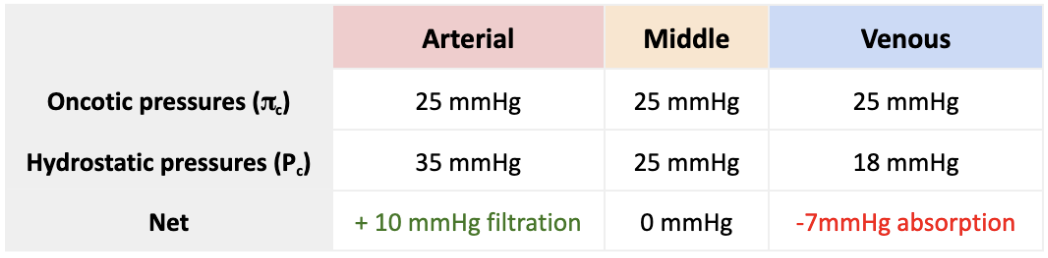
True or False: The amount of fluid leaving and the amount returning are equal, resulting in 0 net forces.
False - 4L/day of excess fluid left in all of your interstitial tissues combined (more is filtered than absorbed)
What happens to this remaining interstitiual fluid (4L/day)?
enters lymphatic system to be returned back to circulation
Is the excess fluid (4L/day) left per day detrimental? What occurs once this fluid has left the bloodstream?
→ No, it’s the normal amount that’s left behind to keep tissues hydrated
risk of exposure to contaminating microbes/antigens once it leaves the bloodstream
this is why the excess fluid is taken up by lymphatics first to be cleaned, before entering blood stream
What does interstitial volume depend on?
Filtration rate
Reabsorption
Lymphatic flow
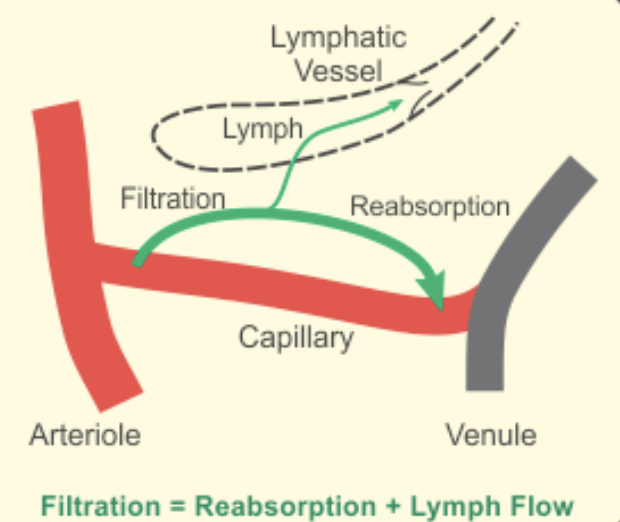
What maintains transcapillary fluid equilibrium?
Filtration = Reabsorption + Lymphatic flow
remember this is what interstitial volume depends on
What factors ↑ Pc (capillary hydrostatic pressure)?
Arteriolar dilation
↑ Arterial pressure
Venous constriction/obstruction
↑ Venous pressure
Right HF
ECF volume expansion
What factors ↓πc (capillary oncotic pressure)?
↓ [plasma protein]
Severe liver failure (can’t make proteins)
Protein malnutrition
Nephrotic syndrome (protein loss in urine)
What factors ↑ Kf (hydraulic conductance)?
Burn
Trauma
Inflammation (histamine/bradykinin/cytokine release)
What factors caused impaired lymphatic drainage?
Standing (no SM compressing on the lymphatics)
Removing/irradicating lymph nodes (e.g., due to breast cancer)
Parasitic infection of lymph nodes (e.g., filariasis)
List the factors that cause Edema.
↑ Pc
↓ πc
↑ Kf (Capillary permeability)
Lymphatic obstruction
What is the normal lymphatic flow in the body?
Thoracic duct: ~100 mL/hr (~2.4 L/day)
Other lymphatic vessels: ~25 mL/hr (~0.6 L/day)
Total: ~4–5 L/day → closely matches the ~4 L/day of excess fluid left in tissues after capillary filtration and reabsorption, preventing edema