2A1 Chapter 2 ASME Code Calculations: Stayed Surfaces, Pressure Relief Valves & Furnaces
 Call Kai
 Learn
Learn Practice Test
 Spaced Repetition
 Match
Match Flashcards
 Knowt Play
1/97

Earn XP
Description and Tags
2nd Class Power Engineering
Name | Mastery | Learn | Test | Matching | Spaced | Call with Kai | Chat |
|---|
No analytics yet
Send a link to your students to track their progress
98 Terms
What is the formula for calculating longitudinal stress in a cylindrical vessel?
Longitudinal Stress = (P * (R - 0.4t)) / (2Et)
What is the formula for calculating circumferential stress in a cylindrical vessel?
Circumferential Stress = (P * (R + 0.6t)) / (Et)
What is the relationship between longitudinal stress and circumferential stress in a cylindrical vessel?
The longitudinal stress is approximately half of the circumferential stress.
What is the minimum thickness of plates to which stays may be applied?
8 mm, except for welded construction covered by PW-19.
What does the C factor represent in the design pressure and thickness calculations for stayed plates?
The degree of restraint to rotation that the stay attachment provides.
What is the formula for calculating the design pressure for stayed plates?
P = (2tSC) / p
What is the formula for calculating the minimum thickness for stayed plates?
t = (pP) / SC
What does the variable 'p' represent in the stayed plate equations?
The maximum pitch measured between straight lines passing through the centers of the staybolts.
What is the significance of the variable 'S' in the stayed plate calculations?
S represents the maximum allowable stress, given in ASME code tables.
What is the purpose of stays in pressure vessels?
To carry part or all of the pressure loading and reduce the span and/or thickness of pressure components.
What is the effect of bending moments on the required thickness of stayed surfaces?
The required thickness may be less than that of surfaces which are not stayed due to the resistance from stays.
What does the term 'ligament efficiency' refer to in pressure vessel design?
The effectiveness of the openings in the pressure boundary of a pressure vessel.
What is the significance of the variable 't' in the stayed plate equations?
t represents the minimum thickness of the plate in mm.
What is the maximum allowable working pressure for a plate material with a maximum allowable stress of 108 MPa?
Calculated using the formula P = (2tSC) / p.
What is the purpose of the ASME Code in pressure vessel design?
To ensure safety and reliability in the design and construction of pressure vessels.
What is the significance of the factor C in the thickness calculation?
C = 2.2 is used for welded stays or stays screwed through plates over 11 mm thick.
What is the maximum allowable working pressure (MAWP)?
The internal design pressure that a vessel can safely withstand.
What are telltale holes and their purpose in stays?
Telltale holes are drilled to detect corrosion in stays, allowing for early leak detection.
What is the required diameter for telltale holes in stays?
At least 5 mm diameter to a depth of at least 13 mm beyond the inside of the plate.
What is the formula for calculating the stay load?
Stay load = P * (p - a), where P is the internal design pressure, p is the pitch area, and a is the cross-sectional area of the stay.
How is the minimum required area of stay calculated?
Minimum area of stay = (stay load / maximum allowable stress) * 1.10.
What is the significance of the factor 1.10 in the area calculation?
It provides a safety margin in the calculation of the minimum required area of stay.
What is the formula for determining the minimum diameter of the stay?
d = sqrt((4 * A) / π), where A is the minimum required area of stay.
What is the maximum pitch for firetubes used as stays?
The pitch shall not exceed 15 times the diameter of the tubes.
What is a ligament in the context of pressure vessels?
A ligament is the area of metal between the holes in a tubesheet.
What are the three types of ligaments in a boiler drum?
Longitudinal, circumferential, and diagonal.
What is the formula for calculating ligament efficiency when pitch is equal?
E = (p - d) / p, where p is the pitch and d is the diameter of openings.
What is the purpose of ligament rules in pressure vessel design?
To determine the minimum required thickness and/or maximum allowable working pressure for cylindrical components.
What does PG-47 state about staybolts?
It specifies requirements for staybolts, including drilling telltale holes for corrosion detection.
What is the significance of the maximum allowable stress values from Section II, Part D?
They are used to determine the safe limits for materials under pressure.
What is the design pressure in the context of ASME codes?
The pressure that a pressure vessel is designed to withstand safely.
What is the relationship between stay load and maximum allowable stress?
Stay load is divided by the maximum allowable stress to calculate the minimum area of stay.
What is the importance of the thickness of stays in boiler design?
It ensures structural integrity and safety under operational pressures.
What is the role of the tubesheet in a firetube boiler?
It serves as a flat plate supporting the firetubes and is critical for maintaining pressure integrity.
What is the significance of the equation for calculating the thickness of firetubes used as stays?
It ensures that firetubes meet safety and operational standards under pressure.
How is the load carried by a stay calculated?
It is the product of the area supported by the stay times the internal design pressure.
What does PG-49 reference for computing the load on a staybolt?
It points to PFT-26 for the calculation of staybolt loads.
What is the formula for calculating the area supported by a stay?
Area supported = pitch area - cross-sectional area of stay.
What is the significance of using welded stays in boiler design?
Welded stays do not require telltale holes, reducing potential leak paths.
What is the maximum temperature for SA-192 steel used in stays?
300° C.
What is the purpose of pressure relief valves in a boiler?
To automatically limit the internal boiler pressure to a point below the maximum allowable working pressure.
According to ASME Section I, how many pressure relief valves must a boiler have?
At least one; if it has more than 47 m² of bare tube heating surface, it must have two or more.
What does Paragraph PG-67.2.2 state regarding waste heat boilers?
The boiler manufacturer determines the minimum required relieving capacity of the pressure relief valves based on the heat produced by auxiliary firing or waste heat recovery.
What is the significance of the ASME Code Symbol for pressure relief valves?
It indicates that the manufacturer has met the rules and capacity tests required by Section I.
What is the formula for calculating the relieving capacity of pressure relief valves?
W = 0.75 × C × H, where W is the mass of steam generated, C is the mass or volume of fuel burned per hour, and H is the heat of combustion of fuel.
What does Paragraph PG-70 state about pressure relief valves?
The pressure relief valve manufacturer determines the maximum design capacity of the valve.
What does the term 'ligament efficiency' refer to?
The effectiveness of structural elements (ligaments) in withstanding pressure.
What does Section IV apply to?
Heating and hot water boilers.
What is the relationship between the number of pressure relief valves and the heating surface area?
If the heating surface area exceeds 47 m², more than one pressure relief valve is required.
What does the term 'maximum design capacity' refer to in the context of pressure relief valves?
The highest capacity that a pressure relief valve can safely handle.
What is the significance of the staggered pattern of openings in the cylindrical drum?
It affects the structural integrity and efficiency of the drum.
What is the effect of the diagonal ligament being weaker than the longitudinal ligament?
It reduces the overall efficiency of the structure.
What is the significance of heating value in boiler design?
The heating value of the fuel must be known to solve equations determining the mass of steam that can be generated in a boiler.
How can the minimum pressure relief valve relieving capacity be estimated?
It can be estimated based on the kilograms of steam generated per hour per square meter of boiler heating surface.
What are the three methods to check pressure relief valve capacity?
1. Accumulation test with all steam outlet valves shut. 2. Measuring maximum fuel burned to compute steam generation. 3. Measuring maximum feedwater supplied under maximum firing rates.
What factors determine the strength of a plain furnace?
The strength depends on the length, diameter, and square of the thickness.
What advantages do corrugated furnaces have over plain furnaces?
1. Stronger than a plain furnace of the same dimensions. 2. Better expansion allowance. 3. More surface area for better heat transfer.
What is the minimum thickness for a heating boiler furnace wall?
6 mm minimum as specified in Section IV, HG-312.1.
What is the minimum thickness for plain furnaces in firetube boilers?
8 mm as specified in Section I, PFT-15.1.
What is the historical significance of corrugated furnaces?
The rules for corrugated furnaces were developed in England in the late 1800s, improving construction methods over time.
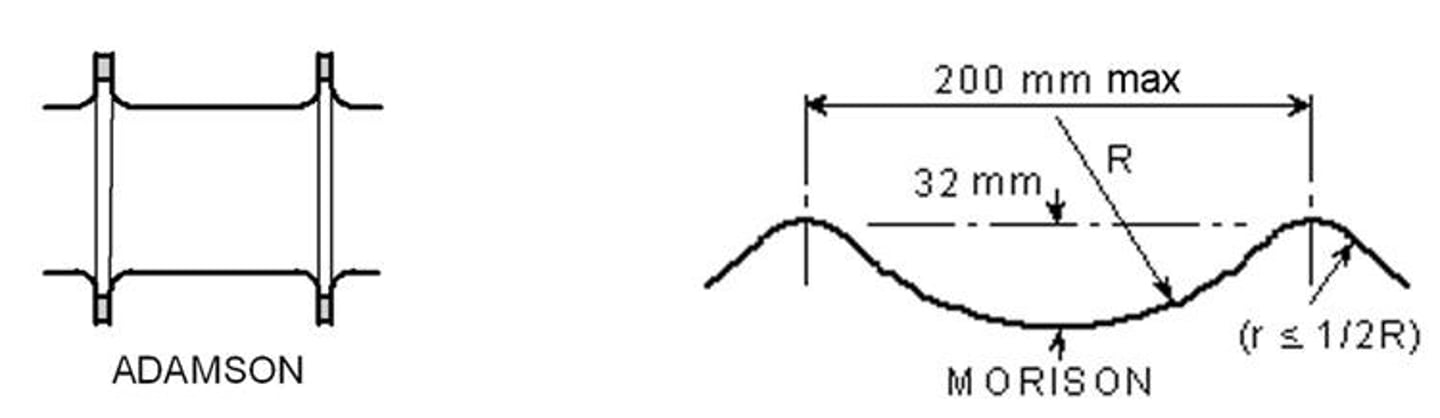
What is the difference in minimum thickness requirements between heating boilers and firetube boilers?
Heating boilers require a minimum thickness of 6 mm, while firetube boilers require 8 mm due to different pressure constructions.
What external conditions can affect furnace design?
Furnaces are subject to external pressure, which can cause compressive stresses leading to buckling and failure.
What is the purpose of ASME equations and procedures in furnace design?
They are developed for safe furnace design to prevent failure due to incorrect material or insufficient wall thickness.
What is the role of the factor 'A' in the furnace design equations?
Factor 'A' is determined from Section II, Part D and is used to enter the applicable material chart for design calculations.
What does 'Do' represent in furnace design calculations?
'Do' represents the outside diameter of the cylindrical furnace or tube in millimeters.
What does 'L' stand for in the context of furnace design?
'L' is the total length of the plain furnace, measured from center to center of weld attachments in millimeters.
What does 'E' represent in furnace design calculations?
'E' is the modulus of elasticity of the material at the design temperature.
What is 'P' in furnace calculations?
'P' is the external design pressure measured in megapascals (MPa).
What does 'S' denote in the context of furnace design?
'S' denotes the maximum allowable stress value at the design metal temperature in megapascals (MPa).
What is the procedure to calculate the thickness of a furnace?
1. Assume a value of 't' and determine ratios L/Do and Do/t. 2. Enter the chart at the value of L/Do. 3. Move horizontally to the line for Do/t and find Factor A. 4. Use Factor A to enter the applicable material chart for further calculations.
What is in the Section I, paragraph PFT-51?
It outlines the procedure to determine the maximum allowable working pressure of tubes, flues, and furnaces.
What is the purpose of charts developed in ASME procedures?
Charts are developed to simplify the use of equations for safe furnace design.
What limitations exist for using certain methods to check pressure relief valve capacity?
There are limitations on the boiler designs that can be used with these methods.
What is the significance of the design temperature specified in Section IV, HG-312.1?
It specifies the design temperature of the furnace in heating boilers as 2600 C.
What is the implication of a Do/t value less than 4 in furnace design?
If Do/t is less than 4, a specific formula must be used to calculate the value of A.
What is the maximum design metal temperature referred to in furnace design?
It refers to the maximum temperature at which the material can safely operate, affecting stress and thickness calculations.
What is the first step in calculating maximum allowable external pressure (Pa)?
Determine the intersection point based on the value of A and the material/temperature line.
How do you calculate the maximum allowable external pressure (Pa) using Factor B?
Use the formula: Pa = (B D) / (4/3 t).
What formula is used for calculating Pa when A falls to the left of the material/temperature line?
Pa = (AE D) / (2/3 t).
What should be done if the calculated Pa is smaller than the pressure P?
Select a larger value for t and repeat the design procedure.
What is the significance of Section IV, HG-312 and Section VIII-1, UG-28 in ASME codes?
They provide similar steps for calculating external pressures on cylindrical vessels.
What is the maximum allowable pressure for SA-285-C carbon steel at 260°C?
108 MPa.
What is the minimum allowed thickness for a furnace according to PG-15.1?
8.0 mm.
What is the value of C for Leeds furnaces in ASME codes?
C = 119.
What does the pitch of stays refer to in the context of flat plates?
The distance between welded staybolts that support the plate.
How do you determine the maximum allowable working pressure for a watertube boiler drum?
Using the thickness, radius, joint efficiency, and material properties.
What is the significance of the pitch of boiler tube holes in a drum?
It affects the structural integrity and pressure handling of the boiler.
What is the maximum amount of natural gas that can be burned if a boiler is converted from coal?
Depends on the re-rated safety valves and the maximum load conditions.
What is the external design pressure for a furnace using the Fox corrugation system?
1375 kPa.
What is the required thickness of a furnace tube with a maximum working temperature of 370°C?
Calculated based on the furnace's dimensions and material properties.
What is the relationship between the mean diameter and the thickness of a furnace?
The thickness must be sufficient to withstand the calculated pressures based on the diameter.
What is the formula for calculating the maximum allowable working pressure for corrugated furnaces?
P = Ct / D.
What is the significance of the suspension curve depth in furnace design?
It affects the structural integrity and pressure handling of the furnace.
What is the formula used to calculate the ratios L/Do and D/t?
L/Do = length of the furnace / outside diameter; D/t = outside diameter / thickness.
What is the importance of calculating the ratios in furnace design?
They help determine the appropriate wall thickness and pressure capacity.
What is the purpose of using charts in ASME code calculations?
To find values for A and B based on material and temperature conditions.
What is the minimum thickness for a Morison furnace according to ASME codes?
Not less than 11 mm.