Instruction Giving - How to answer questions
 Studied by 0 people
 Call with Kai
 Learn
Learn Practice Test
 Spaced Repetition
 Match
Match Flashcards
 Knowt Play
1/13

There's no tags or description
Looks like no tags are added yet.
Name | Mastery | Learn | Test | Matching | Spaced | Call with Kai |
|---|
No study sessions yet.
14 Terms
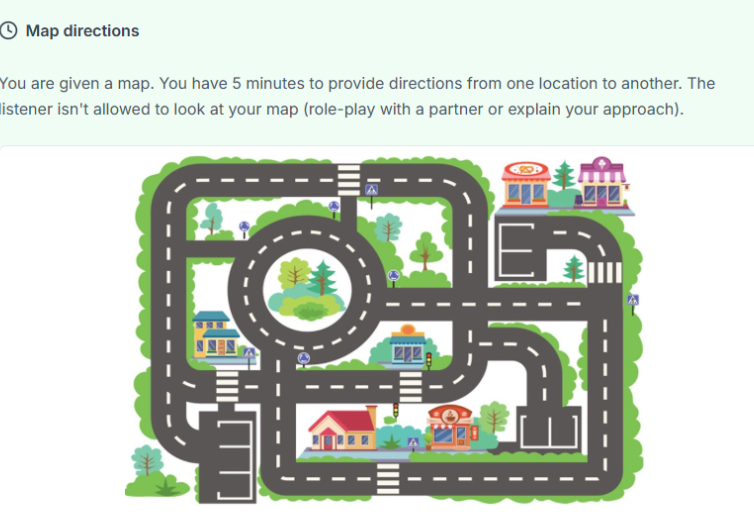
Introduction
Introduces self and confirms listener is ready
Confirms shared understanding of start and end points
Confirms listener cannot see map and understands format
Explains approach (e.g. step-by-step description with landmarks)
Encourages questions for clarification
Middle
Clearly describes starting point and initial orientation
States initial direction of travel
Encourages questions for clarification
Middle
Clearly describes starting point and initial orientation
States initial direction of travel
Uses landmarks and features throughout to aid navigation
Provides directional changes in logical sequence (e.g. turns, crossings)
Checks understanding throughout
Requests confirmation or repetition to ensure clarity
Maintains clear, patient communication style
End
Seeks feedback on clarity and confidence with directions
confidence with directions
Adjusts based on feedback if needed
Summarises route with key landmarks
Extra
Uses additional orientation aids (e.g. compass directions, distances, time estimates)
Incorporates descriptive details to enhance clarity
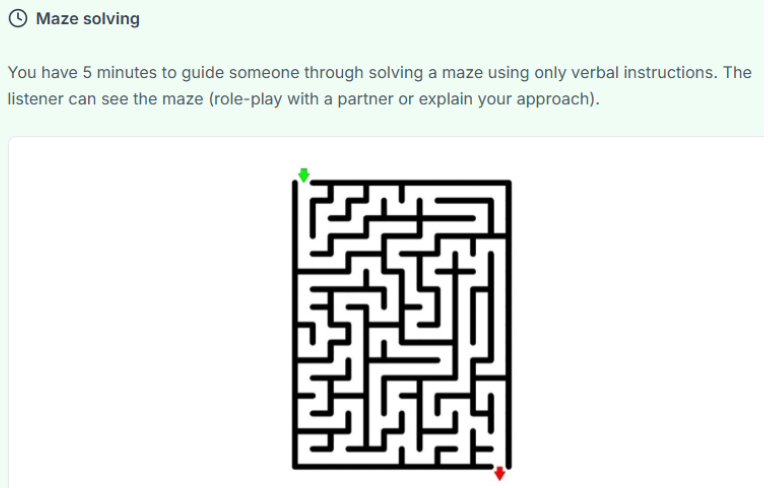
Introduces self and explains the task
Assesses listener's prior experience with similar tasks
Confirms listener can see materials and is ready
Middle
• Clearly identifies starting point
Provides clear directional instructions (e.g. left, right, forward, compass directions)
Describes choice points and states decisions clearly
Uses available landmarks or
Describes choice points and states decisions clearly
Uses available landmarks or features to aid navigation
Monitors progress and provides calm corrections
Encourages questions for clarification
End
Seeks feedback on instruction clarity
Summarises the solution path
Acknowledges completion and effort
Extra
Applies relevant problem-solving strategies
Provides encouragement throughout process
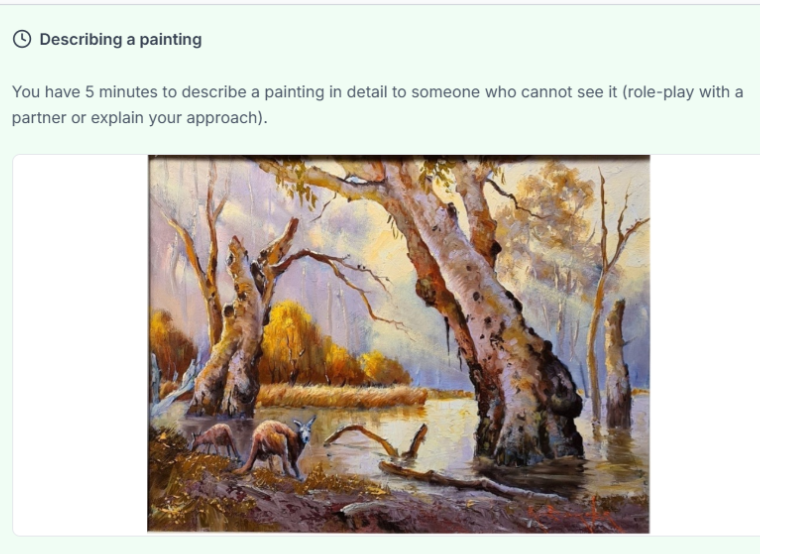
Introduces self and explains the task
Confirms listener cannot see the image
Reassures about thoroughness of description
• Checks readiness and asks if listener has specific interests or questions
Middle
Describes overall scene or Introduces self and explains the task
Confirms listener cannot see the image organsie this information
Reassures about thoroughness of description
Checks readiness and asks if listener has specific interests or questions
• Describes overall scene or subject matter
Describes format and layout (e.g. portrait, landscape, composition)
• Describes positions and arrangement of elements
Describes visual qualities (e.g. colours, tones, mood)
Engages listener periodically to check understanding and interest
End
Describes visual qualities (e.g. colours, tones, mood)
Engages listener periodically to check understanding and interest
End
Summarises key elements and overall impression
Encourages visualisation and invites further questions
Acknowledges listener's engagement
Extra
Shares personal interpretation or emotional response
Uses figurative language to enhance description
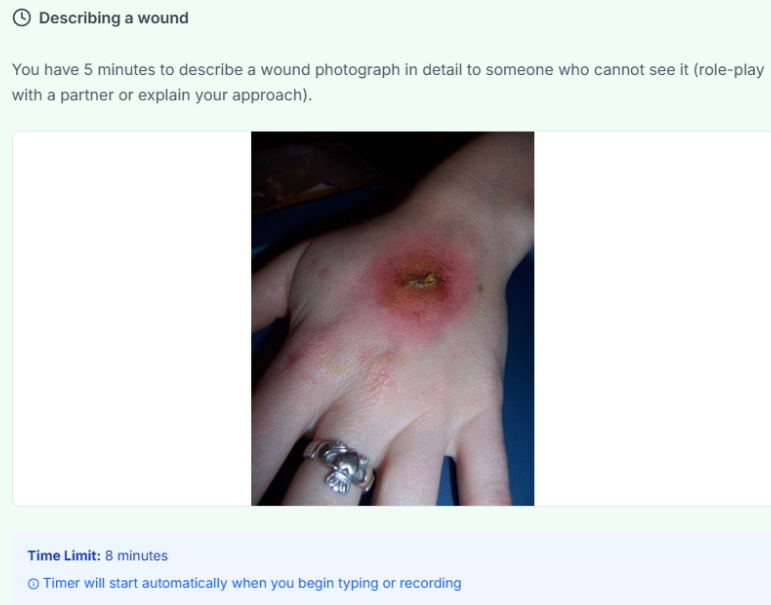
Introduction
Introduces self and explains the task
Confirms listener cannot see the image
Checks readiness and offers note-taking if helpful
Middle
Confirms listener cannot see the image
Checks readiness and offers note-taking if helpful
Middle
Provides contextual information if available
Describes anatomical location
Describes dimensions using relatable comparisons
Describes appearance (e.g. colours, textures, specific features)
Checks understanding periodically and invites clarifying questions
Encourages focus on specific areas if needed
End
Summarises key features
Confirms listener'sSummarises key features
Confirms listener's understanding (e.g. through visualisation or notes)
May request description to be repeated back
Acknowledges listener's engagement
Extra
Demonstrates sensitivity if listener shows discomfort
Uses analogies or comparisons to aid understanding
• Note: Auto-marking unavailable, but qualitative feedback generated successfully.
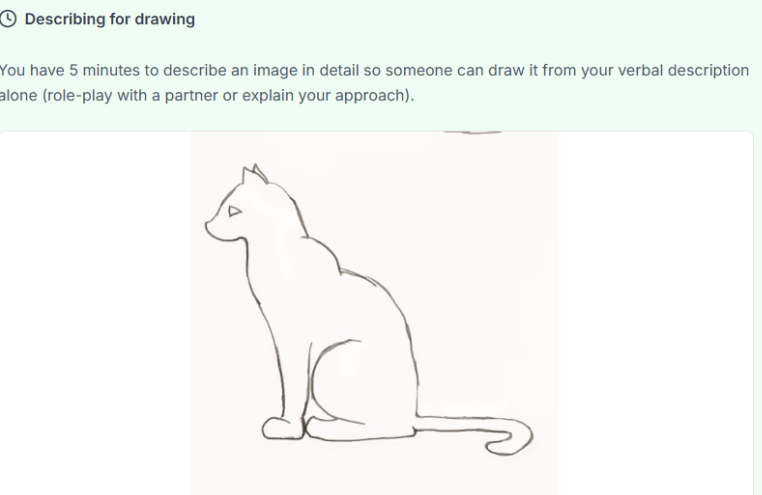
Introduction
Introduces self and explains the task
Confirms listener cannot see the image
Reassures about thoroughness of description
Checks readiness and specific interests
Confirms ability to see listener's drawing if applicable
Middle
States subject matter to establish goal
Uses systematic approach to description (e.g. left to right, top to bottom) ability to see listener if applicable
Middle
States subject matter to establish goal
Uses systematic approach to description (e.g. left to right, top to bottom)
Describes style and medium (e.g. sketch, colour, outline)
Provides detailed descriptions of elements sequentially
Encourages questions and clarifications throughout
End
Seeks feedback and adjusts description accordingly
Summarises key elements
Acknowledges effort and result
Extra
You have 5 minutes to explain how to make a slice of toast
Introduction
Introduces self and explains the task
Assesses listener's prior experience or knowledge
Clearly states the goal of the task
Identifies materials needed and their purpose
Highlights safety considerations (e.g. hot surfaces, burns)
Confirms readiness to begin
Middle
Provides clear, sequential instructions for each step
Explains operation of equipment where applicable
Explains operation of equipment where applicable
Explains waiting periods or automatic processes
Maintains safety awareness throughout
Checks understanding and corrects misunderstandings politely
End
Notes any cleaning or tidying required
Mentions optional additions or customisations
Acknowledges completion
Extra
Provides guidance on checking ingredient quality
Discusses storage or preparation tips
Addresses variations in technique