Neurodevelopmental and Conduct Disorders: DSM-5-TR Clusters, Symptoms, Causes, and Treatments
 Studied by 0 people
 Call with Kai
 Learn
Learn Practice Test
 Spaced Repetition
 Match
Match Flashcards
 Knowt Play
1/57

There's no tags or description
Looks like no tags are added yet.
Name | Mastery | Learn | Test | Matching | Spaced | Call with Kai |
|---|
No study sessions yet.
58 Terms
What are the three clusters of personality disorders in the DSM-5-TR?
The three clusters are: Cluster A (Odd or eccentric disorders), Cluster B (Dramatic, emotional, or erratic disorders), and Cluster C (Anxious or fearful disorders).
What distinguishes obsessive-compulsive personality disorder from obsessive-compulsive disorder (OCD)?
Obsessive-compulsive personality disorder is characterized by a preoccupation with orderliness, perfectionism, and control, while OCD involves unwanted repetitive thoughts (obsessions) and behaviors (compulsions).
What is the definition of intellectual development disorder?
Intellectual development disorder (ID) is a generalized neurodevelopmental disorder characterized by significantly impaired intellectual and adaptive functioning.
What are the three criteria for diagnosing intellectual development disorder?
1. Significant limitation in general mental abilities. 2. Significant limitations in adaptive behavior across multiple environments. 3. Evidence that limitations became apparent in childhood or adolescence.
What is the difference between syndromic and non-syndromic intellectual development disorders?
Syndromic intellectual development disorder is associated with other medical and behavioral signs, while non-syndromic intellectual development disorder occurs without other abnormalities.
What percentage of the general population is affected by intellectual development disorder?
About 2-3% of the general population.
What is the most common preventable environmental cause of intellectual development disorder?
Fetal alcohol syndrome.
What are common genetic causes of intellectual development disorder?
Down syndrome and Fragile X syndrome.
What is the goal of managing intellectual development disorder?
To prevent further worsening, minimize symptoms of disability, and improve the quality of everyday life.
What role does behavioral therapy play in treating intellectual development disorder?
Behavioral therapy encourages positive behaviors while discouraging undesirable behaviors.
How should healthcare practitioners approach patients with intellectual and developmental differences?
They should treat them similarly to other patients, acknowledging their needs and ensuring they understand their health issues.
What is a communication disorder?
A communication disorder affects an individual's ability to comprehend, detect, or apply language and speech effectively.
What are the characteristics of a language disorder?
Difficulties in learning and using language, caused by problems with vocabulary, grammar, and sentence structure.
What is a speech sound disorder?
A disorder involving problems with pronunciation and articulation of the native language.
What is childhood-onset fluency disorder?
Also known as stuttering, it involves interruptions in the standard fluency and rhythm of speech, often causing repetition of words and syllables.
What is social (pragmatic) communication disorder?
A disorder characterized by difficulties in the social uses of verbal and nonverbal communication, affecting social relationships and discourse comprehension.
What is an unspecified communication disorder?
A condition where individuals have symptoms of a communication disorder but do not meet all criteria, causing distress or impairment.
What are the main types of communication disorders?
Language disorder, speech sound disorder, childhood-onset fluency disorder (stuttering), and social (pragmatic) communication disorder.
What is a language disorder?
Difficulties in learning and using language.
What characterizes a speech sound disorder?
Issues with the pronunciation and articulation of their native language.
Which factor is NOT considered a contributor to the etiology of stuttering?
Socioeconomic status.
What are the three main areas affected by autism spectrum disorder?
Deficits in social interaction, communication, and repetitive patterns of behavior or interests.
What is the prevalence of autism spectrum disorder in children?
1 in 59 children in the United States.
How does autism spectrum disorder prevalence differ by gender?
It is 4 times more common in boys (1 in 38) than in girls (1 in 152).
What is attention deficit/hyperactivity disorder (ADHD)?
A constant pattern of inattention and/or hyperactive and impulsive behavior that interferes with normal functioning.
What are some diagnostic criteria for ADHD?
Difficulty with sustained attention, failure to follow instructions, disorganization, lack of attention to detail, becoming easily distracted, and forgetfulness.
What is the prevalence of ADHD in children?
About 5% of children, with boys being 3 times more likely to have it than girls.
What is a specific learning disorder?
A classification of disorders where a person has difficulty learning in a typical manner within one of several domains.
What is dyslexia?
The most common learning disability, affecting reading abilities.
What is dyscalculia?
A math-related disability involving difficulties with learning math concepts, memorizing facts, and organizing numbers.
What is dysgraphia?
A condition characterized by multiple writing-related deficiencies, such as grammatical errors and poor penmanship.
What are conduct disorders?
Mental disorders diagnosed in childhood or adolescence characterized by a pattern of behavior violating the rights of others or age-appropriate norms.
What are the four main symptom groups of conduct disorders?
Aggression to people and animals, destruction of property, deceitfulness or theft, and serious violations of rules.
What is oppositional defiant disorder (ODD)?
A pattern of angry/irritable mood, argumentative/defiant behavior, or vindictiveness in children and adolescents.
What are common symptoms of ODD?
Frequent loss of temper, touchiness, anger, arguing with authority figures, and blaming others for mistakes.
What are motor disorders?
Malfunctions of the nervous system causing involuntary or uncontrollable movements.
What is developmental coordination disorder (DCD)?
A chronic neurological disorder beginning in childhood that affects coordination.
What is Tourette's syndrome?
A neurodevelopmental disorder characterized by multiple motor tics and at least one vocal tic.
What is a persistent tic disorder?
A condition where an individual has one or more motor tics or vocal tics, occurring many times a day nearly every day for more than a year, starting before age 18, and not due to medication or other medical conditions.
What defines a provisional tic disorder?
A condition with one or more motor or vocal tics present for no longer than 12 months, starting before age 18, and not due to medication or other medical conditions.
What is enuresis?
The repeated voiding of urine into bed or clothing in children who are at least five years old, requiring significant frequency or distress.
What are the diagnostic criteria for encopresis?
Involuntary or voluntary passage of feces into inappropriate places in children at least four years old, with at least one event a month for three months.
What diagnosis might apply to a child who is angry, argumentative, and vindictive?
Oppositional Defiant Disorder (ODD)
What are the major psychological perspectives on neurodevelopmental disorders?
Biological, Sociocultural, Psychodynamic, Humanistic, Cognitive, and Behavioral perspectives.
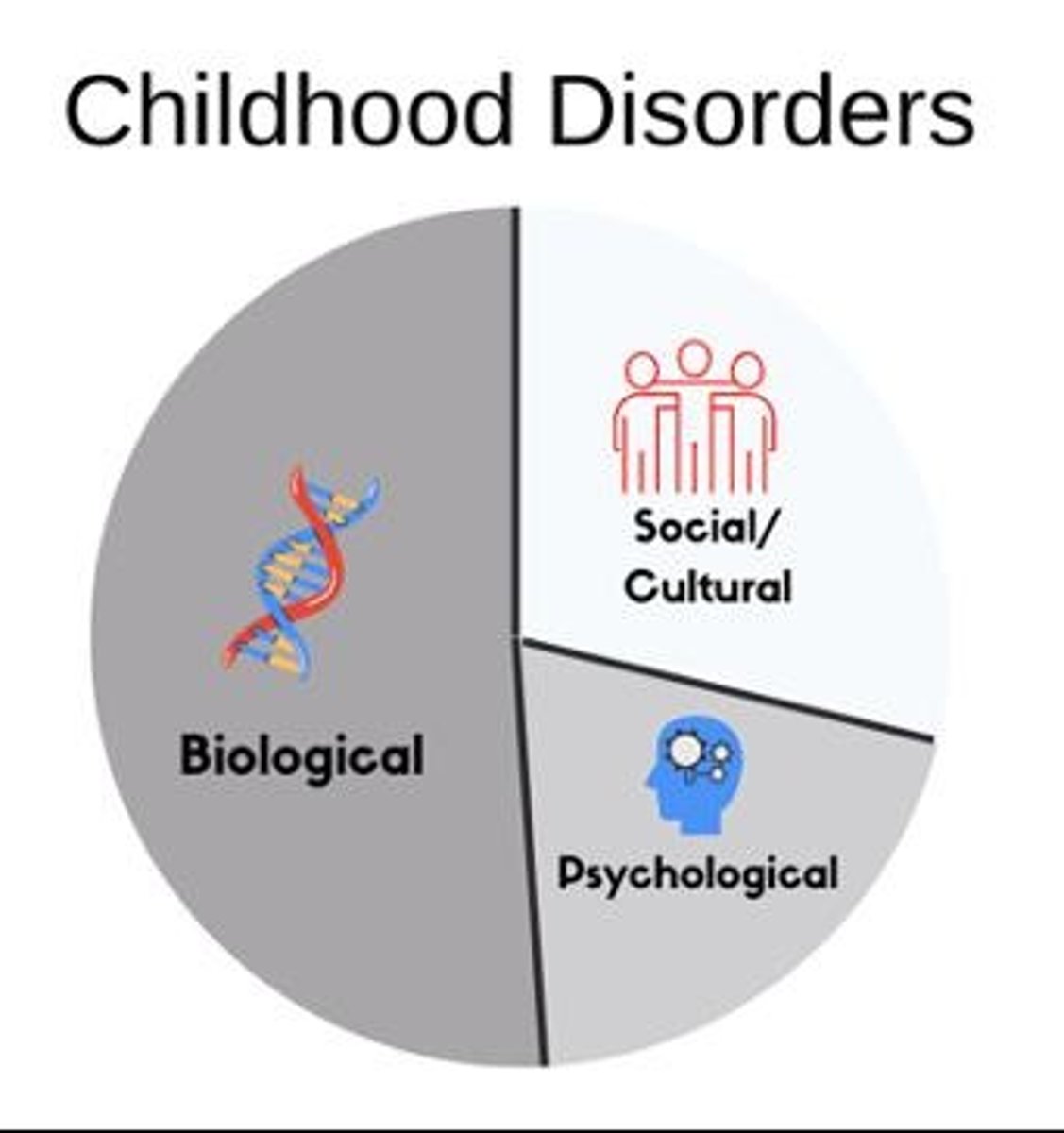
How does the biological perspective view neurodevelopmental disorders?
It associates disorders like Down's syndrome and Fragile X syndrome with genetic factors and mutations.
What is the focus of the cognitive perspective on childhood disorders?
It studies the relationship between thoughts, experiences, and actions.
What treatments are recommended for autism?
Early behavioral interventions or speech therapy to improve self-care, social, and communication skills.
What management strategies are typically used for ADHD?
A combination of counseling, lifestyle changes, and medications.
What role do speech and language therapists play in treating communication disorders?
They use various techniques to stimulate language learning.
What is the first step in managing motor disorders?
Psychoeducation.
What is the treatment approach for intellectual development disorders?
Active participation from caregivers, community members, and clinicians.
What was Connor's diagnosis and treatment history?
Connor was diagnosed with ADHD and was on multiple medications, including appetite stimulants.
What perspective does a therapist use if they believe a child acts out due to not wanting to live up to societal norms?
Psychodynamic perspective.
What is Applied Behavior Analysis (ABA)?
A technique that uses reinforcements or punishments to influence behavior.
What are some early signs of autism spectrum disorder?
Delayed speech, lack of eye contact, and difficulty with social interactions.
What are conduct disorders characterized by?
Patterns of behavior that violate societal norms and the rights of others.
What distinguishes oppositional defiant disorder (ODD) from conduct disorder?
ODD involves a pattern of angry, irritable mood and argumentative behavior, without the severe violations of rules seen in conduct disorder.
What is the significance of developmental age in diagnosing elimination disorders?
Children must be at least five years old for enuresis and four years old for encopresis.