HISP 225: Geography, Prehistory, Pre-Roman Iberia
 Call Kai
 Learn
Learn Practice Test
 Spaced Repetition
 Match
Match Flashcards
 Knowt Play
1/31

Earn XP
Description and Tags
Lecture 1 Flashcards
Name | Mastery | Learn | Test | Matching | Spaced | Call with Kai | Chat |
|---|
No analytics yet
Send a link to your students to track their progress
32 Terms
What do we know abt civilizations in iberia - earliest
hominids established 1.2 million years ago
Homo antecessor - hunter-gatherer survival
Catalian meseta excavations
unknown relationship to other hominids
What are the 3 main areas of the iberian penninsula?
Mediterranean Region
Central Plateau
Atlantic Region
What was the bronze age?
material wealth
copper
tin
iron
What were the regional advantages of the Iberian Penninsula?
Crossroad of cultures
Contact with cultures of Northern Atlantic World (CELTS/FRANKS)
Contact w the cultures of northern and easter mediterranean (Phoenicians, Romans)
Contact with cultures of the southern Mediterranean (carthage, berbers, etc)
What (site) is the earliest evidence of humans in western europe? What did they find?
Atapuerca
Fragments of jawbone and teeth, dating back 1.1-1.2 milllion years
Oldest tools
What is the most important archeological site within atapuerca?
Put of Bones
1,600 human fossils
300,000-600,000 years old
Earliest known evidence of DNA
What is the Cave of Altamira?
1879, Marcelino Sanz de Sautuola amateaur archeologists
Apogee of paleolithic cave art
Window of prehistoric world
35,000 to 11,000 BC
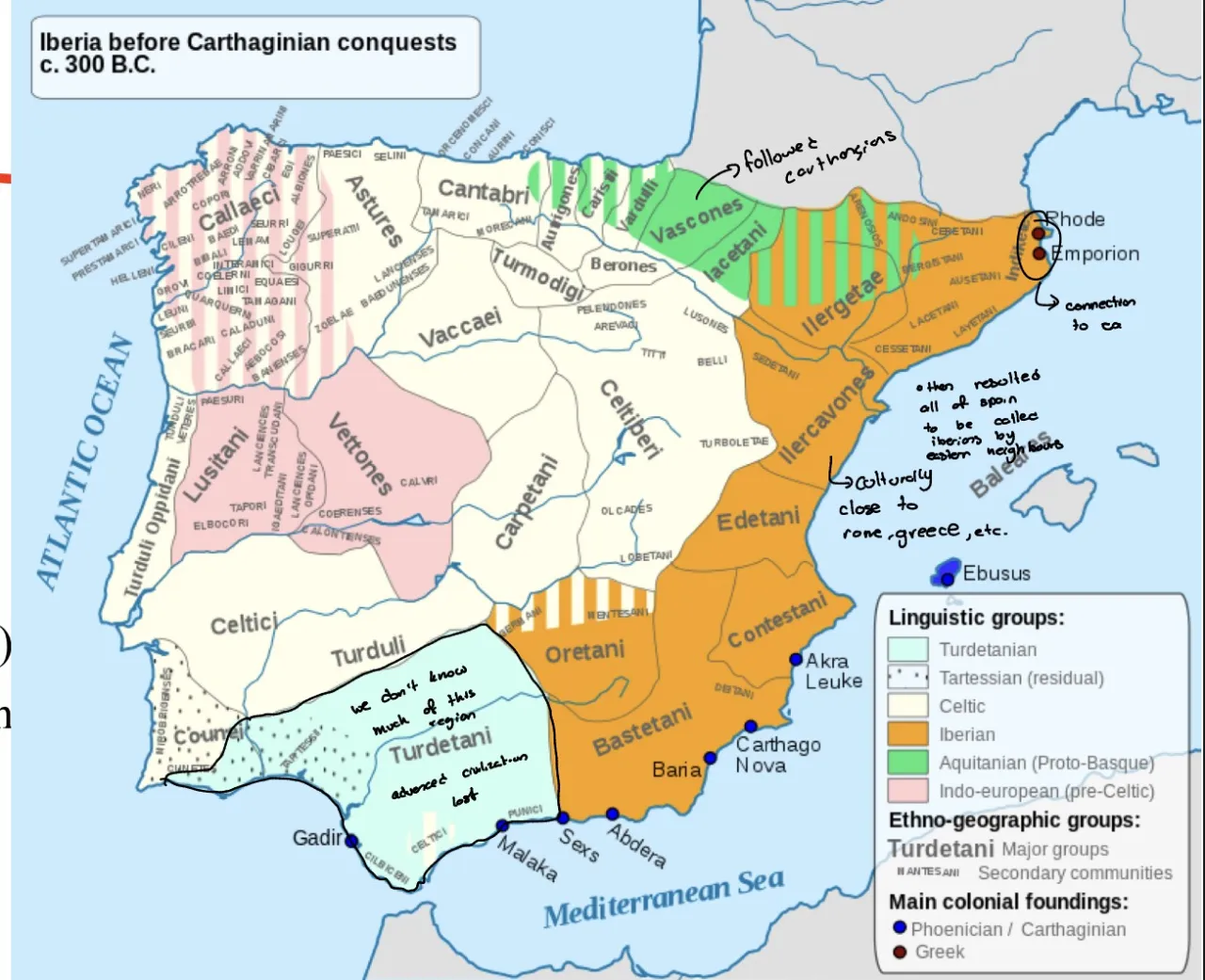
What were the regions of the iberian peninsula before Carthaginian and roman Conquests
Iberos (east)
Celtic (Centre and northwest)
Turdetanian and Tartessian (south-west)
Aquitanian (North, basquian)
Greek (North mediterranean)
Phonecian settlements (Southern mediterranean and baleric islands)
Talaiotic culture in Menorca (Balerc islands)
Who were the iberos? What was their connection to mediterranean?
Origin: North Africa.
Iberian culture developed from 6th century BC
Strong influence of eastern meditteranean (greek/phonecian)
Notable features
Complex urban settlements
Diversified society, but not clearly centralized politically
Sophisticate art in stone and bronze
Iberian language
Developed 3 diff writing systems →undeciphered
Strong military and horses
Plain region → could travel easily
Who were the phonecians?
arrived on iberian soil around 1100 bc @ gadir
cadiz - rich deposits of metal ores
Two pheonician settlements
cadiz
villarices
When and Where did Celtic Iberia arrive to Iberian Peninsula?
6th to 5th century BC
Northwest and centre
Celtic Iberia and the Atlantic connection?
Connected to Northern European Culture and Myths
Strongly opposed to carthage and rome
What kind of language was celtiberian?
indoeuropean language
Greeks (not prioritized but learn)
imported goods from 630 BC onwards
575 BC - founded rading centre at emporian
Rhode and ampurias became important distibution points for greek ceramics and italian mealwork → helped by phoenecians
more colonies unknown
Taratessos (not prioritized but learn)
commericial exchange w phoenicians and indigenous iberians
dame of elche and dama de boza
What were the 3 principal cultural groups in Iberia?
Western pyrenees - stronghold of basques
Celtic tribes
iron using
dominated N and W iberia
Castros - round houses
Celeberian
aragon - upper erbo valley and plains of estern mesta
celtic and iberian traditions
Who were the pastoralists? What did they to to Iberian Alphabet?
Controlled the territory around the grazing areas through hill forts named castros.
What did the pastoralists do to Iberian alphabet?
→ Adapted it to celtic language
Who were the basques?
Inhabited upper course of Ebro river and southern basin of western pyrennes
What are the 3 theories explaining the origin of the Basques
Native Theory
Basque-Iberism
Caucasian origin
Explain Native Theory
Proposes that the basques are descendants of mesolithic hunter-gatherers
DNA evidence is inconvlusive
Studies link them to neolithic farmers, while others find no distinction from the broader iberian population
Explain Basque-Iberianism
Suggests a direct connection bet. basque language and extinct iberian language
First proposed by Strabo in the 1st century
Lack of pre-roman written records makes it difficult to prove
Longest theory
Caucasian Origin
Highlights similarities between basque and caucasian languages (gregorian)
DNA comparisons bet. Basque and Georgian populations reveal significant differences, but no definitive connections to other languages can be proven
What was tyre?What happened
Last phoencian city-states of eastern mediterranean
various abandoned trading centres
once abandoned, taken over by carthage - needed to expand after 1st punic war
Who are the Carthage?
Founded as a phoenician colony in northern africa
814 BC
Grew into powerful mediterranean empire between 6th and 4th centuries BC
Took over south of iberia
What was the Carthage’s conflict with Rome?
Struggle for control of mediterranean
Sparked Punic Wars
What was the strategic importance of the Carthage in the Iberian Peninsula
Crucial region and source of silver
Conquered by Carthaginian general Hamilcar Barca
Resistance persisted from celtic tribes in centre and east
Used as a base during Second Punic War, involving Hannibal’s (son) crossing of ALPS with elephants
Lost control of peninsula after 2nd punic war
Final fall in 3rd Punic war
What are the key points of the carthage in the iberian peninsula?
Carthaginian conquest placed iberian peninsula @ heart of conflict bet. two superpowers of ancient world
Period contributed to unification of territory
Led to decline of pre-existing civilizations (Iberos)
Carthage’s defeat curtailed Phoenician and eastern mediterranean influence in the peninsula
Why did carthage expand to Iberian Peninsula?
Carthage lost italian territory to Roman Empire
Economics crisis
Lost trade empire
Composed of merceneries → weak
held certain areas of southern iberia
Did iberia have the strongest merceneries?
Yes, rich in iron, horses, etc.
What jumpstarted the 2nd Punic War
Roman’s violating treaty
Expanded into Saguntum, Cathages' land
What is the sculpture of the Lady of Elche?
Famous sculpture of Iberian Peninsula
Display @ Louvre, before returned to spain