Breast and Regional Lymphatics Assessment
 Studied by 2 people
 Call Kai
 Learn
Learn Practice Test
 Spaced Repetition
 Match
Match Flashcards
 Knowt Play
1/4

There's no tags or description
Looks like no tags are added yet.
Name | Mastery | Learn | Test | Matching | Spaced |
|---|
No study sessions yet.
5 Terms
Inspection
Breasts are symmetrical with normal skin and nipple appearance. No retraction, dimpling, or discharge.
Maneuvers
Raise arms overhead
Push hands into hips and lean forward
Look for skin dimpling, nipple retraction, out asymmetrical movement
Palpation
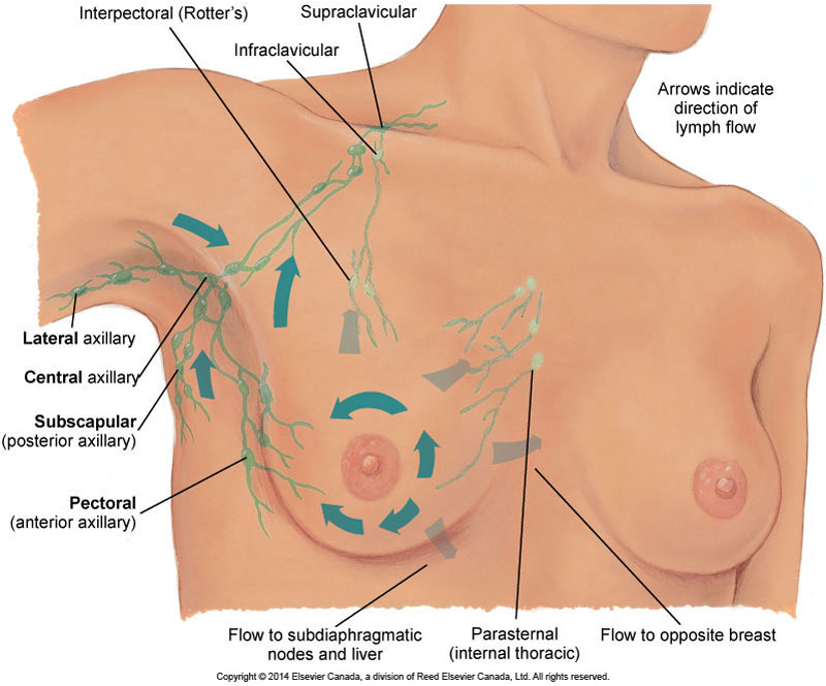
Axillae (armpit): lateral, central, posterior, and anterior, nodes - axillary and regional lymph nodes not palpable.
Breast Tissue: patient supine, hands over their head - is smooth and free of masses or lumps.
Nipple: gently compress the nipple tissue within the areola.
BSE - Why? Who? When?
Why: to detect any changes, lumps, or abnormalities that could indicate breast cancer or other breast conditions early.
Who: all women (and men at risk of breast cancer) should perform BSEs to become familiar with the look and feel of their breasts.
When: once a month, about 3-5 days after the menstrual cycle, when breasts are least tender or swollen.
BSE - Performance
Note General Appearance: asymmetry (common), stretch marks, nipple (flat, protrude, or inverted), discharge - important to determine if it is a new development.
Palpation Technique: vertical strips, spiral going outwards, outward from center in all directions (like a clock).
Return Demonstration: have patient demonstrate technique on model.