Chapter 2: Innate Immunity
 Call Kai
 Learn
Learn Practice Test
 Spaced Repetition
 Match
Match Flashcards
 Knowt Play
1/32

There's no tags or description
Looks like no tags are added yet.
Name | Mastery | Learn | Test | Matching | Spaced | Call with Kai | Chat |
|---|
No analytics yet
Send a link to your students to track their progress
33 Terms
Inflammation {Purpose}
Accumulations of leukocytes and proteins at infection site or tissue injury (non-infection)
Kills microbes and eliminates damage tissues
Antiviral Defense {Methods}
Target intracellular viruses via
NK cells: eliminate infected cells with reduced MHC I
Type I Interferons
Type I Interferons
Infected cell release interferons (alert) to neighboring cells so they can enter antiviral state
Innate Immunity {Sites}
Recognize PAMP that are shared by many microbes but not present in mammalian cells (self cells)
Present at
Epithelia: portals of entries that are reinforced with antimicrobial molecules & lymphoid cells (B, T, & NK cells)
Tissues
Blood: complement system
Mammalian Cells {Recognize}
Self cells that have pattern-recognition receptor (PRR) that recognize
Viral double-stranded ribonucleic acid (dsRNA)
Microbial unmethylated oligonucleotides that are uncommon in regular cell DNA
Pathogen-Associated Molecular Patterns (PAMPs) {Examples}
Structures that are essential for pathogen survival and effectiveness, but also get recognize by PRR such as lipopolysaccharide (LPS), and peptidoglycans
Around 1000 patterns
Damage-Associated Molecular Patterns (DAMPs)
Released by damaged mammalian cells or tissue such as infarction (tissue damaged from lacked of oxygen
Germline
PRR is encoded by inherited genetic DNA
Innate vs Adaptive Receptors
Innate receptors | Adaptive receptors | |
|---|---|---|
Main receptors | PRRs | B & T cells receptors |
Recognize | PAMPs / DAMPs | Specific antigens/epitopes |
Genetic origin | Germline-encoded | Somatic V(D)J rearrangement |
Diversity | Limited | Extremely diverse |
Specificity | Recognize common molecular patterns | Highly antigen-specific |
Memory | No classic antigen-specific memory | Yes |
Found on | Many innate immune cells | B and T lymphocytes |
Toll-Like Receptor (TLR)
A subset of PRR that is homologous to Drosophila Toll protein that protect flies against infections
NOD-Like Receptors Pyrin(NLRP-3) {Conditions, Release}
A cytosolic receptors (reside in the inside cytoplasm) that recognize PAMP & DAMP
Triggers cytokine interleukin-1β (IL-1β) when:
ATP released
Uric acid crystal derived from DNA/RNA
Change in intracellular potassium concentration
Endogenous substances deposited in cells (e.g. cholesterol)
Interleukin-1β (IL-1β)
Primary pro-inflammatory cytokine of innate system, and triggers fever (systemic effect)
activate caspase-1 that convert pre-IL-1β to the active version
Inflammasome
Multiprotein complex that activate inflammation response via production of interleukin-1 (IL-1)
NLRP-3: sensor
Adaptor protein: trigger
Caspase-1: inactive enzyme
RIG-Like Receptor (RLR)
Sense viral RNA and produce type 1-IFN
Cytosolic DNA Sensor (CDS)
Sense microbial/viral DNA (ds-DNA) and produce type 1-IFN
Autophagy
When cell detects that its own cellular components are damaged, send to the lysosome for degradation
Intraepithelial Lymphocytes (IELs) {Receptor}
Carry gamma-delta T-cell receptor (γδ-TCR) that recognize shared microbial components.
T cells (several kinds) reside within the epithelial layer
Specitivity and functionality are still unknown
Defensins & Cathelicidins
antimicrobial peptides released by endothelial cells that disrupt the microbes membranes
Opsonization
Process where foreign pathogens or dead cells are coated with opsonins to make them stand out for immune cells
Microbes are coated with C3b to be phagocytized via complement receptor type 1 on phagocytes
Classical Pathway {Trigger Condition}
Triggers when Igs bind to microbial Ags and the Fc region is opened
C1q binds Fc region to activate C1r & C1s
C1s cleaves both C4 & C2
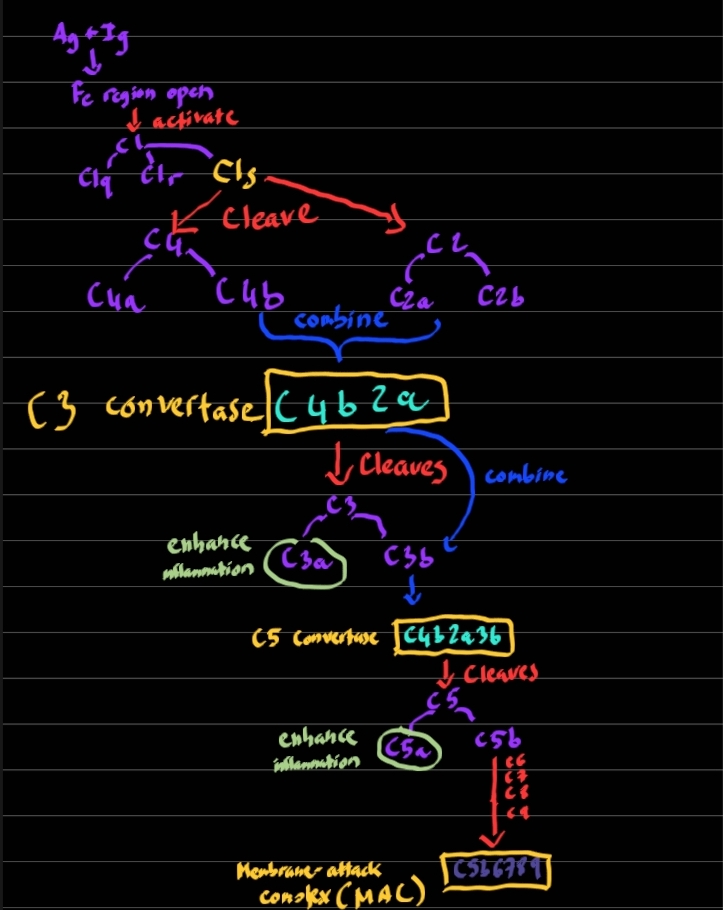
Lectin Pathway {Trigger Condition}
Initiates by mannose-bind lectin (MBL) attaches to mannose of microbes
MBL-associated serine proteases (MASP-1 & MASP-2) becomes activated
MASP-1 & MASP-2 performs similar job as C1s by cleaving C4 & C2

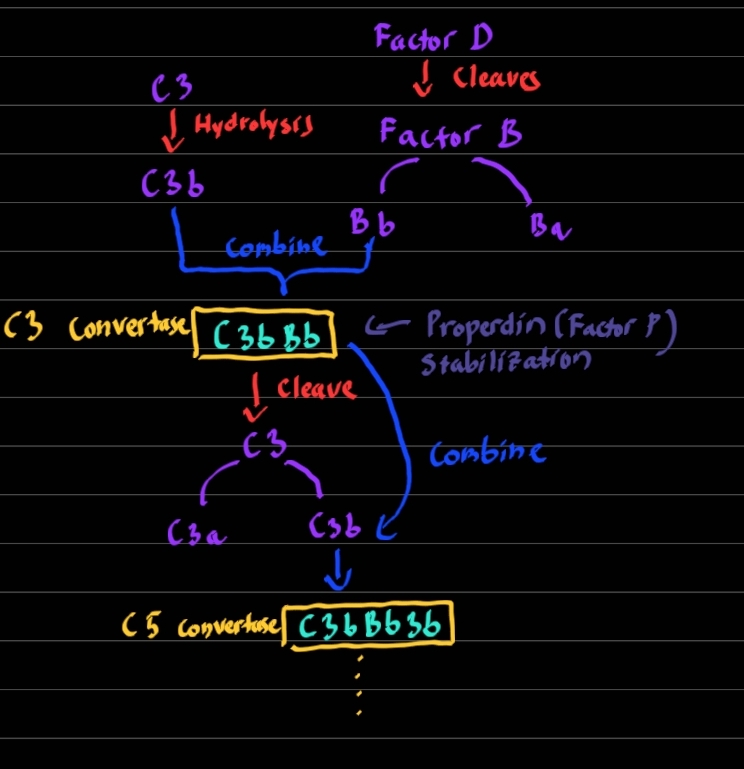
Alternate Pathway {Trigger Condition}
Triggers when C3b (hydrolyze from C3) opsonizes the microbe (binds to factor b)
Factor D then cleaves it into C3 convertase (C3bBb) and Ba
Properdin stabilizes the C3 convertase
Chemoattractants {Functions}
Chemokines
Smaller fragments 3a, 5a from complement system that induces inflammatory response
Proteolytic Enzymes {Functions}
Cleave proteins into active fragments, with 3 main functions
Inflammatory chemoattractants (e.g. C3a)
Opsonization & phagocytosis (e.g. C3b)
Cell lysis (e.g. MAC)
Membrane Attack Complex (MAC) {Mechanism}
Form from the final protein C9 polymerizes
Creates pore in the cell membrane, which ions/water enter that leads to cell lysis
Effective against microbes with thin cell walls
Complement System Function
Inflammation: C3a, and C5a induce inflammation by recruiting neutrophils. Act on endothelial cells to enhance migration of leukocytes & plasma proteins from blood → tissue
C3d acts as a molecular “tag” that enhances B-cell activation through complement receptor type-2 on the B cells
Acute-Phase Protein (APP) {Promote, Released Conditions}
Plasma proteins produced by liver in response to cytokines from Nф, Mф
Promote sepsis (uncontrolled response to infection that leads to organ dysfunction) & increase erythrocyte sedimentation rate
C-Reactive Protein (CRP) {Function}
An acute-phase protein that opsonizes microbes for Mф
Activate classical complement proteins
Acute Phase Response
Increase production of plasma proteins in response to system dissemination (spread) of inflammatory cytokines
Source of Cytokines in Innate Immunity
Mast cells, DC, Mф
Secrete due to stimuli recognition of microbial components (e.g. LPS, dsRNA)
Secrete in small amounts bind to high-affinity receptors
Triggers fever when act on hypothalamus
Swelling, pain around infection site
Recruiting Blood Neutrophils Cytokines
Chemokines
Tumor necrosis factor (TNF)
Interleukin-1
Tumor Necrosis Factor
Combine with IL-1 in hypothalamus triggers fever
Combine with IL-6, and IL-1 stimulates acute-phase proteins for microbial killing and walling off infection sites
Promotes thrombosis on endothelium
Reduce blood pressure
Septic Shock
Due to severe bacterial infections that leads to high TNF level
Cause low blood pressure and organ failure, disseminated intravascular coagulation (depletion of coagulation factors)