Finals EXAM
 Call Kai
 Learn
Learn Practice Test
 Spaced Repetition
 Match
Match Flashcards
 Knowt Play
1/55

Earn XP
Description and Tags
Module 5 6 7
Name | Mastery | Learn | Test | Matching | Spaced | Call with Kai | Chat |
|---|
No analytics yet
Send a link to your students to track their progress
56 Terms
Network Layer
This layer is responsible for sending out packets between endpoints over multiple links. It’s also the lowest layer in the OSI Reference Model that deals with end-to-end transmission. Finally, this layer provides services to the transport layer.
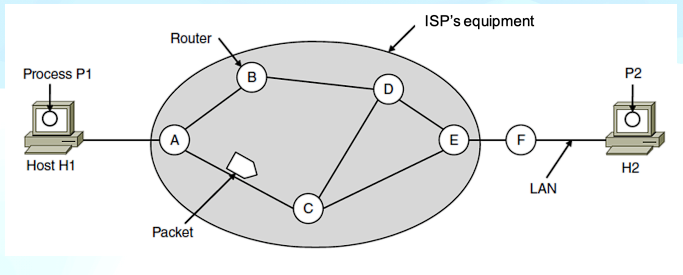
Store and forward packet switching
The host sends a packet into the network; packets are then forwarded between routers
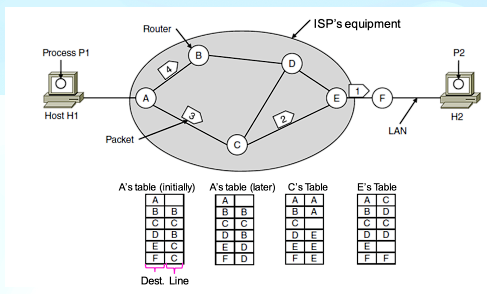
Connectionless service - datagrams
Packets are forwarded using a destination address inside, where different packets may take different paths
Connection-oriented virtual circuit
Packets are forwarded along a virtual circuit using a tag inside. A part of this is also already set up ahead of time
Forwarding
A routing algorithm process, where it processes arriving packets by looking up the appropriate outgoing link to use from the routing tables. In short, it is the sending of packets along a path the routing algorithm discovered.
Routing
The process in discovering network paths
Datagram
The term for packets, in analogy with telegrams and the network is called the ______ network.
Routing Algorithm
The algorithm that manages the tables and makes the routing decisions
Congestion Control
Congestion causes packet delay and loss that degrades performance.
Leaky bucket algorithm
No matter the rate of incoming packets, the outflow is always at a constant R or less
Token Bucket Algorithm
To send a packet, it must be able to retrieve tokens from the bucket. No more than a fixed amount of tokens can accumulate in the bucket.
MPLS (Multiprotocol Label Switching)
Used within ISP networks in the Internet, with IP packets wrapped in it’s header having a 20-bit connection identifier or label
Nonadaptive algorithm
This type of algorithm do not base their routing decisions on any measurements or estimates of the current topology and traffic.
Static Routing
Nonadaptive algorithms do not base their routing decisions on any measurements or estimates of the current topology and traffic. Instead, this procedure gives the choice of the route to use to get from I to J (for all I and J) is computed in advance, offline, and downloaded to the routers when the network is booted.
Adaptive algorithm
This type of algorithm change their routing decisions to reflect changes in the topology, and sometimes changes in the traffic as well.
DAG (Directed Acyclic Graph)
A permission where all of the possible paths can be chosen, the tree becomes a more general structure
NAT (Network address translation)
long-term solution is for the whole Internet to migrate to IPv6
ICMP (Internet Control Message Protocol)
connectionless network layer protocol used by devices like routers to diagnose communication issues. The operation of the Internet is monitored closely by the routers. When something unexpected occurs during packet processing at a router, it is reported via this.
ARP (Address Resolution Protocol)
Let’s nodes find target; maps dynamic IP addresses to fixed physical MAC addresses on a local area network (LAN).
DHCP (Dynamic Host Configuration Protocol)
A network protocol that automatically assigns IP addresses and configuration settings—such as subnet masks, default gateways, and DNS servers—to devices connecting to a network.
Flooding
When a routing algorithm is implemented, each router must make decisions based on local knowledge, not the complete picture of the network. This technique ensures that every incoming packet is sent out on every outgoing line except the one it arrived on.
Distance Vector Routing
This algorithm operates by having each router maintain a table (i.e., a vector) giving the best-known distance to each destination and which link to use to get there. It’s also referred to as Bellman-Ford
OSPF (Open Shortest Path first)
This is used to calculate the most efficient path for data packets within a single network or Autonomous System (AS).
BGP (Border Gateway Protocol)
Computes routes across interconnected, autonomous networks and to exchange routing and reachability information among different networks (Autonomous Systems)
Convergence
The settling of routes to best paths across the network
count to infinity problem
Gradually, all routers work their way up to infinity, but the number of exchanges required depends on the numerical value used for infinity. For this reason, it is wise to set infinity to the longest path plus 1.
Broadcasting
Sending a packet to all destinations simultaneously
Multidestination Routing
Where each packet contains either a list of destinations or a bit map indicating the desired destinations.
Transport Layer
Builds on the network layer to provide data transport from a process on a source machine to a process on a destination machine with a desired level of reliability that is independent of the physical networks currently in use.
Transport Protocol Data Unit (TPDU)
to enable end-to-end communication, handle flow control, ensure reliable delivery, and manage data sequencing between networked devices
Transport entity
The software and/or hardware within the transport layer that does the work
Internet Domain Sockets (AF_INET)
implemented via IP addresses and port numbers
Unix Domain Sockets (AF_UNIX)
implemented via filenames (think “named pipe”)
Stream (SOCK_STREAM)
A type of socket, uses TCP protocol. Connection-oriented service
Datagram (SOCK_DGRAM)
A type of socket, uses UDP protocol. Connectionless service
Raw (SOCK_RAW)
A type of socket used for testing
DNS (Domain Name System)
resolves high-level human-readable names for computers to low- level IP addresses
Name Servers
contain data for portions of the name space called zones (circled).
TCP (Transmission Control Protocol)
Connection-oriented. It establishes a reliable connection using a "three-way handshake" before sending data. It assigns sequence numbers, verifies delivery, and resends any lost packets.
UDP (User Datagram Protocol)
Connectionless. It simply sends "datagrams" (data packets) directly to the destination without establishing a connection or verifying that the recipient is ready. It does not check for lost packets or retransmit them.
SMTP (Simple Mail Transfer Protocol)
standard TCP/IP protocol used to send, relay, and transfer outgoing emails across the internet.
DCCP (Datagram Congestion Control Protocol)
A version of user datagram protocol with congestion control
SCTP (Stream Control Transmission Protocol)
A reliable transport-layer protocol that combines the error-free, connection-oriented features of TCP with the message-oriented speed of UDP.
URL (Uniform Resource Locator)
The specific character string used to identify and locate a unique resource on the internet or a computer network.
TSAP (Transfer Service Access Point)
A specific conceptual address or endpoint in the OSI networking model used to identify a specific application or service running on a device
NSAP (Network Service Access Points)
A conceptual location where the network layer delivers its services to the transport layer
CDN (Content Delivery Networks)
They scale Web servers by having clients get content from a nearby node (cache)
Peer to Peer Networks
Is an alternative CDN architecture with no dedicated infrastructure (i.e., servers); Clients serve content to each other as peers