6- Orthodontic Treatment (Dr. Suri)
 Call Kai
 Learn
Learn Practice Test
 Spaced Repetition
 Match
Match Flashcards
 Knowt Play
1/54

There's no tags or description
Looks like no tags are added yet.
Name | Mastery | Learn | Test | Matching | Spaced | Call with Kai | Chat |
|---|
No analytics yet
Send a link to your students to track their progress
55 Terms
- Transverse Dimension (width)
- Sagittal Dimension (depth, AP)
- Vertical Dimension (height)
Evaluation and management of malocclusions is done in what three dimensions?
Transverse dimension
Which dimension is the evaluation of the parameters of width?
Sagittal dimension
Which dimension is the evaluation of the parameters of depth/ antero-posterior?
Vertical dimension
Which dimension is the evaluation of the parameters of height?
Transverse dimension
If a child is still very young and has work to be done in all 3 dimensions with the 4th dimension of time working against us, discrepancies in the ________ dimension should be corrected first?
Vertical dimension
If a child is still very young and has work to be done in all 3 dimensions with the 4th dimension of time working against us, discrepancies in the ________ dimension can be addressed last?
Decreases
As humans age, the visibility of the maxillary incisors __________
2mm
"Normally" at rest, the maxillary incisal edge should be about ___mm below the stomion
All choices
Which of the following is apart of the ultimate goals of orthodontic treatment?
A) Ideal occlusion
B) Ideal facial esthetics
C) Ideal stability of result
D) Maintaining teeth over basal bone
E) Maintaining the health of periodontal tissues
- Class I molar
- Class I canine relationship
- Ideal overjet and overbite
- Relief of crowding/spacing
- Reduction of protrustion/retrusion
What are the parameters of ideal occlusion for orthodontic treatment?
90°
In order to achieve the goal of maintaining the teeth over the basal bone, the IMPA (incisor mandibular plane angle) should be ___ degrees
- What is the timing of orthodontic treatment? (depends on a variety of parameters)
- What is the type of skeletal pattern?
- Is space available in the dental arch to correct malocclusion?
What are the three fundamental questions to ask at the beginning of treatment planning?
True
T/F: A patient does not have to be in perfect health to have orthodontic treatment, as long as the disease or pathology is under control. Any pathological problem must be addressed before treatment of orthodontic problem begins.
Permanent incisors and molars are erupting
Why is seven years old the suggested appropriate age to have a 1st orthodontic evaluation?
Preventative orthodontics
What type of early treatment can be done in the primary dentition?
Interceptive orthodontics
What type of early treatment can be done in the mixed dentition?
Corrective orthodontics
What type of late treatment can be done in the permanent dentition?
- Interdisciplinary treatment
- Corrective Orthodontics
What type of treatment can be done in the post-permanent dentition?
True
T/F: If a cross-bite is detected, it should be addressed no matter what age the patient is
B. Crossbite correction
Which orthodontic correction is generally easier to maintain after treatment?
A. Rotated teeth
B. Crossbite correction
C. Deep bite correction
D. Midline correction
Crossbites are maintained by occlusal interdigitation, whereas rotated teeth are pulled back by gingival fibers
Why are corrected rotated teeth more likely to relapse than corrected crossbites?
Maxillary expansion
What is the appropriate treatment for a cross-bite?
Transpalatal Arch Appliance
In a young patient who receives a maxillary expansion appliance, what also should be given to maintain the expansion as the child continues to grow?
Space already lost
If a child has stainless steel crowns, what can you safely assume?
Remove the opposite primary canine and give a bilateral space maintainer
What is the appropriate treatment for young patient that presents with premature loss of one of the primary canines?
To remove obstacles of normal growth of the face and jaws
What is the main goal of treatment planning in the Primary dentition?
- Cross-bites
- Skeletal problems
- Space maintenance
- Habits
- Occlusal equilibration
What are some conditions treated in the primary dentition?
Transverse
When canines erupt, they can contribute to some ________ direction development
- Crossbites
- Skeletal problems
- Space maintenance/ regaining
- Habits
- Arch length discrepancies- Serial Extractions
What are some conditions treated in the mixed dentition:
Once the permanent 1st molars erupt (~6 years old)
When can you consider a patient has mixed dentition?
Serial extraction
Define the following:
The orderly removal of selected primary and permanent teeth to facilitate or simplify orthodontic treatment
- C (primary canine)
- D (primary 1st molar)
- 4 (permanent 1st premolar)
What is the sequence of extractions for a serial extraction case?
- Class I
- No skeletal disproportions
- Normal overbite
- Large arch length discrepancy
What are the four indications for a serial extraction?
No
If a patient has a deep bite, should you still extract the teeth?
As the permanent laterals erupt
In a Serial Extraction case, when should the primary canines be extracted?
As the permanent centrals erupt
In a Serial Extraction case, when should the primary laterals be extracted?
6-12 months before their normal exfoliation
In a Serial Extraction case, when should the primary 1st molars be extracted?
Before eruption of the permanent canines
In a Serial Extraction case, when should the permanent 1st premolars be extracted?
To transfer the incisor crowding posteriorly to the premolar extraction site
What is the ultimate goal to performing serial extractions?
Extraction of the first premolars before eruption of the permanent canines
What step is the KEY to success in a Serial Extractions case?
Lingual Arch
What fixed appliance can be used to space maintain AND/OR regain space in the mandible?
C) Permanent
All possible malocclusions to correct may be taken up in _____ dentition
A) Primary
B) Mixed
C) Permanent
Greater
The greater the arch length discrepancy/ crowding, the _______ need for extractions
less than 4mm
If a patient presents with an Arch Length Discrepancy (ALD) of _____mm, they do not require extractions
5-9mm
If a patient presents with an Arch Length Discrepancy (ALD) of ___-___ mm, they may require extractions
Greater than 10mm
If a patient presents with an Arch Length Discrepancy (ALD) of _____mm, they will almost always require extractions
- Distalize the maxillary teeth
- Mesialize the mandibular teeth
What are the two treatment options for correcting this patients class II sequence on his right?
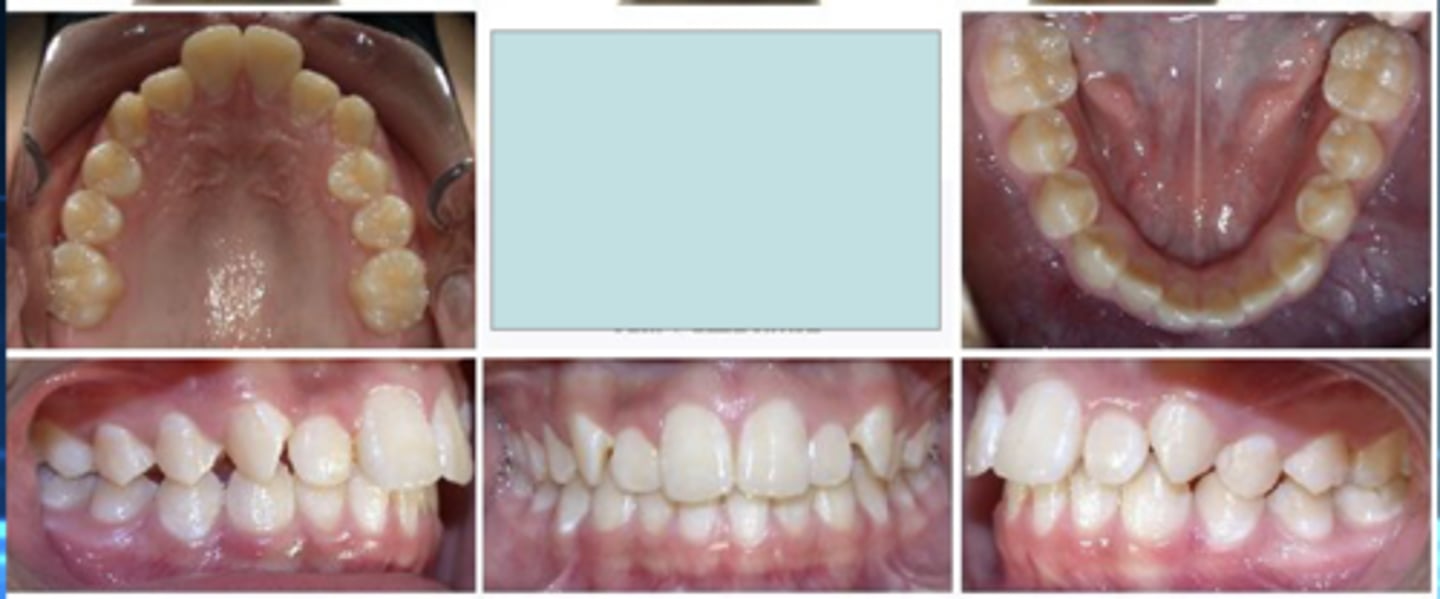
Surgery
If a patient has completed growth, what would you consider instead of expander applications?
Incomplete passive eruption
Define the following:
When the teeth are erupting appropriately, but the gingiva has not receded to the border near the CEJ, creating a "tiny tooth" appearance/ less clinical crown visible
1st premolar
What is the most common permanent tooth to extract to fix arch length discrepancies in the permanent dentition?
- Crowding may be resolved through expansion or interproximal reduction of teeth
- Expansion can be done- either skeletal or dental
What is the treatment for crowding in a patient with a space discrepancy of less than 4mm?
- Arch expansion via Skeletal/Dental expansion
- Possible extractions
What is the treatment for crowding in a patient with a space discrepancy of 5-9mm?
TRUE - do not want to expand teeth away from being centered over the basal bone
T/F: The danger of misdiagnosed expansion is that teeth can be driven out of the alveolar bone envelope
Extractions required to create space
What is the treatment for crowding for a patient with a space discrepancy of 10mm or more?
1st premolar
What is the most commonly extracted tooth because it provides the greatest flexibility in terms of space closure from both anterior and posterior segments (sits in the middle of 1/4 arch's dentition)?