Human and Rat Anatomy Flashcards
 Call Kai
 Learn
Learn Practice Test
 Spaced Repetition
 Match
Match Flashcards
 Knowt Play
1/25

Earn XP
Description and Tags
Vocabulary flashcards identifying key organs and anatomical structures in human models and rat dissections.
Name | Mastery | Learn | Test | Matching | Spaced | Call with Kai | Chat |
|---|
No analytics yet
Send a link to your students to track their progress
26 Terms
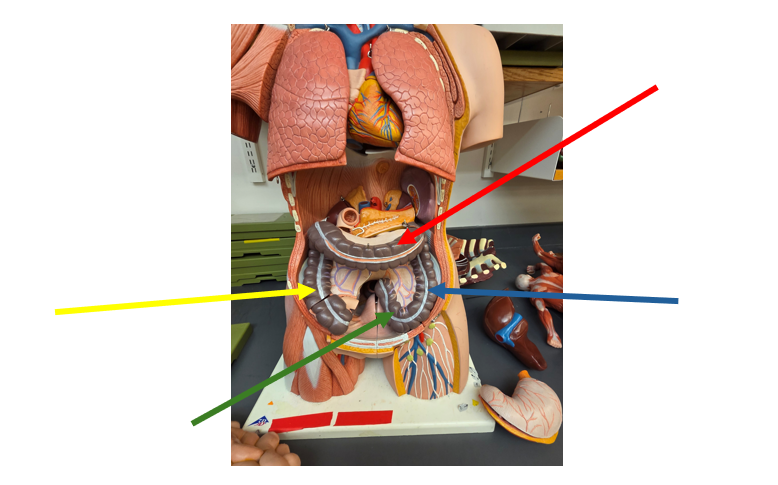
Transverse Colon (Human)
The middle section of the human large intestine, indicated in red on the anatomical model.

Ascending Colon (Human)
The section of the large intestine that ascends on the right side of the abdominal cavity, indicated in yellow on the anatomical model.

Descending Colon (Human)
The part of the large intestine that passes downward on the left side, indicated in blue on the anatomical model.

Sigmoid Colon (Human)
The S-shaped final portion of the colon, indicated in green on the anatomical model.

Stomach (Human)
The organ of digestion located below the diaphragm in the upper abdominal cavity, as shown on the human torso model via a red arrow.

Small Intestine (Human)
The long, highly folded digestive organ responsible for most chemical digestion and absorption, as depicted on the human torso model via a red arrow.

Kidneys (Human)
Paired bean-shaped organs that filter waste from the blood, indicated in yellow on the deep posterior wall of the torso model.
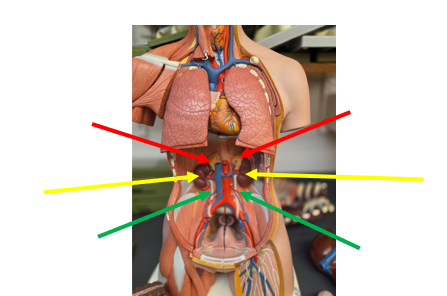
Adrenal Glands (Human)
Endocrine glands sitting atop each kidney, indicated in red on the human torso model.

Ureters (Human)
Ducts that convey urine from the kidneys to the urinary bladder, indicated in green on the torso model.
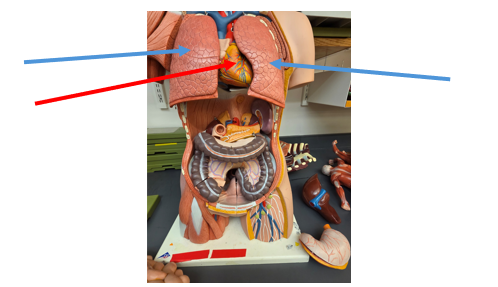
Lungs (Human)
Paired organs of gas exchange located in the thoracic cavity, indicated in blue on the anatomical model.

Heart (Human)
The muscular organ located between the lungs in the chest, indicated in red on the human torso model.
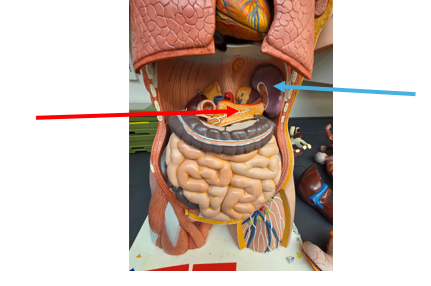
Spleen (Human)
A dark, vascular organ involved in immune function and blood filtering, indicated in blue on the torso model.

Pancreas (Human)
An elongated, yellowish organ located posterior to the stomach, indicated in red on the human anatomical model.

Liver (Human)
A large accessory digestive organ located in the upper right quadrant of the abdomen, indicated in yellow on the human model.

Lung (Rat)
A spongy organ in the thoracic cavity of a dissected rat, identified by an orange flag pin.

Heart (Rat)
The central circulatory organ located in the chest cavity of a dissected rat, identified by a red flag pin.
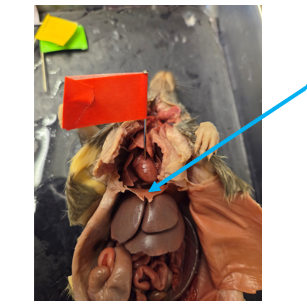
Diaphragm (Rat)
The muscular membrane separating the thoracic cavity from the abdominal cavity in a rat dissection, pointed to by a blue arrow.

Thymus (Rat)
A lymphoid organ located above the heart in the upper thoracic region of a dissected rat.

Liver (Rat)
A prominent, multi-lobed organ in the upper abdomen of a dissected rat, identified by a green flag pin.

Stomach (Rat)
A digestive sac located beneath the liver in a dissected rat, marked by a yellow flag pin.

Spleen (Rat)
An organ situated lateral to the stomach on the left side of a dissected rat, identified by a purple flag pin.
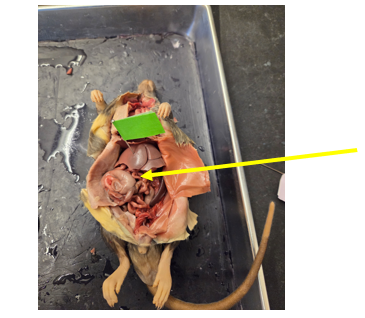
Small Intestine (Rat)
The intestinal section characterized by a smaller diameter, indicated by a yellow arrow in a dissected rat.

Cecum (Rat)
A large, pouch-like structure located at the junction of the small and large intestines in rats, into which the small intestine empties; pointed to by a red arrow.

Large Intestine (Rat)
The digestive segment that is larger in diameter than the small intestine, receiving contents from the cecum.

Kidneys (Rat)
Right and left kidney bean-shaped excretory organs located deep within the abdominal cavity of a rat, indicated by a yellow arrow.

Retroperitoneal Space
The anatomical space deep beneath the abdominal organs against the posterior wall where the rat's kidneys reside, requiring other organs to be moved aside for viewing.