Intro To BC - Exam 1
 Call Kai
 Learn
Learn Practice Test
 Spaced Repetition
 Match
Match Flashcards
 Knowt Play
1/110

There's no tags or description
Looks like no tags are added yet.
Name | Mastery | Learn | Test | Matching | Spaced | Call with Kai | Chat |
|---|
No analytics yet
Send a link to your students to track their progress
111 Terms
Metabolism
the sum total of all reactions of an organism
Macromolecules & H2O Affinity
Hydrophilic/Polar - proteins, carbohydrates, nucleic acids
Hydrophobic/Nonpolar - fatty acids (technically is not a polymer like the others)
Metabolic Pathways that yield complex molecules from simple precursors are:
anabolic (input of energy)
Dipole Moment
any molecule that has a net separation of charges (ex: CHCl3)
In a bacterial cell, DNA is in the
nucleoid
In eukaryotes, the nucleus is enclosed by a double membrane called
the nuclear envelope
In place of a nucleus a prokaryotic cell has a
nucleoid
Hydrogen Bond Donors
partially charged hydrogens (due to H being bonded to a highly electronegative atom - F, O, or N)
examples: NH3+, H2O, Alcohols, HF, Amines
Hydrogen Bond Acceptors
electronegative atom with lone pairs to attract the partially positive charge on the donor hydrogen (F, O, N, CL, S, P, or even a pi bond in alkenes or aromatic rings)
examples: water oxygen, ether oxygen, or carbonyl oxygen found in ketones, amides, and aldehydes
Weak Interactions in Order of Most to Least Energy needed to Disrupt
charge-charge (ionic), covalent, H bond, van der Waals
Types of van der Waals Interactions
charged-dipole: partially charged molecule (dipole) (polar molecules have dipoles) interacts with fully charged molecule (cation/anion)
dipole-dipole: 2 dipoles face opposite partial charges to each other
charge-induced dipole: molecule that was originally neutral becomes a dipole due to close proximity of an anion/cation
dipole-induced dipole: strong enough dipole can take a neutral molecule and create a dipole in it
dispersion forces: weak partial charge distribution interactions within two molecules in close proximity
Which of the following factors is responsible for the fact that water is liquid at room temperature
H-bonds holds water molecules close together
Hydronium Ion
H3O+
Hydroxide Ion
OH-
Which properties of water promote relatively constant climate of earth
high heat of fusion
high heat of vaporization
high heat capacity
Why does the hydrolysis of ATP to ADP have a middle road, negative delta G value
if the value was too negative, the overall metabolism of ATP would be too difficult

What molecules is this?
ATP
What can lead to the determination of delta G?
delta E of a rxn
ratio of products to reactants of a reaction
entropy & enthalpy of a rxn
delta G naught of a rxn
In biological systems, most energy generating redox rxns involve hydride ion transfer or hydrogen atom transfer using which of the following? (electron carriers)
NADH & FADH2
In order to determine the standard voltage of a rxn
the standard cell must be written as they occur in the rxn and the voltages are added
In a redox rxn, an electron acceptor is
converted to an electron donor with the gain of one or more electrons
oxidizing agent
gets reduced
Amino Acids with Hydrophobic Side Chains
aliphatic AAs: glycine, alanine, valine, leucine, proline, isoleucine
aromatic AAs: phenylalanine, tyrosine, tryptophan
Amino Acids with Hydrophilic Side Chains
Polar Uncharged: amide, glutamine, asparagine, threonine, cysteine, serine
Acidic: aspartic acid & glutamic acid
Basic: lysine, histidine, arginine
Local folding of a protein occurs at what defined level of protein folding
Secondary
Types of Bonds within an Amino Acid (omega Ω, psi Ψ, phi Φ)
Omega Ω: peptide bond (between carboxylic acid C & amine N) - no free rotation because they are partial double bonds - planar geometry
Psi Ψ: bond between alpha-carbon and carbonyl carbon
Phi Φ: bond between alpha-carbon and amide nitrogen

The following amino acid would stabilize the 3˚ protein folding through which interaction?
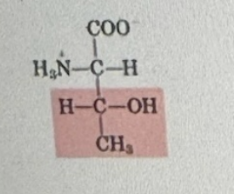
hydrogen bond
Salt bridges in proteins are an exmaple of what type of attraction?
ionic interactions
Examples of post translational modification of proteins
phosphorylation, acetylation, proteolytic cleavage, glyocsylation, hydroxylation, carboxylation
The three-dimensional structure of a protein is determined mainly by
the sequence of AAS in the protein
When looking at a double reciprocal graph of data from an uncompetitive enzyme compared to data from a competitive enzyme, which properties will show up differently on the graph
Km & Vmax
NOT concentrations or time
Km represents the..
formation of ES
4 Main Macromolecules (monomer, polymer, linkage, polarity)
Polar (polymer - monomer - linkage)
protein - amino acid - peptide bond
carbohydrate (polysaccharide) - monosaccharide - glycosidic (ether)
nucleic acid - nucleotide - phosphodiester
Nonpolar
Lipids are NOT polymeric because they do not link together, but rather group together (usually to hide from water)
fatty acids are the “monomers”
linked via ester bonds
Most Abundant Chemical Elements in Living Systems
CHON
Most biomolecules can be considered to be derivatives of
hydrocarbons
Amphipathic Molecules
have both a hydrophilic & hydrophobic portion
example: CH3CH2CH2COOH
The plasma membrane…
provides support
present in both eukaryotes and prokaryotes
control the flow of substances in and out of the cell
Prokaryotes are more efficient because they are:
polycistronic: single messenger RNA (mRNA) that contains coding instructions to make different proteins
Which of the following compounds is capable of hydrogen bonding with like molecules?
CH3NH2 & HOCH2CH2OH
both of these molecules have partially positive H!
Noncovalent Interactions
H bonds, ionic interactions, van der waals, hydrophobic interactions (aggregation of hydrophobic molecules in a polar solvent to hide from water)
noncovalent interactions do not include sharing electrons
Examples of Weak Acids
anything that is NOT a strong acid (HCl, HBr, HI, HNO3, HClO4, H2SO4, HClO3)
example: HCO3-
acids typically have an H in them to donate
In any redox reaction, an electron donor is
the reducing agent
gets oxidized
Strongest Reducing Agents a Standard Reduction Potential that is
more negative
reducing agent gets oxidized, meaning a lower reduction potential
higher reduction potential means it is more likely to get reduced
A constant source of ___ is required for maintenance of a cell’s ordered state
energy
Enzymes are biological catalysts that enhance the rate of reaction by
decreasing the activation energy
Cellular Components arranged in order of increasing size
amino acid < protein < ribosome < mitochondrion
What is not true about the nucleus
found in both eukaryotes and prokaryotes
Which of the following is present in only prokaryotes:
nucleus
endoplasmic reticulum
plasma membrane
nucleolus
none of the above
nucleus, ER, & nucleolus are in eukaryotes
prok have a nucleoid region
plasma membrane is in both prok & euk
the delta G naught of a rxn can
be used to calculate whether a rxn is thermodynamically favorable under defined non-standard conditions
The enzyme fumarase catalyzes the reversible hydration of fumaric acid to l-malate, but it will not catalyze the hydration of maleric acid, the cis isomer of fumeric acid. this is an example of
stereospecificity
the function of a lyase enzyme
to facilitate a rxn of one substrate to form two products without the use of water

What bond (pink) / macromolecule is this? (label parts of molecule)
phosphodiester bond

nucleic acid
ether ring = ribose
ring with letters = base

What is this macromolecule (broad term)? What bond is forming & what comes out of this bond?
carbohydrate
glycosidic bond (ether —> R-O-R)
h2o released (1 O, 2 H’s from the reacting OH groups)
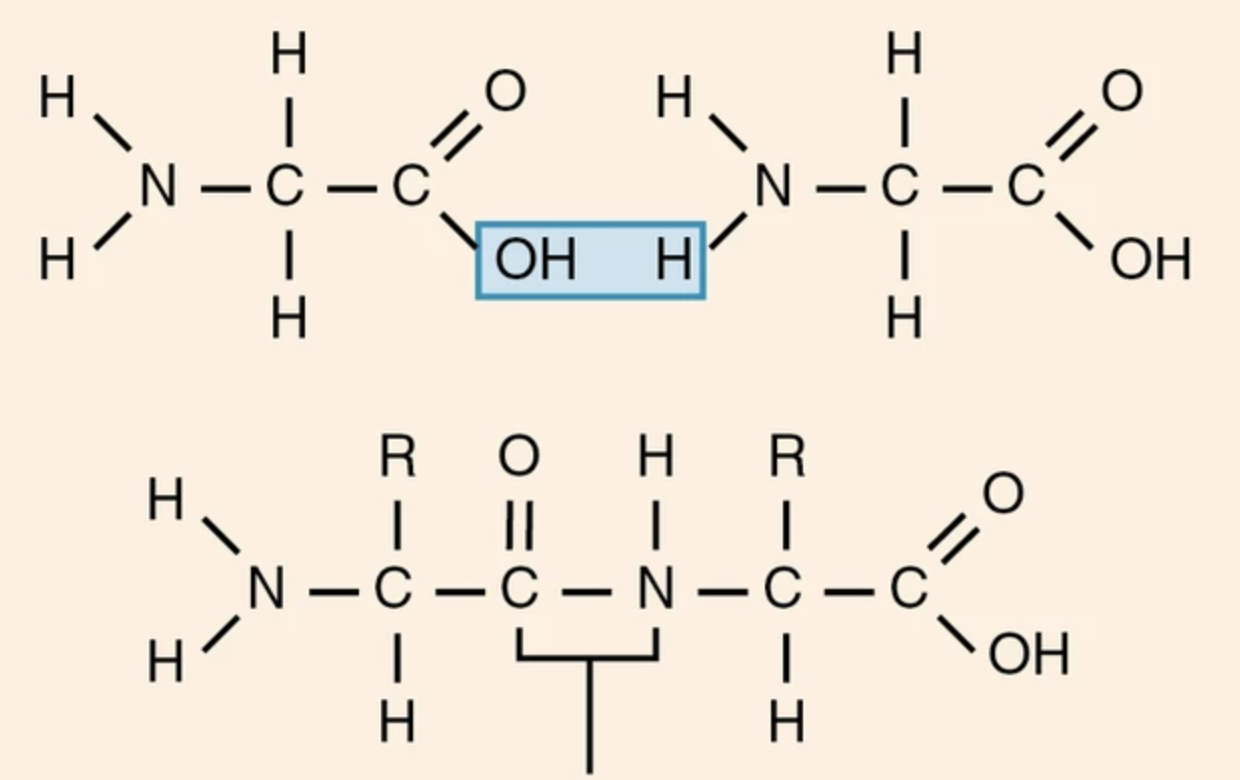
What macromolecule? What bond is forming? Favorable?
protein
peptide bond (amide bond)
condensation reaction between −COO- group (carboxyl) and −NH3+ (amino) group with water elimination (dehydration rxn facilitated by ribosome)
not thermodynamically favorable (∆G >0)

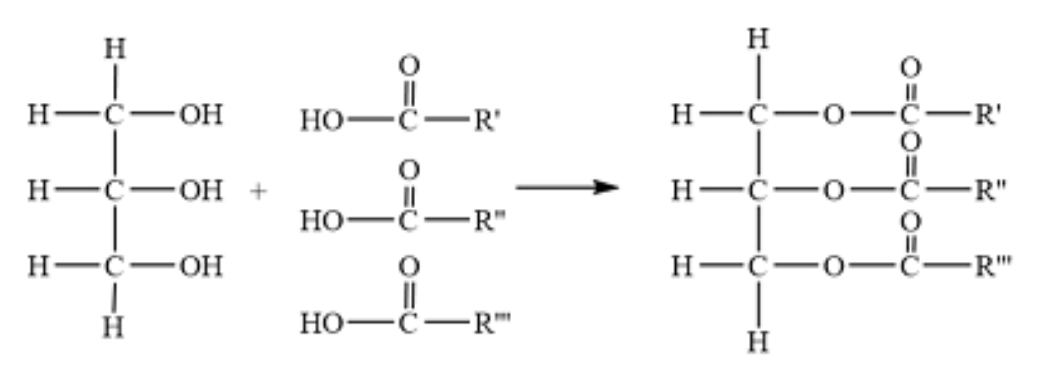
What are the two molecules being added to form the product (name this too)? Bond being formed?
lipids are usually chains of hydrocarbons! (hydrophobic)
4-membered hydrocarbon ring = steroid
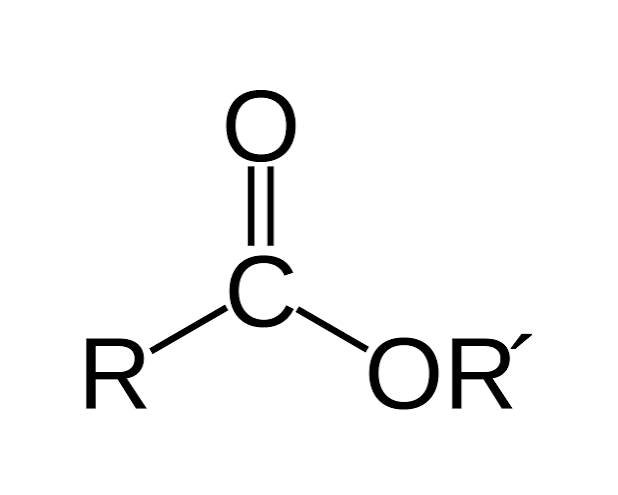
bond = ester linkage (RCOOR)

Compare & Contrast Prok & Euk
prok
no internal division
DNA is in nucleoid region
binary fission for cell division
euk
internal division
DNA is in nucleus
mitosis/meiosis
both
ribosomes
cell walls
plasma membrane - support, regulates what enters cell & what leaves
Water’s Unique Properties
2 H-bond donor sites (2 Hydrogens) & 2 H-bond acceptor sites (LPs on oxygen)
permanent dipole
high heat capacity
surface tension
amphipathic
Buffer
resists pH change following the addition of acid or base within about + 1 pH unit of the pKa (50-50 point) of a solution
weak acid/conjugate base pair = buffer
Henderson-Hasselbach Equation
pH = pKa + log ([A-]/[HA])
pH & pKa Relationships
pH < pKa - [HA] > [A-] (favoring acid form)
pH = pKa - [HA] = [A-] (50% protonated & 50% deprotonated)
pH > pKa - [HA] < [A-] (favoring conjugate base form)
Ka
acid dissociation constant
indicates strength of acid (higher = stronger)
[H+][A-] / [HA]
Isoelectric Point
pH at which the average charge on the molecule is zero
pI = (pKa1 + pKa2)/2 (average of the two pKa values surrounding the isoelectric species
Methods of Separating Biomolecules
gel electrophoresis: separates DNA by size (smallest go farther on gel)
DNA moves toward positive anode because DNA is negative
agarose gel or acrylamide gel
isolectric focusing
Tube with different sections (Each with different pH) - molecules loaded in - charge to molecules will bring molecule toward anode until it hits the pI since charge in now 0 & molecule will not be attracted/repelled by anode/cathode
Thermodynamic Systems
Closed: can exchange energy (heat/work) but not matter with the surroundings
Open: can exchange matter & energy with surroundings
Isolated: can exchange neither matter nor energy with surroundings
living systems generally operate at a constant T & pressure
First Law of Thermodynamics
energy is conserved
closed system - E exchanged in formed of work/heat
enthalpy is the heat exchanged between system & surroundings at constant pressure (typical condition of living systems)
Heat of a Rxn
at constant pressure, the heat of the reaction is equal to change in enthalpy (ΔH)
in reversible rxns, the magnitude of ΔH doesnt change, only sign flips
Exothermic Reactions: Δ𝐻 < 0, meaning the system releases heat to the surroundings
Endothermic Reactions: Δ𝐻 > 0, meaning the system absorbs heat from the surroundings
Reversible/Irreversible Rxns
Reversible Process: near a state of equilibrium
Process @ equilibrium:
Lowest energy state of the system
Forward & reverse rates of process are equal
Example: ice melting at 0oC
Irreversible Process: set up far from an equilibrium state, and then proceed towards that state
Example: burning paper
2nd Law of Thermodynamics
Entropy of an isolated system will tend to increase to a maximum value
Entropy (S): the measurement of degree of randomness or disorder of a system
2nd Law of Thermodynamics Equation (open system)
ΔG = ΔH - TΔS
ΔG Definition & Meaning of Values
portion of total energy change that is available to do useful work at constant T & P
ΔG > 0 → thermodynamically unfavorable (reverse process = favorable); endergonic process; free energy is required to do work
ΔG = 0 → zero free energy; rxn is reversible - system @ equilibrium
ΔG < 0 → thermodynamically favorable (reverse process = unfavorable), spontaneous; free energy is available to do work; exergonic process; free energy is available to do work
Effect of T on ΔG

Equilibrium Equations (ΔG = …. , K = ….., Q = ……., R = ….., Standard Temp=?
ΔG = ΔG˚ + RTlnk (WHEN RXN IS AT EQUILIBRIUM)
because ΔG = 0 @ equilibrium:
ΔG˚ = -RTlnk
k = e^(-ΔG˚/RT)
ΔG = ΔG˚ + RTlnQ (WHEN RXN IS NOT AT EQUILIBRIUM)
K (uses concentrations @ equilibrium) or Q (uses concentrations not @ equilibrium) = ([C]c[D]d) / ([A]a[B]b) for rxn: aA + bB —> cC + dD
R = 8.314 J/molK
T = 298k (standard! K = 273 + celsius)
Equilibrium Constant & Corresponding Delta G Naught Values Meaning
Keq > 1 → [product] Favored → ΔG˚ < 0
Keq = 1 → [product] = [reactant] → ΔG˚= 0
Keq < 1 → [reactant] Favored → ΔG˚ > 0
Equilibrium vs Homeostasis
Concentrations of reactants & products are constant in both
Energy is required to maintain homeostasis
maintains Q far from K such that ΔG does not equal 0
Q < K → ΔG < 0 → fwd rxn is favored (products)
Q = K → ΔG = 0 → equilibrium, neither direction is favored
Q > K → ΔG > 0 → reverse rxn is favored (reactants)
Coupling Favorable & Unfavorable Rxns
Living systems couple favorable (ΔG˚’ < 0) & unfavorable (ΔG˚’ > 0) processes to drive the unfavorable process forward
(FAVORABLE = EXERGONIC ⇒ DELTA G NAUGHT IS NEGATIVE)

Standard Conditions for Biochemical Gibb’s Energy ∆G°′

Activity of H+ is at 1 and pH 7 ( [H+] = 10-7M )
Activity of H2O is defined by convention to be 1

Molecules Involved in Energy Change
ATP, ADP, AMP
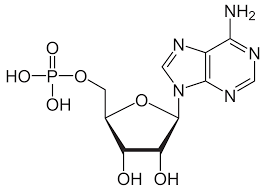
Molecule?
Adenosine Monophosphate AMP
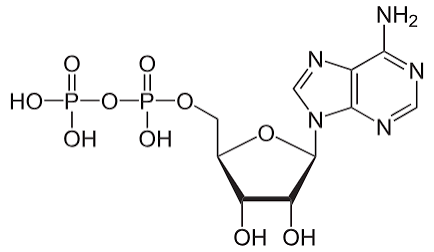
Molecule?
Adenosine Diphosphate ADP
Redox Reaction Terminology
OIL RIG
Oxidation Is Loss of electrons (or loss of hydrogen, or gain of oxygen)
the one that gets oxidated is the reducing agent/reductant
Reduction Is Gain of electrons (or gain of hydrogen, or loss of oxygen)
the one that gets reduced is the oxidizing agent/oxidant
Biochemical Standard Reduction Potential (E˚’)
the greater the reduction potential, the greater the tendency for a given electron carrier to become reduced
stronger oxidizing agents have higher values of H
standard reduction potential is measured at pH = 7
ΔG˚ in Redox Rxns
ΔG˚’ = -nFΔE˚’ = -nF [ΔE˚’(e- acceptor) - ΔE˚’(e- donor)
F= Faraday’s constant = 96.5J/molV
Identify all 20 AAs by Single Letter Code, Full Name, and Structure (label structure with carboxylic acid group, amino group, alpha carbon, R group, phi/psi/omega bonds)
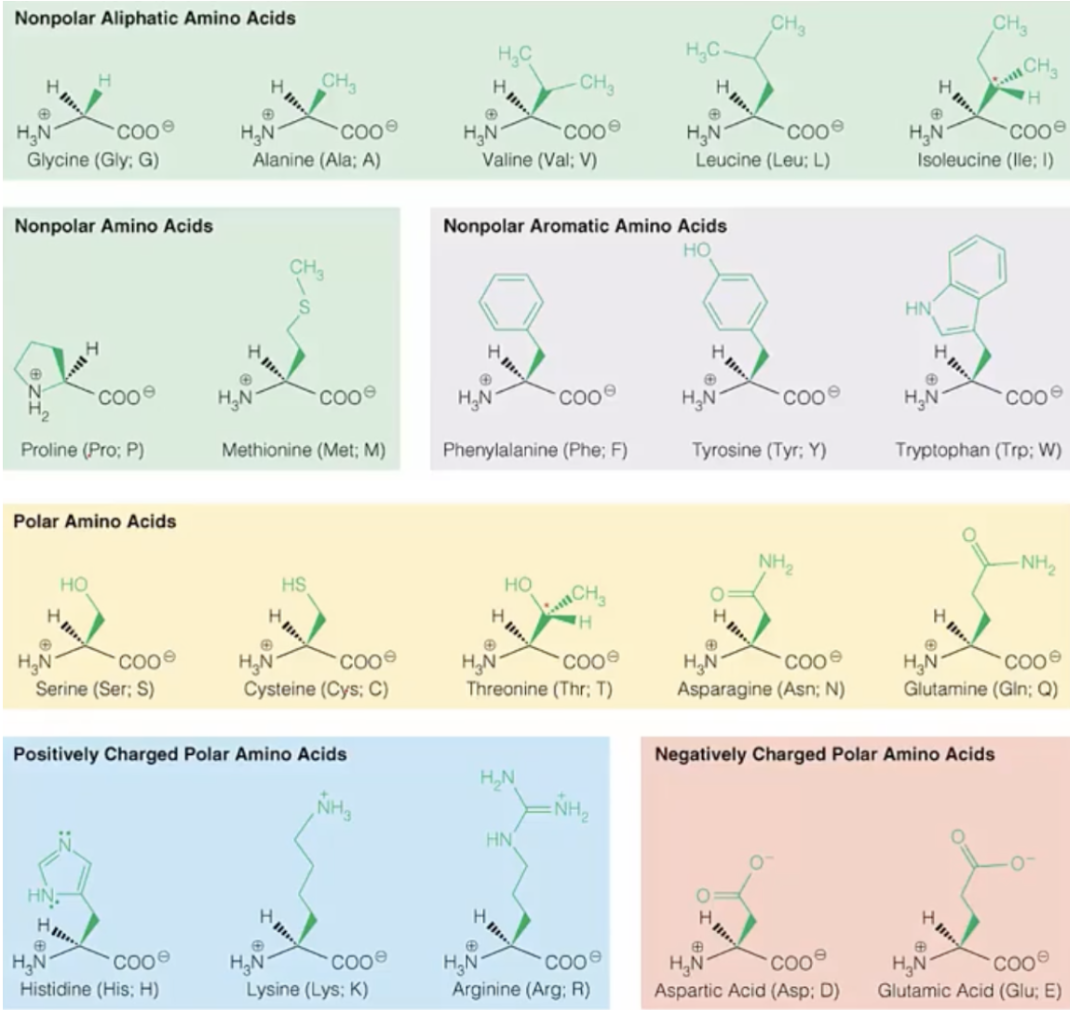
Alpha Amino Acid Stereochemistry
All Alpha Amino Acids, except Glycine, contain an asymmetric alpha carbon → chiral
D (large group to the right) & L (large group to the left) structures = enantiomers
Biological Amino Acids are always L
Sugars are always D
Geometry of Peptide Bond & Favored Form
peptide bond is nearly planar, and the trans form is favored over cis, partial double bond character for C—N bond
Oligopeptide vs Polypeptide
Oligopeptides (NOT PROTEIN, TOO SHORT) are peptide chains consisting of only a few residues, while polypeptides (PROTEIN) contain greater than 15-20 residues
Peptides can be cleaved at specific sites by
proteolytic enzymes: chymotrypsin, trypsin, pepsinogen
chemical agents: CNBr
Peptide Termini
one amino terminus (N-terminus) and one carboxyl terminus (C-terminus), always write the N-terminal residue to the left and the C-terminal residue to the right
Polyampholyte
Peptides are polyampholytes: can have many charges
as pH increases, overall charge on peptide becomes more negative
as pH decreases, overall charge on peptide becomes more positive
pKa of Side Chain
pKa of a side chain is influenced by its environment
Unperturbed, the pKa of glutamic acid is 4.2
In proximity to a negative charge, the pKa of a glutamic acid is raised
In proximity to a positive charge, the pKa of a glutamic acid is lowered
Genetic Code
3 bases = 1 amino acid
Start codon: AUG
Stop codon: UAA, UGA, UAG
2˚ Structures & Bonds Involved
local folding
alpha helix, beta plated sheet, 310 helix
H bonds
1˚ Structures & Bonds Involved
Amino Acid Sequence
peptide bonds
3˚ Structures & Bonds Involved
ultimate 3D shape
Disulfide bonds (prevalent in cysteine - have a terminal sulfur)
Hydrogen bond (betwen polar R groups)
Nonpolar/hydrophobic R group interactions (nonpolar R groups typically want to hide from water)
Ionic bonds (some R groups are charged and will interact)
4˚ Structures & Bonds Involved
more than one 3˚ structure
Disulfide bonds (prevalent in cysteine - have a terminal sulfur)
Hydrogen bond (betwen polar R groups)
Nonpolar/hydrophobic R group interactions (nonpolar R groups typically want to hide from water)
Ionic bonds (some R groups are charged and will interact)
Ramachandran Plot: What is it & what are the significant ranges
Shows sterically allowed psi Ψ & phi Φ angles
bond angles are very defined when trying to form secondary structures
L & R handed alpha helix have equal & opposite degree rotation

Fibrous Protein Structures
fibrous proteins are elongated molecules with well-defined 2˚ structures
Keratin - hair, fingernails, feathers, scales, or intermediate filaments (intracellular)
coiled-coil structure
Fibroin - silk cocoons
stacked beta sheet
Collagen - abundant connective tissue protein; matrix material in bone on which mineral components precipitate
triple-strand left-handed helix
Globular Protein Domains
globular proteins fold into defined proteins
domains are regions that fold independently and frequently possess some defined function
Anfinsen’s Experiment
proved that info needed for structure & function of protein is contained in primary structure of amino acid (AA sequence)
process:
used ribonuclease from cown
anfinsen used Urea & Beta-mercaptoethanol (BME) to denature the molecule instead of heat
BME reduces sulfur (causes disulfide bond to become H bond)
took denatured protein and put it through two diff processed
first, he oxidized it, which caused protein to form disulfide bonds, then he removed urea - wrong cysteines were bonded = incorrect structure
second, he took the denatured protein and removed urea first then slowly oxidized it allowing protein to choose favorable folds = original structure is back!
3 Thermodynamic Factors Influence the Folding & Stability of Proteins
Favorable intermolecular enthalpic interactions
Charge-charge interactions (ionic bonds; salt bridges)
Ionic bonds = salt bridges between charge entities
These charged entities can be between two R groups or something that gets in between two oppositely charged R groups, forming a salt bridge (electrostatic bridge that gets groups close enough to have interactions that matter)
Intermolecular hydrogen bonds
Van der waals interactions; proteins are densely packed
Unfavorable loss of conformational entropy
Unfolded state has many conformations (high entropy)
Folded state has only a few closely related conformations (low entropy)
Favorable gain of solvent entropy from burying hydrophobic groups (“hydrophobic effect”)
Hydrophobic side chains cluster in the interior, they release ordered solvent molecules from clathrate structures
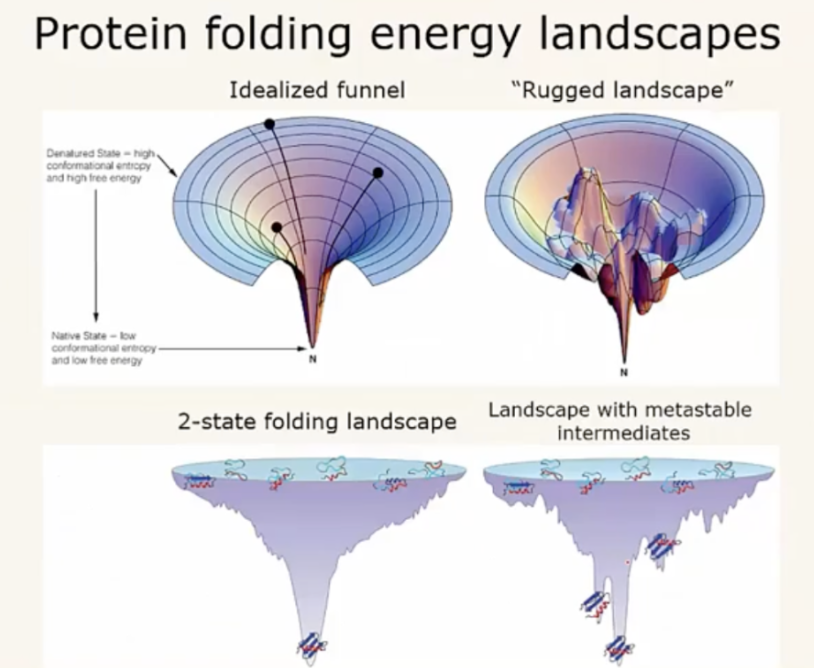
Protein Folding Landscape
as the unfolded protein begins to fold, even just once, it narrows down the possibilities of the native state (more folds = less possibilities - funnel!)
“Rugged landscape of funnel” → sometimes proteins can thermodynamically unfold, but if it's too far into folding, it is less likely to do this (energetically too hard to change the fold - ends up breaking back down to amino acids to be remade into another protein)
chaperones prevent making the wrong folds!