1- Facial Esthetics & Soft Tissue Considerations (Dr. Salam)
 Call Kai
 Learn
Learn Practice Test
 Spaced Repetition
 Match
Match Flashcards
 Knowt Play
1/57

There's no tags or description
Looks like no tags are added yet.
Name | Mastery | Learn | Test | Matching | Spaced | Call with Kai | Chat |
|---|
No analytics yet
Send a link to your students to track their progress
58 Terms
Aisthesis
Facial esthetics originated from the Greek concept of "________" for "Perception" or "Sensation". It was formalized in the 18th century as a philosophical discipline.
Edward Angle
Who focused on the beauty inspired by Greek art and considered the profiles portrayed in their classical art as ideal standard for the orthodontic profession?
modern patient-centered approach
face-driven orthodontics
2 standards of beauty
Modern Patient-Centered Approach
What standard of beauty?
Facial esthetics emphasizes subjective beauty and cultural diversity
Face-Driven Orthodontics
What standard of beauty?
Current orthodontic treatment integrates facial harmony, function, growth, and patient satisfaction over strict cephalometric norms for better outcomes
Esthetics and Psychological Impact
Comprehensive Esthetic Evaluation (photos, angles - not just the correction of malocclusion)
Growth & Facial Esthetics
Parent Expectations (clear communication)
What are 4 reasons for why we need to evaluate soft tissue when considering orthodontic tx?
True
T/F: Growth and development impact facial esthetics, requiring anticipation of treatment effects on face and profile.
True
T/F: Successful outcomes depend on clear communication and aligning esthetic goals with parent/patient expectations.
nasolabial
what angle is this
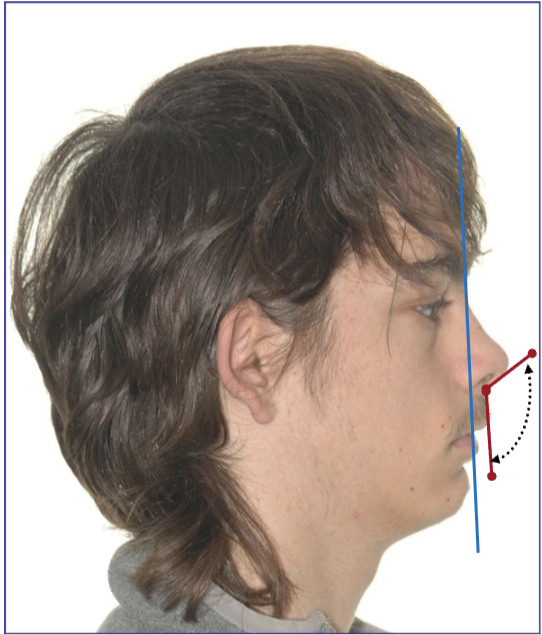
102°
(Range: 90-120°)
What is the mean nasolabial angle?
0-3 mm
What is the interlabial gap when lips are relaxed?
Mentalis strain
What do you see on the chin with lip incompetence?
Lip incompetence
Mentalis strain
What are 2 common things to see in a profile analysis of a patient with bimaxillary dentoalveolar protrusion?
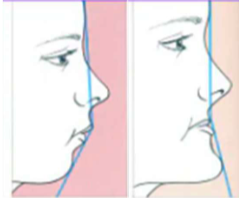
convex: class II
concave: class III
A convex vs. concave profile which skeletal class relationships
Deep bite
A deep sublabial fold is in indicative of what?
It guides diagnosis and influence decisions regarding the treatment modality either growth modification, camouflage, or orthognathic surgery
What is a clinical application of facial profile analysis?
3 approximately equal 1/3s
In a well-proportioned face, the face is divided vertically into what?
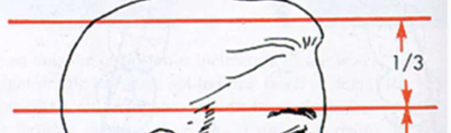
Trichion (hairline) to glabella
The upper facial 1/3 extends from what to what?
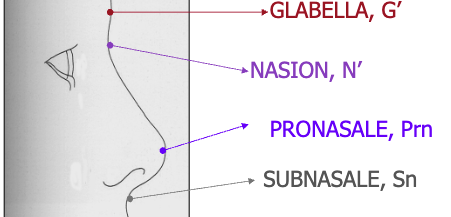
Glabella to subnasale
The middle facial 1/3 extends from what to what?
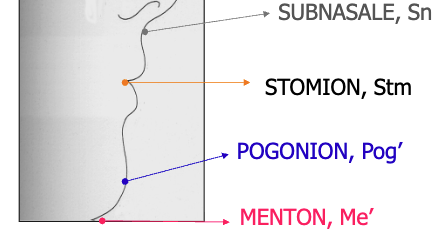
Subnasale to menton
The lower facial 1/3 extends from what to what?
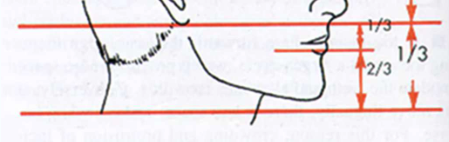
- Upper lip = 1/3
- Lower lip and chin = 2/3
In an esthetically balanced face, the lower facial 1/3 is divided into what?
glabella
nasal tip
upper lip midpoint
chin along the midsagittal plane
When analyzing the midsagittal plane symmetry, ideal facial symmetry aligns which 4 key landmarks
zygomatic arches
facial width is usually greatest where
Vertical growth pattern/open bite tendency
An increased lower facial 1/3 is most commonly associated with what?
Deep bite
A decreased lower facial 1/3 may be indicative of what?
Upper stomion
Lower stomion
When the lips are incompetent at rest, the lower facial third is divided using which landmark?
Harmony, balance
Alignment of facial features, such as mouth edges with iris edges, guides esthetic judgment of _________ + _________
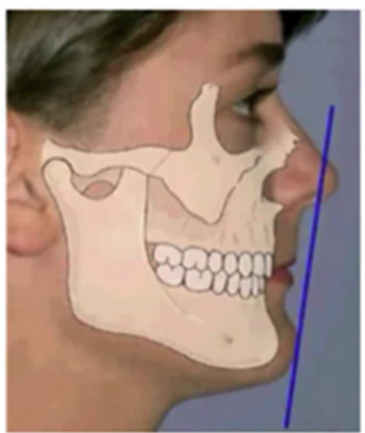
S-line (steiner line)
Define the following:
A line from soft tissue chin to the midpoint of the S-curve line
Evaluates...
- Lip support
- Underlying position of dentoalveolar complex
- Functional
What is the purpose of the Steiner S-line?
Retrusive (lips are behind the S-line)
What is the lip posture described as?
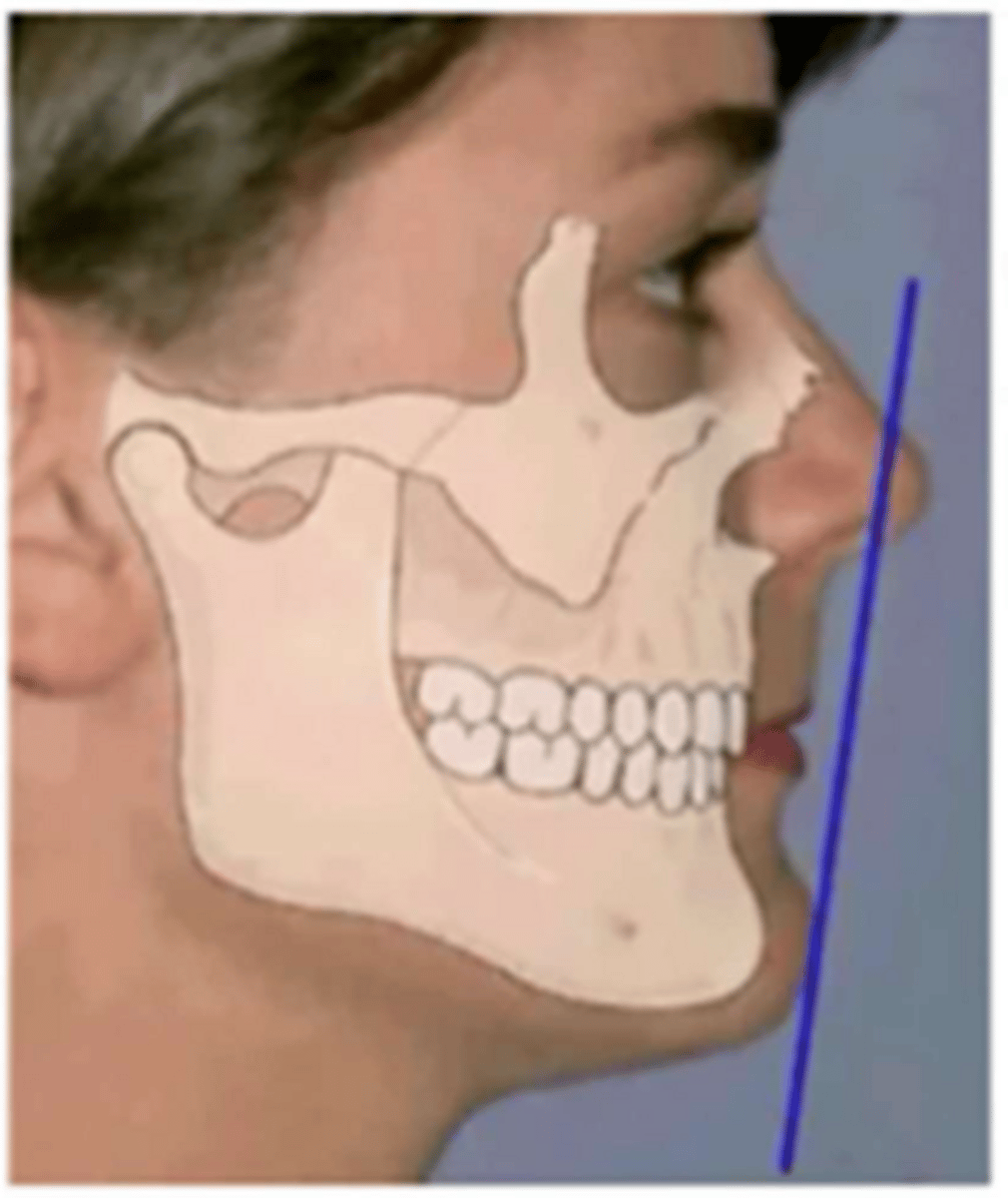
Protrusive (lips are in front of the S-line)
What is the lip posture described as?
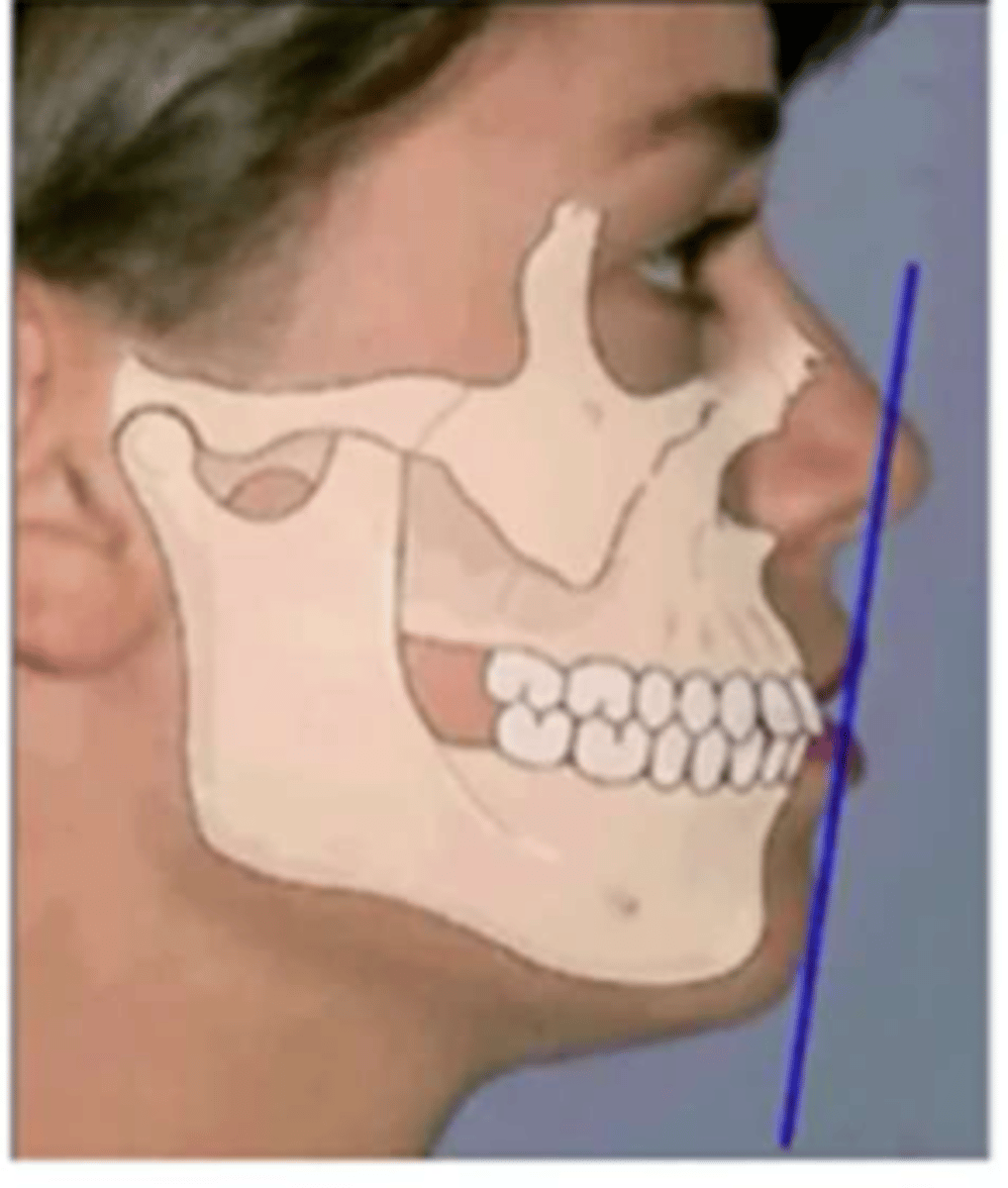
B. Increased body mass index (BMI)
Which of the following factors increases the risk of sleep-disordered breathing (SDB)?
A. Decreased body mass index (BMI)
B. Increased body mass index (BMI)
C. Increased overbite
D. Class I molar relationship
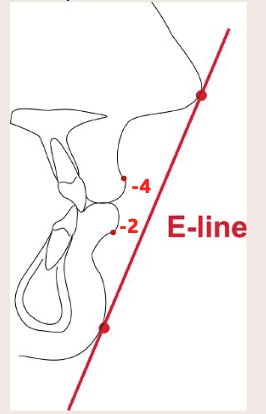
Nasal tip to soft tissue chin
Where is the Ricketts E-line drawn from?
upper lip: 2-4 mm behind the E-line
lower lip: On the E-line (0 mm) or about 2 mm behind it
In a well-balanced female profile, the lips are typically positioned where?
Males
Who has a slightly less protrusive E-line, males or females?
Nasal tip
The E-line is dependent on the position of the __________
The E-line is affected by the position of the nasal tip
Why should clinicians be cautious when interpreting the E-line in a patient with a prominent nose?
Buccal corridor
Define the following:
The dark space visible between the corners of the mouth and the buccal surfaces of the posterior teeth during smiling
A broad smile with minimal buccal corridors
What type of buccal corridor is described as more esthetic and fuller?
75-100%, 2 mm
Upon smiling, ideal exposure is ___-___% of the crown height to ___ mm of gingival tissues
Females
Who shows more gingival tissues, males or females?
Touch or closely follow the contour of the lower lip during smiling
In a youthful smile, the maxillary incisal edges typically follow what?
True
T/F: Lateral incisors should be positioned slightly gingival to the central incisors and canines
False - gingival smile line diminishes with age
T/F: Gingival smile line improves with age
Lower
(Rather than the upper incisors - this is particularly true when the mandibular anterior teeth are above the functional occlusal plane at the start of treatment)
From an esthetic point of view, the best treatment strategy in the majority of deep overbite cases is to actively intrude which incisors?
Decreased
As patients age, a __________ maxillary incisor display is typically observed
Lengthening
Aging is commonly associated with __________ of the upper lip
Nasal tip ptosis
Which nasal change commonly occurs with aging and can affect facial esthetics?
- Lip lengthening
- Tooth wear
The decrease in maxillary incisor display seen with aging is primarily related to what?
Senile smiling
What type of smile has the following characteristics?
- Lip lengthening
- Nasal tip ptosis
- Tooth wear
- Decreased both upper incisal and gingival display
Early assessing smiles in static and dynamic states helps clinicians create treatment plans preserving esthetic appeal over time
Why should smile esthetics be evaluated early in orthodontic treatment planning?
Too short
Is this upper left central incisor too short or too wide?
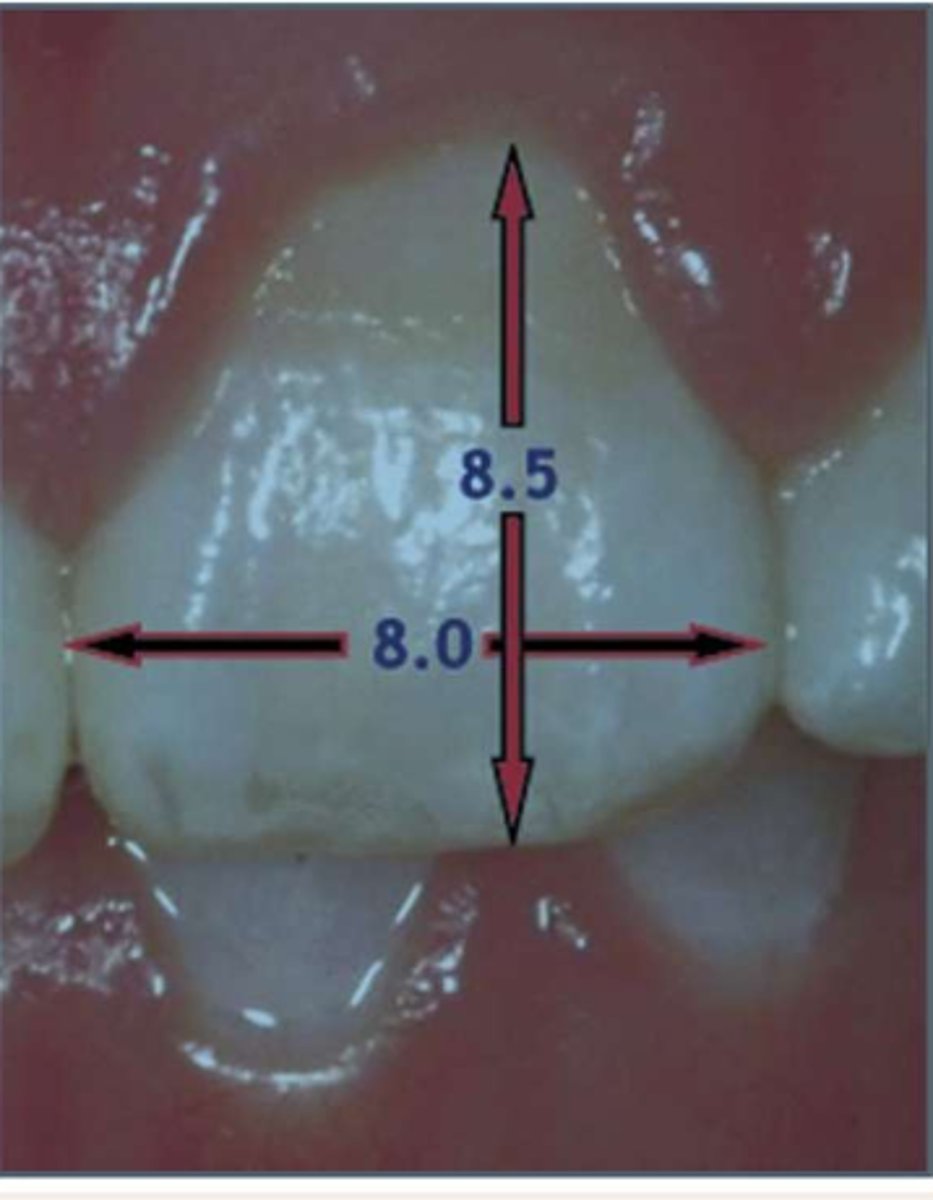
80%
The width of a tooth should be ____% compared to the height
Incomplete incisor display
What is affecting the esthetics?
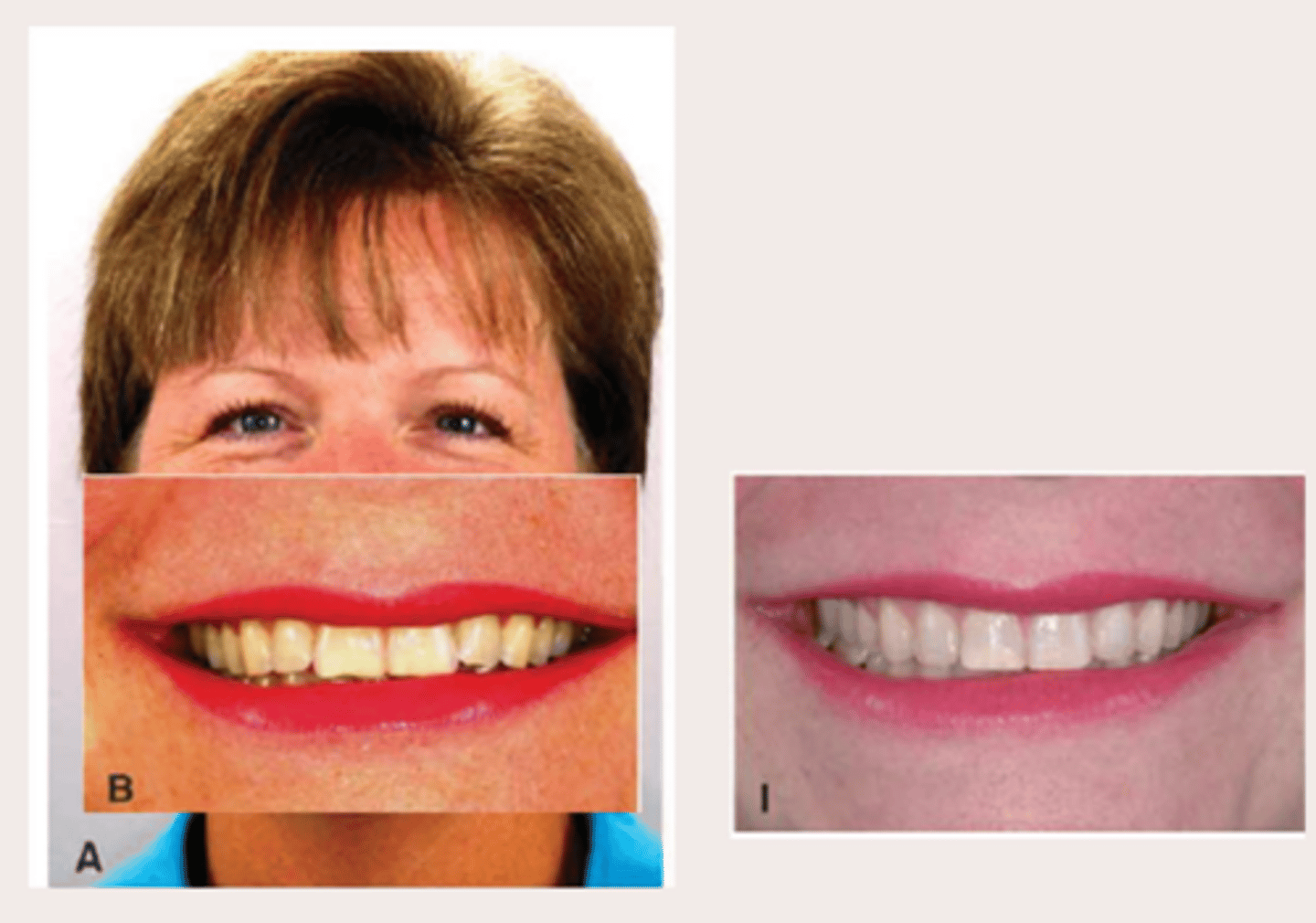
Upper lip
There is an intimate relationship between the inclination of the upper incisors and the _________ position
Consonant Smile Arc
Marginal vertical positions
Shape and position of the gingival margins
what are the 3 major components of an esthetic smile
Lateral incisors
In an esthetic smile, which teeth are typically positioned slightly shorter than the maxillary central incisors?
Gingival zeniths
Define the following:
Highest points of the gingival margins