Exam 1 Study Guide
 Call Kai
 Learn
Learn Practice Test
 Spaced Repetition
 Match
Match Flashcards
 Knowt Play
1/170

There's no tags or description
Looks like no tags are added yet.
Name | Mastery | Learn | Test | Matching | Spaced | Call with Kai | Chat |
|---|
No analytics yet
Send a link to your students to track their progress
171 Terms
What is a lipid contained of? Based on this, can it dissolve in water? What about nonpolar compounds?
A lipid contains hydrocarbonds (C-H) and a high percentage of nonpolar C-C bonds. They cannot dissolve in water for that reason, but can dissolve in solvents that are nonpolar themselves (like benzene)
There exsists a saturated fatty acid and an unsaturated fatty acid. What’s the difference?
A saturated fatty acid is one that contains ONLY hydrocarbonds (C-H), while an unsaturated fatty acid will contain C=C bonds, which will make the entire structure form a kink.
Look at image

At the top of all saturated/unsaturated fatty acids exist a ____.
polar carboxyl functional group (-COOH)
How can you convert unsaturated lipids to saturated ones? (hint: think about structure)
You can do this by breaking the double bonds and adding hydrogen atoms via the process of hydrogenation.
What are the three most important types of lipids found in our body?
Steroids, fats, and phospholipids.
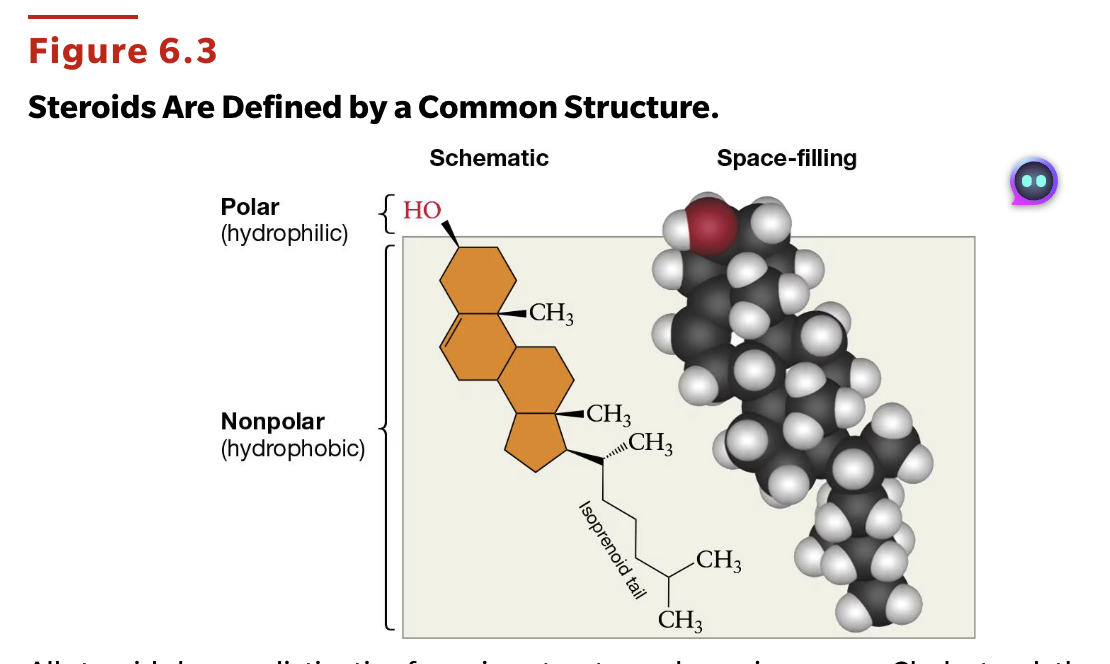
What does a steroid look like SPECIFICALLY in cholesterol?
A steroid has a four-ring structure with an isoprenoid tail. At the very top is a hydroxyl group.
Look at image, which is cholesterol!
What do fats contain? What can they also be called, why?
All fats have nonpolar molecules composed of three fatty acids that are linked to a three-carbon molecule called glycerol.
They can also be called triacylglycerols or simple triglycerides because of that glycerol molecule.
What is the primary function of fats? Why does this make sense?
They primarily function as energy storage.
This makes sense because of the high-energy bonds in the fatty acid chains. There’s a ton of C-C and C-H bonds compared to the C-O bonds in carbohydrates, meaning they store MUCH more energy (think the quantity here!).
Look at the image. The hydroxyl groups in the carbohydrate are more likely to dissociate in water—not in a lipid though!

How do fats form?
They form through dehydration reactions between a hydroxyl group of glycerol and the carboxyl group of a free fatty acid.
Look at image
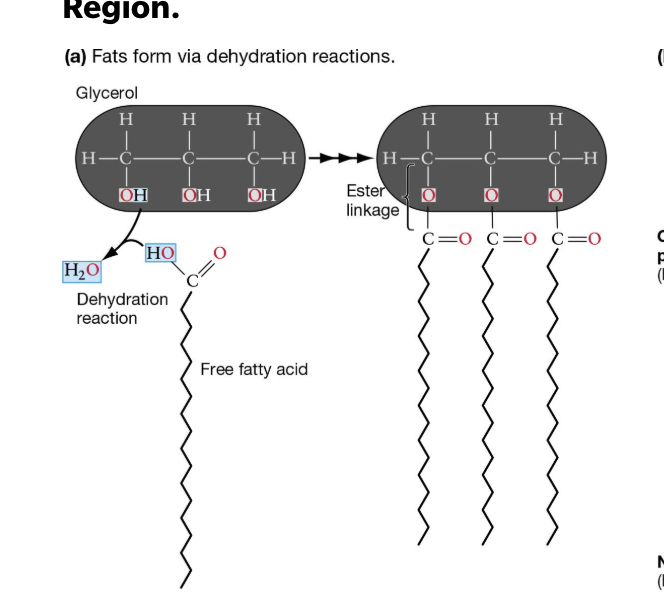
After a lipid (fatty acid) reacts to become bigger in a dehydration reaction, how are they joined (aka, after glycerol groups’ hydroxyl group and the carboxyl group react)?
What does the ester linkage provide (what goes in between those two molecules)?
They are joined through an ester linkage between that glycerol and fatty acid molecule, which puts an oxygen atom between them.
Look at image

What is a phospholipid composed of?
A phospholipid has a glycerol that is linked to a phosphate group and two hydrocarbon chains of either isoprenoids or fatty acids. The phosphate group is also bonded to a small organic molecule.
look at image

What is the use of a phospholipid?
It functions as a component of the cell membrane (plasma membrane).
Phospholipids have a head and a tail. (omg it’s like the phospholipid bilayer). Is the head polar or nonpolar? What about the tail?
The head is polar and hydrophilic, whie the tails are nonpolar and hydrophobic.
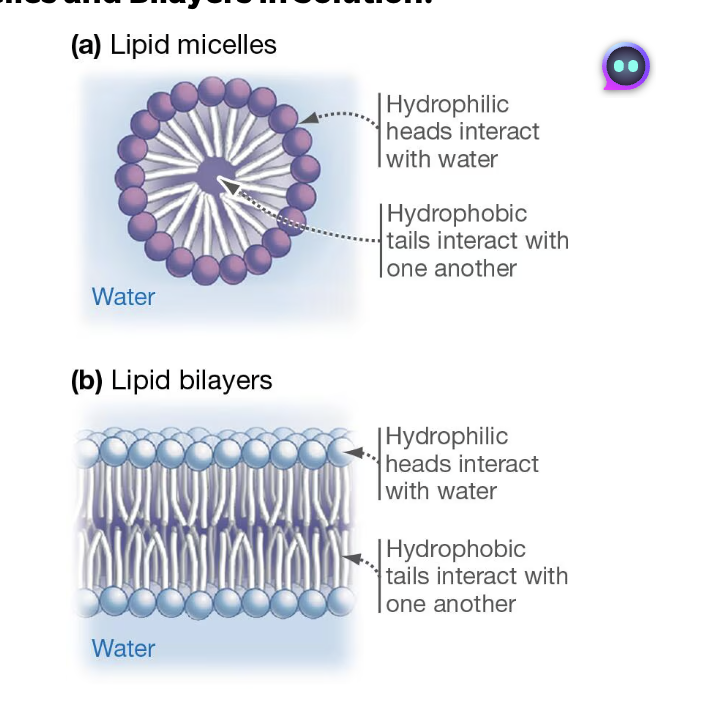
What happens when you put amphipathic lipids (lipids w/ hydrophilic and phobic parts) in water? What two structures form?
When they are placed in water, they do not dissolve because of their hydrophobic tails. Instead, they form either micelles and lipid bilayers.
Micelles are little structures that form when the hydrophilic heads face outward into water. They look like vesicles—small circle.
A lipid bilayer is created when lipid molecules align in paired sheets.
look at image
How are free fatty acids even formed?
They are formed THROUGH micelles (which are like vesicles—a small circle)
What does selective permeability even mean? In a phospholipid bilayer, what substances can cross through easily?
It means that some substances cross a membrane more easily than other substances.
In a bilayer, only small and nonpolar molecules can pass through it since it won’t interact with the hydrophobic, nonpolar tails. Remember that almost anything charged—even ions—cannot cross through well.
Look at image

What happens to the phospholipid bilayer, specifically the _____, if the temperature drops?
hydrophobic tails; they will start to move more slowly and then pack more tightly together. This makes it more difficult for any molecule, regardless of polarity or size, to pass through it.
What is the result of cholesterol in terms of permeability? Why
It can increase or decrease it based on temperature. At high temperatures, it decreases permeability because the four-ring structure forms van der Walls interactions with the fatty acid tails, restricting their movement and decreasing gaps. At lower temperatures, it increases permeability because cholesterol will PREVENT the tails from packing too tightly, making the membrane more permeable.
What happens when the phospholipid tails contain unsaturated fats?
This will create kinks by the double bonded C=C, producing spaces among the tails. As a result, this reduces the number of van der Waal interactions that keep the tails together, increasing its permeability (allowing more things in).
Look at image

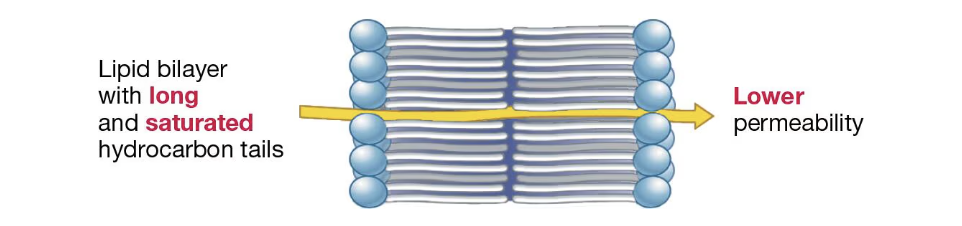
What happens when the phospholipid tails contain saturated fats?
This will create fewer spaces (since no kinks) in the atmosphere and produce MORE van der Waal interactions. The forces that hold them together will therefore increase, making the membrane denser and decreasing its permeability (allowing less things in).
Look at image
Can certain polar molecules cross the membrane easily without using energy?
Yes, but they have to small small and uncharged.
What is diffusion?
This is the spotaneous (automatic) movement of molecules and ions.
How does a concentration gradient form? And how does it work? Finally, what KIND of transport is that?
It forms when there is a difference in SOLUTE concentration. THey will move from higher concentrations to areas of lower concentrations.
this kind of transport is called passive transport.
When the concentrations inside and outside the cell are at equilibrium, will movement just stop? Why?
It will NOT stop because particles are still colliding with each other in random directions, causing movement.
What is osmosis? When does this occur?
This is the movement of water across the lipid bilayer.
This only occurs when solutoins of different solute concentrations are separated by a membrane that PERMITS water to cross. KEYWORD PERMITS.
For example, osmosis might happen when water can cross through a membrane but the solutes themselves cannot.
What is the direction of water during osmosis?
Water will move from areas with LOW solute concentration to areas of HIGH solute concentration to get a perfect balance of solute concentration.
How can a protein fit within the lipid biplayer?
It can fit in based on its structure. It’s possible to have polar and charged amino acids be at the ends of the protein, with the nonpolar strands being lodged in the middle.
Look at image


Label from top to bottom:
Peripheral membrane protein, integral membrane protein, peripheral membrane protein.
How can you remove a protein(s) from the phospholipid bilayer?
You can do this by using detergents, which is a small amphitpatic molecule that can form micelles and ARE water soluble (unlike amphipathic lipids).
When detergents are added to the solution surrounding the lipid biplayer, the hydrophobic tails of the detergent molecule interact with the hydrophobic tails of the lipids and of the transmembrane proteins. As a result, the membrane becomes displaced and forms water soluble detergent-protein complexes that can be isolated.
Look at image

How might ions travel through the lipid bilayer? How?
They will usually travel through the membrane using ion channels, which form pores (openings) in a membrane. They will travel from regions of high concentration to regions of low concentrations and from areas from like charge to unlike charge.
What is an electrochemical gradient?
This is a gradient that considers both the concentration of ions and their respective charges.
PLEASE look and read image

What is a carrier protein? What is the best studied example and what is its carrier protein?
These proteins selectively pick up a solute on one side of the membrane, then drop it off on the other side.
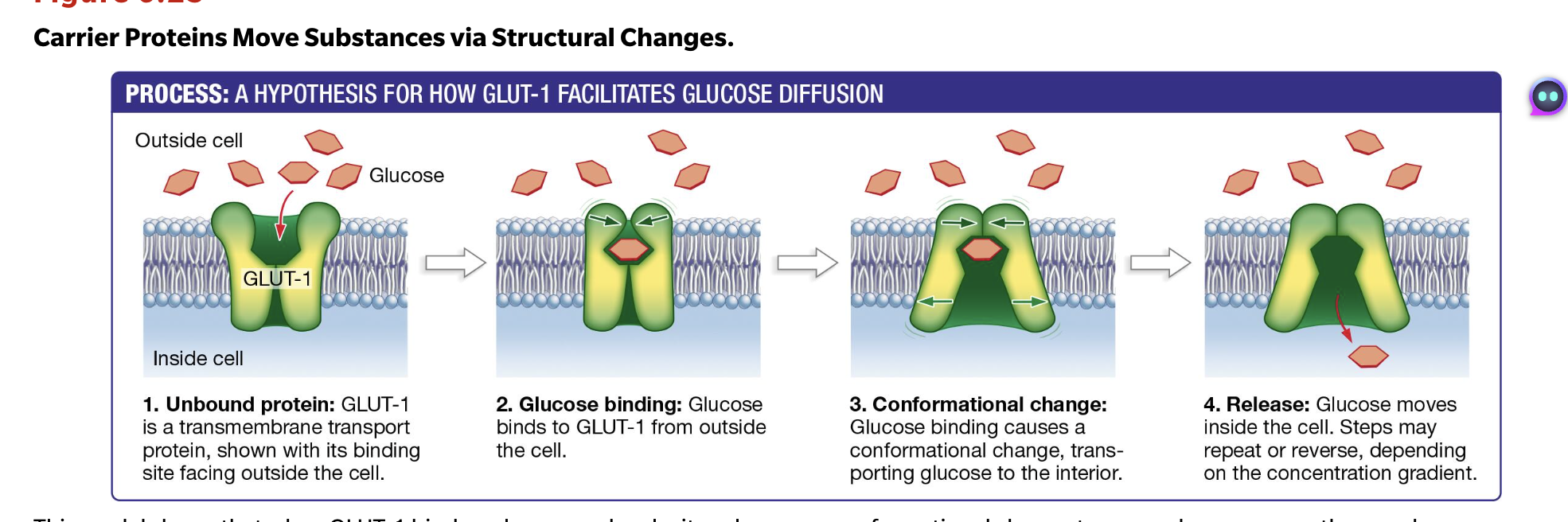
The best studied example is the glucose carrier protein, since it takes glucose so long to diffuse through passive transport. The carrier protein is called GLUT-1.
How does the GLUT-1 carrier protein work? Does it require energy?
It works by binding to a glucose molecule (6-carbon sugar), then causing a conformational change (aka an induced fit). As it binds, the protein moves in a way that moves the sugar through the hydrophobic region of the membrane, then releasing it on the otherside.
It does not require energy because it all takes place through diffusion (concentration gradients).
Look at image
What is the type of transport that moves molecules AGAINST the concentration gradient? What usually provides the energy for this?
This is called active transport. ATP usually provides this energy!
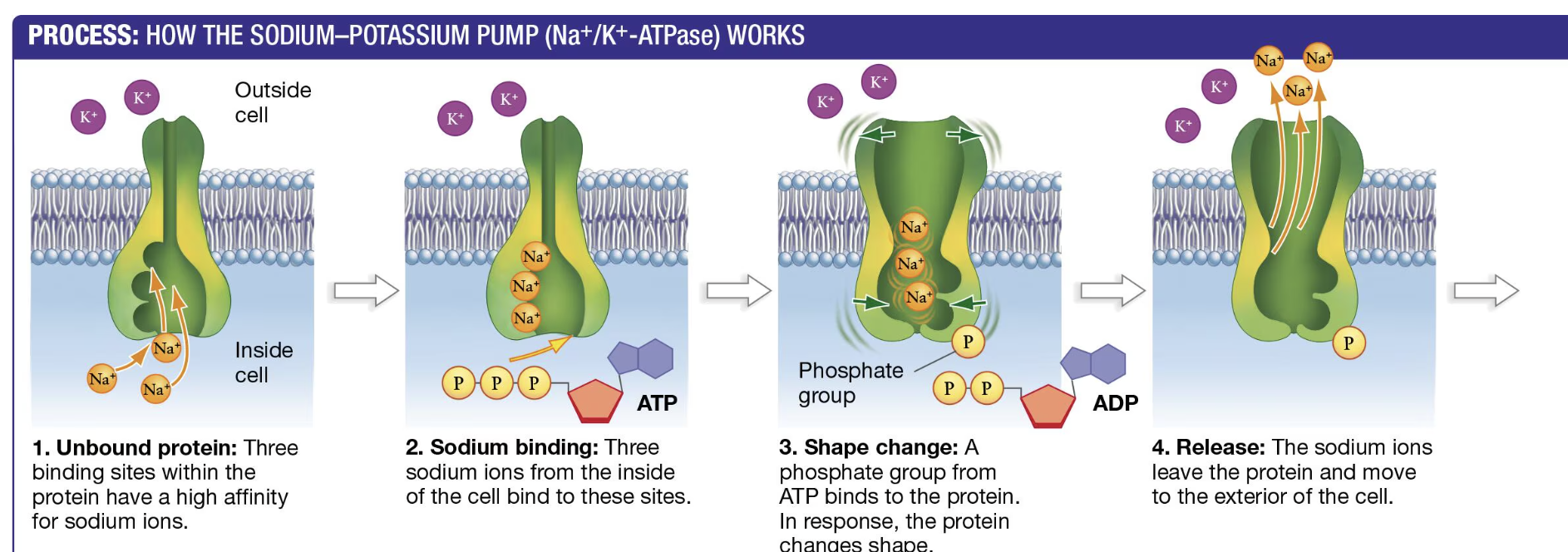
How does Na+/K+ ATPase work for sodium? FIRST, give the name you’re familiar with :)
This is the sodium-potassium pump.
First, the pump will look for sodium ions when there is a high affinity (or desire). After the sodium ions bond, a phosphate group form ATP binds to the protein, making it—the protein—change shape. As the protein changes shape, it will push the sodium ions to the outside of the cell here potassium ions lie.
Look at image
How does Na+/K+ ATPase work for potassium? FIRST, give the name you’re familiar with :)
This is the sodium-potassium pump.
for potassium, the protein will have two potassium ions bond to the pump. WWhen this happens, the phosphate group is taken OUT of the protein, allowing the pump to return to its ORIGINAL shape and releasing the potassium ions into the INSIDE of the cell.
Look at image

For potassium ions to get into the inside of the cell, what needs to happen beforehand?
sodium ions needed to have left the cell. Otherwise, there’s no way the potassium ions could’ve binded.
Why are electrochemical gradients so crucial toward the function of a cell? After you answer this, explain how that process works… (also, does it use ATP)
They are essential because they make it possible for the cell to engage in secondary active transport (cotransport).
Cotransport is when the cell uses the energy released by the sodium-potassium pump to drag a SECOND substance (like glucose/amino acid) across the membrane, even going AGAINST its natural concentration gradient. IT DOES NOT use ATP and relies on the concentration gradient created by other pumps.
Is it possible for glucose to be moved AGAINST its concentration gradient? How?
It is possible, but only through cotrasnport (secondary active transport). This occurs when sodium ions move back into the cell, driving glucose across the membrane against its gradient.
What is the difference between a substance and a mixture?
A substance is matter with a fixed composition. A mixture has two or more substances that are physically connected with a variable composition.
EX: Water is pure substance because it has a fixed chemical composition. Saltwater is a mixture because it includes two substances (NaCl and H2O).
What is an element? Can it contain multiple atoms?
It is a pure substance that cannot be broken down.
An element CAN contain multiple atoms (e.g., O2).
What is the difference between an element and a molecule?
An element is a pure substance that cannot be broken down. A molecule is formed with two or more atoms bind together. (like H2O).
NOT all molecules are elements.
How is a molecule different from a compound?
A molecule is when two or more elements bind together. A compound is when two or more DIFFERENT elements bind together.
Can a compound be broken down into simpler substances? What about an element?
If it can, explain how!
A compound is able to be broken down because it includes two different elements. An element CANNOT be broken down.
Any sort of breaking down is done through chemical changes. EX: an electric current will break down molten NaCl into metallic sodium and chlorine gas.
In mixtures, are substances (elements/compounds) physically or chemically intermingled?
physically!
How is a mixture different from a compound in terms of a separation method?
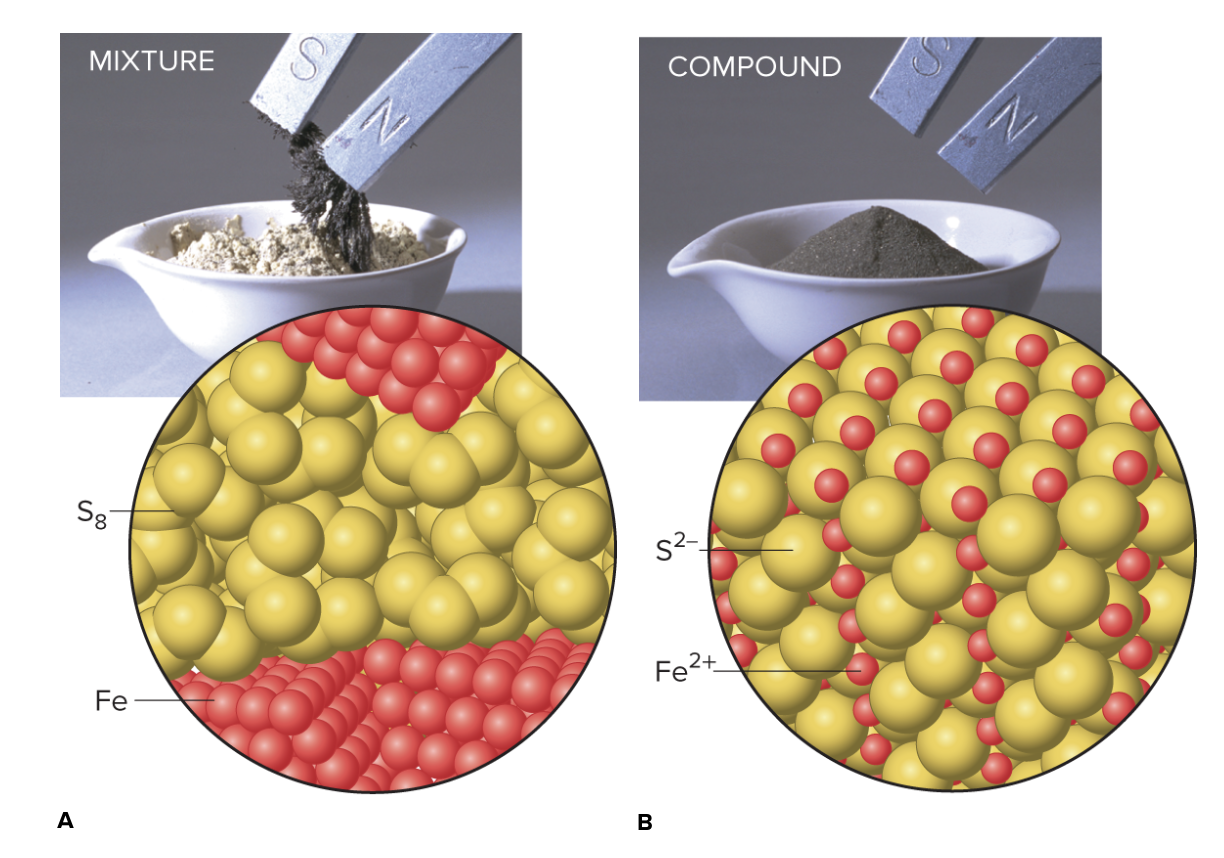
In a mixture, the composition of a solution can change like in salt water. The ratio could be TONS of salt and a little water or vice versa—it’s still a mixture.
Mixtures can be separated by their components using physical changes. Chemical changes ARE NOT needed (but could work). Compounds have to be separated by chemical changes.
Look at the image for a great example!
What are the four most common ways of separating a mixture? REMEMBER, this is a (physical/chemical) ← answer first.
Also, give definitions of each process!
Hint: distillation has two types!
physical;
Filtration - Separates particles based on their size and helps to separate a solid from a liquid, which will flow through tiny holes in filter paper. (or vacuum filtration)
Crystallization - This separates particles based on solubility (amount of mixture that dissolves in a fixed amount of solvent). Usually uses hot and cold, since solubility increases with temperature.
Distillation - This separates particles through differences in volatility (tendensy of a substance to become a gas). Simple distillation with separate components with large differences in volatility (think of boiling!) Fractional distillation uses vaportization-condensation to separate components with small volatility differences.
Chromatography - Separates particles through differences in their solubility.
Describe how chromatography separates substances…
Then, describe GLC and HPLC
First, the mixture you want to separate is dissolved in a gas/liquid called the mobile phase. After, this new solution will flow through a solid (or liquid) called the stationary phase. Components with LOWER solubility will move through the solid/liquid faster.
GLC (Gas-liquid Chromatography) uses a gas as the mobile phase, like helium. As the stationary phase continues, the components reach a detector separately.
HPLC (high pressure liquid chromatography) is similar to GLC, but the mixture does not need to be vaporized into a gas since the mobile phase is a liquid. This relies more on heat-sensitive components.
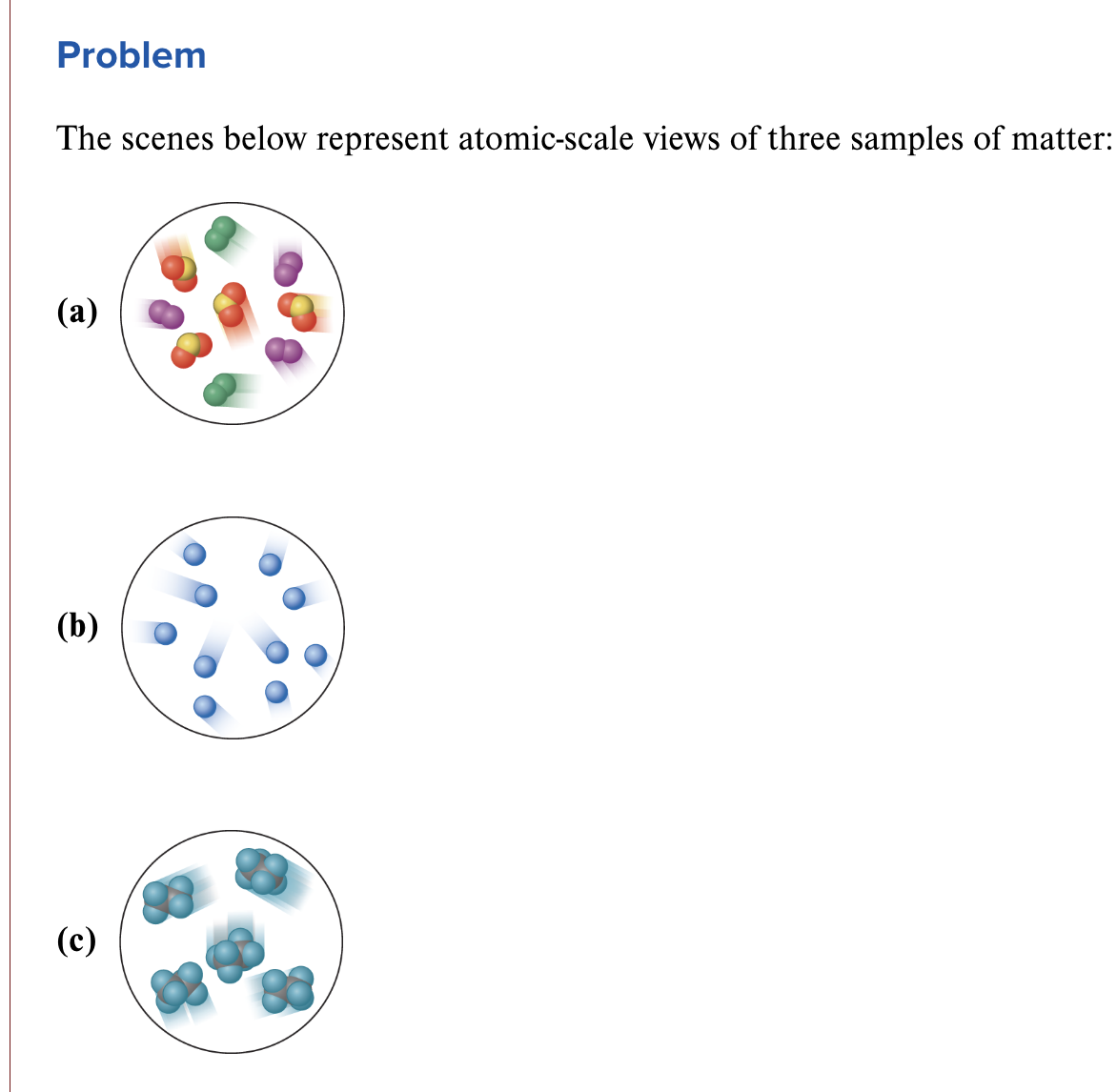
The scenes in the image represent atomic-scale views of three samples. Describe each sample as an element, compound, or mixture. Which sample(s) can be separated into its (their) components by a physical change?
A. mixture; can be separated by physical change
B. Element; cannot be separated! it’s in its purest form
C. Compound; can be separated through chemical change.
What is the law of mass conservation? Why is it important?
This law says that the TOTAL mass of a substance does not change during a chemical reaction. This is important because it tells us matter cannot be created or destroyed!
We know from the ______ that there is a fixed proportion of elements in a compound. That proportion can be expressed in two ways: (also give definition)
law of mass conservation;
The first way is mass fraction which is the ratio of the mass of each element to the total mass of the compound. AKA, fraction of oxygen in CO2. Mass Fraction = mass of element X in A / mass of compound A
The second way is mass percent, which is the percentage of the mass fraction. Literally the % of oxygen in CO2 for example.

Find the mass fraction and percent of each element.
8.0/20.0 = 0.40 or 40% of calcium (NEED SIG FIGS!)
2.4./20.0 = 0.12 or 12% of chlorine
9.6/20.0 = 0.48 or 48% oxygen.
NOTICE: this is unitless because the grams cancel out.
What is the law of definite composition? Why is it important?
This law says that no matter the sample, a particular compound is composed of the same elemnts in the same fractions by mass.
Essentially a 20 gram sample of CO2 will contain the same fraction of oxygen as an 800 g sample.
Pitchblende is the most important compound in uranium. Mass analysis of an 84.2-g sample of pitchblend shows that it contains 71.4 g of uranium, with oxygen the only other element. How many grams of uranium and of oxygen are in 102kg of pitchblend?
Turn the kg into g. 1000 g = 1kg, so 102 kg * 1000 g/1kg = 102000 g.
Find the mass percent of each in the known sample: 71.4 g / 84.2 g = 0.848 uranium. 12.8 g / 84.2 g = 0.152
Simply do 102000 × 0.848 = 86496 g of Uranium, then 102000 × 0.152 = 15504 g of oxygen
What is the law of multiple proportions? Why is it important?
This law says that when two elements combine to form more than one compound, the masses of one element that combine with a fixed mass of hte other are always in ratios of small numbers (EX: in CO vs CO2 the oxygen ratio is 1:2).
you dont need to know this definition, just know the concept.
Look at picture


Solve this problem
The mass conservation and definite composition is represented. For mass conservation that’s a duh; there are 7 purple and 9 green atoms.
The compound formed has one purple and two green atoms, so it has definite composition. ONLY ONE compound forms, so the law of multiple proportions DOES NOT apply here.
What is the notion for a proton, neutron, and electron? (very very bad thing you have to know)
Proton p+
Electron: e-
Neutron: n0

Fill out the blanks, going from the left half (top to bottom) then the right half. ALL YOU ARE ANSWER IS THE A, Z, then X
Mass number (p+ + n0)
Atomic number (p+)
Atomic Symbol

Identify this element and its characteristics
It contains 235 protons + neutrons for its mass number.
It contains 92 protons in the atomic number
Its atomic symbol aligns with U—uranium.
What is an isotope?
This is an element (atoms) that have a different number of neutrons and therefore a different mass number.
EX: carbon-12, carbon-13, carbon-14
look at screenshot


Look at the problem and solve:
In 28, Si has 14 protons, 14 neutrons.
in 29, Si has 14 protons, 15 neutrons
in 30, Si has 14 protons, 16 neutrons.
electrons and protons will stay the same! (i was lazy)
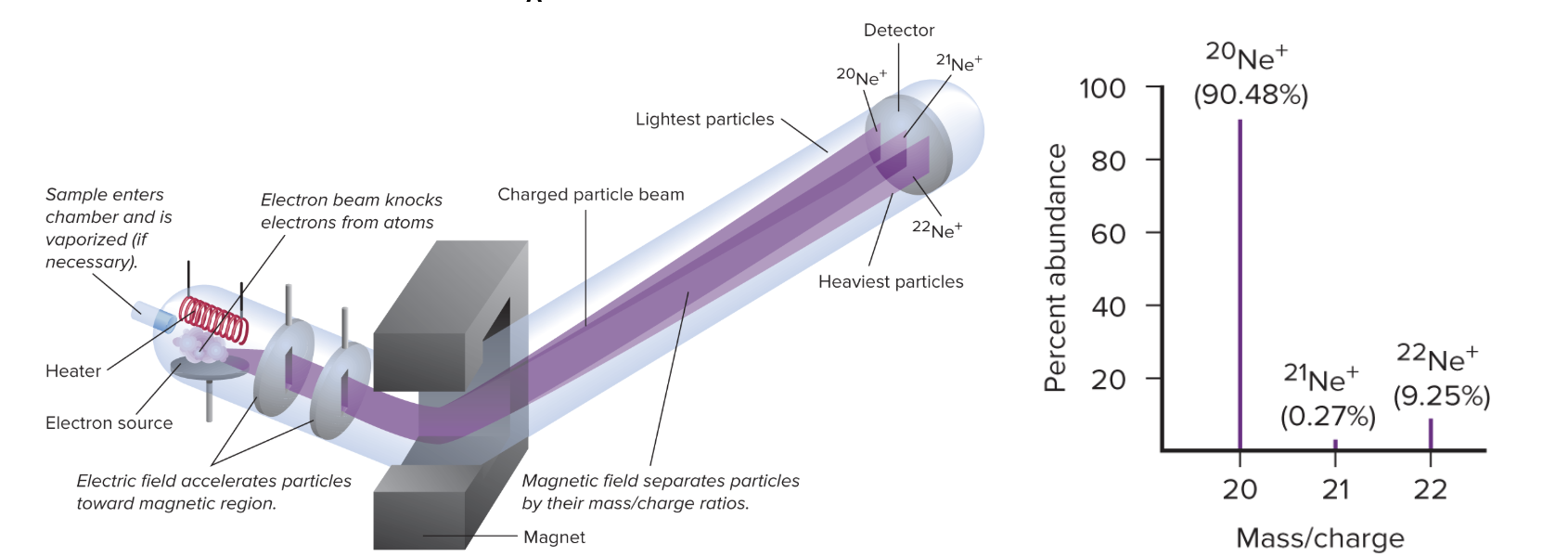
What is mass spectrometry? Give the process of it too!
ALSO, say what it can be used for (think AMU)!
Mass spec is a way to separate an element based on relative masses and abundances of atom-scale particles.
Essentially, you’ll take the substance and vaporize it into a gas so atoms can move more freely. Afterards, a high-energy electron beam will knock off the electrons, converting the molecules into positive ions (cations). Then, an electric field will accelerate the cations into high speed. Finally, they will be deflected. Ions with a lower mass will deflect more. They will all slam into a dector, which records the impact location and converts it into a graph/table.
The table generated can be used to find the average AMU! This is ez math btw
Look at image
What are periods and groups?
The periods of the periodic table are horizontal rows, while the groups are vertical columns.
Which side contains the metals? Non-metals?
The left side (group 1-2); groups 13-18
look at picture


Answer this (difficult)
For this question, we know that calculating AMU is like (known mass)*percentage + (another known mass)*percentage).
For the first one, we know some things: 120.90*x + 122.90*(1-x) = 121.76 (on periodic table).
So then we solve for x here, which is 0.57.
Then you simply plug this into the equation to find the abundance of each one, so the first one would be x = 0.57, then the second would be 1-x = 0.57 (AKA 0.43)
JUST REMEMBER TO MAKE THESE PERCENTAGES!

Answer this:
distillation; distill
What is the monomer of a protein? How many of them are there?
amino acid; 20
What is the structure of an amino acid?
A hydrogen atom, NH2 as the AMINO functional group, COOH (carboxyl functional group), and a distinctive R-group (side chain)
In an amino acid, what is the central carbon also known as?
It is known as the alpha carbon, where all of the four bonds (that make up the structure of the amino acid) bond around.

Label the image from left to right with the black covers first, then answer the pink one last (be specific with that!)
Also, is this ionized or non-ionized?
Amino group, R-chain, Carboxyl Group, Alpha carbon.
This is NON-ionized!
What happens when an amino acid is put into water? (say why)
The amino acid will ionize. Since water has a pH of 7, the amino group (NH2) will act as a base, attracting a proton to form (NH3+). Additionally the carboxyl group will donate a proton, forming COO-
Why are the charges on the functional groups (name them and give their charge) of an amino acid so important? (two reasons)
amino group (positive since it gains a proton), carboxyl group (negative since it loses a proton).
It is so important that they have charges because they help amino acids STAY in an aqueous solution, where they can interact with one another and with other solutes. Additionally, the affect the amino acid’s reactivity to perform reactions.
What is the importance of the R-chain on an amino acid?
This r-chain is what characterizes a specific amino acid (remember there’s 20).
NOTE: YOU NEED to know whether they are polar, nonpolar, acidic, basic, which one forms a disulfide bond based on a picture of them!
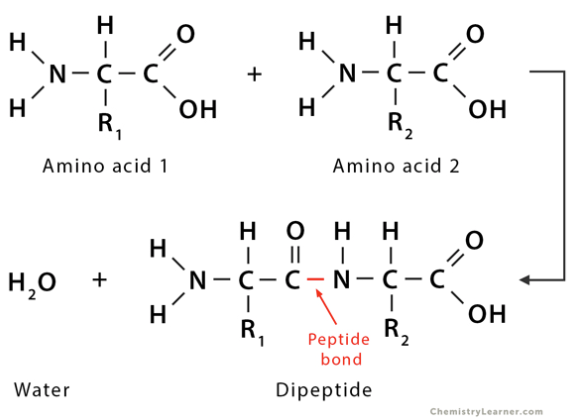
Peptide bonds are between (what kind of macromolecule)? Are they stable or unstable AND WHY?
two amino acids. They are usually stable because the nitrogen can sporadically (it goes back and forth) donate its pair of unshared valence electrons to the carbon in the C-N bond, forming a C=N double bond. When this happens, a pair of electrons are pushed FROM the carbonyl (C=O) ot the oxygen atom, forming a single bond with an oxygen anion (C—O-). This gives the peptide bond flexibility!
TLDR; think of resonance because that’s the big picture here!
Look at image for peptide bond
What is the directionality of an amino acid chain? (be relatively specific here)
It will usually start at the N-terminus (NH3+) and then end at the C-terminus or carboxyl group (COO-)
When you have many amino acids binded together, but fewer than 50, what is the chain called? What about one with more than 50?! And finally, why don’t we just called it a protein?
An oligopeptide (or simply a peptide lol). More than 50 is called a polypeptide!
We don’t just call it a protein because a protein refers to the complete, fully functional form of the molecule. They usualy contain multiple polypeptides!
What kind of R-groups would be willing to dissolve in water (or are considered hydro_____)? What about ones that don’t dissolve in water; what do they do instead?
hydrophilic;
The r-groups that fit this category are ones that are both polar and electrically charged.
The ones that don’t dissolve in water are non-polar and don’t have highly electronegative atoms capable of forming hydrogen bonds with water. Instead of dissolving, they usually group up with each other in an aqueous solution.
What amino acid is a really special one? Why?
The special one is methionine, because it does not have a negative charge, a positive charge, or an oxygen atom. It’s a nonpolar amino acid!
What is the primary structure of a protein characterized as?
The primary structure usually contains the unique SEQUENCE of amino acids. There’s over 10,000 billion variations!!!
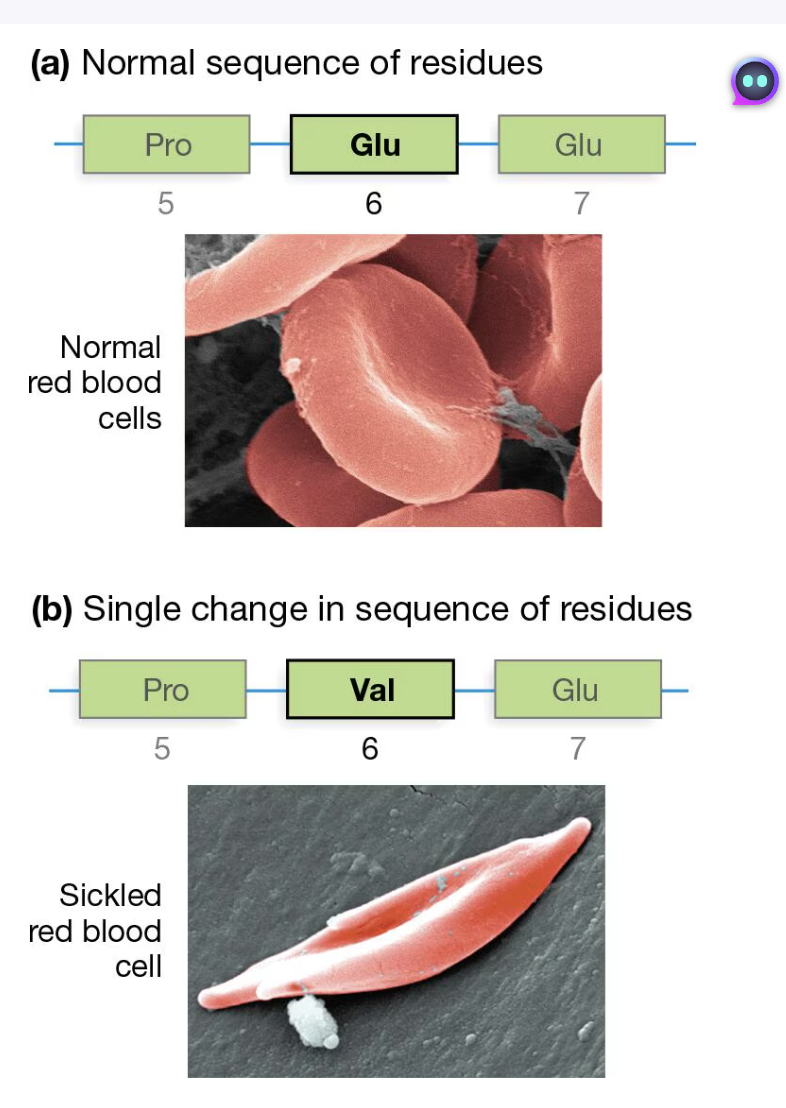
Why is the order and type of amino acid so important in the primary structure of a protein?
It is because every R-group affects the overall protein’s size, shape, reactivity, and solubility. So if something is just slightly incorrect or flipped (like a different amino acid), then the entire protein could be messed up, like in the example of hemoglobin, where a change on the amino 6 group makes it sickle cell disease.
look at image
What is the second structure of a protein characterized by? (be specific on where hydrogen bonding occurs!)
ALSO, say what this results in?
The secondary structure contains the interactions between funtional groups in the peptide-bonded backbone. They are largely formed of hydrogen bonding that occurs between the oxygen on the carbonyl group of one amino acid and the hydrogen on the amino group of another.
This will result in either an alpha-helix or beta-plated sheet (look at image)

You don’t need to know the specifics, but how do we know whether an alpha-helix or beta-plated sheet will form?
We will usually know based on the molecule’s primary structure, specifically the amino acid sequence(s). Certain amino acids, like proline, are rarely found in alpha-helices because of its unusual R-group.
How is it that hydrogen bonds give shape to an alpha or beta shape of a protein (secondary structure) if the hydrogen bond is SO much weaker to a covalent bond?
It’s mainly because of the NUMBER of hydrogen bonds that occur on both the alpha and beta shape. As a result, they make the secondary structure really stable and define its shape.
What are the characteristics of the tertiary structure of a protein? (five specifics; this is the hardest flashcard)
The tertiary structure is characterized by its three-dimensional shape, which happens from the interactions between the R-groups OR between the R-groups and their backbone. There are five important interactions that build to this 3D shape:
hydrogen bonding - between the polar side chains and/or the backbone.
hydrophobic interactions - between water molecules interacting with the hydrophilic polar side of a polypeptide, forcing the hydrophobic ends to group together
Van der Waal interactions - when nonpolar chains are close to one another, they can bring each other together for a temporary amount of time
covalent bonding between the side chains of TWO CYSTEINES via disulfide bonds. This is a VERY strong linkage that gives to shape
Ionic bonding betwen groups tha thave full and opposite charges, like the ionized acidic and basic chains
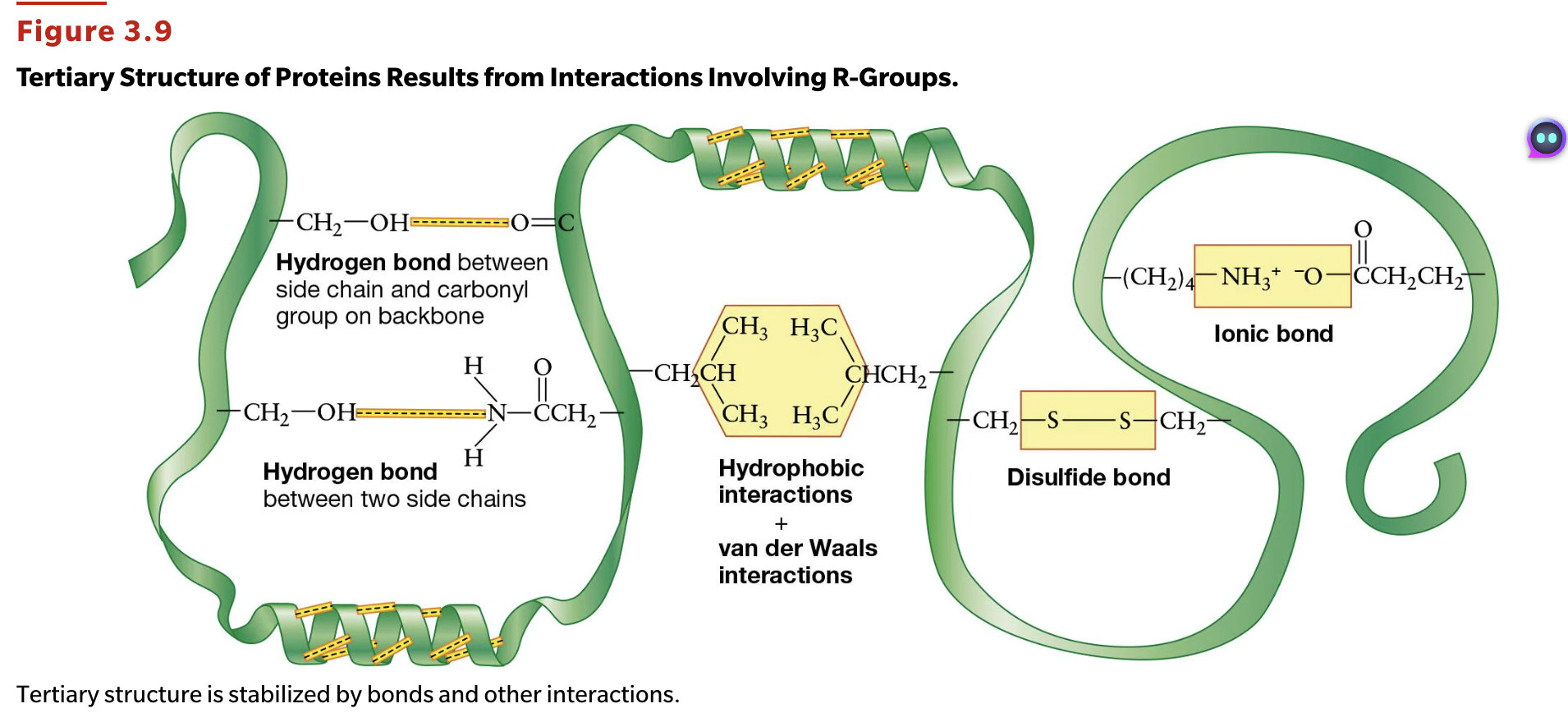
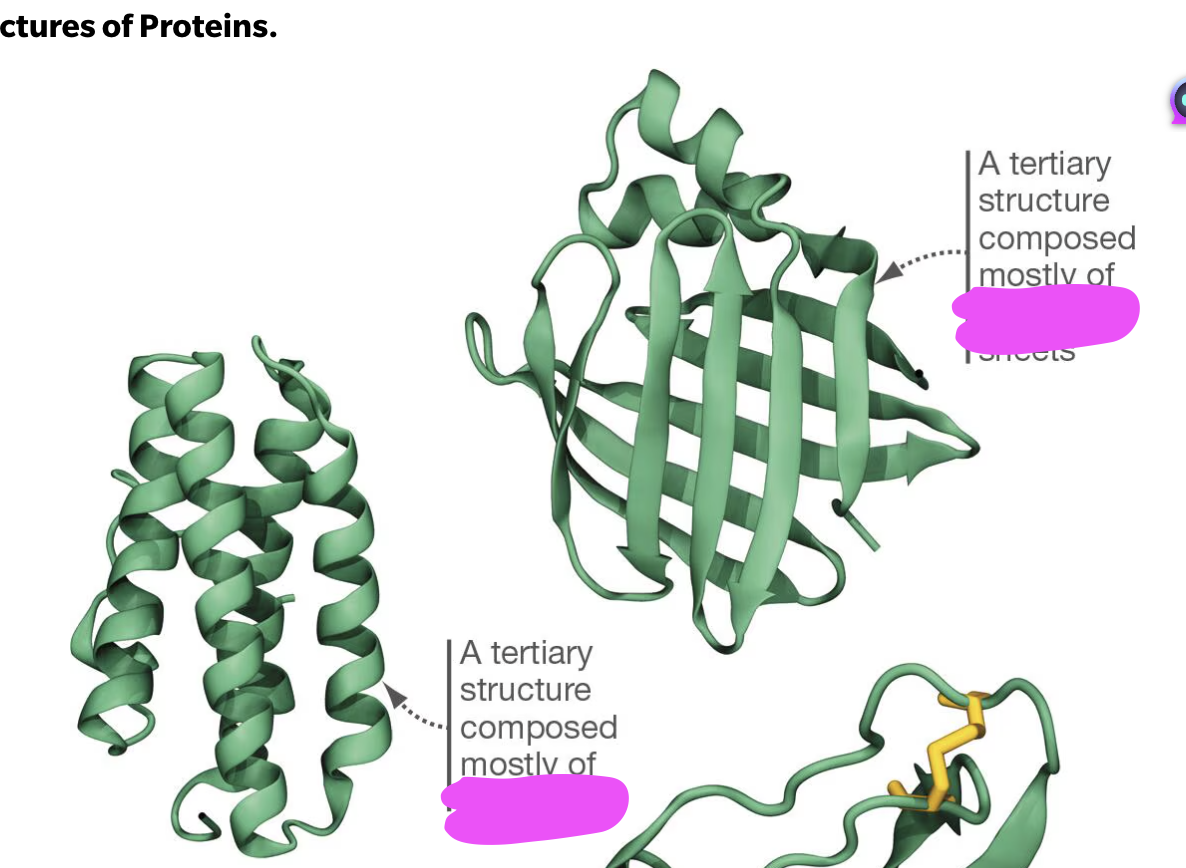
Go from left to right filling that in:
alpha-helices; beta-plated sheets
What are the characteristics of the quaternary structure?
This structure includes multiple polypeptides, which might be the same or different. When the two polypeptide subunits are identical, they are homodimers; heterodimers when they are non-identical.
You can also have a mix of homo/hetero dimers of the quaternary strucutre includes MULTIPLE polypeptides (e.g., 40).
Look at image
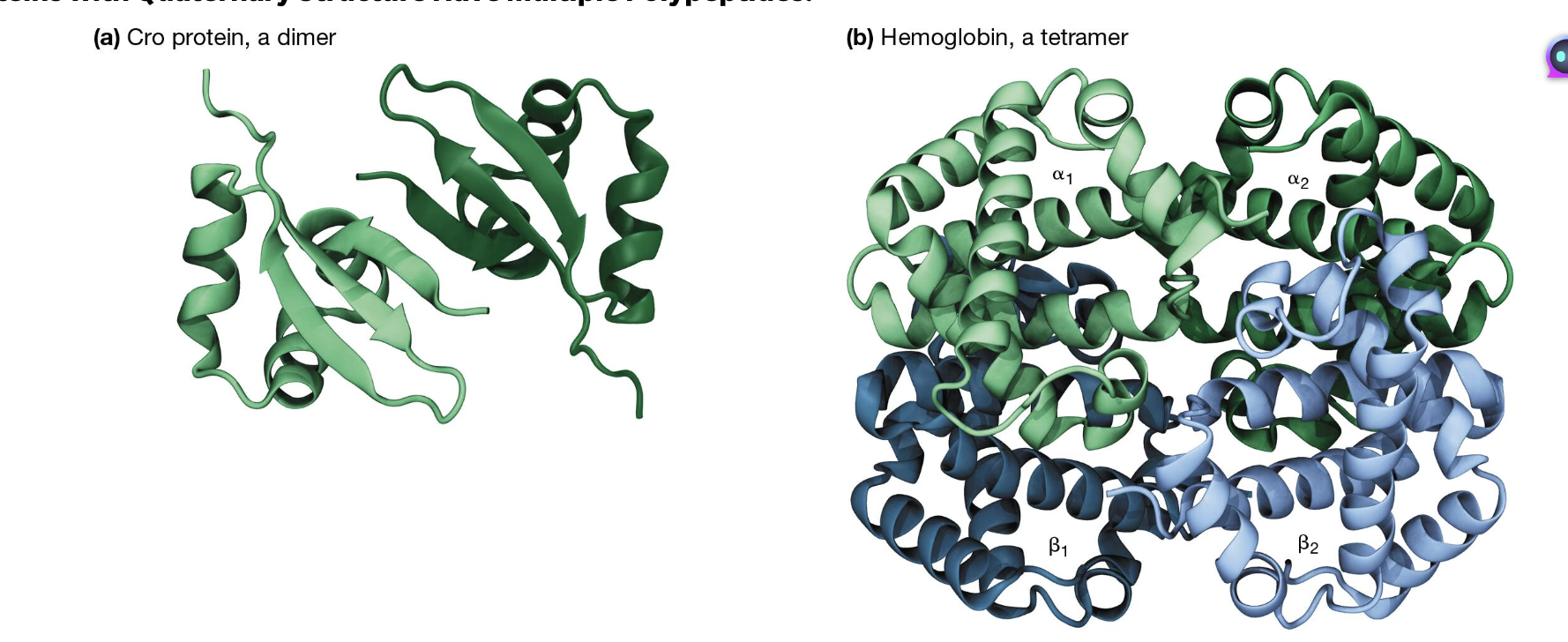
The first three stages of protein structure only involve _____?
SINGLE polypeptides
In a primary structure, what stablizes the polypeptide? What about in secondary? Tertiary? Quaternary?
Primary - Peptide bonds stablize it
Secondary - Hydrogen bonding between groups ALONG the peptided-bonded backbone
Tertiary - Bonds and other interactions (those 5) between R-groups or between R-groups and the peptide-bonded backbone
Quaternary - Bonds and other interactions between R-groups and between peptide backbones of DIFFERENT polypeptides.
Look at image (top to bottom like this card)

How might a protein be denatured? How might one guess if they’re denatured by simply looking at the protein?
A protein can be denatured if it is put into compounds that break the hydrogen bonds and disulfide bonds, which give the protein by default a unique condensed structure.
Them unfolding is a sign of denaturing!
What is the name of the special protein(s) that help proteins fold? How does this work?
They are called molecular chaperones. Essentially, they assist in the folding of a protein by attaching to the hydrophobic parts of the nonpolar side chain of polypeptides to prevent aggregates from forming, THEN, they will release them to fold properly.
look at image

Since protein folding can be so critical to its function, how is it regulated?
It is regulated by molecular chaperons and won’t fold UNLESS it binds to other molecules/ions during a signaling event (this is where molecular chaperons are apparent).
What is the reactant in a catalyzed reaction? Additionally, why are enzymes such effective catalysts?
The reactant in a catalyzed reaction is the substrate. Enzymes are so good because they can hold the subtrate in a precise orientation that allows them to react in reactions.
Where do substrates bind on the enzyme? And what happens?
They bind on the active site, which is very specific FOR that substrate. After binding, the active site will slightly shift to lock in that substrate called an induced fit.
What is the nucleic acid monomer?
nucleotides
What are the three components of a nucleotide?
a phosphate group, a five-carbon, and a nitrogenous base
You will be expected to draw a nucleotide on the exam. Draw one out, even if it’s on Microsoft Paint…
Remember, you need a five carbon sugar (draw a hexagon). The nitrogenous base is on the 1’ sugar. The phosphate grpu is ALWAYS on the 5’ sugar.
What are the monomers of RNA? What about DNA?
For RNA it’s ribonucleotides; for DNA it’s deoxyribonucleotides.
There are two main differences between DNA and RNA. Give both of them and be specific!
RNA contains one more sugar than DNA, specifically a hydroxyl group bonded to the 2’ carbon (on top of the 3’ carbon). DNA only has a hydroxyl group to the 3’ carbon. On the 2’ there is only an H. (it’s a difference of a single oxygen atom)
ADDITIONALLY, RNA contains a nitrogenous base called uracil.

Label the following images starting at the top half. Go left to right for the three. Then move to the bottom half and do the other two.
The pink ones should be listed last (go top to bottom)
Cytosine, Uracil (in RNA), Thymine, Guanine, Adenine.
Pyrimidines (the three), Purines (the two)
I know this sucks, but it’s 100% a test question. Draw both a ribonucleotide and a deoxyribonucleotide:
A ribonucleotide MUST have two hydroxyl groups (one on the 2’; one on the 3’). That’s the ONLY difference in a drawing.
Look at image
