iGCSE CS - Data Representation
 Call Kai
 Learn
Learn Practice Test
 Spaced Repetition
 Match
Match Flashcards
 Knowt Play
1/46

There's no tags or description
Looks like no tags are added yet.
Name | Mastery | Learn | Test | Matching | Spaced | Call with Kai | Chat |
|---|
No analytics yet
Send a link to your students to track their progress
47 Terms
All data must be converted to — before a computer can understand and process it
Binary
Define Denary number system
Denary is a number system that is made up of 10 digits, 0-9
It is a base-10 number system
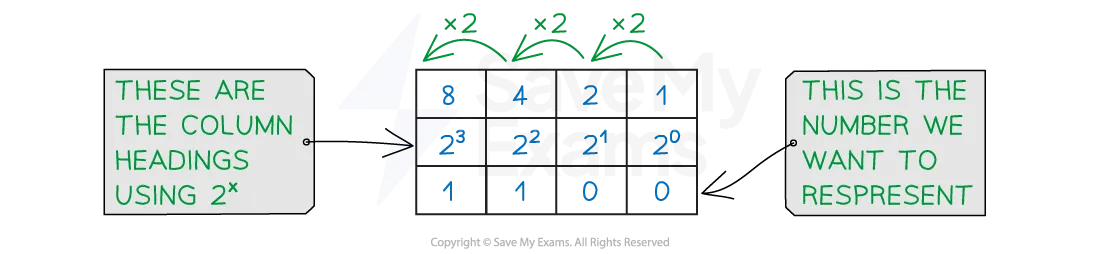
Define binary
Binary is a base-2 number system, made up of 1s and 0s.
Define Hexadecimal
Hexadecimal is a number system made up of 16 digits - 10 numbers (0-9) and 6 letters (A-F)
Base-16 number system
2 reasons why hexadecimal > binary
more bits in binary make it harder for humans to read
binary is more prone to errors when being copied
3 examples of where hexadecimal is used
MAC addresses
Color codes
URLs
MAC addresses consist of 12 — digits = 48 — digits. Writing down or performing calculations with 48 — digits makes it very easy to make a mistake.
Hexadecimal
Binary
Binary
A typical hexadecimal color code consists of — hexadecimal digits = — binary digits
6
24
Define Character Set
All the characters and symbols that can be represented by a computer system. Each character is given a unique binary code and are ordered logically.
A character set provides a — for computers to — and…
Standard
Communicate and send/receive information
Name the 2 common character sets
ASCII
UNICODE
ASCII uses — bits, providing maximum — characters
7 bits
128 characters
Extended ASCII uses — bits, providing — maximum characters. It provides essential characters such as — — and more recent symbols
8 bits
256
mathematical operators
List the 3 limitations of ASCII and Extended ASCII
ASCII has a limited n.o characters so it only represents the English alphabet and numbers, along with some characters
Cannot represent characters from other languages
No modern symbols or emojis
UNICODE uses a minimum of — bits, providing — characters max. It can represent characters from all major languages in the world.
16
65,536 characters
One drawback of ASCII
Uses more storage space
Describe the process of Analogue to Digital conversion
Measure amplitude of the analogue sound wave at a point in time, called samples
Each measurement/sample generates a value which is represented in binary and stored
Using the samples, a computer is able to generate a digital version of the original wave
Digital wave is stored on secondary storage and can be replayed back at any time by reversing the process
Define sample rate + unit of measurement
The amount of samples taken per second of the analogue wave
Hertz (Hz)
Samples are taken each second for the — of the sound.
Duration
The higher the sample rate, the…
Closer to the original sound wave the digital version looks
Define sample resolution
Number of bits stored per sample of sound
A bitmap image is made up of squares called —
Pixels
A pixel is the — — of a bitmap image
Smallest element
Each pixel is stored as..
A binary code - this is unique to colour of each pixel
Define resolution and how to calculate
The total number of pixels that make up a bitmap image
Image height x image width
Define colour depth
Number of bits stored per pixel in a bitmap image
Dependent on the number of colours needed in the image
How to calculate amount of colours from the colour depth?
2 to the power of n, n being colour depth
As resolution and colour depth increases, the file size — on — storage
increases
secondary
Simply name all the units of data storage in increasing order first
Bit
Nibble
Byte
Kibibyte
Mebibyte
Gibibyte
Tebibyte
Pebibyte
Exbibyte
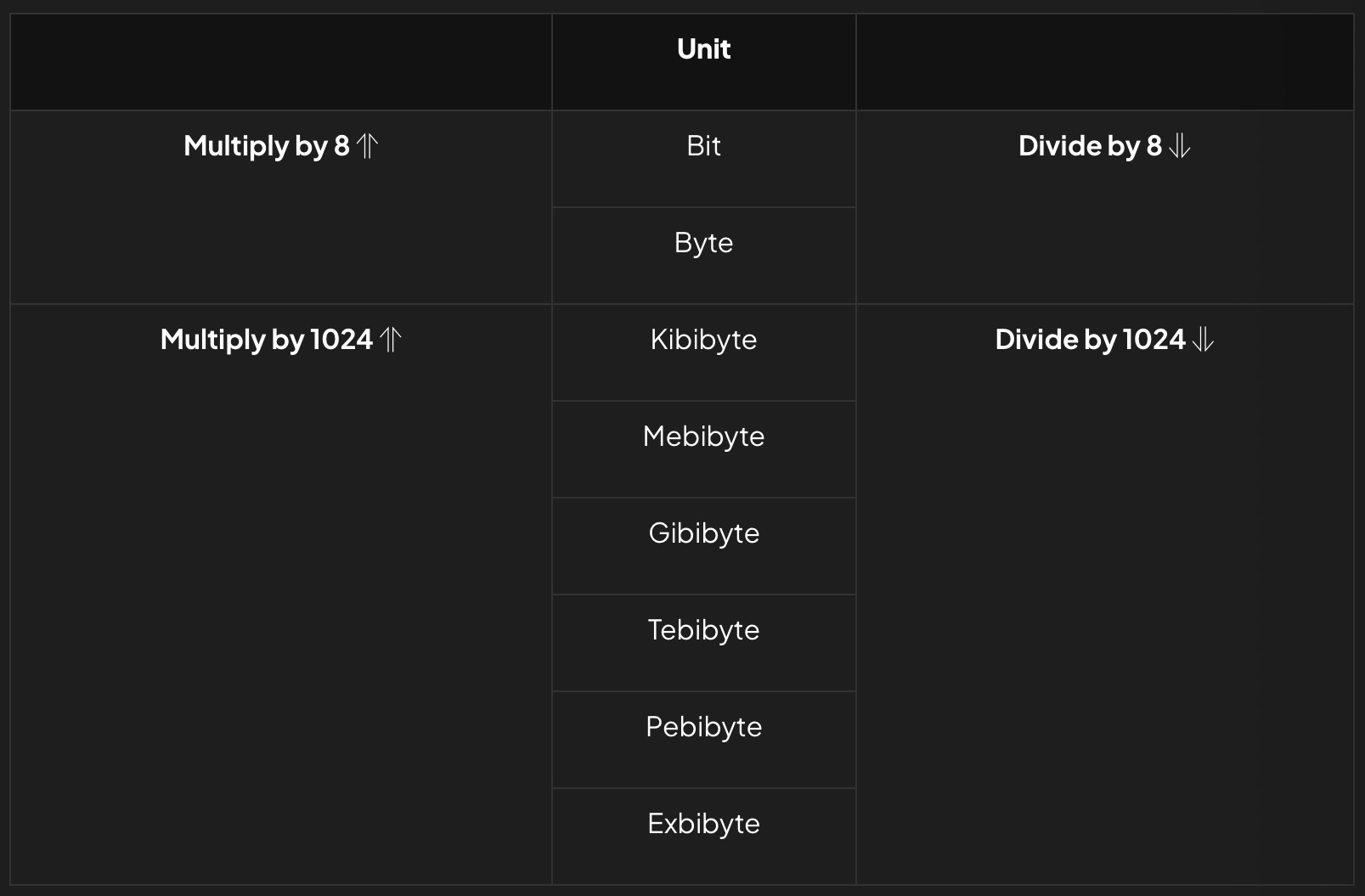
How many bits in a nibble
4
How many bits in a byte
8
How many bytes in a kibibyte
1024
Describe converting between units
Give the 2 formulae for calculating the size of a bitmap image
Resolution x Colour Depth
Image Width x Image Height x Colour Depth
Formula for calculating size of a sound file
Sample Rate x Duration x Sample Resolution
Define Compression
Reducing the file size so that it takes up less storage space on secondary storage
3 effects of compression
Less storage space required
Less bandwidth required
Shorter transmission time
Name 2 types of compression
Lossy and lossless
Define Lossy compression
When data is lost in order to reduce the size on secondary storage
Greatly reduces the file size but at the expense of losing quality
Irreversible
Define lossless compression
when data is encoded in order to reduce the file size on secondary storage
File size reduction not as dramatic
Reversible
Define Run Length Encoding (RLE) and e.g
A form of lossless data compression that condenses identical elements into a single value, with a count
E.g: AAAABBBCC is compressed to 4A3B2C
RLE is used in — — to compress sequences of the — —
bitmap images
same colour