Language Impairment
 Call Kai
 Learn
Learn Practice Test
 Spaced Repetition
 Match
Match Flashcards
 Knowt Play
1/20

There's no tags or description
Looks like no tags are added yet.
Name | Mastery | Learn | Test | Matching | Spaced | Call with Kai | Chat |
|---|
No analytics yet
Send a link to your students to track their progress
21 Terms
communication cycle
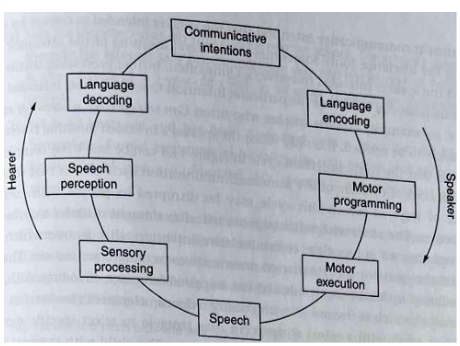
communicative intentions
- conceptualization of what one wants to sa
language endcoding
- Selection of semantic, syntactic and phonological
structures
motor programming
- Selection of motor activities (for lips, tongue, vocal
folds
motor execution
- Carrying out movements of articulator
speech
Result: audible, intelligible speech
speech processing
Conversion of sound waves in the ear from
mechanical vibrations into nervous impulses
(these are carried to auditory centers in the brain
speech perception
Recognition of nervous impulses as speech
sounds (speech vs. non-speech sounds)
language decoding
- Analysis of phonological, syntactic and semantic
structures
- Attribution of significance to utterance
Result: Communicative intentions (+ additional
pragmatic processing
expressive vs receptive language disorder
- Production vs. Understanding of utterances
- Possible mismatch in receptive and expressive skills
- Expressive disorders usually occur later: secondary to the receptive impairment (Honbolygó et al. 2006)
- Receptive: often unrecognized
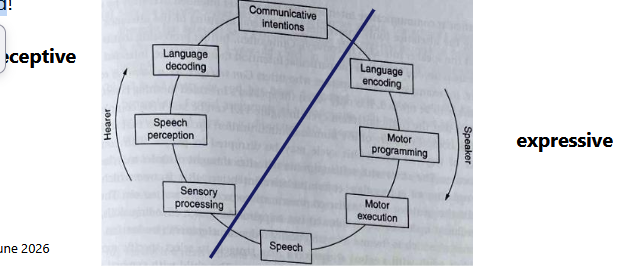
speech disorder
→ motor programming and motor execution
Example: Stuttering, verbal dyspraxia, etc.
→ Inability to program and execute articulatory movements
language disorder
anguage encoding and decoding
Example: Aphasia, DLD, etc.
→ Inability to encode or decode aspects of language (e.g. syntax, semantics)
developmental language disorder
Speech and language skills are not acquired
normally during the developmental period
1) Due to anatomical defect in pre-natal period OR
neurological insults / brain damage in perinatal
period OR neurological damage / cerebral palsy
in post-natal period
2) No evident reason (etiology unclear)
Examples: ASD, DLD
aquired language disorder
Initially intact speech and language skills
Disruption due to e.g. disease, trauma/injury
affecting the anatomical and neurological structures
that are integral to communication (e.g. multiple
sclerosis, Parkinson‘s disease, Alzheimer‘s disease),
head injury, stroke, infection (e.g. meningitis), etc.
Examples: Aphasia, Landau-Kleffner syndrome
ASD - social communication
Deficits in social communication are a defining characteristic
➢ discourse processing, narrative and referential communication
→ Impaired Theory of Mind
Understanding pragmatics, or generally “pragmatic language
ASD theory of mind
awareness that
people have mental states (such
as knowledge, beliefs, desires, and
intentions) which may differ from
one‘s own
ASD pragmatic language
“aspects of language in context that
go beyond what is explicitly stated and includes
inferencing, figurative language, scalar implicatures
DLD etiology
Breakdown in the phonetic/phonology domain alongside problems in grammatical processing
But also: specific to language
Other aspects of development (e.g. motor skills) not affected, non-verbal IQ ok
No known etiology (physiological causes
DLD sound inventories
Phonetics/Phonology
• Smaller sound inventories overall
• Higher degrees of omission of consonants (increasing as a function of position in a word)
• Simpler syllable types
DLD overregularisation
Tense marking less developed
• Past tense over-regularisation (I drinked, he falled) (higher production and acceptance rates)
• Greater use and acceptance of infinitive forms in finite positions (he fall of)
• Greater acceptance of finite form errors in VP complement positions (e.g. he made him fell)
• Less use of functional categories
DLD word retrieval
Reduced learning of novel words
• Words are vulnerable to retrieval failure (Wortfindungsstörungen)
• Don‘t know or non-specific responses in naming age appropriate objects
• Overgeneralizations: thing, stuff