Linear alg
 Call Kai
 Learn
Learn Practice Test
 Spaced Repetition
 Match
Match Flashcards
 Knowt Play
1/40

Earn XP
Description and Tags
2026
Name | Mastery | Learn | Test | Matching | Spaced | Call with Kai |
|---|
No analytics yet
Send a link to your students to track their progress
41 Terms
Linear combination

Vector form of a line
x=td+p, where l={x:x=td+p for some t exist in R}

Vector form of a plane
vector x = td_1 + sd_2 + p. That is, P={x:x=td₁+sd₂+p for some t,s exist in R}

Span

Linear dependence (geometric)

Linear dependence (algebraically)

Homogenous system of linear equations

Orthogonal

Normal vector

Normal form of a line

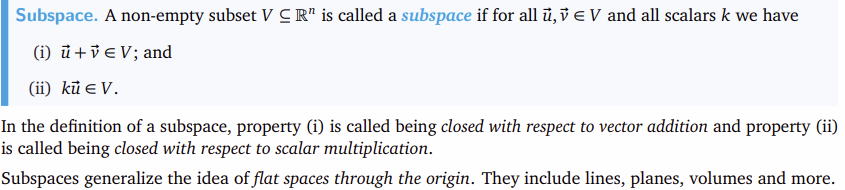
Subspace
contains a 0 vector
closed under scalar multiplication
closed under vector addition
Basis

Subspace-Span theorem

Image of a set
Image of a set X under transformation L is the set of all outputs of L when the inputs come from X

Linear transformation
Transformation T is linear of it distributes over addition and scalar multiplication

Rank of a linear transformation
Rank is used to measure compressibility. Rank 0 means sends everything to vector 0, 1 to a line, etc.

Null space/kernel
The kernel is a subspace and describes how many columns are linearly dependent in a set of vectors

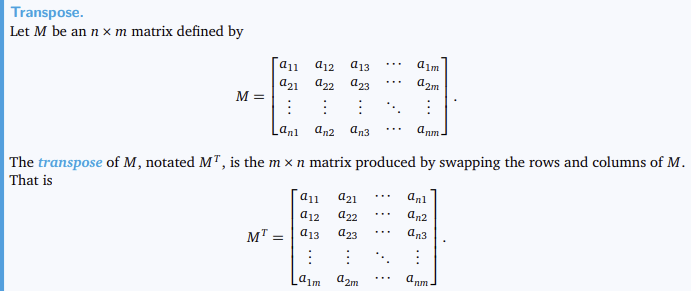
Transpose
Switching the columns and rows of a matrix
One-to-one/injective
Every column has a pivot

Onto/surjective
Every row has a pivot

Bijective
All columns and rows have pivots
Inverse matrix
Set equal to identity matrix and solve

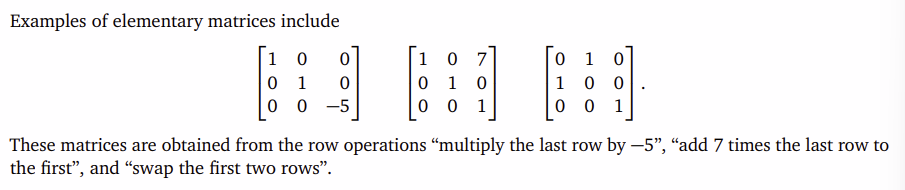
Elementary matrix
Change of basis matrix

Determinant
det(A)=ad-cb

Eigenvector

Eigenvalue
fill out
Characteristic polynomial

Diagonalizable
A matrix is diagonalizable if it is similar to a diagonal matrix
Consistent
Has at least one solution
Inconsistent
If there is no solution
Equivalent systems
2 equations or systems of equations are equivalent if they have the same solutions
RREF
The first non-entry zero in every row is a 1
above and below each leading one are zeros
Leading ones form a staircase pattern to the right and below
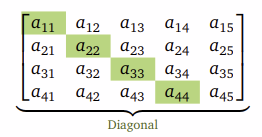
Diagonal
If all numbers above and below the diagonal are 0, then the determinant is the product of all the things in the diagonal
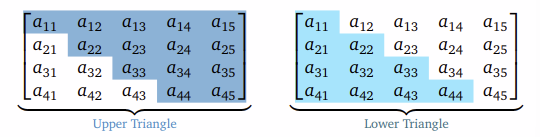
Upper and lower triangle
The top/bottom of the lower/upper triagnel include the diagonal (respectively)
Gauss-Jordan theorem
Every system of linear equations can be transformed by row operations into an equivalent system in rref, and the rref is unique
Rouché-Capelli theorem
Talks about number of solutions
1 solution if…
no solution if…
infinite solution if…
Finding bases
The nonzero rows of the rref of a matrix form a basis for its row space
Rank-nullity theorem
For an m*n matrix A,
rank(A)+nullity(A)=n
diagonalization theorem
an n*n matrix A is diagonalizable if A has n linearly independent eigenvectors
A=PDP^-1
Gram-Schmidt process
Given a linearly independent set, the process produces orthogonal basis for the same subspace