lecture 20 - DNA/RNA structure
 Call Kai
 Learn
Learn Practice Test
 Spaced Repetition
 Match
Match Flashcards
 Knowt Play
1/27

There's no tags or description
Looks like no tags are added yet.
Name | Mastery | Learn | Test | Matching | Spaced | Call with Kai | Chat |
|---|
No analytics yet
Send a link to your students to track their progress
28 Terms
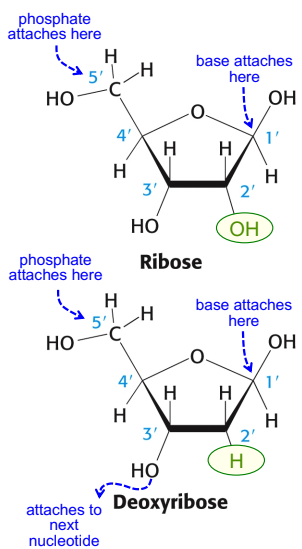
what is the basic buliding block of DNA and what is it made of
nucleotides and they are made of a phosphate group, pentose sugar, and base
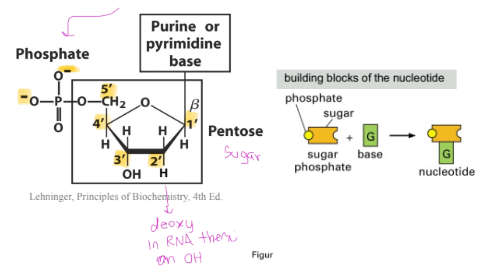
carbon numbering in pentose sugar
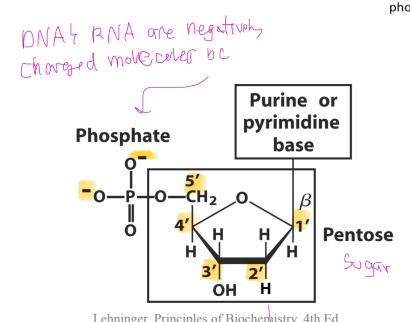
why is DNA and RNA negatively charged?
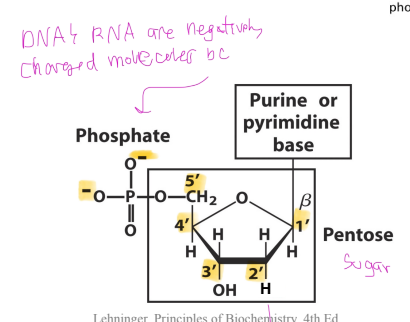
The phosphate group is an acid. At physiological pH the phosphate group of every nucleotide within the DNA/RNA strand is deprotonated and thus carries a net negative charge
what are DNA and RNA polymers called
nucleic acids
bc of the acidic phosphate groups
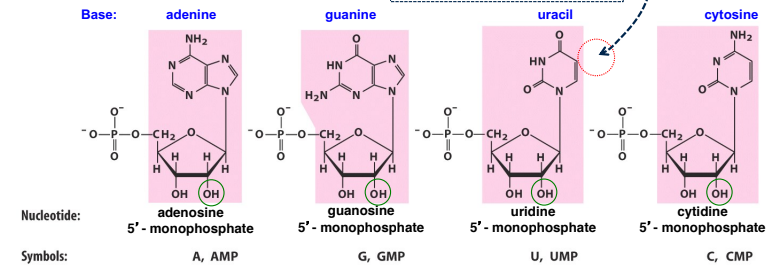
difference in pentose sugar in DNA vs. RNA
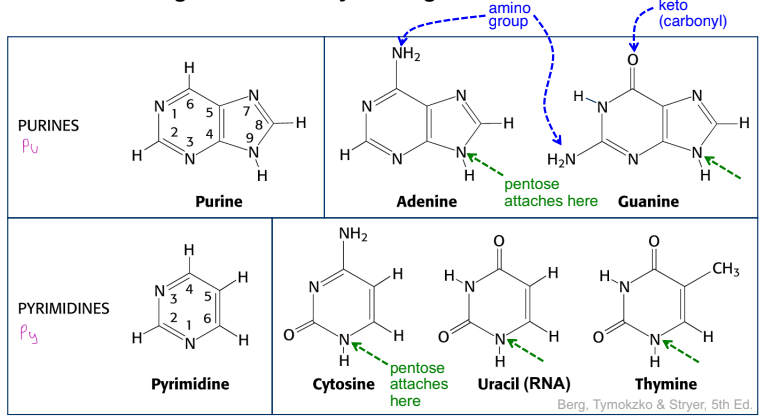
structure of bases
whats the bond between pentose sugar and base
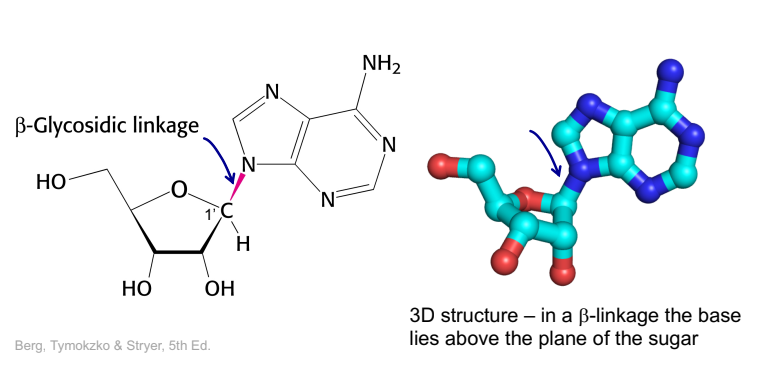
what is a nucleoside
base & sugar (not phosphate)
Deoxyribonucleotides
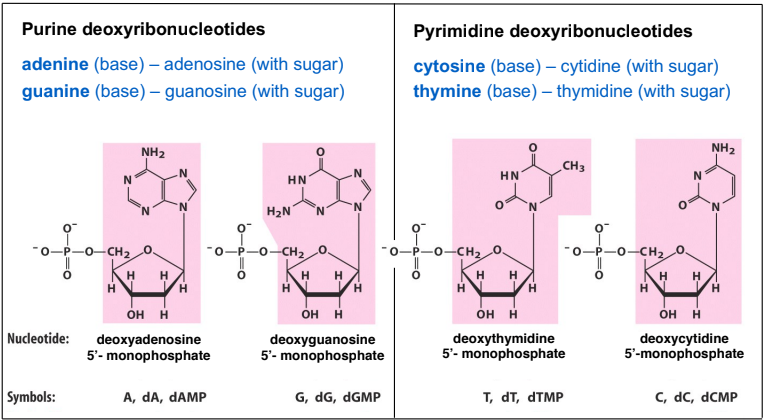
difference between thymine and uracil
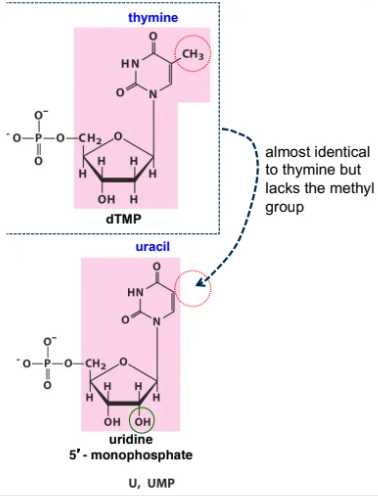
Ribonucleotides
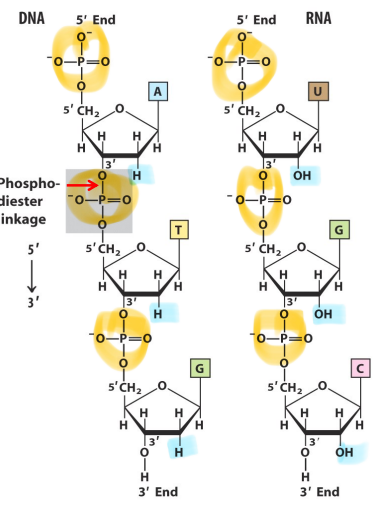
DNA primary structure
nucleotide sequence
how is nucleotide sequence written and read?
5’ → 3’
pACGTA (p = 5’ end)
what is a short nucleotide called
oligonucleotide
only a few residues (nucleotides)
5’ and 3’ ends
free phosphate at 5’ end
hydroxyl at 3’ end
is DNA asymmetric or polar
yes its both
DNA secondary structure
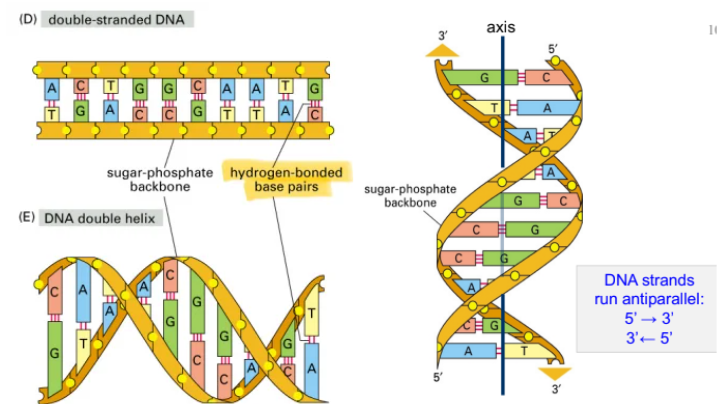
DNA base-pairing
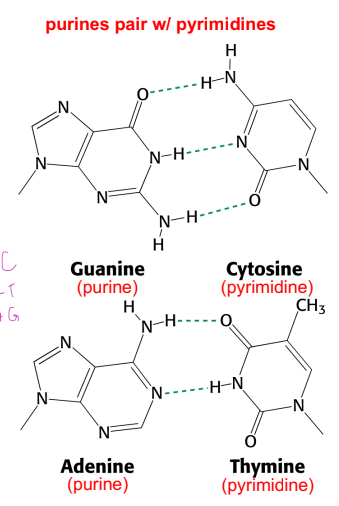
base-pairing means hydrogen bonding between the bases in the two DNA strands
pairing is specific based on H-bond complementarity: guanine forms three H-bonds with cytosine, GoC; adenine forms two H-bonds with thymine, A=T (or uracil in RNA, A=U)
watson-crick base pairing
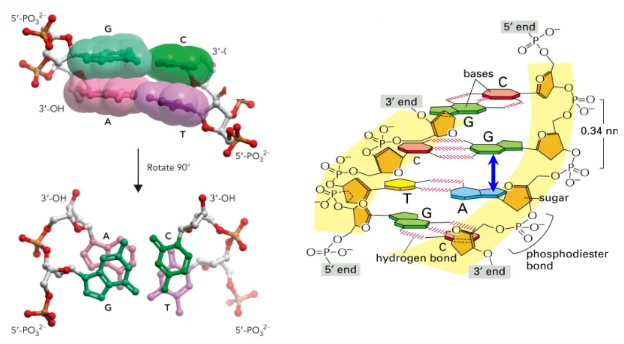
base stacking - double helix
Base stacking between the hydrophobic bases minimizes their contact with water and stabilizes
the double helix.
base-stacking is a form of van der Waals forces
bases are slightly offset so they are not directly on top of one another
the bases lie in a plane almost perpendicular to the axis of the helix
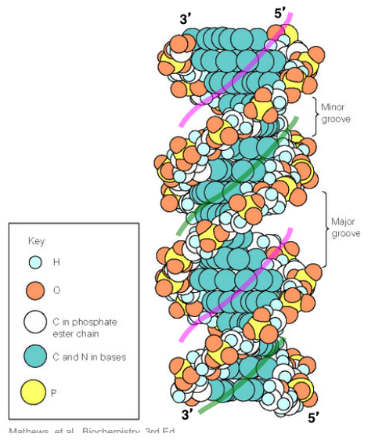
major and minor grooves - double helix
the offset pairing of the two strands (i.e., bases not in the center of the double strand) forms a major groove (deep) and a minor groove (shallow) on the surface of the duplex
these grooves lie on opposite faces of the double helix and twist around the helix axis, so that if you see a major groove facing you, the minor groove is on its back side
the base pairs are more exposed to solvent on the major groove side than minor groove side
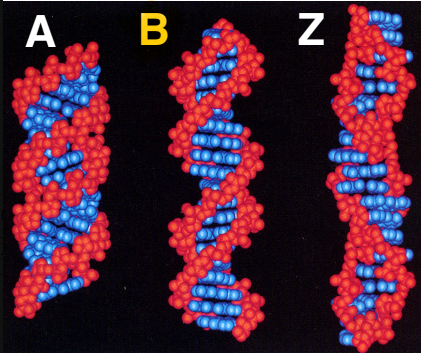
forms of double helix
A form | B form | Z form |
|
|
|
nucleotide UV light absorbtion
260 nm
purines and pyrimidines are highly conjugated - resonance among rings give most of the bonds a partial double-bond character, allows UV absorption
DNA melting (denaturation) and re-annealing (renaturation)
denaturation: DNA can be melted apart by temp or adding a chaotropic agent (urea, removing salt)
renaturation(re-annealing): when DNA is cooled or chaotropic agents removed
how is A260 used
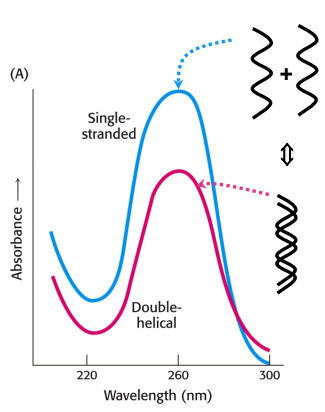
A260 is used to distinguish between single-stranded and double-stranded DNA
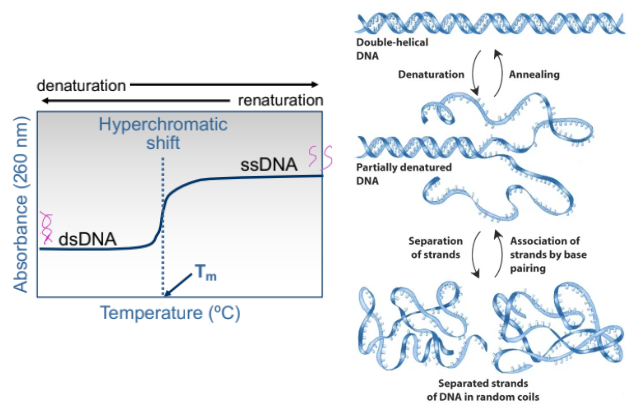
dsDNA can be disrupted by heating into ssDNA which is melted, disrupting base pairing & stacking. melting occurs at a specific temp, Tm which depends on the nucleotide sequence
when DNA is cooled, the strands re-anneal(come back tgt), stacked bases (ds) absorb less UV light than unstacked bases (ss)
beers law
alculating DNA/RNA concentration from A260
Beer's law: A = εcl
A = absorbance (measured at 260 nm)
ε = molar extinction coefficient (constant for a given nucleic acid)
c = concentration
l = path length (cm, usually 1 cm for standard cuvettes)
Rearranged to solve for concentration: c = A / (εl)
what is Tm
melting point
the temp at which half the DNA is in ds form, half is in ss form
the hyperchromic shift
The hyperchromic shift (or hyperchromic effect) is the large increase in the absorption of ultraviolet (UV) light by nucleic acids—such as DNA or RNA—when they change from a double-stranded structure to single-stranded strands. This happens during denaturation (melting) caused by heat, high pH, or chemical agents.
factors affecting Tm
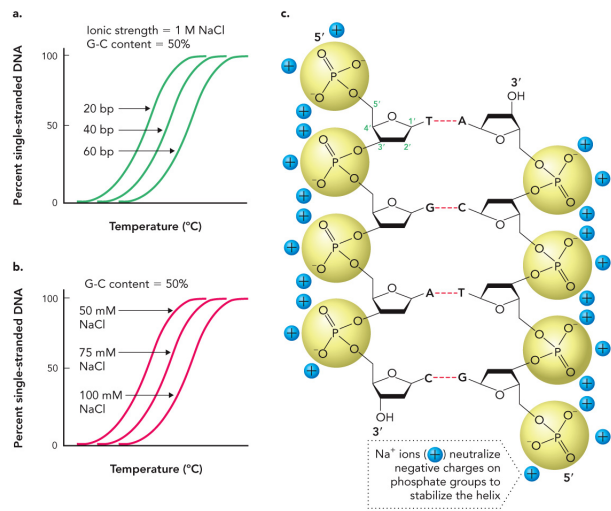
size: longer sequence length = higher Tm
GC pairs: stacking energy is more negative(more stable) for GC than AT(3 H bonds) so more GC = higher Tm
salt concentration: high salt concentration stabilizes the duplex, salt ions shield negatively charged phosphate on DNA backbone which can repel each other when unshield, so more salt = higher Tm