Intro to Anesthesia
 Call Kai
 Learn
Learn Practice Test
 Spaced Repetition
 Match
Match Flashcards
 Knowt Play
1/58

There's no tags or description
Looks like no tags are added yet.
Name | Mastery | Learn | Test | Matching | Spaced | Call with Kai | Chat |
|---|
No analytics yet
Send a link to your students to track their progress
59 Terms
define Anesthesia
A loss of sensation.
define Anesthetic agent
Any drug used to induce a loss of sensation with or without unconsciousness.
define Sedation
A drug-induced CNS depression and drowsiness.
define General anesthesia
A reversible state of unconsciousness, immobility, muscle relaxation, and loss of sensation throughout the whole body.
define Anesthetic induction
The process by which an animal loses consciousness and enters general anesthesia.
define Anesthesia maintenance
The process of keeping a patient in a state of general anesthesia during the period between induction and recovery.
define Anesthetic recovery
The period between the time the anesthetic is discontinued and the time the animal is able to stand and walk.
Tranquilization
A drug-induced state of calm where the patient is reluctant to move, and is aware but unconcerned with surroundings.
Hypnosis
A drug-induced sleep-like state that impairs the ability to respond appropriately.
Narcosis
A drug-induced sleep from which the patient is not easily aroused.
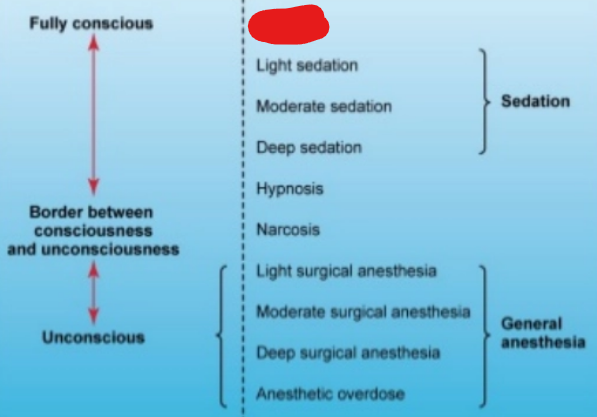
what stage is it
awake

what stage is it
light sedation

what stage is it
moderate sedation
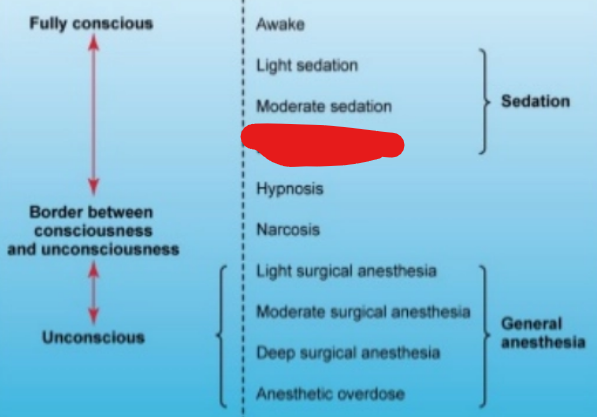
what stage is it
deep sedation

what stage is it
hypnosis

what stage is it
narcosis
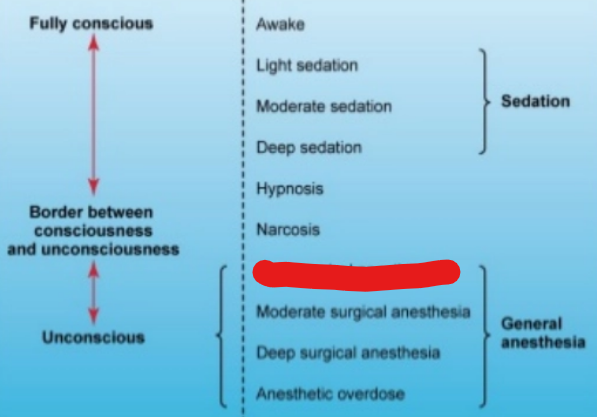
what stage is it
light surgical anesthesia

what stage is it
moderate surgical anesthesia
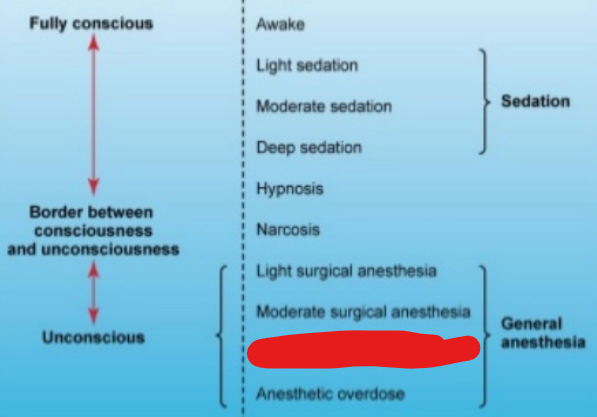
what stage is it
deep surgical anesthesia

what stage is it
anesthetic overdose
define local anesthesia
small area
define topical anesthesia
directly to site
define regional anesthetic
larger area via proximal to sensory nerves
define balanced anesthesia
The administration of multiple drugs concurrently
More amount of one drug, means — risks
higher
define Surgical anesthesia (2)
a specific stage of general anesthesia
a sufficient degree of analgesia (a loss of sensitivity to pain) and muscle relaxation to allow surgery to be performed without patient pain or movement.
define Anxiolysis
the reduction of anxiety
PR stands for (2)
prescribed rate (ml/kg/hr)
dr stands for (3)
delivery rate (drips/ml or gtt/ml)
IR stands for (2)
infusion rate (ml/hr)
DR stands for (3)
drip rate (drips/s or gtt/s)
define gtt
drops
what are two main types of circuits to use on anesthetic machines
Rebreathe system
Non-rebreathe system
equation for CRI (3ish)
mg = (( dose(mg/kg/hr) )( ml(bag size) )) / ( prescribed fluid rate(ml/kg/hr) )
Olds College Standard Rates for delivery rates for less than 10kg
60 drips/ml
Olds College Standard Rates for delivery rates for more than 10kg
10 drips/ml
Olds College standard Rates for prescription rates for PR dogs
5 ml/kg/hr
Olds College standard Rates for prescription rates for PR cats
3 ml/kg/hr
Olds College standard Rates for minimum 02 flow meter settings
1 L/mins
Olds College standard corrugated tubing for the rebreathe systemm is for patients — 10kg
over
Olds College standard bain tubing for the non-rebreathe system is for patients — 10kg
under
Olds College standard Oxygen flow rates for Chamber induction is? (2ish)
5L/min is recommended regardless of patient size
There are three main elements of preparation (3)
a general review of the procedure to determine the equipment, supply, anesthetic agent, and personnel needs,
preparation of the patient, equipment, associated supplies,
and agents that will be administered, andcommunication with the anesthesia care team prior to
commencing the procedure.
The minimum patient database consists of the following (3)
Patient history
Complete PE findings
Results of a preanesthetic diagnostic workup
The Pre-Induction Checklist (10)
Patient name, owner consent, and procedure confirmed
Intravenous (IV) catheter (cannula) placed and patent
Airway equipment available and functioning
Endotracheal tube cuffs checked
Anesthetic machine checked today
Adequate oxygen supply for proposed procedure
Breathing system connected, leak-free, and adjustable pressure-limiting valve open
Person assigned to monitor patient
Risks identified and communicated
Emergency interventions available
The Pre-Procedure Checklist (3)
Patient name and procedure confirmed
Depth of anesthesia appropriate
Safety concerns communicated
The Recovery Checklist (8)
Airway good
Breathing good
Circulation (fluid balance) good
Body temperature good
Pain good
Assessment and intervention plan confirmed
Analgesia plan confirmed
Person assigned to monitor patient
Patient History checklist (6)
Confirm the procedure to be performed
Gather historical information
Confirm compliance with fasting instructions
Confirm vaccines and other preventive care are current
Inquire about drug allergies or reactions
Note pertinent medical problems and communicate these to the attending veterinarian
Client Communication checklist (8)
Present the standard consent form
obtain the client's signature
Present a fee estimate and obtain the client's signature
Complete any financial transactions (deposits, payments, insurance)
Answer the client's questions
Inform the client of the nature of the procedure, the expected outcome, and the expected time of completion
Communicate the date and time of discharge if known
Determine an emergency communication protocol, including client phone number, availability, and schedule
Physical Examination checklist (9)
Double-check the patient's identity
Weigh the patient
Confirm the patient's sex and reproductive status
Determine the patient's hydration status
Determine the vital signs
Perform a physical assessment, focusing on the cardiovascular and pulmonary systems
Determine the patient's pain score and physical status class
Communicate to the attending veterinarian any pertinent physical abnormalities
Note any concurrent conditions that may be best treated while patient is under anesthesia
Direct Patient Preparation checklist (6)
If patient is hospitalized, make arrangements for preanesthetic fasting
Perform diagnostic tests, convey results to the attending veterinarian, and highlight abnormal data
Give medications ordered by the attending veterinarian
Place IV catheter and administer fluids if indicated
Administer preanesthetic medications
Make any necessary preparations for postoperative care
Equipment Preparation checklist (3)
Gather all necessary equipment
Prepare the anesthetic machine
Check that all equipment is in good working order
ASA is known as (not abreaviation really)
American Society of Anesthesiologists Physical Status Classification System
ASA 1 is what kind of patient
A healthy patient
ASA 2 is what kind of patient
A patient with systemic disease that is mild
ASA 3 is what kind of patient
A patient with systemic disease that is severe but not life-threatening
ASA 4 is what kind of patient
A patient with "severe systemic disease that is a constant threat to life”
ASA 5 is what kind of patient
A comatose patient who is "not expected to survive without the operation"
ASA 6 is what kind of patient
A brain-dead patient whose organs are being procured for transplantation into another patient