PSY388 Lecture 4: Emotional Disorders 3: Trauma- and Stressor-Related Disorders; Somatic Symptom and Dissociative Disorders
 Call Kai
 Learn
Learn Practice Test
 Spaced Repetition
 Match
Match Flashcards
 Knowt Play
1/28

There's no tags or description
Looks like no tags are added yet.
Name | Mastery | Learn | Test | Matching | Spaced | Call with Kai | Chat |
|---|
No analytics yet
Send a link to your students to track their progress
29 Terms
Trauma- & Stressor-Related Disorders
Posttraumatic Stress Disorder (PTSD)
Acute Stress Disorder
Adjustment Disorders
The prevalence of PTSD in Primary Care
PTSD in this setting is common (regardless of the type of population) with the medican prevalence (12.5%) approximating that of depression.
The prevalence of psychological disorders in individuals with and without posttraumatic stress disorder

DSM-5-TR Posttraumatic Stress Disorder (PTSD) - Criterion A
A. Exposure to actual or threatened death, serious injury, or sexual violence in one (or more) of the following ways:
1. Directly experiencing the traumatic event(s).
2. Witnessing, in person, the event(s) as it occurred to others.
3. Learning that the traumatic event(s) occurred to a close family member or close friend. In cases of actual or threatened death of a family member or friend, the event(s) must have been violent or accidental.
4. Experiencing repeated or extreme exposure to aversive details of the traumatic event(s) (e.g., first responders collecting human remains; police officers repeatedly exposed to details of child abuse).
LEC-5 (NCPTSD, 2013)

Criterion A & PTSD Recovery
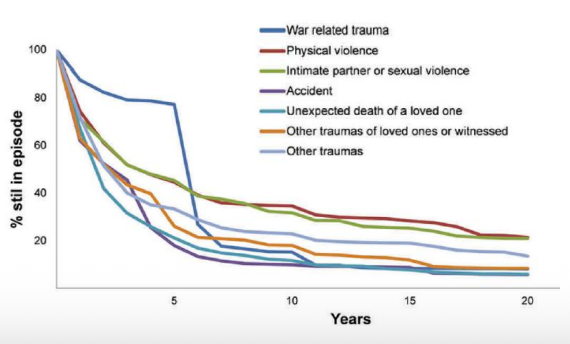
DSM-5-TR PTSD
Intrusion “reexperiencing” sx (e.g., recurring intrusive memories, flashbacks, disturbing dreams/nightmares)
Avoidance
Negative alterations in cognition/mood (e.g., shame/guilt/blame, impaired memory, depression, anhedonia
Altered arousal/reactivity (e.g., hypervigilance, exaggerated startle, aggression, irritability, impaired attention/concentration, sleep disturbance)
Different criteria for children under 6 years old
ICD-11 PTSD
Re-experiencing symptoms (e.g., recurring intrusive memories, flashbacks, disturbing dreams/nightmares)
Deliberate avoidance
Persistent perceptions of heightened current threat (e.g., hypervigilance, exaggerated startle,
aggression, irritability, impaired attention/concentration, sleep disturbance)
Negative alterations in cognition/mood (e.g., shame/guilt/blame, depression, anhedonia)- Additional clinical features
PTSD

PTSD: EvidenceBased Treatments

Little evidence for pharmacotherapy alone for PTSD
High dropout of all treatments for PTSD
Use of MDMA for PTSD, only after use of other treatments haven’t worked due to expenses
Meditation and Yoga for PTSD treatment
Both patients & providers ask for more PTSD treatment options
Meditation & yoga allow for a variety of treatment options & address several domains of PTSD.
Meditation & yoga-based approaches yielded small to medium effects on PTSD symptom reduction.
Complementary interventions increase patient choice & offer a second-line treatment option.
Efforts to move toward integrative approaches for PTSD warrant further study.
Dissociative Disorders
Dissociative Identity Disorder (DID)
Dissociative Amnesia
Depersonalization/Derealization Dx
DSM-5 Dissociative Disorders
Disruption of and/or discontinuity in the normal integration of consciousness, memory, identity, emotion, perception, body representation, motor control, and behaviour
“Positive” symptoms: intrusions and loss of continuity (e.g., fragmented identity, depersonalisation, derealisation)
“Negative” symptoms: inability to control function or access info (e.g., amnesia)
Dissociative Identity Disorder (DID)
Two or more distinct identity or personality states
Up to 90% report hx of trauma, abuse, neglect
High suicide risk (~70%)
Dissociative Amnesia
Loss of memory for personal info
“Amnesia for their amnesia”
Depersonalisation/Derealisation Disorder
Changes to sense of self (e.g., an outside observer to oneself, or detached)
Changes to sense of world (e.g., surroundings suddenly seem foreign, lacking depth)
Dissociative identity as a continuum from healthy mind to psychiatric disorders: Epistemological and neurophenomenological implications approached through hypnosis
During hypnosis the subjects underwent spontaneous non-intrusive experiences of other selves which were not recalled after the end of the session, due to posthypnotic amnesia. The fMRI showed a significant decrease of connectivity in the DMN especially between the posterior cingulate cortex and the medial prefrontal cortex.
Dissociation in Psychiatric disorders
Symptoms of dissociation are present in a variety of mental disorders and have been connected to higher burden of illness and poorer treatment response, and not only in disorders with high levels of dissociation
Epidemiology of depersonalisation and deralisation
transient symptoms of depersonalisation/derealisation in the general population are common, with a lifetime prevalence rate of between 26 and 74% and between 31 and 66% at the time of a traumatic event
Treatment of Dissociative Disorders
Three-phased approach:
1. Safety, stabilisation, symptom reduction
2. Cognitive reappraisal and integration of traumatic memories
3. Integration and rehabilitation of different identities
Other potential approaches (typically, trauma-focused):
DBT
Transdiagnostic CBT
Schema Therapy
Imagery Rescripting
Interpersonal Therapy
?Hypnosis
?rTMS
?Medicatio
Somatic Symptom & Related Disorders
Somatic Symptom Disorder
Illness Anxiety Disorder
Functional Neurological Symptom Disorder (Conversion Disorder)
Factitious Disorder
Chronic pain, psychipathology & DSM-5 Somatic symptom disorder
Historically, pain without an apparent anatomical or neurophysiological origin was labelled as psychopathological. This approach is damaging to the patient and provider alike…many medically unexplained pains are now understood to involve an interplay between peripheral and central neurophysiological mechanisms that have gone awry. The new DSM-5 somatic symptom disorder overpsychologizes people with chronic pain; it has low sensitivity and specificity, and it contributes to misdiagnosis, as well as unnecessary stigma [emphasis added]
Comorbidity(a) of 12-month mental disorders and physical conditions, by sex, 2020–2022

Somatic Symptom Disorder
Experience distressing or debilitating somatic symptoms
Excessive thoughts, feelings, behaviours
Somatic sx may be explained OR unexplained by medical condition
Most common = w/ predominant pain, persistent
Illness Anxiety Disorder
Preoccupation with & worry/anxiety about getting a serious illness
Excessive health “checking”, reassurance seeking, help seeking or avoidance
Somatic sx nonexistent or only mild
Functional Neurological Symptom Disorder (Conversion)
Unexplained disturbance in motor or sensory functioning (e.g., loss of function)
Clinical review finds incompatibility between symptom and recognised neurological/medical condition
Factitious Disorder (by Proxy)
Deliberate fabrication of psychological or medical symptoms
No obvious external reward (other than attention/comfort)
Somatic Symptom Disorder w/ predominant pain “CBT for Chronic Pain”

Treatment of Somatic Symptom Dx “CBT for Chronic Pain”
Individual and group-based CBT:
Psychoeducation
Cognitive reappraisal
Behavioural experiments
Paced activities
Graded exposure
Response prevention (reassurance-seeking, avoidance)
Medical:
ONE primary physician
Assessment
Non-prescription analgesics