Biology topic 5
 Call Kai
 Learn
Learn Practice Test
 Spaced Repetition
 Match
Match Flashcards
 Knowt Play
1/50

There's no tags or description
Looks like no tags are added yet.
Name | Mastery | Learn | Test | Matching | Spaced | Call with Kai | Chat |
|---|
No analytics yet
Send a link to your students to track their progress
51 Terms
what is an ecosystem
A community of organisms in conjunction with nonliving factors EG rainfall
Community
The various populations found in an area
Population
a group of individuals of a single species
Habitat
an area with distinct set of conditions where an organism lives
Abiotic factors
non-living physical and chemical components of an environment that influence the distribution, survival, and growth of living organisms
biotic factors
all the living components of an ecosystem that shape, influence, and interact with other organisms
List the biotic factors that can affect the numbers and distribution of species in an ecosystem
interspecific, intraspecific competiotion, predation
List the abiotic factors that can affect the numbers and distribution of species in an ecosystem
air/soil temp, rainfall, humidity, disolved oxygen sensor, light intensity, aspect, slope, soil compction, soil/water PH, soil water content
the two sampling techniques that can be carried out in an ecological study
systematic and random
how to determine which method is appropriate based on the area of study (give examples)
Systematic Sampling
Use when there is a clear environmental gradient.
Why: Shows how species change across the gradient.
Example: Plant distribution from shore → inland along a transect.
Random Sampling
Use when the area is uniform with no obvious pattern.
Why: Avoids bias and gives a representative sample.
Example: Estimating clover cover in a uniform grass field.
a valid and reliable method for carrying out systematic sampling
Lay a transect line across the environmental gradient.
Place quadrats at regular intervals (e.g., every 2 m).
Use the same quadrat size and same measurement technique each time.
Keep conditions consistent (same observer, time of day).
Repeat the transect multiple times to improve reliability.
a valid and reliable method for carrying out random sampling
Divide the study area into a grid using tape measures.
Use a random number generator to select grid coordinates.
Place quadrats at the randomly chosen points to avoid bias.
Use the same quadrat size and same measurement technique each time.
Keep conditions consistent (same observer, time, weather).
Take many samples to increase reliability.
how a frame quadrat can be used to estimate percentage cover of a species
Place the frame quadrat randomly or systematically in the study area.
Look at each square within the quadrat and judge whether the species is present.
Count how many squares contain the species.
Calculate percentage cover:
Percentage cover=Number of squares with speciesTotal squares×100
If squares are not marked, estimate visually what proportion of the quadrat is covered.
how a frame quadrat can be used to calculate species richness
Place the frame quadrat randomly or systematically in the habitat.
Identify every different species present inside the quadrat.
Count the number of distinct species (not abundance).
Repeat in multiple quadrats and calculate the mean species richness.
when it would be appropriate to use a student t test stats analysis. Give a couple of examples
compareing two mean values
how you would correctly write a hypothesis for the student t test
Null hypothesis (H₀)
There is no difference in the population means.
→ Uses = (or “no change” for paired tests)
how you would select the correct critical value to compare to
degrees of freedom and significance
how you would write a conclusion to a student t test if the result was significant
The result is significant at the 0.05 level, so the null hypothesis is rejected. This means there is a statistically significant difference between the two means. The data therefore support the conclusion that [insert biological effect].
how you would write a conclusion to a student t test if the result was insignificant
The calculated t‑value was less than the critical value, so the result is not significant at the 0.05 level. The null hypothesis is retained. This means there is not enough evidence to conclude that the two means are different.
Give the definition of primary and secondary succession
the gradual development of an ecosystem, changes the proportion of species over time
primary - development from nothing
secondary- rebuilding an ecosytem after damage
Give the definition of a pioneer species
the first species to colonize an area
Explain how pioneer species are adapted to exploit their niche
Generally extremeophiles, able to survive with very little nutrience in harrsh environmnets, break up the soil and decompose adding nutience
Explain how pioneer species change the abiotic conditions in an ecosystem
they break up the soil and as they decompose they add nutrients to the soil
Give the definition of a climax community
pioneer species are out competed until staability is reached, many species
Explain the stages of succession from colonisation to climax community
pioneer stage - pioneer species such as lichens and small plants
these decompose to add nutriients to the soil, and they break up the soil
SOIL IS FORMED
more plants and shrubs can grow who generally outcompete the pioneer species
CLIMAX COMMUNITY
eventually reaches a steady state where species are stable and few changes occur
balanced symbol equation for photosynthesis

the definition of photosynthesis
Photosynthesis isthe process used by plants, algae, and some bacteria to turn sunlight, water, and carbon dioxide into oxygen and energy-making sugar
the meaning of the acronym OILRIG in relation to photosynthesis
oxidation Is Loss (of electrons), Reduction Is Gain (of electrons).
In photosynthesis, NADP is reduced when it gains electrons and H⁺ to form reduced NADP.
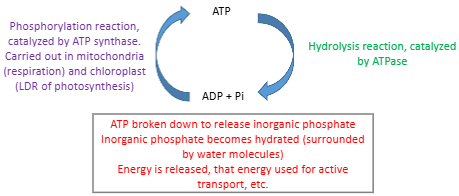
Give the equation to form ATP. State the name of the reaction and the enzyme responsible
:
Phosphorylation

Give the equation to breakdown ATP. State the name of the reaction and the enzyme responsible
hydrolysis

Explain how ATP can be used as an energy source
ATP hydrolysed (ATP à ADP + Pi)
Phosphate hydrated/surrounded by water molecules
Energy released (when bonds formed between water and phosphate)
Describe the structure of ATP
a nitrogenous base, a pentose sugar, and a chain of three phosphate groups

Compare and contrast the structure of ATP to a DNA nucleotide
Both have a a pentose sugar phosphate and nitrogenous base
ATP= why both sugar Vs DNA = deoxyribose
ATP = always adenine DNA = Adenine thymine cytosine or guanine
State the site of light dependent reactions
thylakoid membrane
Describe photolysis
water broken down via light

State the term used to describe the production of ATP via the light dependent reaction. Explain why it is given this name
photophosphorylation - splitting of water with light, adding phosphate group
State the term used to describe the process by which electrons move down the electron transport chain. Explain why the term is used
redox reaction, both oxidation and reduction occur
State the three products of light dependent stage
ATP, reduced NADP, O2
State the role of the three products of the light dependent stage
ATP: Acts as a chemical energy carrier that transfers energy to power the light-independent reactions (Calvin cycle) in the stroma
Reduced NADP: Provides high-energy electrons and hydrogen ions needed to convert carbon compounds into sugars during the light-independent stage.
Oxygen: Released as a byproduct into the atmosphere (or used in cellular respiration) following the photolysis (splitting) of water molecules.
Describe the process of the light dependent stage
Takes place at thylakoid membrane/grana/granum
Light strikes chlorophyll, 2e- released to a higher energy level
2e- move down electron carrier molecules via redox reactions
ADP+Pi à ATP via ATP synthase
Water undergoes photolysis into 2e- , 2H+ and ½ oxygen
2e- replace those lost from chlorophyll
2H+ and 2e- combine with NADP to form NADPH/reduced NADP
the site of the light independent reactions
stroma
the alternate name for the light independent reactions
calvin cycle
light independent reactions can be divided into three interlinked reactions
carbon fixation, reduction and phosphorylation
what happens in carbon fixation
RuBP +Co2 —> GP via RUBISCO
what happens in reduction
GP —>GALP
ATP—> ADP +Pi for energy
NADPH —> NADP for H+ ions and electrons
what happens in phosphorylation
GALP —>RuBP
using the phosphate form ATP —> ADP + Pi, it the inorganic phosphate
the process of the light independent stage
Occurs in the stroma
CARBON FIXATION
RuBP +Co2 —> GP via RUBISCO
REDUCTION
GP —>GALP
ATP—> ADP +Pi for energy
NADPH —> NADP for H+ ions and electrons
PHSOPHORYLATION
GALP —>RuBP
using the phosphate form ATP —> ADP + Pi, it the inorganic phosphate
2GALP —> 1 glucose
the products of the light independent stage can be used to produce cellulose cell walls
2x GALP - beta glucose, this can be polymerised to cellulose
the light independent stage relies on the light dependent stage occurring
It needs the products of ATP - for energy for GP —> GALP and phosphate to convert GALP to RuBP again
It also needs NADPH —> NADP for the hydrogen ions
Draw and label a diagram of the chloroplast, show on the diagram where the light dependent and light independent reactions occur
LDR thylakoid membrane, LIR stroma
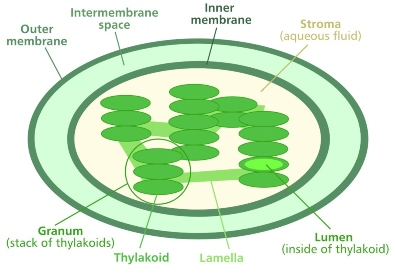
State the adaptations the chloroplast has for enabling photosynthesis
chlorophyll - light sensitive pigment which triggers the LDR
starch grain - holds energy
enzymes - cataluse the reactions
surface area - maximises the rate of the LDR and space that can hold excited H+ ions