Key Science skills Psych
 Call Kai
 Learn
Learn Practice Test
 Spaced Repetition
 Match
Match Flashcards
 Knowt Play
1/18

There's no tags or description
Looks like no tags are added yet.
Name | Mastery | Learn | Test | Matching | Spaced | Call with Kai | Chat |
|---|
No analytics yet
Send a link to your students to track their progress
19 Terms
Controlled experiment
investigates the relationship between one or more IV(s) and a DV, while all other variables are controlled.
Controlled experiment strengths and limitations
strengths:
can idenitify a cause and effect relationship between IV(s) and DV
can be repeated to gather more data and increase reproducibility and repeatability of results
Limitations
strictly controlled conditions/variable can be hard to maintain, so results can be influenced by extraneous variables
participants behaviours may be influenced by the artificial nature of the setting
external validity can be low due to artificial nature
Between subjects design
investigation design in which participants are allocated to only one condition of the experiment
Between subjects design strengths and limitations
strengths:
time efficient, as both groups can be tested at the same time
lower rate of participant withdrawal
Limitations:
more participants needed
less control over extraneous variables of participants
Within subjects design
All participants in the sameple completing all conditions of the experiment
Within subjects design strengths and limitations
strengths:
no extraneous variables
fewer participants needed than in a between subjects design
Limitations
more time consuming, as both cannot be tested at the same time
higher rate of participant withdrawel, as DV has to be measure multiple times
Stratified sampling
When the population is divided into groups based on relevant characteristics, participants are selected from each group in proportion to how they appear in the population
time consuming and expensive
may be unethical or impossible to obtain such groups
if sample is big enough it could improve external validity
random sampling
When every member of a population has an equal chance of being selected for the sample
reduces bias → more likely to represent population
time consuming
Neither stratified nor random sample (convenience)
Sample selected using the quickest and easiest means possible, selecting readily available people
However not representative of the population
Random error
Affect the precision of a measurement by creating unpredictable variations in the measurement process, resulting in a spread of readings.
Maybe be produced by a limitation in the instrument, an environment factor or a slight variation in the procedure
Systematic error
affect the accuracy of a measurement by causing readings to differ from the true value by a consistent amount or by the same proportion each time a measurement is made
All the readings are shifted in one direction from the true value
May be produced by observational error, imperfect instrument calibration or environmental interference
Personal errors
mistakes, miscalculations an dobserver errors made when conducting research
to remove them, the investigation should be repeated correctly, and errors should NOT be included in the reporting and analysis of the data
uncertainty
lack of exact knowledge of the value being measured
NOT the same as error - results cna be uncertain even when measurements are taken correectly.
Repeatability
Repeatability refers to the degree to which a specific research investigation obtains similar results when it is conducted again under the same conditions on all occasions.
Can the same person get the same results using the same method under the same conditions?
Focuses on consistency within the same setup.
→ Think: If I re-do the same experiment, do I get the same result?
Reproducibility
Reproducibility refers to how close the results are to each other when an investigation is replicated under changed conditions.
Are the results consistently accurate across different times, people, or tools?
Focuses on overall consistency and trustworthiness of the measurement.
→ Think: Is this method giving me the right result every time, no matter who uses it?
Is my sample representative of the population?
Precision
how close a set of measurement values are to each other (SD)
Accuracy
how close a measurement is to the true value of the quanitity being measured
fieldwork
a type of investigation that involves collecting information through observing and interacting with a selected environment
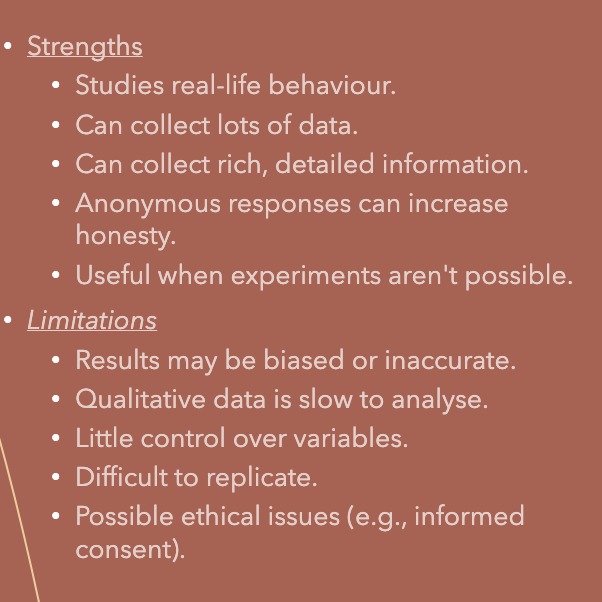
Strengths and limitations of fieldwork