L14 - FA Synthesis
 Call Kai
 Learn
Learn Practice Test
 Spaced Repetition
 Match
Match Flashcards
 Knowt Play
1/14

There's no tags or description
Looks like no tags are added yet.
Name | Mastery | Learn | Test | Matching | Spaced | Call with Kai | Chat |
|---|
No analytics yet
Send a link to your students to track their progress
15 Terms
Overall lipid catabolism scheme
Acetyl-CoA turns into free fatty acids that can be used to make triacylglycerols, glycophospholipids, sphingolipids, or eicosanoids
Acetyl-CoA turns into HMG-CoA and enters keto body synthesis to allow acetyl-CoA to be distributed throughout the body
HMG-CoA is used to make cholesterol that can be turned into steroids, bile, acids, or vitamins (Ex. Vit D)

General information about FA synthesis
Makes long FA chains
Most cells can do this, but liver and adipose tissue create the most
Occurs in the cytosol
Has a three-carbon intermediate called malonyl-CoA
Energy-expensive/highly regulated
Requires 14 reducing equivalents (NADPH from PPP) and 7 ATPs
Formation of Malonyl-CoA; pathway within enzyme; similar to what enzyme seen previously
Acetyl-CoA + Bicarbonate + ATP → Malonyl-CoA + ATP + Pi via an enzyme complex consisting of: Biotin carboxylase domain + Biotin carrier protein domain + Transcarboxylase
HCO3- is attached to biotin via ATP hydrolysis at biotin carboxylase domain
Biotin carrier protein domain rotates 180° to the transcarboxylase domain
Acetyl-CoA enters transcarboxylase domain and attaches to bicarb, which is then released from the biotin arm
Acetyl-CoA carboxylase (ACC); functions similarly to pyruvate carboxylase (Exam 2)
Since this is the first step in FA anabolism, it is rate-limiting (Exam 1) and therefore allosterically and covalently regulated

FA synthesis enzyme complex?
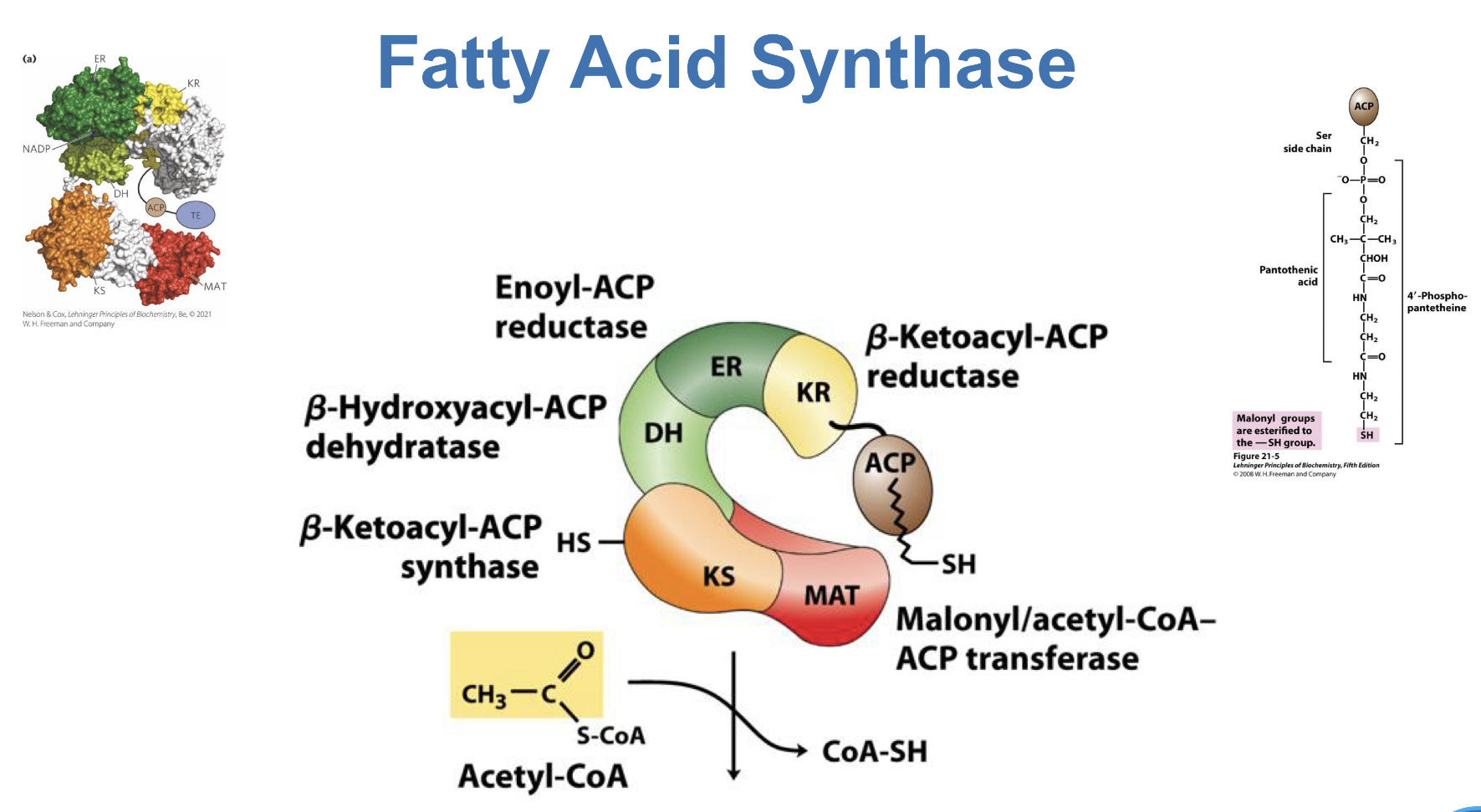
Fatty Acid Synthase
ACP - Acyl carrier protein (Swings around and brings substrate to each subunit)
KR - β-Ketoacyl-ACP reductase
ER - Enoyl-ACP reductase
DH - β-Hydroxyacyl-ACP dehydrogenase
MAT - Malonyl/acetyl-CoA-ACP transferase
KS - β-Ketoacyl-ACP synthase
Activation of FA Synthase requires what
Acetyl-CoA attaches to KS
Malonyl-CoA attaches to ACP
These steps are assisted by MAT

Step 1 of FA synthesis
Condensation (KS)
Produces CO2
Fatty Acid Synthase Complex is charged with an acetyl and a malonyl group to make β-Ketobutyryl-ACP

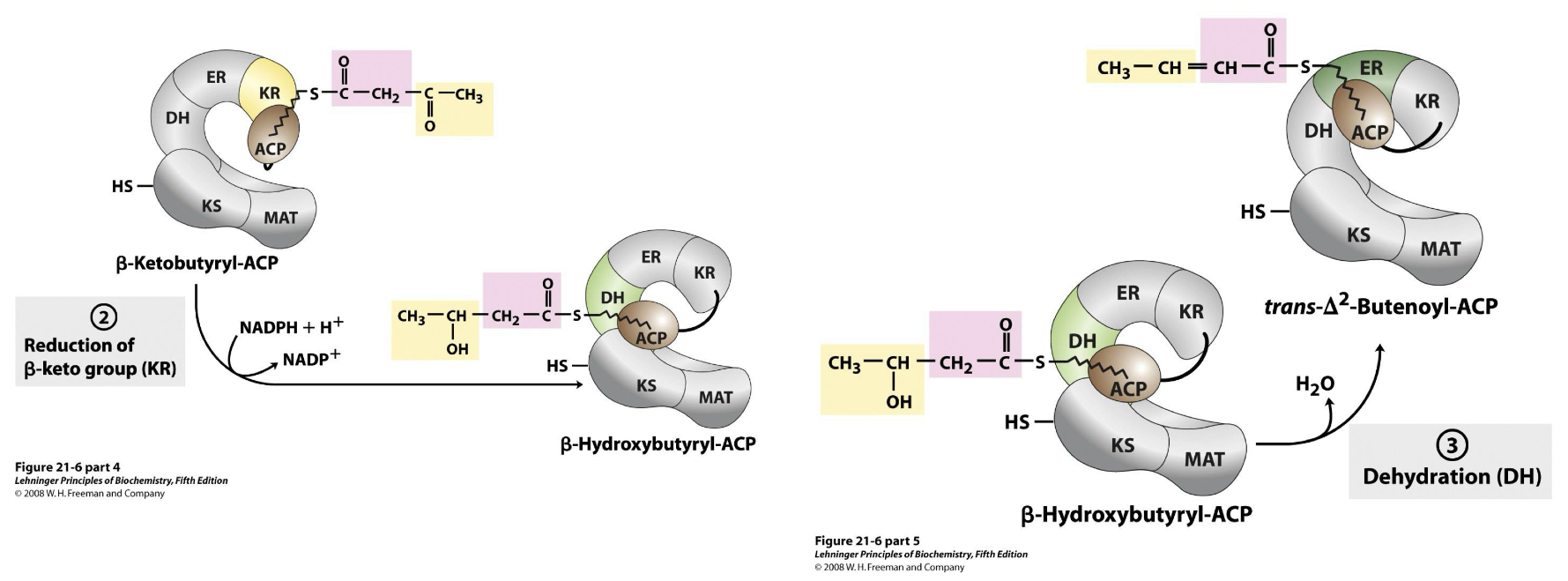
Step 2 and 3 of FA synthesis
Reduction and Dehydration
β-Keto group goes to KR to be reduced to β-Hydroxybutyryl-ACP (Needs NADPH + H+)
β-Hydroxybutyryl-ACP goes to DH to be dehydrated to trans-Δ2-Butenoyl-ACP
Step 4 of FA synthesis
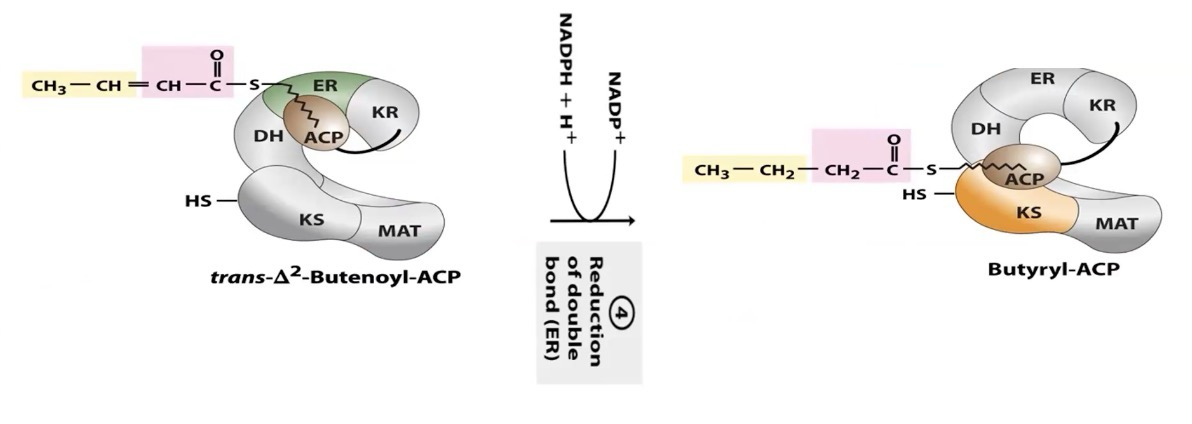
Reduction
trans-Δ2-Butenoyl-ACP goes to ER to be reduced to Butyryl-ACP (Needs NADPH + H+)
Step 5 of FA synthesis
Transfer
Butyryl-ACP is transferred to KS so the next malonyl-CoA can be loaded (Catalyzed by MAT)

Extension of FA chain
After FA chain is transferred to KS, ACP accepts another malonyl-CoA with the help of MAT
Condensation occurs again to form β-Keto group that can go through the steps of FA synthesis again

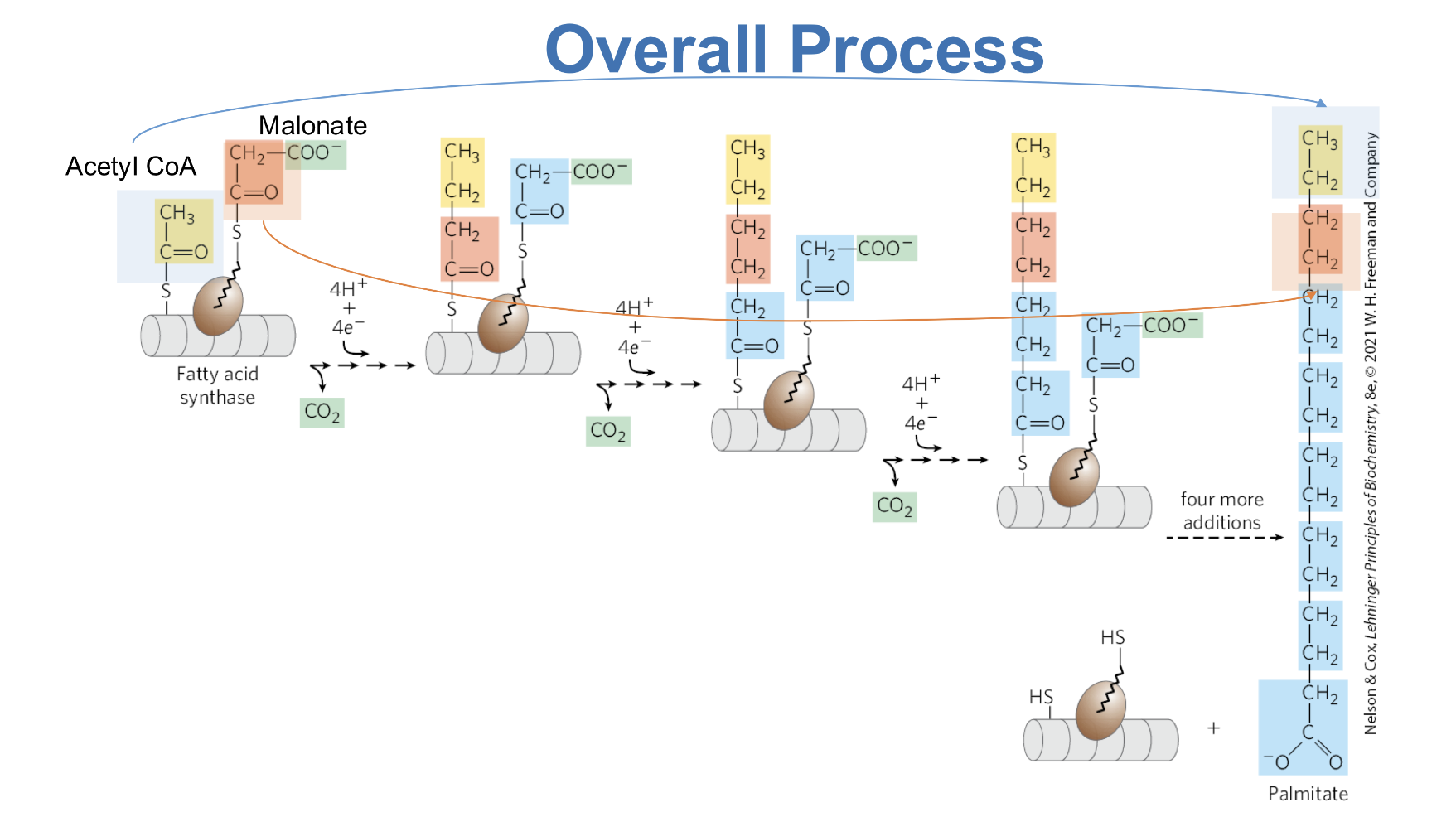
Overall Process of FA synthesis; How is the final product released from the enzyme
Thioesterase releases the finished FA from FA synthase
Notice how addition begins from the back end of the FA
The last two C comes from Acetyl-CoA, the rest is from Malonyl-CoA
Overall steps:
Acetyl-CoA attaches to KS
Malonyl-CoA attaches to ACP
These steps are assisted by MAT (Activation)
Fatty Acid Synthase Complex is charged with an acetyl and a malonyl group to make β-Ketobutyryl-ACP (KS)
β-Keto group goes to KR to be reduced to β-Hydroxybutyryl-ACP (Needs NADPH + H+)
β-Hydroxybutyryl-ACP goes to DH to be dehydrated to trans-Δ2-Butenoyl-ACP
trans-Δ2-Butenoyl-ACP goes to ER to be reduced to Butyryl-ACP (Needs NADPH + H+)
Butyryl-ACP is transferred to KS so the next malonyl-CoA can be loaded (Catalyzed by MAT)
After FA chain is transferred to KS, ACP accepts another malonyl-CoA with the help of MAT
Condensation occurs again to form β-Keto group that can go through the steps of FA synthesis again
Thioesterase comes in once FA chain is fully synthesized
Basic requirements of FA synthesis for Palmitate
Palmitate = 16C
1 Acetyl-CoA + 7 Malonyl-CoA + 7 ATP + 14 NADPH

Where does the body get the Acetyl-CoA required for FA synthesis; What processes are required to get this Acetyl-CoA
Via PDH complex (Pyruvate → Acetyl-CoA)
Acetyl-CoA is converted to Citrate (Citrate synthase + Oxaloacetate) in the mitochondria and transferred out via citrate transporter.
In the cytosol, citrate lyase reverses the synthase reaction.
Oxaloacetate is recovered either via pyruvate (PDH) or malate (Malate Dehydrogenase)
PHD may be preferred as malic enzyme produces reducing agent NADPH + H+, which is needed for FA synthesis

Allosteric control + Hormonal Control (FA Synthesis)
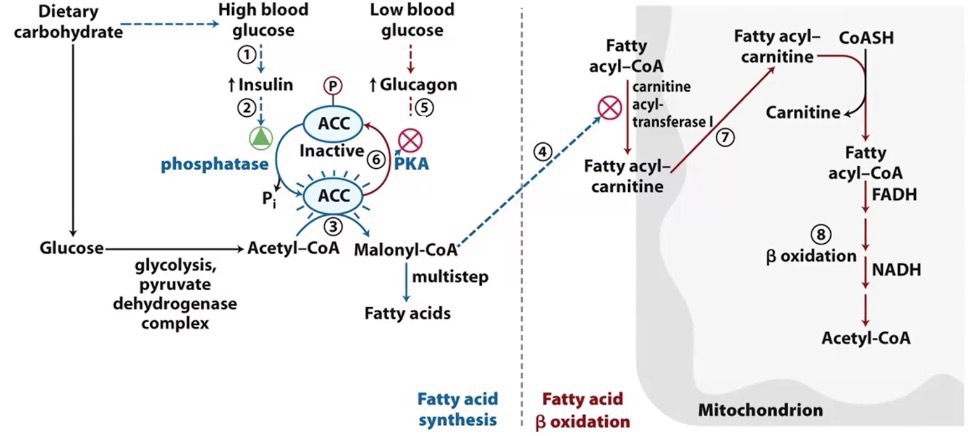
Palmitoyl-CoA inhibits acetyl-CoA carboxylase (ACC)
Glucagon, epinephrine, high [AMP] triggers phosphorylation/inactivation (Hormonal)
Acc is activated by citrate
Carnitine acyltransferase I is inhibited by malonyl-CoA (Stops β-oxidation)
![<p>Palmitoyl-CoA inhibits acetyl-CoA carboxylase (ACC)</p><p>Glucagon, epinephrine, high [AMP] triggers phosphorylation/inactivation (Hormonal)</p><p>Acc is activated by citrate</p><p>Carnitine acyltransferase I is inhibited by malonyl-CoA (Stops β-oxidation)</p>](https://assets.knowt.com/user-attachments/59866839-2a69-495c-b178-888132b6f117.png)
Closer look at regulation of β-oxidation and FA synthesis
Hormonal regulation, coupled with β-oxidation being regulated by Malonyl-CoA, prevents futile cycle of coupled β-oxidation and FA synthesis
Glucagon: Binding to receptor causes PKA activation which will inhibit ACC, activate HSL, and inhibit Pyruvate dehydrogenase (PDH)
Decreases FA synthesis and increases stored fat mobilization and gluconeogenesis
Insulin: Dephosphorylates via phosphoprotein phosphatases which will activate ACC, inhibit HSL, and activate PDH
Increases FA synthesis and glycolysis while decreasing stored fat mobilization and gluconeogenesis