ICP MS + Atomic Absorption
 Call Kai
 Learn
Learn Practice Test
 Spaced Repetition
 Match
Match Flashcards
 Knowt Play
1/35

There's no tags or description
Looks like no tags are added yet.
Name | Mastery | Learn | Test | Matching | Spaced | Call with Kai | Chat |
|---|
No analytics yet
Send a link to your students to track their progress
36 Terms
Sample requirements for ICP Mass Spec
Whole blood: royal blue top with EDTA
Serum - royal blue top
Urine - approved containers
Laboratory glassware is metals free or acid washed
ICP-MS Sample introduction system
Composed of a nebulizer and spray chamber and provides the means of getting samples in the instrument
Small droplets enter the torch while discarding the larger droplets
How does inductively coupled plasma (ICP) ionization work
Argon plasma heats up liquid droplets to dry them to a solid and then heated to gas. As the atoms continue their travel to the plasma, they absorb enough energy to release one electron to form singly charged ions
Use of interface for ICP-MS
Links the atmospheric pressure ICP ion source to the high vacuum mass spec
Use of universal cell in ICP-MS
Helps deal with interferences in analysis
How to deal with ICP-MS interferences without using a universal cell?
Mathematical calculations used to negate interferences
Ex. Argon oxide can mimic iron as it has the same mass of 56. Causes a false positive
Argon chloride has a m/s of 75, which would cause false positives when measuring arsenic
3 modes of universal cell
Standard mode, Collision cell, Reaction cell
Universal cell standard mode
All ions pass through the mass spec
Universal cell collision cell (kinetic energy discrimination)
Interferant removal based on size of interferent. Interferants react with an inert gas more frequently than the analyte of interest.
The interferrants no longer have enough energy to pass through the energy barrierC
Cons of kinetic energy discrimination
Lose signal of analyte. There should be high concentrations of analyte
Universal cell reaction cell theory
Interferent removal based on chemical reaction. Interferent produces exothermic reaction with reacrtive gas (analyte produces endothermic reaction)
Interferent becomes neutral and ejected from cell before passing into quadrupole. Analyte signal is preserved
Use of ion optics in ICP-MS
Guides the desired ions into the quadrupole while assuring that neutral species and photons are discarded from the ion beams
Two examples of triple quad (QQQ) ICP-MS setups
Mass Shift and On Mass
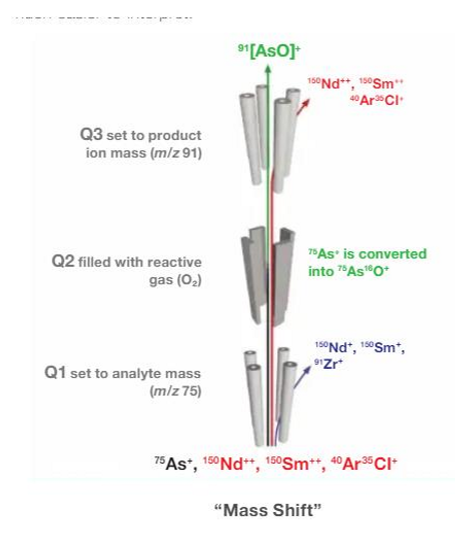
Mass Shift ICP-MS QQQ
Example use with Arsenic (m/z = 75) and Interferent Sm2+ (m/z=75):
Set Q1 to 75, gets rid of Sm+, but we still have Sm++
Collision cell converts Aresenic to aresnic oxide, converts mass to 91
Set Q3 to measure 91
On Mass ICP-MS QQQ
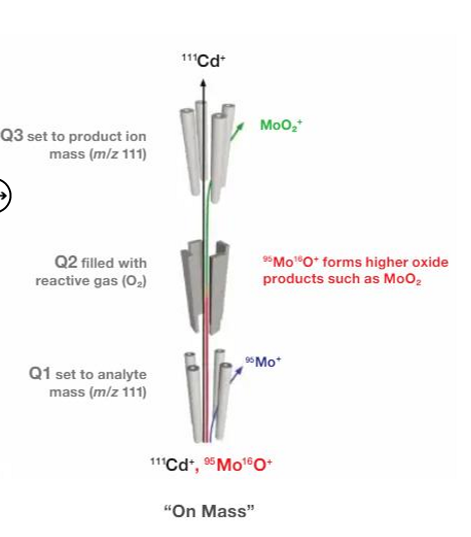
Example use with Cadmeium (m/z = 111) and MoO (111)
Set product ion mass to 111 in Q1
Q2 filled with reactive gas converts interferant into something new
Q3 measures 111 still, and only Cd+ is measured
Atomic Absorption Light Source
Hollow-Cathode Lamps coated with the metal of interest. (Each element tested needs its own lamp)
The lamp is filled with a monoatomic gas at low pressure, and special glass is allowed for transmission of the proper wavelength
How does a Hollow-Cathode Lamp work
When light is turned on:
Electrical potential built up between cathode and anode, impacts the inert gases in the lamp which get ionized
Positively charged gases attracted to negatively charged cathode
When gas hits cathode, the element of interest is released
Arsenic atoms get excited, and then fall back down to ground state, releasing radiant energy that arsenic in the sample can absorb (different energy levels for different atoms)

Sputtering
Continual release of metal atoms from the inner surface of the cathode due to an electrical charge
Atomic Absorption Line Spectra
Radiant energy is measured In line spectra because aborption bands are thin of energy levels
Choose wavelength that Is best for analysis (usually more intense ones)
How does atomic absorption work?
Now that we have the light source is producing radiant energy, we have to get smaple between light source and detector. Done through a spray chamber/nebulizer
Sample goes through nebulizer and hits glass bead, converts sample to a fine mist/aerosol
Heavy droplets go to waste
Sample is now introduced into flamed, and dissociates from chemical bonds (MgCl2 --> Mg2+ + 2e- from flame --> Mg)
Ions absorb electrons to become atoms
Radiant energy released from light source that magnesium atoms can absorb in its ground state
Light not absorbed is transmitted to detector

What is nebulization
As sample solution goes through the nebulizer, it is converted into a fine spray or aerosol while being introduced into the flame
Purpose of glass impact bead in Atomic absorption sample introduction
Produces fine spray for nebulization
2 types of burners for Atomic absorption sample introduction
Total consumption burner and premix burner
What is a total consumption burner
Fuel, oxidant, and sample are all passed through separate channels to a single opening from which the flame. The entire sample passes into the flame, but in the rapid transit of the droplets through the hot region only the smallest droplets have time to be dried and burned.
What is premix burner
Sample, fuel, and oxidant are mixed in a chamber before entering the flame. The large droplets in the mixing chamber are collected on the walls and pass down the drain, while only the small droplets travel to the flame
Flame type in Atomic Absorption
Premix: Air-acetylene or nitrous oxide acetylene
Total consumption: air-hydrogen
What is emission interference
During atomic absorption, the normal process occurs - ground state atoms absorb light and non-absorbed light is transmitted in
However, When atoms absorb light, they get excited, go back down to ground state and release their own energy! Which will falsely decrease results because more E is getting transmitted to detector (transmission converted to absorbance for measurement)

How to eliminate the issue of emission interference
Problem eliminated bt use of a chopper, which is placed between the lamp and the flame
Detector only detects light that comes from light source, because chopper causes pulse beam of light
The chopper “chops” up light
Detector can distinguish between pulse beam and steady beam. Only measures pulse beam because emission interference produces steady beam
Two forms of flameless atomic absorption
Cold vapor generation assembly: used for mercury analysis
Graphite furnace
What is cold vapour generation assembly used for
Limited to analysis of mercury, as mercury can exist in a volatile free atomic state at room temperature
Cold vapour generation assembly steps
Chemical reactions are used to convert mercury into an atomic vapour
Sample is decomposed by acid digestion (nitric acid)
A reducing agent (sodium borohydride) converts mercury to elemental state
A stream of gas is bubbled through the apparatus pushing mercury vapour into a sealed cell with quartz windows in the optical beam
How does graphite furnace Atomic absorption work
Sample is placed on a solid support
Graphite tube is heated via electrical resistance sucessfully to different temps:
100-120C drying stage - solvent removed from sample furnace
400-800C ashing stage: removes organic molecules or inorganic material (removal of matrix components)
2600C atomization stage - free atoms are generated within a confined zone. Signal is a peak, with the height/area being related to the amount of analyte present
Use of a monochromator
Isolates a pure radiant signal, keeping extraneous radiant energy (other atomic spectra wavelengths or flame light) from reaching the photomultiplier tube
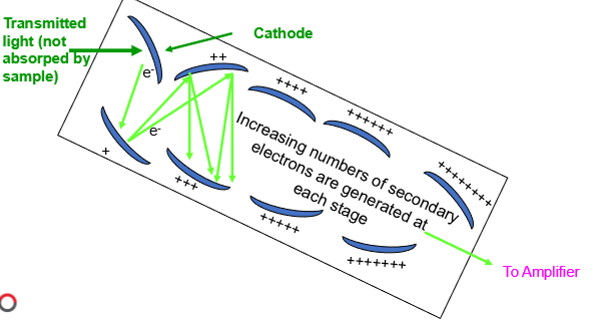
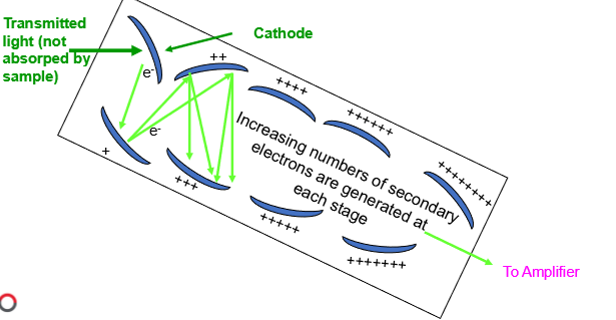
Use of a photmultipler tube
The detector - measure the intensity of the signal isolated by the monochromator. It functions to convert radiant energy from the hollow cathode to a signal that amplifies this signal to drive a recorder or meter
Photomultiplier tube principle
Light impinges upon cathode and frees an electron
Electron is drawn towards first dynode by applied voltage
Secondary electrons are released and pass on to successive dynodes, which are increasingly higher voltages
Increasing numbers of secondary electrons are generated at each stage
Pros and Cons of ICP-MS over Atomic absorption
Pros:
Multi-analyte analysis
Increased sensitivity
Less sample preparation
Less sample needed
Cons:
Initial purchase of instrument is costly