Microbiology Lab Practical 1: Microscope
 Call Kai
 Learn
Learn Practice Test
 Spaced Repetition
 Match
Match Flashcards
 Knowt Play
1/41

There's no tags or description
Looks like no tags are added yet.
Name | Mastery | Learn | Test | Matching | Spaced | Call with Kai | Chat |
|---|
No analytics yet
Send a link to your students to track their progress
42 Terms
3 Lenses on a Light Microscope
1. Ocular lens
2. Objective lens
3. Your eyes
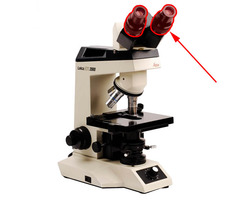
Eyepieces (Ocular Lenses)
Lens that the viewer looks through. Contains a lens that magnifies about 10x
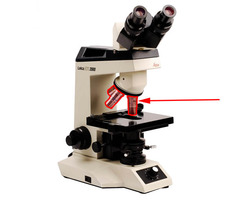
Objective Lenses
4 pieces that have various magnification powers from 4x, 10x, 40x, & 100x.
Fine and Course Adjustment Knobs Function
Used to visualize the sample.
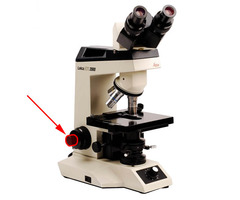
Fine Focus Knob
Fine tunes the focus, increases the detail.
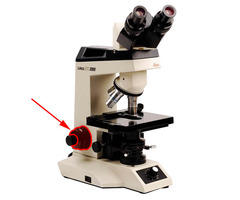
Coarse Focus Knob
Brings specimen into general focus.
Condenser
Focuses the concentration of light.
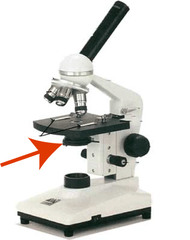
Iris Diaphragm
Adjusts the amount of light.
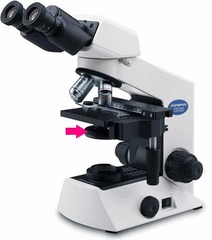
Observation Tube
Connects the eyepiece to the objective lenses.
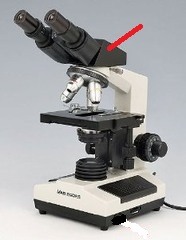
Revolving Nose Piece
Rotating turret that houses the objective lenses.
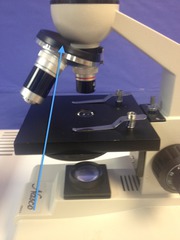
Stage
Platform where you put the slide.
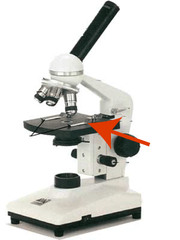
Slide Clip
Metal piece that holds the slide in place.
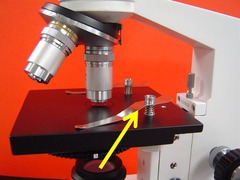
Microscope Frame
The part that connects the observation tube to the stage as well as the rest of the microscope.
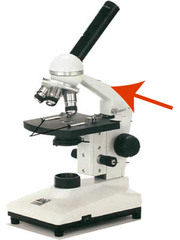
Arm
Connects the eyepiece to the base.
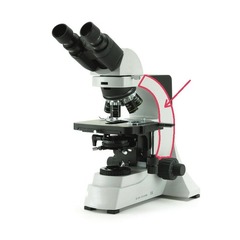
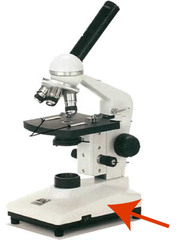
Base
Bottom part of the microscope that contains the light source & supports the microscope
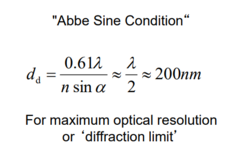
Abbe's Equation Definition
Demonstrates how immersion oil works to improve resolution.
Abbe's Equation
(mathematical resolution definition)
d = 0.61(λ) wavelength / nSin𝜃
Layman's Definition of Resolution
The shortest distance between two objects where one can still discern two distinct objects.
d stands for?
Minimal Distance
λ stands for?
Wavelength / Visible light
0.61 stands for?
Constant (always there)
nSin𝜃 stands for?
Angle of Refraction
Do you want resolution or "d" to be a small or large number?
Small (10/5=2)
How to decrease the resolution?
Increase the denominator
How do you achieve an improvement in resolution when you increase your magnification to 1000 times?
Immersion oil on the 100x objective lens works to improve resolution when the magnification is increased to 1000 times.
What is total magnification and how do we calculate it?
Total magnification is ocular lens x objective lens.
Calculate the total magnification of 4x.
4x * 10x = 40x
Calculate the total magnification of 10x.
10x * 10x = 100x
Calculate the total magnification of 40x.
40x * 10x = 400x
Calculate the total magnification of 100x (oil).
100x (oil) * 10x = 1000x
What is the difference between the iris diaphragm and the condenser on a light microscope in terms of managing light?
The condenser focuses the concentration of light through the specimen. The iris diaphragm controls the amount of light passing through the specimen.
Increase the Magnification
Loses clarity or resolution of an image.
If you increase in magnification, what do you generally have to do with your light? (2)
The light intensity decreases as magnification increases. Higher magnification means the light is bent more. At a certain point, the light is bent so much that it can't make it through the objective lens. You have to perform oil immersion with your light.
If you increase in magnification, what do you generally have to do with your light? (1)
Increase the brightness of bulb.
Oil Immersion (1)
At 100x you'll need to put a drop of oil between your specimen and the objective lens. The oil "unbends" the light to stretch out the working distance and make it possible to image at high magnifications.
Oil Immersion (2)
It increases the angle of aperture or the light rays and focuses the light into the specimen.
1. What is the total magnification when viewing a sample using the 40X objective lens?
Ocular lens 10x *x* Objective lens 40x = 400x
2. How does a condenser affect light compared to the iris diaphragm?
Condenser = Focuses whole light.
vs.
Iris Diaphragm = Controls amount of light.
3. When you increase magnification do you generally have to increase or decrease light?
The light intensity decreases as magnification increases.
4. What is the layman's definition of resolution?
Shortest distance between two objects where one can still discern two distinct objects.
5. How does immersion oil improve resolution?
It increases the angle of aperture and/or the light rays.
6. When you looked at the prepared slides were larger organisms best viewed at higher or lower magnification?
Larger organisms were best viewed at lower magnification because it has the largest field of view compared to higher magnification where the field of view closes in.