psych- biopsychology/ approaches
 Call Kai
 Learn
Learn Practice Test
 Spaced Repetition
 Match
Match Flashcards
 Knowt Play
1/22

There's no tags or description
Looks like no tags are added yet.
Name | Mastery | Learn | Test | Matching | Spaced | Call with Kai |
|---|
No analytics yet
Send a link to your students to track their progress
23 Terms
outline the behaviourist approach
concerned with behaviour that can be observed and measured
behaviourists rely on lab experiments to ensure control and objectivity
CC:
CC is learning through association
demonstrated by Pavlov
Pavlov showed dogs could be conditioned to salivate at the sound of a bell
the bell was repeatedly paired with food and started as a NS but became a CS which produced the CR of salivation
OC:
researched by skinner
positive reinforcement is receiving a reward when a certain behaviour is performed
negative reinforcement occurs when someone avoids something unpleasant- the outcome is positive/rewarding- NR increases the likelihood of behaviour
punishment is an unpleasant consequence of behaviour, a negative experience- decreases the likelihood of a behaviour being repeated
skinners box:
rats in boxes
every time the rat activated a lever it was rewarded a food pellet
from then on the rat would continue that behaviour
skinner also introduced electric shocks to act as NR
evaluate the behaviourist approach
strength
lab research is well controlled
a focus on measurable, observable behaviour within highly controlled lab settings
all EVs were therefore removed, allowing a cause and effect relationship to be established
this makes it replicable and reliable and therefore has high scientific credibility
real world application
OC is the basis of token economies that have been used successfully in institutions such as prisons
this works by rewarding appropriate behaviour with tokens which can be exchanged with privileges
this increases the value of the approach
weakness
environmental determinism
the BA sees all behaviour as learnt by past conditioning experiences
skinner suggested that everything we do is a sum of our reinforcement history
this ignores the influence of free will
ignores the influence of conscious decision making on behaviour
animal research
caution must be taken when applying it to humans
outline the social learning theory
a way of explaining behaviour that involves direct and indirect reinforcement
agrees with BA that behaviour is learnt through experiences but also says we can learn through observation and imitation
identification is when an observer associates themselves with a role model and wants to be like them
vicarious reinforcement is reinforcement which is not directly experienced but occurs through observing someone else being reinforced for a behaviour
mediational processes are the cognitive factors that influence learning and come between stimulus and response
there were 4 mediational processes identified by bandura:
attention- taking notice of behaviour
retention- how well the behaviour is remembered
motor reproduction- the ability of the observer to perform behaviour
motivation- the will to perform behaviour, determined by whether the behaviour was punished or rewarded
bandura recorded the behaviour of young kids who watched a video of an adult express aggressive behaviour towards a bobo doll
when the children were later left alone with the bobo doll they imitated the behaviour and showed aggression
boys showed more physical aggression but girls were more verbally aggressive
kids were more likely to imitate behaviour if they identified with the role model
evaluate SLT
strengths
takes into account more cognitive factors in learning
CC and OC both can’t offer a valid cognitive explanation but SLT does
suggests it is a more comprehensive definition by recognising the role of mediational processes
HOWEVER> SLT ignores biological factors
research suggests mirror neurons in the brain allow us to imitate people and copy their actions
this suggests our behaviour isn’t solely determined on the environment around us and SLT under-emphasises biological influences
weaknesses
the use of lab studies in banduras research has been criticised as it has a risk of demand characteristics
it has been suggested that the main purpose of the bobo doll is to hit it so children were just acting in a way they thought was expected
this suggests research may tell us little about how kids actually learn aggression in everyday life
outline the cognitive approach
CA argues that internal mental processes should be studied scientifically
IMPs are the private functions of the mind and cannot be directly observed so we have to make inferences
schema are the set of ideas/beliefs we have about things
schemas are developed by experience
act as a framework for interpreting incoming info received by the cognitive system
as we get older our schemas become more complex and developed
they enable us to process lots of info quickly which prevents us from getting overwhelmed however they can distort info
in the CA we use models to represent the human mind
models are a representation of something else
in this case computer models are used to represent the processes of the human mind
we take inputs, process info and output data just like a computer does
another example of a model is the multistore model of memory
models are often shown as diagrams or flowcharts and they are useful as they mean abstract processes can be represented as concrete images to make invisible processes visible
evaluate the cognitive approach
strengths
the use of scientific methods
CA employs highly controlled research methods to produce objective and measurable data
in addition cognitive neuroscience has enabled the two fields of biology and cognitive psychology to come together to enhance the scientific basis of study
this gives the approach high scientific credibility
employed by psychologists as it forms the basis of many therapies such as CBT
this shows it has practical applications
weakness
machine reductionism
there are similarities between the human mind and the computer model however it is too simplistic
computers dont have emotions such as anxiety which us humans do and the computer model doesn’t account for motivation
this suggests machine reductionism may weaken the validity of the approach
outline the biological approach
suggests everything psychological is first biological so to fully understand the human behaviour we must study biological structures
everything is innate and governed by biology
twin studies are often used to determine whether a trait is genetic or not by comparing concordance rates of identical and non-identical twins
identical twins chare 100% DNA whereas non-identical twins share 50% DNA
genotype is the particular set of genes someone possesses
phenotype is the characteristics of an individual determined by both genes and the environment
the theory of natural selection proposed by Darwin to suggest any genetic material can aid an individuals survival is passed onto offspring with the effect that only those with those alleles that allowed this behaviour will survive
cognitive neuroscience applies brain scanning methods to our understanding of mental processes
evaluate the biological approach
strengths
real world application
increased understanding of neurochemical processes in the brain is associated with the use of psychoactive drugs to treat mental health conditions
the biological approach has promoted the use of antidepressant drugs that increase levels of the neurotransmitter serotonin to reduce depressive symptoms
this means people with depression may be able to better manage their symptoms
weakness
not so objective methods
a study by bennet involved a dead salmon being studied in an fMRI scanner
when researchers started looking at the data, it appeared the fish’s brain was active and the data was changing
of course this was not the case however it meant false positives made it look like some were active
this suggests some biological methods may lack validity
deterministic
the approach suggests humans behaviour is decided by internal genetic causes over which we have no control
however we have already seen that a person’s phenotype is heavily influenced by the environment
the genetic argument becomes problematic when we consider factors such as crime, a violent criminal couldn’t just excuse their actions due to a certain crime gene
what are the subdivisions of the human nervous system
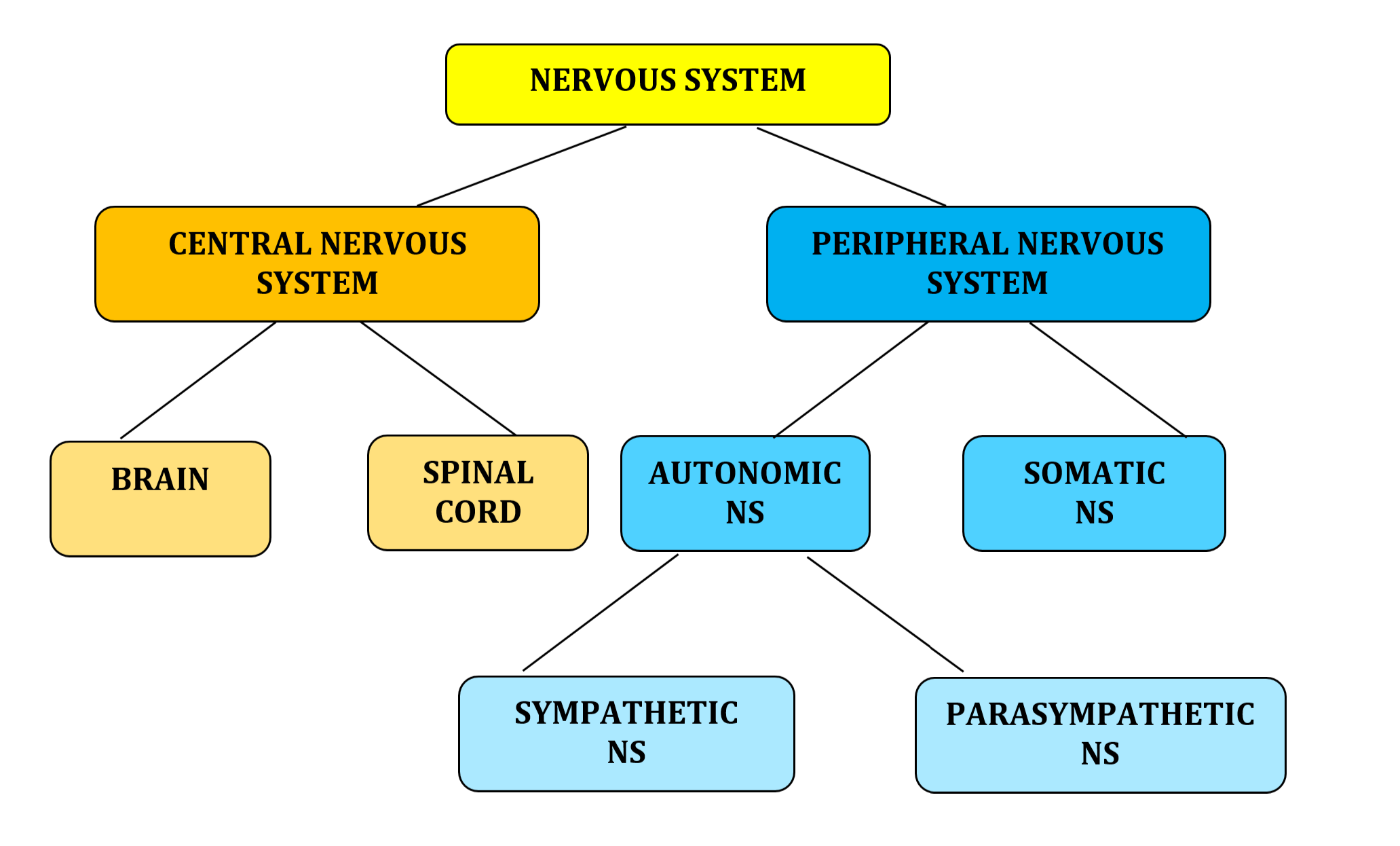
what is the nervous system
a specialised network of cells in the human body and is our primary internal communication system
based on electrical and chemical signals
explain the CNS
made up of the brain and spinal cord
the brain is the centre of all conscious awareness
the CNS is the origin of all complex decisions and commands
the spinal cord is an extension to the brain and passes messages to and from the brain
the spinal cord connects nerves to the PNS and is responsible for reflex actions
explain the PNS
PNS transmits messages via millions of neurons to and from the CNS
it is further divided into the autonomic NS and the somatic NS
the ANS governs vital functions of the body such as breathing, heart rate, digestion etc
the SNS governs muscle movement and receives info from sensory receptors
the ANS can be further divided into the sympathetic and parasympathetic NS
explain parasympathetic/ sympathetic NS
parasympathetic NS- this should be our default state where we are stress free and relaxed- known as the ‘rest and digest’ state, controls unconscious every day maintenance tasks which preserve energy
sympathetic NS- drives the body’s involuntary ‘fight or flight’ response, kicks into overdrive when faced with stress
explain the endocrine system
works alongside the NS to control vital functions in the body
the endocrine system works more slowly than the NS but has widespread effects
it consists of glands which releases hormones
hormones are secreted into the bloodstream to hit target organs with receptors for that specific hormone
main glands and their hormones are:
pituitary gland> releases hormones from most other endocrine glands in the body
thyroid gland> releases thyroxine to control metabolic rate
adrenal gland> releases adrenaline to trigger the fight or flight response
explain how the ANS works with the endocrine system during flight or flight
when stressor is perceived a signal is sent to the hypothalamus which activates the sympathetic nervous system and two pathways are simultaneously set in motion: fight or flight (SAM pathway) and the longer term HPA axis
SAM pathway: sympathetic + adrenal medulla: the immediate fight or flight response which causes the adrenal glands to release stress hormone adrenaline
adrenaline causes physiological changes in the body which happens in an instant as soon as stress is detected
HPA axis: hypothalamic+ pituitary+ adrenal cortex: the longer term stress response- not part of fight or flight
at the same time a signal is sent to the adrenal medulla, a signal is sent to the hypothalamus which sends a signal to the pituitary gland which releases cortisol
cortisol helps deal with longer term stress
parasympathetic action: one threat has finally passed the PSNS returns the body to its resting state
it is antagonistic to the sympathetic NS
rest and digest response
what are some changes to the body when the sympathetic NS is activated
increased heart rate
increased breathing rate
dilated pupils
inhibits digestion
inhibits saliva production
what are some changes to the body when the parasympathetic NS is activated
decreases heart rate
decreases breathing rate
constricts pupils
stimulates digestion
stimulation salivation
what are neurons
nerve cells which process and transmit messages through electrical and chemical signals
what are the three types of neurons
sensory
motor
relay
what does a sensory neuron do and name two features
carry messages from PNS to CNS
they have long dendrites and short axons
what does a motor neuron do and name two features
connects the CNS to effectors such as muscles and glands
short dendrites and long axons
what does a relay neuron do and name two features
connects sensory neuron to motor neurons or other relay neurons
short dendrites and short axons
describe the structure of a neuron
vary in size from less than a mm to up to a metre long
cell body includes a nucleus (contains DNA)
branchlike structures called dendrites (receive chemical messages from other neurons which may turn into electrical signals in the cell body)
the axon carries the electrical signal away from cell body
the axon is covered in a fatty layer of myelin sheath that protects the axon
the myelin sheath is separated by the nodes of ranvier to speed up transmission by forcing electrical impulses to jump across the gaps
at the end of the axon are terminal boutons that communicate with dendrites of other neurons across the synapse