Wave Systems Formulae
 Call Kai
 Learn
Learn Practice Test
 Spaced Repetition
 Match
Match Flashcards
 Knowt Play
1/6

Earn XP
Description and Tags
Best use as flashcards
Name | Mastery | Learn | Test | Matching | Spaced | Call with Kai | Chat |
|---|
No analytics yet
Send a link to your students to track their progress
7 Terms

dsinθ = nλ
d = distance between adjacent slits (or grating lines), in meters (m)
θ = angle from the central axis to the bright fringe
n = which bright fringe you're looking at (n = 0 is the central max, n = 1 is the first bright fringe on either side, etc.)
λ = wavelength of the light (meters, m)

nλ = dx/L
n = which bright fringe
λ = wavelength of light (meters, m)
d = distance between the slits (meters, m)
x = distance from the central bright fringe to the nth bright fringe on the screen (meters, m)
L = distance from the slits (or grating) to the screen (meters, m)
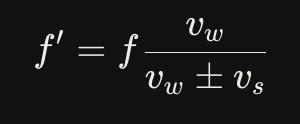
f′ = f(vw/vs ± vw)
f' — observed frequency — hertz (Hz)
f — source (actual) frequency — hertz (Hz)
vw — speed of wave — meters/second (ms-1)
vs — speed of the source — meters/second (ms-1)
v = fλ
v — wave speed — meters/second (ms-1)
f — frequency — hertz (Hz)
λ — wavelength — meters (m)
f = 1/T
f — frequency — hertz (Hz)
T — period (time for one full cycle) — seconds (s)
d = 1/Lines per unit length
d — slit spacing — meters (m) (after converting)
Input: lines per unit length — lines/mm or lines/cm
Output: d, in whatever length unit you started with (then convert to meters)
fbeat = f1 − f2
fbeat — beat frequency (rate at which loudness pulses) — hertz (Hz)
f₁ — frequency of first wave — hertz (Hz)
f₂ — frequency of second wave — hertz (Hz)