SMU PLSC-3325 - Introduction to Law: Final Exam
 Call Kai
 Learn
Learn Practice Test
 Spaced Repetition
 Match
Match Flashcards
 Knowt Play
1/128

Earn XP
Description and Tags
SMU PLSC-3325 - Introduction to Law: Final Exam
Name | Mastery | Learn | Test | Matching | Spaced | Call with Kai | Chat |
|---|
No analytics yet
Send a link to your students to track their progress
129 Terms
Judicial Remedies
Once a person has established a substantive right through judicial procedures, the court will award relief. Judicial relief can assume many different forms, called remedies (see Figure 7.1). The most common remedy is awarding money damages in the form
of compensatory damages and, where permissible, punitive damages. Additional remedies include injunctive relief (requiring someone to do or refrain from doing something), restitution (restoring a person to a previous position to prevent unjust enrichment), declaratory judgment (a judicial determination of the parties’ rights), and reformation (judicially rewriting a written instrument to reflect the real agreement of the parties).
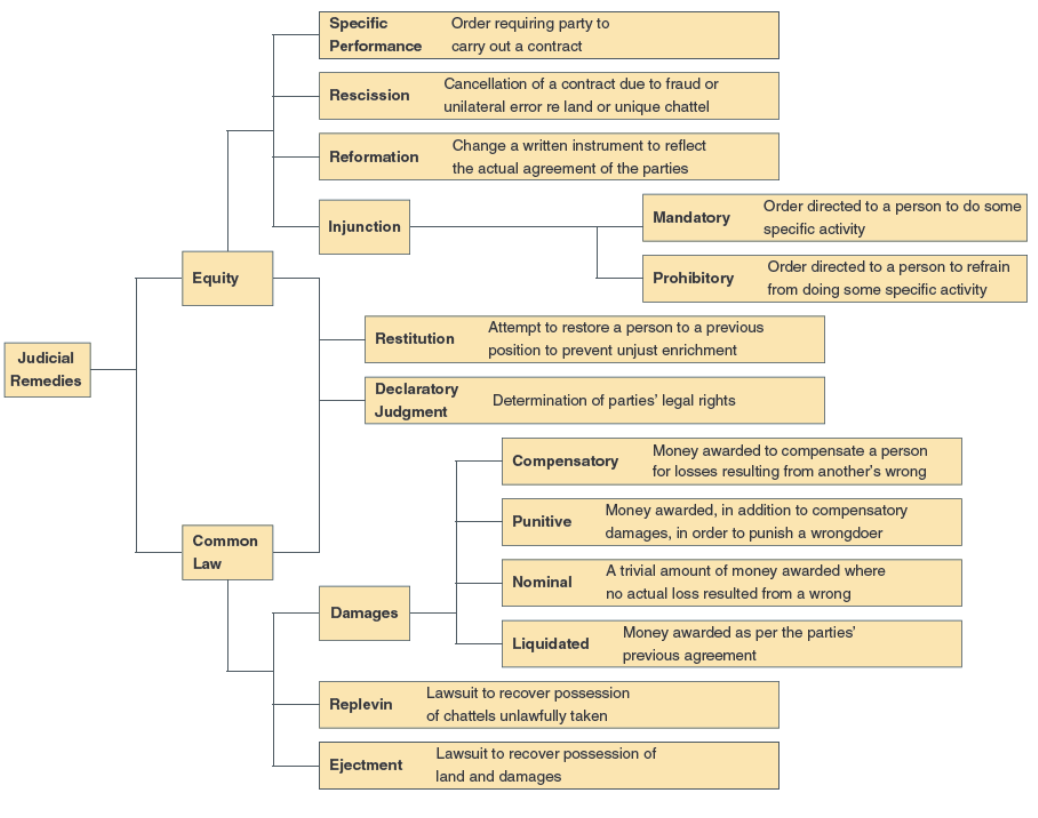
Common Law Remedies
Common law remedies generally are limited to the court’s determination of some legal right and the award of money damages. There are some exceptions. For example, when parties want the court’s opinion concerning their legal rights but are not seeking damages or injunctive relief, they seek a declaratory judgment. In addition, the common law remedies of ejectment and replevin both seek restitution. An ejectment occurs when a trespasser secures full possession of the land and the owner brings an action to regain possession, as well as damages for the unlawful retention of possession. Usually, this process involves a title dispute between plaintiff and defendant, and the ejectment action settles this dispute. Replevin is an action used to recover possession of personal property wrongfully taken. Once the action is brought, the goods are seized from the defendant after proper notice has been given and held until title has been determined.
Usually, however, a common law court grants relief in the form of damages, a sum of money awarded as compensation for an injury sustained as the consequence of either a tortious act or a breach of a legal obligation. Damages are classified as compensatory, punitive, nominal, and liquidated.
Compensatory Damages
Compensatory damages are awarded to compensate the plaintiff for pecuniary losses that have resulted from the defendant’s tortious conduct or breach of contract. Although the permissible damage elements vary by jurisdiction, they typically include awards for loss of time or money, bodily pain and suffering, permanent disabilities or disfigurement, injury to reputation, and mental anguish. Future losses are also recoverable; however, compensation is not allowed for consequences that are remote, indirect, or uncertain (i.e., where speculative).
Damages usually are limited to those reasonably foreseeable by the defendant as a result of the breach. Assume that two plaintiffs have a contract to buy some equipment needed to open their new business, and a defendant breaches by nondelivery. If the plaintiffs sue for lost profits from the delay in opening because they have to procure alternative goods, they would probably not recover, because the defendant could not have foreseen this without knowing that the opening depended on the delivery. Also, future profits are very difficult to measure with any degree of certainty.
In awarding compensatory damages, the court’s objective is to put the plaintiff in the same financial position as existed before the commission of the tort or, in a contract case, in the financial position that would have resulted had the promise been fulfilled. In the absence of circumstances giving rise to an allowance of punitive damages, the law will not put the injured party in a better position than the person would have been in had the wrong not been done.
Compensatory Damages (Two Rules)
A plaintiff who is injured must use whatever means are reasonable to avoid or minimize damages. This rule is called by most the rule of mitigation (and by others the avoidable-harm doctrine). It prevents recovery for damages that could have been foreseen and avoided by reasonable effort without undue risk, expense, or humiliation. For example, P (plaintiff) sues to recover the loss of a crop, because D (defendant) removed some rails from P’s fence, and as a result, cattle escaped and destroyed the crop. Since P, knowing the rails were missing, did not repair the fence, only the cost of repairing the fence is recoverable, because the loss of the crop could have been avoided.
When the defendant’s misconduct causes damages but also operates directly to confer some benefit on the plaintiff, then the plaintiff’s damage claim may be diminished by the amount of the benefit conferred. This policy is called the benefit rule. For example, a trespasser digs on plaintiff’s land, but the digging works to drain swampy areas and improves the value. The plaintiff may recover for the trespass and any damage it caused, but the defendant gets a credit for the value of the benefit conferred. However, this credit exists only for clear benefits and not for those that are remote and uncertain. Problems arise in deciding what constitutes a benefit and what standard to measure it by.
Compensatory Damages (General and Specific)
Compensatory damages may be categorized as either general or special. This distinction is very important to lawyers because general damages do not have to be specifically pleaded, whereas special damages must be listed in the pleadings. General damages are those that are the natural and necessary result of the wrongful act or omission, and thus can normally be expected to accompany the injury. Pain and suffering, mental anguish, and the loss of enjoyment of life are damages that occur so frequently in the tort of battery that they do not have to be specifically pleaded. Special damages are awarded for injuries that arise from special circumstances of the wrong. A plaintiff in a battery case, for example, would have to plead specifically such special damages as medical and hospital expenses, loss of earnings, and a diminished ability to work.
Putting a dollar value on the plaintiff’s loss for the purpose of compensation often becomes a difficult task. Because the amount of damages is a factual question and decisions on factual issues do not create precedent, previous case decisions are not binding. The amount of damages is decided by a jury, unless a jury trial has been waived.
The next case (Macomber v. Dillman) involves a plaintiff who seeks to recover a variety of damages for medical malpractice. The court rules that the state’s public policy prohibits her from recovering for all that she claims. The concurrence contains a discussion of the benefits rule and the rule requiring the mitigation of damages.
Liquidated Damages
Parties may agree, in advance, about the amount to be paid as compensation for loss in the event of a breach of contract. Liquidated damages are the stipulated sum contained in such an agreement. An example can be seen in the Campbell Soup case, where Campbell’s contract with the Wentz brothers included a provision for damages of $50 per acre if the contract were breached. If the court determines that the amount stipulated in the agreement is a punishment used to prevent a breach rather than an estimate of actual damages, it will deem that sum a penalty and refuse to enforce it. Traditionally, the court upholds a liquidated damages clause only when:
(1) the damages in case of breach are uncertain or difficult to compute,
(2) the parties have agreed in advance to liquidate the damages, and
(3) the amount agreed on is reasonable and not disproportionate to the probable loss. Another form of liquidated damages results when money is deposited to guarantee against future damages.
Some courts require plaintiffs to prove some actual loss before the liquidated damage clause is triggered.
Occasionally, a plaintiff who has suffered no actual damages can recover substantial liquidated damages; however, this occurs only rarely.
Nominal Damages
If a defendant breaches a legal duty owed to the plaintiff and injures that person, compensatory damages may be awarded. The compensatory damages are measured by the amount of the loss. Nominal damages are awarded when there has been a breach of an agreement or an invasion of a right but there is no evidence of any specific harm. This occurs, for example, if a person trespasses on your land but causes no actual harm. In such a situation, the plaintiff would only be entitled to a judgment for a trivial amount, such as $1 or $50. The judge awards this token sum to vindicate the plaintiff’s claim or to establish a legal right. Nominal damages also are awarded when a plaintiff proves breach of duty and harm but neglects to prove the value of the loss. They are likewise allowable when the defendant’s invasion of the plaintiff’s rights produces a benefit.
Courts award nominal damages because a judgment for money damages is the only way a common law court can establish the validity of the plaintiff’s claim. Students should be careful not to confuse nominal charges with small compensatory damage awards, which are awarded when the actual loss was minor.
Punitive (Also Exemplary) Damages
Damages also can be awarded to punish defendants for their conduct and to deter others from similar conduct. These are called punitive damages or exemplary damages, and are awarded to the plaintiff beyond the compensatory amount. They are additional damages for a civil wrong and are not imposed as a substitute for criminal punishment. Punitive damages are awarded to plaintiffs to deter defendants from repeating their conduct, and to deter others from following their example. An award of punitive damages also may include an award of attorney’s fees, although this varies by jurisdiction.
Such an award is appropriate only when a defendant has engaged in aggravated, wanton, reckless, malicious, or oppressive conduct. This includes all acts done with an evil disposition or a wrong and unlawful motive, or the willful doing of an injurious act without a lawful excuse. Punitive damages generally are available only for intentional torts and for some statutory wrongs. The reason courts generally refuse to award punitive damages where defendants have acted negligently is that such persons did not intend to cause the harmful result that ensued. A person cannot be deterred from causing harms that were never intended in the first place.
Some of the actions that may result in punitive damage awards are copyright and trademark infringement, corporate crimes such as antitrust violations, insurers not paying compensation as required by their policies, employers wrongfully discharging employees, libel and slander, wrongful death, trespass, conversion, battery, securities fraud, and negligence actions that involve wanton and willful misconduct. Traditionally, punitive damages have not been awarded in contract cases, even in situations in which there has been a malicious breach. Some jurisdictions have modified this rule in some situations: if a breach of contract is accompanied by a malicious tort, exemplary damages will be awarded for the tort.
Equitable Remedies
An equitable remedy would have been awarded by a court of equity before the merger of the equity and common law courts. Today, most courts in the United States are empowered to grant both equitable and legal relief as required to achieve justice. However, the availability of equitable remedies is a matter for judges, and not juries. Traditionally, courts only grant equitable remedies when the common law remedies are inadequate.
Injunctions (Equitable Remedies)
Injunctions
An injunction is an equitable remedy in the form of a judicial order directing the defendant to act or refrain from acting in a specified way. An order compelling one to do an act is called a mandatory injunction, whereas one prohibiting an act is called a prohibitory injunction. An injunction may be enforced by the contempt power of a court, and a defendant may be fined, sent to jail, or deprived of the right to litigate issues if he or she disobeys an injunction. This order must be obeyed until it is reversed, even if it is issued erroneously or the court lacks jurisdiction.
Injunctions may be divided into three classes:
(1) Permanent
(2) Preliminary or interlocutory
(3) Temporary restraining orders (TRO).
A permanent injunction is a decree issued after a full opportunity to present evidence. It is permanent only in the sense that it is supposed to be a final solution to a dispute. It may still be modified or dissolved later. A preliminary or interlocutory injunction is granted as an emergency measure before a full hearing is held. There must be notice to the defendant and a hearing, usually informal. This remedy is generally limited to situations in which there is a serious need to preserve the status quo until the parties’ rights have finally been decided. Thus a preliminary injunction continues only until a further order of the court is issued.
The TRO is an ex parte injunction. This means that it is granted without notice to the defendant. The trial judge has heard only the plaintiff’s side of the case. Because of the potential for abuse, certain procedures protect a defendant. A TRO may not be granted unless irreparable harm would result and there is no time for notice and a hearing. There must be clear evidence on the merits of the case. The court should look at any damage to the defendant that would be noncompensable in money if the plaintiff’s relief is later shown to be improper. This consideration must be balanced with the plaintiff’s harm if the TRO is not granted. Factors weigh more heavily against the plaintiff, since there is no notice to defendant.
Certain classes of cases are not considered proper subject matter for injunctions. In general, an injunction is not issued to stop a criminal prosecution or to prevent crimes. However, this policy has been modified in recent years by regulatory statutes and civil rights statutes. Injunctions are usually not proper in defamation cases because they would intrude on the defendant’s constitutional right of free speech and would be considered prior restraint.
Reformation and Rescission
The equitable remedy of reformation is granted when a written agreement fails to express accurately the parties’ agreement because of mistake, fraud, or the drafter’s ambiguous language. Its purpose is to rectify or reform a written instrument in order that it may express the real agreement or intention of the parties. If a court orders rescission, each party normally has to return any property or money received from the other party in performance of the agreement (restitution). This topic, with an illustrative case (Carter v. Matthews), is addressed in Chapter 10.
The equitable remedy of rescission is granted when one of the parties consents to a contract because of duress, undue influence, fraud, or innocent misrepresentation, or when either or both of the parties made a mistake concerning the contract. Rescission means the court cancels the agreement.
Court of Conscience
In equity’s early period, chancellors were almost always members of the clergy attempting to attain justice between parties to a dispute. A court of equity has always been considered to be a court of conscience in which natural justice and moral rights take priority over precedent. For example, a chancellor may decline to grant a plaintiff relief because of the plaintiff’s wrongdoing in connection with the dispute. A chancellor may also decline to enforce a contract clause that is too unfair or one-sided. Such a clause would be declared to be unconscionable. To enforce it by granting equitable remedies would “shock the conscience of the court.”
Equitable Maxims
Instead of using rules of law in reaching decisions, courts of equity use equitable maxims, which are short statements that contain the gist of much equity law. These maxims were developed over the years (with no agreement as to the number or order) and today are used as guides in the decision-making process in disputes in equity. The following are some of the equitable maxims:
Equity does not suffer a wrong to be without a remedy.
Equity regards substance rather than form.
Equality is equity.
Equity regards as done that which should be done.
Equity follows the law.
Equity acts in personam rather than in rem.
Whoever seeks equity must do equity.
Whoever comes into equity must do so with clean hands.
Delay resulting in a prejudicial change defeats equity (laches).
Specific Performance
Specific performance is an equitable remedy that is identified with breaches of contract. The plaintiff brings suit to obtain a court order that requires the defendant to fulfill his or her contractual obligations. Specific performance will only be granted where there is a valid contract. It is enforced through the use of the contempt power.
Like all equitable relief, specific performance is limited to situations in which there is no adequate remedy at common law. This means that under the particular circumstances of the case, the plaintiff can establish that a breach of contract action for money damages is inadequate. We saw an example of this in the Campbell case. Campbell wanted the court to order the Wentz brothers to live up to their contractual obligations to deliver Chantenay carrots to Campbell. Campbell argued that requiring the Wentz brothers to pay Campbell $50 per acre in liquidated damages for breach of contract was an inadequate remedy. Campbell contended that it couldn’t go out on the open market and purchase Chantenay carrots from another seller. There was no alternative source of supply.
Specific performance is usually applied in situations involving contracts for the sale of land and unique goods. Common law relief is often inadequate for unique goods, because one cannot take money damages and go out and purchase the same item. A similar item might be purchased, but that is not what the parties had bargained. The buyer had an agreement to purchase a particular, unique property item. Thus, if a seller and buyer have contracted for the sale of real estate, a painting, a sculpture, an antique car, or a baseball card collection, money damages are just not a substitute for the item. The Chantenay carrot was unique for Campbell soup. It was the only carrot that would work in the machinery. Consumers of Campbell soups were accustomed to that particular carrot’s firmness, consistency, color, and taste.
A plaintiff must have substantially performed, or be ready to perform, his or her obligations under the contract in order to be entitled to specific performance. This is referred to as a condition precedent for specific performance.
In addition, equity courts are concerned with practicality. For example, an equitable court generally will not order one person to fulfill a personal service contract and perform work for another. Such a decree would be tantamount to involuntary servitude. It is also impractical for a court to require one person to work for another. Such an order could involve the court in a never-ending series of employer–employee spats.
A defendant can assert various equitable defenses in response to a plaintiff’s claim for specific performance. These include
(1) unclean hands
(2) hardship
(3) laches.
Hardship involves sharp practices where the contractual terms are entirely one-sided and where there is a gross inadequacy of consideration. Hardship exists because one party is attempting to take unfair advantage of the other party. Laches, as we saw in Chapter 6, is an equitable defense that is used to deny equitable relief where a plaintiff’s unreasonable delay in bringing the action has caused prejudicial harm to the defendant. This defense is similar to the common law defense of statute of limitations. The equitable defense of laches does not involve any specific period of time.
Restitution
The remedy of restitution is in some situations an equitable remedy and in other cases a common law remedy. Restitution means restoration to the plaintiff of property in the possession of the defendant. The purpose of restitution is to prevent unjust enrichment, which means that a person should not be allowed to profit or be enriched inequitably at another’s expense. Thus a person is permitted recovery when another has received a benefit and retention of it would be unjust.
The restoration may be in specie, in which a specific item is recovered by the plaintiff from the defendant. In many situations, an in specie recovery is impossible or impractical. In such instances, the remedy might have to be “substitutionary,” whereby the defendant is ordered to return to the plaintiff as restitution the dollar value of any benefit he or she has received. If so, the amount is determined by the defendant’s gain, not by the plaintiff’s loss, as in the case of money damages. So if D takes P’s car, worth $4,000, and sells it to someone else at $8,000, D may be liable to make restitution to P for the full amount of $8,000. P never had $8,000, only a car worth half as much, but is still entitled to the total amount. If there was cash in the glove compartment, P would be entitled to recover that also.
Declaratory Judgment
When someone seeks a judicial determination of the rights and obligations of the parties, that person is seeking the remedy of declaratory judgment. The court determines what the law is, or the constitutionality or the meaning of the law. For example, if a legislative body passes a statute making your business activity illegal, you could continue to operate the business and be arrested. You also could try to prevent the enforcement of the law by seeking a declaratory judgment. This action asks a court to determine whether the statute in question is constitutional. Because a judge granting declaratory judgment does not issue any orders telling anyone to act or refrain from acting, people who are seeking declaratory relief often ask for injunctive relief as well.
Declaratory judgment is considered by some courts to be an equitable remedy and by other courts to be a legal remedy.
Jury Trial
Cases are set for a jury trial only if a right to jury trial exists and one or both of the parties properly assert this right. For the most part, trial by jury is a constitutional right. The Seventh Amendment to the U.S. Constitution guarantees litigants in federal court a jury trial in suits at common law, and most state constitutions make similar provisions. However, there is no constitutional right to a jury trial in equity cases because jury trials were not a part of chancery procedure.
Parties in most U.S. courts may join common law and equitable remedies in the same action without giving up their right to a jury trial. A jury decides the legal issues, and the judge decides the equitable issues.
Criminal Law
William Blackstone, an English judge and author of Commentaries on the Laws of England (1765–1769), defined a crime as a wrong committed against the public, a definition that is today still widely recognized as appropriate. Because the general public is injured when a crime is committed, as well as the person who was the perpetrator’s targeted victim, the government and not the victim is responsible for deciding whether to initiate a criminal prosecution. It is the government’s responsibility, and not the victim’s, to investigate, prosecute, and punish those found by the courts to be criminally responsible. This public character of criminal prosecutions means that, irrespective of the targeted victim’s financial condition, the government has an obligation to pay all the costs of investigating and litigating the action. If the accused is convicted and sentenced to incarceration, state-funded correctional institutions will become involved. If the court imposes a sentence of probation, probation officers will be assigned to supervise the probationer at public expense.
Civil remedies, burdens of proof, and court procedures differ significantly from those in criminal cases. Readers might benefit from reviewing Figure 1.2 in Chapter 1, Introduction. Because the actions that are defined as criminal also are recognized as violations of the civil law, it is not uncommon for the victims in criminal cases to maintain separate civil suits against their attackers.
Sources of American Criminal Law
You will recall from the discussion in Chapter 1 that the colonists along the eastern seaboard of North America were very influenced by the English common law. This diminished because of public opposition to things English. Many of the states that abolished common law crimes converted most of them into statutes. Although these “American” statutes deviated in some respects from the common law, they retained significant aspects of that heritage. Some states continue to recognize common law crimes without statutes, and both federal and state judges are sometimes influenced by the common law when interpreting the meaning of criminal statutes.
In the twentieth century, the legislative branch has replaced the judiciary as the dominant criminal law policymaker. The inventions of automobiles, mobile phones, copying machines, airplanes, computers, and the Internet and the growth of sophisticated banking–finance companies and the securities industry produced as a by-product new and previously unforeseen criminal opportunities. Legislative bodies responded by enacting prodigious numbers of new criminal laws. Some of these laws were well thought out; others were enacted on a piecemeal basis to appease voters without sufficient attention to detail or to appropriate constitutional limitations such as vagueness and overbreadth.
The complexities of modern society and the common law’s imprecision led reformers, among them the drafters of the influential Model Penal Code, to call for the abolition of common law crimes. Today, most states define criminal offenses only through statutes, an approach that is consistent with federal law. In 1812, the U.S. Supreme Court decided that Article I, Section 8 of the U.S. Constitution does not include among the enumerated powers the power to adopt the common law. Thus, all federal crimes have to be statutory.
Classification of Crimes (Two kinds)
Classification of Crimes
The common law classified crimes as either mala in se or mala prohibita. Mala in se crimes were offenses that were intrinsically bad, such as murder, rape, arson, and theft. Acts that were criminal only because the law defined them as such were classified as mala prohibita. A second way of categorizing crimes is in terms of the harm they cause to society. Today, state statutes are often organized so that crimes of a particular type are clustered: for example, crimes against persons (rape, kidnapping, battery, murder, etc.); crimes against property (larceny, robbery, burglary, arson, etc.); and crimes against government (contempt, perjury, bribery, etc.).
Crimes also can be classified as felonies and misdemeanors, and the distinction between the two is essentially a decision of each state’s legislature. In some states, felonies are crimes resulting in sentences that are served in state prisons, and misdemeanors are offenses resulting in sentences that are served in county jails. Other jurisdictions provide that crimes authorizing sentences of incarceration of over one year are felonies, whereas those authorizing sentences of one year or less are misdemeanors. The distinction between misdemeanor and felonious theft is usually based on the value of the stolen article. Felony thresholds in theft cases range from $200 in Florida and New Jersey to $2,500 in Texas and Wisconsin. In recent years, other classification schemes have gained popularity: for example, white-collar crimes (tax evasion, insider trading, kickbacks, defrauding governmental agencies, etc.), and victimless crimes (smoking marijuana, loitering, consensual sodomy, etc.). Other crimes have been reclassified: for example, driving while intoxicated, a misdemeanor twenty years ago, is today a felony.
Constitutional Limitations on Criminalization (Pt. 1)
The Constitution limits the imposition of criminal liability and criminal punishments. A criminal statute, for example, must be reasonably precise, since one that is too vague or overly broad violates substantive due process.
Article I, Sections 9 and 10 of the Constitution prohibit federal and state legislative bodies from enacting ex post facto laws—laws that make acts criminal that were not criminal at the time they were committed. Statutes that make a crime greater than when committed, impose greater punishment, or make proof of guilt easier also have been held to be unconstitutional ex post facto laws. A law is not ex post facto if it “mitigates the rigor” of the law or simply reenacts the law in force when the crime was done. The Ex Post Facto Clause restricts only legislative power and does not apply to the judiciary. In addition, the doctrine applies exclusively to penal statutes, whether civil or criminal in form (refer to Hiss v. Hampton, 338 F. Supp. 1141 [1972]).
The Constitution also prohibits bills of attainder—acts of a legislature that apply either to named individuals or to easily ascertainable members of a group in such a way as to impose punishments on them without a trial. In United States v. Brown, 381 U.S. 437 (1965), for example, an act of Congress that made it a crime for a member of the Communist Party to serve as an officer of a labor union was held unconstitutional as a bill of attainder by the U.S. Supreme Court.
Although no specific provision in the federal Constitution guarantees a general right of personal privacy, the U.S. Supreme Court has recognized that a limited privacy right is implicit in the due process guarantees of life, liberty, and property in the Fourth and Fifth Amendments, and in the First, Ninth, and Fourteenth Amendments. The Court also has recognized that certain fundamental liberties are inherent in the concept of ordered liberty as reflected in our nation’s history and tradition and has selected them for special protection. These rights include personal intimacies relating to the family, marriage, motherhood, procreation, and child rearing. The Court also has recognized that a person’s home is entitled to special privacy protection. For example, it has been more exacting in assessing the reasonableness of warrantless searches and seizures under the Fourth Amendment that are conducted within a suspect’s home.
Constitutional Limitations on Criminalization (Pt. 2)
The limited constitutionally recognized right of privacy is not absolute and is subject to limitations when the government’s interest in protecting society becomes dominant. However, a statute affecting a fundamental constitutional right will be subjected to strict and exacting scrutiny, and the statute will fail to pass constitutional muster unless the state proves a compelling need for the law and shows that its goals cannot be accomplished by less restrictive means. If a challenged statute does not affect a fundamental constitutional right, the law will be upheld if it is neither arbitrary nor discriminatory, and if it bears a rational relation to a legitimate legislative purpose—protecting the public health, welfare, safety, or morals. A state can satisfy this rational basis test if it can show that there is some conceivable reason for finding such a rational relationship.
The Equal Protection Clause of the Fourteenth Amendment provides that “No state shall… deny to any person within its jurisdiction the equal protection of the laws.” This clause was included in the Fourteenth Amendment in the aftermath of the Civil War for the purpose of securing freedom for Black people. On its face, the clause might seem to guarantee individuals as well as groups not only the equal application of the laws, but also equal outcomes. The Supreme Court has rejected such an expansive interpretation and has ruled that the Equal Protection Clause only requires that the laws be applied equally, and leaves issues associated with the existence of unequal outcomes to the political branches of government.
The Supreme Court has ruled that classification schemes are inherently suspect if they are based on race, national origin, or alienage, or if they hamper the exercise of fundamental personal rights. When an inherently suspect classification scheme is challenged in court on equal protection grounds, it is subject to “strict scrutiny.” This means that the classification scheme will be overturned unless the government can demonstrate that its discriminatory impact is narrowed as much as possible and that the remaining discrimination is necessary to achieve a “compelling” governmental interest.
Discriminatory classifications that are neither suspect nor based on gender will be sustained only if they are rationally related to a legitimate governmental interest. When a challenged classification scheme involves gender, the Supreme Court applies a special rule. In these cases, the discriminatory scheme must bear a “substantial relationship” to “important governmental objectives.”
Although the Equal Protection Clause rarely has been relied upon to strike down criminal statutes, it has played a small but important role in preventing legislatures from defining crimes in ways that target groups on the basis of race and gender. Examples of criminal statutes that were overturned by the Supreme Court on equal protection grounds include a Massachusetts statute that made it a crime for unmarried adults to use birth control and an Oklahoma statute that allowed females 18 years or older to consume beer containing 3.2 percent alcohol, while withholding this right from males until they were 21 years of age.
The Imposition of Punishment
It is a principle of U.S. law that people convicted of crimes receive only punishments that have been provided by law. Also, legislative bodies are limited in the types of sentences they can provide by the Eighth Amendment’s protection against the imposition of cruel and unusual punishments. The Supreme Court has interpreted this provision as preventing the use of “barbaric punishments as well as sentences that are disproportionate to the crime committed.” The meaning of “barbaric punishment” has been the subject of much discussion in the debate over capital punishment. The majority of the Supreme Court has consistently rejected arguments that imposition of capital punishment is barbaric, emphasizing that capital punishment was known to the common law and was accepted in this country at the time the Eighth Amendment was adopted. At this time, 27 states have enacted statutes providing for the death penalty.
Since 2002, the Supreme Court has reversed course on two capital punishment issues previously decided in 1989. In Atkins v. Virginia, 536 U.S. 304 (2002), the Court, by a 6–3 margin, reversed its ruling in Penry v. Lynaugh, 492 U.S. 302 (1989), which had permitted the execution of mentally challenged offenders. In Roper v. Simmons, 543 U.S. 551 (2005), the Court, by a 5–4 margin, reversed its ruling in Stanford v. Kentucky, 492 U.S. 361, which had permitted states to execute offenders who were as young as 16 years old. The justices ruled in Roper that the Eighth and Fourteenth Amendments prohibited the imposition of capital punishment on criminal offenders who were less than 18 years of age when their crimes were committed.
The Eighth Amendment’s proportionality requirement can be traced to the Virginia Declaration of Rights (1775), the English Bill of Rights (1689), the Statute of Westminster (1275), and even the Magna Carta (1215). The Supreme Court in the past has used this principle to strike down sentences imposed pursuant to
(1) A statute authorizing a jail sentence for drug addiction (because it is cruel and unusual punishment to incarcerate a person for being ill).
(2) A statute authorizing the death penalty for rapists.
(3) A statute authorizing a sentence of life imprisonment without parole for a recidivist who wrote a $100 check on a nonexistent account.
The Basic Components of a Criminal Offense
Criminal offenses traditionally consist of the following basic components:
(1) The wrongful act.
(2) The guilty mind.
(3) The concurrence of act and intent
(4) In some crimes, causation.
To obtain a conviction in a criminal case, the government has to establish each of these components beyond a reasonable doubt. Because criminal defendants are presumed innocent of the charges made against them, the prosecution is required to rebut that presumption with evidence that is probative of guilt. The prosecution always presents its evidence of guilt (its case-in-chief) at the beginning of the trial. Prosecutors have to offer at least a minimum amount of evidence of guilt as to every fact that must be proven to obtain a conviction (the prima facie case).
Whether the prosecutor has established a prima facie case is determined by the trial judge after the prosecution “rests” its case-in-chief (i.e., has finished presenting evidence of guilt). At this point, the defense will make a motion for acquittal (also known as a motion for directed verdict). The trial judge will deny the motion if the prosecution’s case-in-chief is legally sufficient (i.e., the state has established a prima facie case). The judge will grant the motion, however, if the prosecution’s case-in-chief is legally inadequate. If the motion is granted, the trial is ended, and the defendant is acquitted.
The Wrongful Act
The wrongful act, or actus reus, is most easily defined by example. The wrongful act of larceny includes an unlawful taking and carrying away of another person’s property. The wrongful act in a battery is the unjustified, offensive, or harmful touching of another person. The law makes a distinction between acts that are classified as voluntary and those that result from reflexive acts, epileptic seizures, or hypnotic suggestion (refer to the Model Penal Code in Figure 8.1). A voluntary act occurs when the accused causes their body to move in a manner that produces prohibited conduct.
Case: Kansas v. Dinh Loc Ta
The defendant in the next case, Dinh Loc Ta, was accused of having lewdly touched or fondled two little girls (one child was two years old and the other was three). The prosecution alleged that Ta, after first introducing himself to the mothers and while in their presence, had touched the girls on their faces, legs, hands, and hair outside a movie theater. The defendant, who readily admitted to law enforcement that he desired to have sex with children, was arrested, prosecuted, and convicted by a jury of “aggravated indecent liberties with a child.” He was sentenced to concurrent terms of life imprisonment with a minimum 25 years of incarceration.
Ta appealed to the state supreme court, claiming that the trial court should have granted his motion for acquittal, which had been made after the prosecution had rested its case-in-chief. The prosecution, Ta maintained, had not established a prima facie case because it had not proven the commission of any criminal act as required by law. The Kansas Supreme Court’s decision follows.
The Wrongful Act (Special Rules)
When the law recognizes the existence of a legal duty, the failure to act is equivalent to a criminal act. The duty to act can be imposed by statute (filing income tax returns, making child support payments, registering with Selective Service, registering firearms), by contract (such as that between parents and a day care center), as a result of one’s status (parent–child, husband–wife), or because one has assumed a responsibility (voluntarily assuming responsibility for providing food to a person under disability).
Status Crimes
The Supreme Court has emphasized the importance of the wrongful act requirement in its decisions relating to status crimes, ruling that legislatures cannot make the status of “being without visible means of support” or “being ill as a result of narcotic addiction” into a crime. Selling a controlled substance can be made criminal because it involves a voluntary act. The condition of being an addict, however, is a status.
The Criminal State of Mind (Mens Rea)
The second requirement of a criminal offense (subject to a few exceptions) is that an alleged criminal offender must possess a criminal state of mind (mens rea) at the time of the commission of the wrongful act. This is called the concurrence of a wrongful act with a wrongful state of mind. Concurrence is required because some people who commit wrongful acts do not have a wrongful state of mind. For example, if the student sitting next to you mistakenly picks up your copy of a textbook, instead of their copy, and leaves the classroom, there has been a wrongful act but no wrongful intent. Although it is theoretically easy to make this distinction between accidental and criminal acts, it is often difficult to prove that a person acted with mens rea, and prosecutors often have to prove mens rea indirectly and circumstantially. In addition, judges routinely instruct jurors that the law permits them to find that a defendant intended the natural and probable consequences of their deliberate acts. This instruction is based on human experience: most people go about their daily affairs intending to do the things they choose to do.
In the United States, mala in se offenses require proof of criminal intent. Mala prohibita offenses may require criminal intent (in possession of a controlled substance, for instance), or they may involve no proof of intent at all (as in traffic offenses or sales of illegal intoxicating beverages to minors).
Mens Rea (Approaches)
There are two major approaches to mens rea, one formed by the traditional common law approach, the other by the Model Penal Code. The common law approach recognizes three categories of intent: general intent, specific intent, and criminal negligence. General-intent crimes include serious offenses such as rape and arson and less serious offenses such as trespass and simple battery. For conviction of a general-intent crime, the prosecution has to prove that the accused intended to commit the actus reus. The common law permitted the trier of fact to infer a wrongful state of mind from proof that the actor voluntarily did a wrongful act. Thus, a person who punches another person in anger (without any lawful justification or excuse) may be found to have possessed general criminal intent.
A specific-intent crime requires proof of the commission of an actus reus, plus a specified level of knowledge or an additional intent, such as an intent to commit a felony. A person who possesses a controlled substance (the actus reus) and who at the time of the possession has an intent to sell (an additional specified level of intent beyond the commission of the actus reus) has committed a specific-intent crime.
Criminal negligence results from unconscious risk creation. For example, a driver who unconsciously takes their eyes off the road to take care of a crying infant is in fact creating risks for other drivers and pedestrians. Thus, if the driver’s unreasonable conduct created substantial and unjustifiable risks of harm, and if that driver did not act the way a reasonable person would have acted under similar circumstances, the driver would have been acting negligently.
Strict Liability
In strict liability offenses, there is no requirement that there be a concurrence between the criminal act and criminal intent. In such offenses, the offender poses a generalized threat to society at large. Examples include a speeding driver, a manufacturer who fails to comply with pure food and drug rules, and a liquor-store owner who sells alcohol to minors. With respect to such mala prohibita offenses, the legislature may provide that the offender is strictly liable. The prosecution need only prove the actus reus to convict the accused; there is no intent element.
Causation
There are some criminal offenses that require proof that the defendant’s conduct caused a given result. In a homicide case, for example, the prosecution must prove that the defendant’s conduct caused death. To be convicted of an assault, the defendant’s actions must have caused the victim to fear an impending battery. In a battery, the defendant’s conduct must have caused a harmful or offensive touching. In contrast, offenses such as perjury, reckless driving, larceny, and burglary criminalize conduct irrespective of whether any actual harm results.
The prosecution must establish causation beyond a reasonable doubt whenever it is an element of a crime. A key to establishing causation is the legal concept of proximate cause. Criminal liability only attaches to conduct that is determined to be the proximate cause (legal cause) of the harmful result. This includes both direct and indirect causation. Often the legal cause is the direct cause of harm. If the defendant strikes the victim with a fist and injures the victim, the defendant is the direct cause of the injury. If the defendant sets in motion a chain of events that eventually results in harm, the defendant may be the indirect cause of the harm.
Proximate cause is a flexible concept. It permits fact finders to sort through various factual causes and determine who should be found to be legally responsible for the result. In addition, an accused is only responsible for the reasonably foreseeable consequences that follow from their acts. The law provides, for example, that an accused is not responsible for consequences that follow the intervention of a new, and independent, causal force. The next case, Commonwealth v. Berggren, illustrates the legal principle that an accused is only responsible for consequences that are reasonably foreseeable.
Inchoate Crimes
The criminal law recognizes society’s need to protect itself from those people who have taken some preliminary steps leading to a criminal act, but who have not yet completed their intended criminal objectives. Thus, the law defines as criminal the preparatory activities of solicitation, attempt, and conspiracy and refers to them as inchoate crimes.
Inchoate Crimes (Examples)
Solicitation is a specific-intent crime committed by a person who asks, hires, or encourages another to commit a crime. It makes no difference whether the solicited person accepts the offer; the solicitation itself constitutes the actus reus for this offense. All jurisdictions treat solicitations to commit a felony as a crime, and some jurisdictions also criminalize solicitations to commit a misdemeanor.
The crime of attempt is committed by a person who has the intent to commit a substantive criminal offense and does an act that tends to corroborate the intent, under circumstances that do not result in the completion of the substantive crime. For example, assume that person Y intends to commit armed robbery of a bank. Y dresses in clothing that disguises their appearance, wears a police scanner on their belt, carries a revolver in their coat pocket, wears gloves, and drives to a bank. Y approaches the front door with one hand in their pocket and the other over their face. When they attempt to open the front door, they discover that the door is locked and that it is just after the bank’s closing time. Y quickly returns to their car, leaves the bank, and is subsequently apprehended by police. Y had specific intent to rob the bank and took many substantial steps to realize that intent; however, they were unable to complete the crime because of their poor timing. Y has committed the crime of attempted robbery.
The crime of conspiracy is committed when two or more people combine to commit a criminal act. The essential actus reus of conspiracy is the agreement to commit a criminal act, coupled with the commission of some overt act by one or more of the coconspirators that tends to implement the agreement. The prosecution can prove the existence of an unlawful agreement either expressly or inferentially. The crime of conspiracy is designed to protect society from group criminality. Organized groups bent on criminal activity pose a greater threat to the public than do the isolated acts of individuals. Conspiracy is a separate crime and, unlike attempt, does not merge into the completed substantive offense. Thus, a person can be prosecuted both for murder and for conspiracy to murder. If a member of the conspiracy wants to abandon the joint enterprise, they must notify every other coconspirator. Conspiracy is a powerful prosecutorial weapon.
Vicarious Liability
Criminal law recognizes two conditions under which individuals and groups can be held criminally liable for actions committed by other people. Employers can be held responsible for the acts of their employees that occur within the course and scope of employment. For example, if a bartender illegally sells liquor to minors, the bartender’s employer (as well as the bartender) can be prosecuted. Vicarious liability helps to impress on employers the importance of insisting that employees comply with legal requirements. However, an employer can be held vicariously liable only for a strict liability offense. Legislators, when creating a strict liability offense, declare conduct that is not intrinsically (i.e., deliberately) “bad” to be an offense and dispense with the proof of the mens rea requirement for reasons of public policy. For example, prosecutors do not have to prove mens rea at the trial of a person accused of driving 40 m.p.h. in a school zone where the posted limit is 15 m.p.h., because it is necessary to protect children and it would be too easy for drivers to avoid conviction if proof of mens rea were required. Because of the unique nature of strict liability offenses, a person (e.g., an employer) convicted vicariously can be subject only to a fine or forfeiture.
Corporations also can be held vicariously responsible for criminal acts committed by authorized corporate employees who have acted on behalf of the company to enhance corporate profits. For example, a corporate CEO who engages in criminal conduct can be prosecuted just like any other person. But additional charges also can be brought against the corporation itself in order to hold it vicariously liable for the CEO’s criminal acts.
Prosecutors usually bring criminal charges against corporations for reasons of deterrence. If a corporation’s culture has become corrupted, merely prosecuting the individuals involved is sometimes not enough. Corporations have much to lose if prosecuted and convicted of criminal conduct. They risk public embarrassment, damage to the company’s reputation and goodwill, and the devaluation of its stock. The punishment options for corporations are limited, however. The law permits the imposition of fines, but these are often inadequate in size, and it is obvious that corporations cannot go to jail.
Defenses
Defense attorneys often file pretrial motions that ask the trial court to suppress evidence that the accused alleges was obtained improperly by the police. For example, they might allege that the police did not comply with the requirements of Miranda v. Arizona when they interrogated the defendant or violated the requirements of the Fourth Amendment when they conducted a search of the defendant’s home. The court will conduct a hearing on the motion, at which it hears testimony as to the facts and makes a ruling. If the defense is successful, the court will exclude improperly obtained evidence from the trial.
Because of the constitutional presumption of innocence, criminal defendants are not required to prove anything at trial. If the government cannot prove the defendant’s guilt beyond a reasonable doubt with its own evidence, the law provides that the accused is not guilty.
One defense strategy is, therefore, to establish reasonable doubt exclusively through the use of the government’s own witnesses. It is possible to challenge the credibility of prosecution witnesses on the grounds that their testimony is unbelievable. The defense attorney, for example, may be able to show through cross-examination that a prosecution witness was too far away to have clearly seen what they testified to having observed, to be biased against the defendant, or to not really be certain as to the identity of the attacker as was suggested on direct examination. If the defense believes at trial that the prosecution’s evidence is insufficient to establish elements of the crime, the defense attorney can move to dismiss, and it is always possible to defend by arguing that the level of mens rea required for conviction was not proven or that the prosecution in some other respe
Defences (Types)
Sometimes an accused can call witnesses to testify that the defendant was somewhere other than at the scene of the crime on the date and time that the offense allegedly occurred—thereby raising an alibi defense. Rarely, an accused will present a good-character defense. For example, a defendant who is charged with a crime of violence could introduce reputation or opinion testimony that the defendant is nonviolent and peace loving. From this evidence the defense attorney could argue that the defendant’s character is so sterling that they would never have committed the crime with which they were charged.
The law gradually began to recognize that in some situations it would be unfair to impose criminal responsibility on a defendant who admits to having committed an actus reus because of the presence of factors that legitimately mitigated, justified, or excused the defendant’s conduct. These special circumstances came to be known as affirmative defenses or excuse defenses (refer to section on these defenses below). The defendant always bears the burden of production with respect to affirmative defenses. Unless the defense affirmatively introduces some evidence tending to establish such a defense, the court will refuse to give the corresponding affirmative defense instruction to the jury. Because affirmative defenses do not negate any element of the crime(s) charged by the government, states are constitutionally permitted to decide for themselves whether the defendant should bear the burden of persuasion with respect to affirmative defenses. Some states require the prosecution to disprove affirmative defenses beyond a reasonable doubt. But many other jurisdictions refuse that burden and require that the defendant carry the burden. When that occurs, the defendant has to persuade the judge (in a bench trial) or the jury that the claimed affirmative defense has been proven by a preponderance of the evidence and that the defendant’s conduct was either justified or excused. Jurisdictions differ as to the availability of particular defenses and as to their definitions. Affirmative defenses are often further subdivided into justification defenses and excuse defenses.
More Defences
Justification defenses Criminal laws are often written in general terms and without limitations and exceptions. It is understood that exceptions will be made, on a case-by-case basis, where it becomes apparent that a defendant was justified in their actions given the then-existing circumstances. Recognized justification defenses often include self-defense, defense of others, defense of property, necessity–choice-of-evils, and duress–coercion. In each of these defenses, the accused admits to having committed the act that is alleged by the prosecution; however, in each instance the accused claims to have acted correctly.
The law recognizes an individual is justified in defending their person and property, and in defending others. A person is entitled to use reasonable force in self-defense, to protect themself from death or serious bodily harm. Obviously, the amount of force that can be used in defense depends on the type of force being used by the attacker. An attack that threatens neither death nor serious bodily harm does not warrant the use of deadly force in defense. When the attack has been repelled, the defender does not have the right to continue using force to obtain revenge. Although the common law required one to “retreat to the wall” before using deadly force in self-defense, the modern rule permits a person to remain on their property and to use reasonable force (including the reasonable use of deadly force in defense of others who are entitled to act in self-defense). However, as we saw in Katko v. Briney, in Chapter 1, it is never justifiable to use force that could cause death or serious bodily injury solely in defense of property. Necessity (also known as the choice-of-evils defense) traces its lineage to the English common law. Over time, it became apparent that in some limited circumstances, committing a criminal act would actually result in a less harmful outcome than would occur were the accused to adhere strictly to the requirements of the law. To be successful with this defense, the accused must be able to establish that there was no reasonable, legal alternative to violating the law.
Affirmative or excuse defenses In affirmative defenses, also called excuse defenses, the defendant admits to having acted unlawfully, but argues that no criminal responsibility should be imposed, given the particular circumstances accompanying the act. Examples of this type of affirmative defense include duress, insanity, and involuntary intoxication.
A person who commits a criminal act only because they were actively being threatened with death or serious bodily injury may assert the defense called duress–coercion. This defense is based on the theory that the person who committed the criminal act was not exercising free will. Most states do not allow the use of this defense in murder cases. In addition, coercion is difficult to establish. It fails, as we see in the next case, if there was a reasonable alternative to committing the crime, such as running away or contacting the police.
Criminal Procedure
Criminal procedure is that area of the law that deals with the administration of criminal justice, from the initial investigation of a crime and the arrest of a suspect, through trial, sentence, and release.
The goal of criminal justice is to protect society from antisocial activity without sacrificing individual rights, justice, and fair play. The procedures used to apprehend and prosecute alleged criminal offenders must comply with the requirements of the law. One objective of using an adversarial system involving prosecutors and defense attorneys is to ensure that procedural justice is accorded the defendant. The judge umpires this confrontation and tries to ensure that both parties receive a fair trial—one that accords with the requirements of the substantive and procedural law. The judge or jury determines the guilt or innocence of the accused by properly evaluating the facts presented in open court. Ideally, the truth emerges from adversarial proceedings conducted in a manner consistent with constitutional guarantees.
The constitutional limitations on the way governmental officials procedurally go about investigating criminal offenses and prosecuting alleged criminal offenders are primarily contained in the very general statements of the Fourth, Fifth, Sixth, Eighth, and Fourteenth Amendments to the U.S. Constitution. The U.S. Supreme Court, as well as the other federal and state courts, has played a significant role in determining what these amendments actually mean in practice. Does the Constitution mandate that arrested persons who are indigent be provided a court-appointed attorney? Does the Constitution require that twelve-person juries be convened in criminal cases, or are six-person juries sufficient? Do defendants have a constitutional right to be convicted beyond a reasonable doubt by a unanimous jury, or can a guilty verdict be received that is supported by nine out of twelve jurors?
Proceedings Prior to Trial
A criminal trial occurs only after several preliminary stages have been completed. Although there are some jurisdictional variations in the way these stages occur, some generalizations can be made. The “typical” criminal prosecution originates with a police investigation of a crime that has been reported to officers or that officers have discovered through their own initiative. This investigation establishes whether there really was a crime committed and, if so, determines the identity and whereabouts of the offender. In their investigations, officers are limited by federal and state constitutional and statutory law:
(1) They are only permitted to make arrests if they have sufficient evidence to constitute probable cause.
(2) They also are limited in conducting searches and making seizures.
(3) They are limited in the way they conduct custodial interrogations and lineups.
The failure to follow correct procedures in the preliminary stages of a criminal case can result in the suppression of evidence and the dismissal of the charges filed against the accused. Violations of a defendant’s constitutional rights also can result in a civil or criminal lawsuit against the responsible police officers.
Arrest
Arrest
An arrest occurs when an officer takes someone into custody for the purpose of holding that person to answer a criminal charge. The arrest must be made in a reasonable manner, and the force employed must be reasonable in proportion to the circumstances and conduct of the party being arrested. The traditional rule was that police officers could make arrests in felonies based on probable cause, but officers were required to observe the commission of a misdemeanor offense in order to make a valid arrest. Today, many states have repealed the in-presence requirement and permit officers to make arrests for both misdemeanors and felonies based on probable cause. Probable cause means that the arresting officer has a well-grounded belief that the individual being arrested has committed, or is committing, an offense.
If police officers intend to make a routine felony arrest in a suspect’s home, the U.S. Supreme Court has interpreted the U.S. Constitution as requiring that the officers first obtain an arrest warrant. An arrest warrant is an order issued by a judge, magistrate, or other judicial officer commanding the arresting officer to take an individual into custody and to bring the person before the court to answer criminal charges. Before the court will issue a warrant, a complaint containing the name of the accused, or a description of the accused, must be filed. The complaint must be supported by affidavits and contain a description of the offense and the surrounding circumstances. A warrant is then issued if the court magistrate decides that
(1) The evidence supports the belief that
(2) Probable cause exists to believe that
(3) A crime has been committed and that
(4) The suspect is the probable culprit.
Many times, the complaining party does not have firsthand information and is relying on hearsay. The warrant may still be issued if the court believes that there is substantial basis for crediting it.
Custodial Interrogation
Part of the criminal investigative procedure involves questioning suspects with the aim of obtaining confessions and disclosures of crimes.
The privilege against self-incrimination applies to this questioning done outside the courtroom as well as at the trial. In general, only statements that are voluntarily made by a suspect are admissible. That is, statements must be the product of free and rational choice. The statements cannot be the result of promises, threats, inducements, or physical abuse. However, the U.S. Supreme Court has ruled that confessions that are neither voluntary nor intelligently made can in some instances be admissible if the coercion amounts to “harmless error.”
In the case of Miranda v. Arizona, 384 U.S. 436 (1966), the Supreme Court required that people being interrogated while in police custody (i.e., people subjected to custodial interrogation) must first be informed in clear and unequivocal language that they have the right to remain silent, that anything they say can and will be used against them in court, that they have the right to consult with a lawyer and to have a lawyer with them during interrogation, and that they have the right to an appointed lawyer to represent them if they are indigent.
Police officers who take a person into custody and who do not ask this person any questions are not violating the person’s Miranda rights because there is no interrogation. Similarly, if police officers ask incriminating questions of a person who is standing on the sidewalk outside the police station and the person is not explicitly or implicitly in police custody, there is again no Miranda violation. For a violation of Miranda to exist, both police custody and interrogation must have occurred.
In general, courts will suppress statements obtained by police as a result of custodial interrogation from an accused person who was not given the Miranda warnings. That means the prosecution is not allowed to introduce those statements at trial as part of its case-in-chief to prove the defendant’s guilt.
Custodial Interrogation (Case)
Vermont v. Tran
As we will see in the next case, it can be difficult to determine what constitutes a custodial interrogation. Hieu Tran was questioned for about an hour in a police vehicle outside his home in conjunction with an assault and attempted robbery investigation. Tran was not given his Miranda warnings at any time, and he made incriminating statements that the prosecution could use as evidence as part of its case-in-chief at trial. Tran’s motion to suppress the incriminating statements was granted by the trial court. This ruling was appealed to the Vermont Supreme Court by the state, which contended that no warnings were required because the statements were made voluntarily.
In the Tran decision, the two dissenting justices concluded that no Miranda warnings were required until “the detectives assert[ed]… control over defendant by curtailing his cell phone and advising they could arrest him.” These justices would only have suppressed Tran’s statements made subsequent to this point in time. They “respectfully dissent[ed], however, from the majority’s position that Miranda warnings were required before any facts objectively suggested that not only was defendant not immediately free to go, but that he was also likely to be kept under formal arrest.”
Searches and Seizures
Examinations of a person or premises are conducted by officers of the law in order to find stolen property or other evidence of guilt to be used by the prosecutor in a criminal action. With some exceptions, a warrant must be obtained by an officer before making a search.
As in the case of an arrest warrant, the Fourth Amendment requires probable cause for searches and seizures. Although the Fourth Amendment does not prescribe the forms by which probable cause must be established, evidence of probable cause has traditionally been presented to a magistrate in a written application for warrant supported by oath or affirmation, filed by someone who has personal information concerning items to be seized. Today it is increasingly common for statutes to provide for telephonic search warrants, as seen in Figure 8.5.
The Exclusionary Rule
In 1914, the U.S. Supreme Court ruled in the Weeks case that the Fourth Amendment prevented the use of evidence obtained from an illegal search and seizure in federal prosecutions. This exclusionary rule was incorporated into the Fourteenth Amendment’s Due Process Clause and made binding on the states in the 1961 case of Mapp v. Ohio (367 U.S. 643). Although illegally obtained evidence may not be used by the
government to prove the defendant’s guilt, such evidence may be used to contradict (impeach) a defendant’s trial testimony, thus showing that the defendant’s testimony may be untruthful.
The exclusionary rule has been quite controversial, because it suppresses evidence that—since the jury is not allowed to hear this evidence—can lead to a failed prosecution. In recent decades, the rule has been severely limited by Supreme Court decisions. Procedural hurdles to its use have been established and judicial doctrines created to narrow the circumstances in which it can be used. When a recognized exception applies, the evidence still can be admitted as evidence of guilt, despite the violation of the Fourth Amendment. Examples are the independent-source exception (when an untainted source of evidence unrelated to the illegal search and seizure is shown to exist) and the good-faith exception (which applies if the police acted reasonably in relying on what subsequently turned out to be a defective warrant in obtaining evidence).
Investigatory Detentions (Stop-and-Frisk)
The requirement that police officers have probable cause to arrest makes it difficult for them to investigate individuals whose conduct has aroused their suspicions. The Supreme Court was asked in 1968 to balance police investigative needs against citizen privacy rights in the famous case of Terry v. Ohio. In Terry, the Supreme Court ruled that it was reasonable under the Fourth Amendment for police officers to make brief seizures (a “stop”) of individuals based on reasonable suspicion, and, in appropriate circumstances, to make limited searches of the individuals for weapons (a “frisk”). Such a procedure is referred to as a stop-and-frisk. The court interpreted the Fourth Amendment as permitting officers to detain suspiciously acting individuals so that the officers could determine their identity and question them about their behavior. However, police officers must be able to articulate the specific facts and circumstances that created a reasonable suspicion in their minds that criminal activity has been, is being, or is about to be committed.
Further, the Supreme Court has ruled that officers who can articulate facts and circumstances that suggest that the stopped individual is armed have a right to make a “frisk.” The frisk is less than a full search and consists of the pat down of the outer clothing of a stopped individual in order to locate weapons that might be used against the officer. If an officer, while conducting the pat down, feels an object that could be a weapon, the officer is entitled to reach inside the clothing and take the object. If a seized object or weapon is lawfully possessed, it must be returned upon the conclusion of the investigatory detention. If the weapon is unlawfully possessed, it can be seized and used in a criminal prosecution.
Stop-and-frisk is a very controversial investigative technique in many communities. Some police officers are stopping individuals based on factors such as race, age, and choice of friends, rather than on actual evidence of impending criminal activity. Officers also are sometimes accused of wrongfully making investigative stops and frisks for the purpose of conducting exploratory searches for evidence.
Bail
Although the U.S. Constitution does not guarantee criminal defendants the right to bail, at the present time bail is authorized for all criminally accused persons except those charged with capital offenses (crimes for which punishment may be death). There is also much constitutional debate about whether legislatures can classify certain other non-capital offenses as nonbailable.
Under the traditional money bail system, the judge sets bail to ensure the defendant’s attendance in court and obedience to the court’s orders and judgment. The accused is released after they deposit with a clerk cash, a bond, or a secured pledge in the amount of bail set by the judge. In 1951, the U.S. Supreme Court declared that the Eighth Amendment prevents federal judges and magistrates from setting bail at a figure higher than an amount reasonably calculated to ensure the defendant’s appearance at trial. However, the Eighth Amendment’s prohibition against excessive bail has been interpreted to apply only to the federal government and has not been incorporated into the Fourteenth Amendment. Thus, it is not binding on the states.
During the early 1960s, there was considerable dissatisfaction with the money bail system in this country because it discriminated against low-income people. Reform legislation was enacted in many states. The bail reform statutes make it easier for criminally accused people to obtain their release, since judges are required to use the least restrictive option that would ensure that the accused appeared for trial. In most cases, courts require that a surety bond or property be posted as collateral in order for the defendant to be released from custody. In appropriate cases, however, a defendant can be released on their own recognizance (also called a signature bond). This type of bond is an unsecured promise to appear when required, which means the defendant doesn’t have to post any money.
A judge or magistrate can impose appropriate limitations on the accused’s right to travel, as well as their contacts with other people. Such laws permit judges to base their decisions on the defendant’s offense, family roots, and employment history.
The court can revoke bail if the accused fails to appear in court as ordered, is found in possession of a firearm, fails to maintain employment, or disregards the limitations of the bail order.
Public fear about crimes committed by individuals out on bail resulted in the enactment of legislation authorizing preventive detention in the Bail Reform Act of 1984. Under these laws, people can be denied bail who are accused of serious crimes and are thought to be dangerous. The targeted crimes include violent crimes, offenses punishable by life imprisonment, and drug-related crimes punishable by a term of incarceration exceeding ten years. At a hearing, a court determines if the accused is likely to flee and if judicially imposed bail conditions would reasonably protect the public safety. In appropriate cases, the court is authorized to deny bail and detain the accused until trial. Many states are considering discontinuing the cash bail requirement.
Right to an Attorney
The Right to an Attorney
As said earlier, a defendant has an unqualified right to the assistance of retained counsel at all formal stages of a criminal case. An indigent defendant is entitled to a court-appointed attorney under much more limited circumstances. An indigent who is subjected to custodial interrogation by the police is entitled to an appointed attorney in order to protect the Fifth Amendment privilege against self-incrimination. A person’s Sixth Amendment right to counsel does not arise until after adversarial judicial proceedings have begun—and the government has formally initiated criminal proceedings against a defendant—usually, unless waived, after the defendant’s initial appearance in court.
The Supreme Court has ruled that an indigent defendant cannot be sentenced to a term of incarceration for a criminal offense unless appointed counsel was afforded to the defendant at all “critical stages” of a prosecution. Postindictment lineups for identification purposes, initial appearances, and preliminary hearings, as well as trials and sentencing hearings, are examples of such critical stages. Finally, the Court has recognized that indigents convicted of criminal offenses who want to appeal the trial court’s judgment only have a Fourteenth Amendment right to appointed counsel for purposes of a first appeal.
The importance of a nonindigent Missouri defendant’s right to be represented by the attorney of their choosing (if they are paying the bill) was reemphasized in the case of U.S. v. Gonzalez-Lopez. The defendant in this case, Cuauhtemoc Gonzalez-Lopez, was accused in federal district court of conspiracy to distribute more than 100 kilograms of marijuana. He rejected the lawyer hired by his parents (Fahle) and hired a California attorney named Low who was not licensed to practice law in Missouri. The district court judge initially permitted Low to represent Gonzalez-Lopez, pro hac vice (“for this case only”), but subsequently revoked this privilege. Gonzalez-Lopez still wanted Low to be his lawyer and so informed Fahle, who was allowed to withdraw by the judge. Low made repeated attempts to be permitted to appear pro hac vice, all to no avail. With the trial approaching, Gonzalez-Lopez, while still preferring Low, agreed to be represented by an attorney named Dickhaus. The case was tried to a jury, which convicted the defendant. The defendant appealed the district court’s refusal to permit him the counsel of his choice, and the federal court of appeals ruled in his favor, reversed his conviction, and ordered a new trial. The U.S. Department of Justice then successfully petitioned the U.S. Supreme Court for certiorari. The government argued in the Supreme Court that, although it agreed that Gonzalez-Lopez should have been permitted to be represented by Low, this was a “harmless error”—it was a trivial mistake that had no bearing on the outcome of the trial. They argued that Gonzalez-Lopez had been effectively represented by Attorney Dickhaus. The government concluded that the appeals court was wrong to have ordered that the conviction be reversed and the case retried. The Supreme Court explains its decision in the case below. This opinion has been extensively edited because of limitations of space.
Lineups
The police conduct lineups before witnesses for the purpose of identifying a suspect. When formal charges are pending, an accused may not be in a lineup before witnesses for identification unless the accused and accused’s counsel have been notified in advance. In addition, the lineup may not be conducted unless counsel is present, so that the defendant’s counsel is not deprived of the right to effectively challenge the lineup procedures and any identifications that result. It is interesting to note that the U.S. Supreme Court has not required the presence of an attorney where an array of photographs is used in lieu of an actual lineup. Unlike a lineup, a photo array is not a trial-like confrontation that requires the presence of the accused.
Preliminary Hearing and Grand Jury
In order to weed out groundless or unsupported criminal charges before trial, a preliminary hearing is conducted or a grand jury is convened. In a preliminary hearing, the court examines the facts superficially to determine whether there is a strong enough case to hold the arrestee for further proceedings. The prosecution presents evidence before the court, without a jury, in order to determine if there is probable cause. The accused has a right to be present at the preliminary hearing, to cross-examine prosecution witnesses, and to present evidence. If there is no chance of conviction because of lack of evidence, the court dismisses the charges.
A grand jury, composed of people selected at random from the list of registered voters, decides whether there is reason to believe an accused has committed an offense, not whether the person is guilty or innocent. Thus, it determines whether a person should be brought to trial. The decision is based on evidence heard during a secret criminal investigation attended by representatives of the state and witnesses. The grand jury has the right to subpoena witnesses and documents for its investigation. The accused has no right to be present at the proceedings. A grand jury returns an indictment (an accusation in writing) to the court if it believes that the evidence warrants a prosecution.
For prosecutions involving crimes against the United States, the Fifth Amendment provides that all prosecution for infamous crimes (an offense carrying a term of imprisonment in excess of one year) must be commenced by a grand jury indictment. Virtually all states provide for a preliminary hearing for charges involving a felony. Approximately half of the states require a grand jury indictment, while the remainder use a bill of information (a formal charging document prepared by the prosecutor and filed with the court)
Arraignment
An arraignment follows a grand jury indictment or the judge’s finding of probable cause at a preliminary hearing. At arraignments, accused people are advised of the formal charges against them as required by the Sixth Amendment. The description of the charges must be sufficiently clear so that the defendant may be able to enter an intelligent plea. The accused also is asked whether they understand the charges and whether they have an attorney. The court appoints counsel if the accused cannot afford an attorney. Finally, a trial date is set at the arraignment. Defendants and their counsel must be given adequate opportunity to prepare for trial.
The defendant is called on to enter a plea at the arraignment. This plea may be guilty, nolo contendere, or not guilty. The plea of guilty is entered in the great majority of situations; it is simply a confession of guilt. The plea of nolo contendere (“no contest”) is the same as a guilty plea, except that it cannot be used later against the accused as an admission. It is a confession only for the purposes of the criminal prosecution and does not bind the defendant in a civil suit for the same wrong. When the defendant pleads not guilty, the prosecution has the burden of proving the defendant guilty beyond a reasonable doubt at the trial.
Plea bargaining is the process by which the accused agrees to enter a plea of guilty, often to a lesser offense, in exchange for a promise by the prosecuting attorney to recommend either a relatively light sentence or a dismissal of part of the charges. Most criminal prosecutions are resolved this way. The judge does not have to accept the prosecutor’s recommendations and will explain this to the defendant before accepting a negotiated plea.
The Criminal Trial
Every person who is charged with a crime has a constitutional right to a trial. In this way, a defendant has the opportunity to confront and cross-examine the witnesses against them, testify and present evidence and arguments as a defense against the charges, have the assistance of an attorney in most cases, and take full advantage of the rights and protections afforded all people accused of crimes under the Constitution. Trial procedures are essentially the same in criminal and civil trials. The people of the state—as represented by a public prosecutor—are the plaintiffs and must present legally sufficient evidence of the defendant’s criminal culpability with respect to each element of the crime, or the judge will dismiss the charges and terminate the trial. A criminal defendant, unlike a civil defendant, has a constitutional right not to testify at trial. This privilege often is waived by defendants, however, because they wish to explain their version of the facts to the jury, or to the judge in a bench trial. Every criminal defendant (and every juvenile charged with a criminal offense) is additionally protected by the constitutional due process requirement that the prosecution prove guilt beyond a reasonable doubt in order to be entitled to a judgment of conviction.
The Sixth and Fourteenth Amendments guarantee criminally accused people many important rights, including notice of the charges, trial by jury, a speedy and public trial, and representation by counsel. Also protected by these amendments are the rights to present witnesses and evidence and to cross-examine opposing witnesses.
Trial by Jury
Accused people have a constitutional right to have their guilt or innocence decided by a jury composed of people representing a cross section of their community (this right to a jury trial does not extend to offenses traditionally characterized as petty offenses). The jury trial right is a safeguard for defendants who have concerns about whether they would receive a fair trial were the case to be tried only to a judge.
Unless a jury trial is waived, the jury is selected at the beginning of the trial. The number of jurors ranges from six to twelve, depending on state law. A unanimous decision is not required for conviction in all states. However, twelve jurors are required in federal criminal courts, and a unanimous decision is necessary for a conviction. If a jury cannot agree on a verdict, it is called a hung jury, and the judge dismisses the charges. In this situation, the prosecutor may retry the defendant before a new jury.
If a defendant pleads guilty to a charge, there are no questions of fact for a jury to decide, and the judge will proceed to the sentencing phase.
Fair and Public Trial and Cross Examination
The right to be confronted by their accusers in an adversary proceeding protects accused people from being convicted by testimony given in their absence without the opportunity of cross-examination. The defendant also has a right to a public trial. This constitutional right prevents courts from becoming instruments of persecution through secret action. The right is not unlimited, however. It is subject to the judge’s broad power and duty to preserve order and decorum in the courtroom. Judges may limit the number of spectators in order to prevent overcrowding or to prevent disturbances. Judges also have the power to impose sanctions on participants and observers for acts that hinder or obstruct the court in administering justice.
Right to a Speedy Trial
The accused’s right to a speedy trial is interpreted as meaning that the trial should take place as soon as possible without depriving the parties of a reasonable period of time for preparation. This right, applicable to both state and federal courts, protects an accused from prolonged imprisonment prior to trial, prevents long delay that could impair the defense of an accused person through the loss of evidence, and prevents or minimizes public suspicion and anxiety connected with an accused who is yet untried.
The right to speedy trial attaches when the prosecution begins, either by indictment or by the actual restraints imposed by arrest. How much time must elapse to result in an unconstitutional delay varies with the circumstances. The accused has the burden of showing that the delay was the fault of the state and that it resulted in prejudice.
The Prosecutor’s Role
The sovereignty has the duty of prosecuting those who commit crimes; its attorney for this purpose is the prosecutor. As trial lawyer for the sovereignty, the prosecutor has extensive resources for investigation and preparation. The prosecutor is not at liberty to distort or misuse this information and must disclose information that tends to relieve the accused of guilt. Any conduct of a prosecutor or judge that hinders the fairness of a trial to the extent that the outcome is adversely affected violates the defendant’s right to due process.
Sentencing
Following conviction or a guilty plea, the judge determines the sentence that will be imposed on the convicted defendant in accordance with the laws of that particular jurisdiction. The sentencing options, depending on the sentencing structure of the jurisdiction, usually include incarceration, incarceration with work release privileges, house arrest, fines, community service, restitution, and probation. A convicted person has the right to challenge the constitutionality of their sentence by arguing that it is cruel and unusual and in violation of the Eighth Amendment, or that it violates the Equal Protection Clause of the Fourteenth Amendment.
Appeal
The federal and state constitutions guarantee defendants a fair trial, but not an error-free trial. In the federal and state judicial systems, appellate courts determine if significant errors that warrant correction were committed by lower courts. The U.S. Constitution does not require states to provide for appellate review, although all defendants who enter a plea of not guilty are granted at least one appeal. The states differ in the number of discretionary appeals that are made available. A defendant who appeals has to exhaust all appellate opportunities at the state level and raise a federal question before petitioning the U.S. Supreme Court for a writ of certiorari. A person convicted of a crime in a federal district court can obtain review in the U.S. Court of Appeals, and then petition the U.S. Supreme Court for certiorari.
The prosecution is prohibited by the Fifth Amendment’s double-jeopardy clause, and by due process, from appealing a court’s entry of a judgment of acquittal based on a jury verdict or on the insufficiency of the evidence. Statutes, however, may permit the prosecution to appeal
(1) Pretrial court orders suppressing evidence,
(2) A trial judge’s refusal to enter judgment on the jury’s guilty verdict and the entry instead of judgment for the defendant (JNOV),
(3) where the sentencing judge abused their discretion and imposed an “inadequate” sentence, and
(4) from a judgment of acquittal, for the sole purpose of clarifying the law.
Habeas Corpus
The writ of habeas corpus (Latin for “you have the body”) is used to test the legality of a person’s detention by government. It is frequently used by prisoners who have been unsuccessful in directly appealing their convictions and who are serving sentences of imprisonment. The writ of habeas corpus was recognized in Article 1, Section 9 of the U.S. Constitution. Congress extended the common law writ to federal prisoners in the Judiciary Act of 1789, and to state prisoners in 1867. In 1948, Congress replaced the common law practices defining prisoners’ use of the writ with legislation, and the U.S. Supreme Court expanded its scope during the 1960s and 1970s.
Federal habeas corpus has much strategic importance because it permits convicted people, whether convicted in a federal or state court, to seek collateral review of their sentences in a federal court. The habeas process permits local federal district courts to “take a second look” at the functioning of state judicial systems. There have been times when Congress essentially deferred to the judiciary as to the substantive scope of this writ, and access to habeas corpus expanded when the Supreme Court felt it desirable to exercise more oversight over states. In 1976, however, the Supreme Court decided that the federal judiciary was being flooded with federal habeas petitions filed by prisoners in state prisons for drug offenses who wanted to challenge the constitutionality of police searches and seizures that led to their convictions. Because these petitioners’ claims had already been fully litigated in state courts (albeit unsuccessfully), the Court’s majority concluded that there was no reason for continued federal oversight in these cases. The justices announced, in the case of Stone v. Powell, 428 U.S. 465 (1976), that district courts no longer could review Fourth Amendment claims by way of habeas corpus if “the state has provided an opportunity for full and fair litigation of a Fourth Amendment Claim.” This ruling meant that unless the U.S. Supreme Court granted a certiorari petition after a Fourth Amendment claim had been fully litigated in the state courts, the federal judiciary had essentially closed the door to such claims. It is interesting to note that the Court has not adopted a similar strategy with respect to habeas corpus petitions based on the Fifth and Sixth Amendments.
In 1996, the Antiterrorism and Effective Death Penalty Act of 1996 (AEDPA) was enacted. This federal statute greatly limited the scope of federal habeas corpus review in capital punishment cases and was enacted by members of Congress who believed that the writ was being abused by desperate defendants seeking to postpone their execution dates.
Readers will see in the next case how statutory high hurdles can limit the ability of federal courts to “undo” fundamental constitutional mistakes committed by state courts in non-capital cases.
A Brief History of American Contract Law
It has taken centuries for American contract law to evolve to its present form. The modern contract action can be traced to the English common-law writs of debt, detinue, and covenant, which were created in the twelfth and thirteenth centuries. The writ of debt was used to collect a specific sum of money owed. Detinue was used against one who had possession of another’s personal property and refused to return it when requested by the true owner. Covenant was initially used to enforce agreements relating to land (especially leases). Later it was employed to enforce written agreements under seal. Gradually, these writs were supplemented by the common law writ of trespass, which included trespass to land, assaults, batteries, the taking of goods, and false imprisonment. Each of these acts involved a tortfeasor who directly caused injury to the victim by force and arms, and thereby violated the King’s peace.
In 1285, Parliament enacted the Statute of Westminster, which authorized the chancery to create a new writ, called trespass on the case, to address private wrongs that fell outside the traditional boundaries of trespass. Case, as it came to be called, could remedy injuries that resulted from the defendant’s failure to perform a professional duty that in turn resulted in harm to the plaintiff. This case would be appropriate where A’s property was damaged while entrusted to B, as a result of B’s failure to exercise proper skill or care. These early writs were based on property rights and were not based on modern contractual notions such as offer, acceptance, and consideration.
In the fifteenth and sixteenth centuries, some breaches of duty (called undertakings) that had been included within the writ of trespass on the case evolved into a new writ called assumpsit. For example, in one early case a ferry operator was sued in assumpsit for improperly loading his boat such that the plaintiff’s mare drowned while crossing the Humber River. By the early 1500s, a plaintiff could also sue in assumpsit for nonfeasance (failure to perform a promise). During the 1560s, plaintiffs bringing assumpsit actions generally were required to allege that undertakings were supported by consideration (the “this for that” inducement that motivates the parties to reach an agreement). Consideration grew in importance, and in the 1700s chancellors began refusing to order specific performance if they thought the consideration inadequate. This development made the enforceability of contracts uncertain because judges could invalidate agreements reached by the parties and could prevent the parties from making their own bargains.
Assumpsit was the principal “contract” action until the early 1800s, when economic changes and widespread dissatisfaction with the technical requirements and expense of common law pleading resulted in an erosion of the common law approach. The 1800s brought a significant shift in thinking, away from the old writs and toward the emerging new substantive action, called contract, which included all types of obligations. Contributing to the demise of assumpsit was the old-fashioned notion that courts had a responsibility to ensure that contracting parties received equivalent value from their bargains. It became apparent that commercial prosperity required that courts protect the parties’ expectation damages (the return the respective parties each had been promised in an agreement by the other party). When the courts responded to these changes and demands, contract law rapidly developed. New York’s replacement of the writ system in 1848 with its newly enacted Code of Civil Procedure established a trend toward modern code pleading that swept the nation.
By 1850, American courts had accepted the notion that contracts are based on the reciprocal promises of the parties. As courts became increasingly willing to enforce private agreements, they began to recognize the customs of each trade, profession, and business, rather than general customs. The courts often would disregard existing legal requirements in favor of the rules created by the contracting parties. This fragmentation of law was bad for business. The absence of a widely accepted code of contract rules resulted in unpredictability and uncertainty in American society, the economy, and the courts. This caused business firms to press for uniform laws dealing with commercial transactions among states.
In the 1890s, the American Bar Association established the National Conference of Commissioners on Uniform State Laws to encourage states to enact uniform legislation. The Uniform Sales Act and the Negotiable Instruments Law were two products of this movement. During this era, Samuel Williston and Arthur Corbin wrote widely accepted treatises on the law of contracts. Then, in 1928, an esteemed group of lawyers, judges, and law professors, collectively associated with the American Law Institute, developed and published the Restatement of Contracts, a proposed code of contract rules that was grounded in the common law.
In 1942, the American Law Institute and the American Bar Association sponsored a project to develop a Uniform Commercial Code (UCC), which was completed in 1952. In 1953, Pennsylvania was the first state to adopt the UCC. The code covers sales, commercial paper, bank collection processes, letters of credit, bulk transfers, warehouse receipts, bills of lading and other documents of title, investment securities, and secured transactions. The UCC governs only sales of (and contracts to sell) goods, defined as movables (personal property having tangible form). It does not cover transactions involving realty, services, or the sale of intangibles. If a contract involves a mixed goods–services sale (for example, application of a hair product as part of a beauty treatment), the courts tend to apply the UCC only if the sale-of-goods aspect dominates the transaction. The UCC has been adopted at least partially in all 50 states and is the legislation that has had the largest impact on the law of contracts.
Nature and Classification of Contracts
Nature and Classification of Contracts
A contract is a legally enforceable agreement containing one or more promises. Not every promise is a contract—only those promises enforceable by law. Although the word contract is often used when referring to a written document that contains the terms of the contract, in the legal sense the word contract does not mean the tangible document, but rather the legally enforceable agreement itself.
In order to establish an enforceable contract, there must be
(1) an agreement
(2) between competent parties
(3) based on genuine assent of the parties
(4) supported by consideration
(5) that does not contravene principles of law and
(6) that is in writing (in certain circumstances).
An agreement is an expression of the parties’ willingness to be bound to the terms of the contract. Usually, one party offers a proposal, and the other agrees to the terms by accepting it. Both parties to the contract must be competent. Some people—because of age or mental disability—are not competent and thus do not have, from a legal standpoint, the capacity to bind themselves contractually. Genuine assent of both parties is also necessary. It is presumed to exist unless one of the parties is induced to agree because of misrepresentation, fraud, duress, undue influence, or mistake.
Consideration on the part of both parties is an essential element of a contract. One party’s promise (or consideration) must be bargained for and given in exchange for the other’s act or promise (his consideration). The bargain cannot involve something that is prohibited by law or that is against the best interests of society. And, finally, certain contracts, to be enforceable, must be evidenced in writing.
Common law is the primary source of the law of contracts. Many statutes affect contracts, especially specific types of contracts such as employment and insurance agreements. But the overwhelming body of contractual principles is embodied in court decisions.
Valid, Void, Voidable, and Unenforceable Contracts
Contracts can be classified in terms of validity and enforceability. A valid contract is a binding and enforceable agreement that meets all the necessary contractual requirements. A contract is said to be valid and enforceable when a person is entitled to judicial relief in case of breach by the other party.
A void contract means no contract, because no legal obligation has been created. When an agreement lacks a necessary contractual element—such as consideration—the agreement is without legal effect, and therefore is void.
A voidable contract exists when one of the parties can elect to avoid an obligation created by a contract because of the manner in which the contract was brought about. For example, someone who has been induced to make a contract by fraud or duress may be able to avoid the obligation created by the contract. Contracts made by those who are not of legal age also are voidable, at the option of the party lacking legal capacity. A voidable contract is not wholly lacking in legal effect because not all the parties can legally avoid their duties under it. This means that a party who has capacity can be required to fulfill all contractual obligations owed to an opposite party who lacks capacity, if the party lacking capacity elects not to void the deal and fully performs all obligations. A contract is unenforceable (as opposed to void or voidable) when a defense to the enforceability of the contract is present. For example, a court will not enforce an agreement that must be reduced to writing if a sufficient writing cannot be produced. Also, when a party wanting to enforce a contract waits beyond the time period prescribed by law to bring the court action (statute of limitations), the contract is unenforceable.
Bilateral and Unilateral Contracts
All contracts involve at least two parties. Bilateral contracts consist simply of mutual promises by each party to do some future act. The promises need not be express on both sides; one of the promises could be implied from the surrounding circumstances.
A unilateral contract results when one party makes a promise in exchange for another person performing an act or refraining from doing something. For example, assume that someone wants to buy an item owned by another for $100. If the buyer promises to pay the owner $100 for the item if and when the owner conveys legal title and possession to the buyer, a unilateral contract is created. It is a promise in exchange for an act. The contract comes into existence when the act of conveying title and possession is performed. If, however, the buyer promises to pay $100 in exchange for the owner’s promise to convey title and possession of the item, a bilateral contract results. A bilateral contract comes into existence when mutual promises are made.
Agreement
In order for a contract to be formed, there must be mutual agreement between two or more competent parties, who must manifest their intent to be bound to definite terms. The agreement usually is reached by one party making an offer and the other—expressly or impliedly—accepting the terms of the offer.
The intention of the parties is the primary factor determining the nature of the contract. This is ascertained not just from the words used by the parties, but also from the entire situation, including the acts and conduct of the parties. In determining the intent of the parties, the courts generally use an objective rather than a subjective test. In an objective test, the question would be “What would a reasonable person in the position of party A think was meant by the words, conduct, or both of party B?” If a subjective test were used, the question would be “What did party A actually mean by certain expressions?” For example, suppose that one of the parties is not serious about creating a legal obligation, but the other party has no way of knowing this. Under the objective test, a contract still would be created.
In law, invitations to social events lack contractual intention and, when accepted, do not give rise to a binding contract. For example, when two people agree to have dinner together or to go to a baseball game together, each usually feels a moral obligation to fulfill their promise. Neither, however, expects to be legally bound by the agreement. An agreement also lacks contractual intent when a party’s assent to it is made in obvious anger, excitement, or jest. This is true even when the parties’ expressions, if taken literally as stated, would amount to mutual assent. Sometimes it is not obvious that a proposal is made in anger, excitement, or jest. Under the objective test, the surrounding circumstances and context of the expressions would be examined to determine what a reasonably prudent person would believe.
Offer
Offer
An offer is a proposal to make a contract. It is a promise conditional on a return promise, act, or forbearance being given by the offeree. The return promise, act, or forbearance is acceptance of the offer.
A legally effective offer must be
(1) A definite proposal
(2) made with the intent to contract and
(3) communicated to the offeree.
The terms of the offer, on acceptance, become the terms of the contract. An offer must be definite and certain, so that when the offeree accepts, both parties understand the obligations they have created.
It is important to distinguish between a definite proposal, which is an offer, and a solicitation of an offer. A willingness to make or receive an offer is not itself an offer, but an invitation to negotiate. For example, the question “Would you be interested in buying my television set for $100?” is considered an invitation to negotiate. A “yes” response would not create a contract, since there was no definite proposal made (form of payment, when due, etc.).
For an offer to be effective, it need not be made to one specific named person. It can be made to the general public, in the form of an advertisement. These may be circulars, quotation sheets, displays, and announcements in publications. However, the publication of the fact that an item is for sale, along with its price, is usually an invitation to negotiate, not an offer.
Termination of an Offer
Termination of an Offer
The offeree (the person to whom the offer is made) can bind the offeror (the person who makes the offer) to his or her proposal for the duration of the offer—the time from the moment an offer is effectively communicated to the offeree until it is terminated. An offer can be terminated by
(1) Revocation by the offeror (if the revocation is made before the offeree accepts),
(2) lapse of time,
(3) subsequent illegality,
(4) destruction of the subject matter,
(5) death or lack of capacity,
(6) rejection, or
(7) because the offeree makes a counteroffer.
An offeror has the power to terminate the offer by revocation at any time before it is accepted. Even when an offeror promises to hold an offer open for a certain period of time, the offeror can revoke the offer before that time, unless consideration is given to hold the offer open. For example, if a seller promises in an offer to give the offeree one week to accept the offer, the seller still retains the power to withdraw the offer at any time.
A contract whereby an offeror is bound to hold an offer open for a period of time is called an option. In an option contract, consideration is necessary in return for the promise to hold the offer open. For example, if the offeree pays the offeror $10 to hold an offer open for ten days, the offeror does not have the power to withdraw the offer before the ten-day period is up.
If an offer stipulates how long it will remain open, it automatically terminates with the expiration of that period of time. When an offer does not stipulate a time period within which it may be accepted, it is then effective for a “reasonable” length of time.
An offer to enter into an agreement forbidden by law is ineffective and void, even if the offer was legal when made. If the subject matter of an offer is destroyed, the offer is automatically terminated because of impossibility. (For example, if a painter contracts to paint the owner’s garage, but before the painter can commence the work, the garage is totally destroyed by a tornado, the agreement would be terminated due to an unforeseeable natural disaster.)
An offer is terminated prior to acceptance by the death of either the offeror or the offeree. Adjudication of insanity prior to acceptance usually has the same effect as death in terminating an offer. The termination is effective automatically, without any need for the terminating party to give notice. For example, if a person offers to sell an item at a stated price, but dies before the offer is accepted, there can be no contract, because one of the parties died before a meeting of the minds took place. If the offeree had accepted the offer before the death, however, there would have been a meeting of minds, and the offeror’s estate would be responsible under the contract.
An offer is also terminated by a rejection or a counteroffer. When an offeree does not intend to accept an offer and so informs the offeror, the offer is said to have been terminated by rejection. If the offeree responds to an offer by making another proposal, the proposal constitutes a counteroffer and terminates the original offer. For example, if an offer is made to sell merchandise for $300 and the offeree offers to buy this merchandise for $250, the offeree has rejected the original offer by making a counteroffer. However, an inquiry, or a request for additional terms by the offeree, is not a counteroffer and does not terminate the offer. Thus, if the offeree had asked whether the offeror would consider reducing the price to $250, this inquiry would not terminate the original offer.
Acceptance
An acceptance is the agreement of the offeree (the person to whom an offer has been made) to be bound by the terms of the offer. There is no meeting of the minds until the offeree has consented to the proposition contained in the offer. In order for an acceptance to be effective in creating a contract, there must be
(1) an unconditional consent
(2) to an open offer
(3) by the offeree only and
(4) communicated to the offeror.
In addition, there must be some act of manifestation of the intention to contract. This can be in the form of
(1) silence or inaction,
(2) a promise,
(3) an act or forbearance from an act, or
(4) any other manner specifically stipulated in the offer.
In most situations, silence or inaction on the part of the offeree does not constitute acceptance. When a person receives goods or services expecting that they will have to be paid for, the act of receiving the goods or services constitutes acceptance of the offer. An offeror is usually not permitted to word the offer in such a way that silence or inaction of the offeree constitutes acceptance. However, silence or inaction can do so in situations in which this method of dealing has been established by agreement between the parties or by prior dealings of the parties.
In an offer to enter into a bilateral contract, the offeree must communicate acceptance in the form of a promise to the offeror. The offeror must be made aware, by the express or implied promise, that a contract has been formed. An offer to enter into a unilateral contract requires an acceptance in the form of an act. A mere promise to perform the act is not an effective acceptance.
The offeror has the power to specify the means and methods of acceptance, and the acceptance must comply with those requirements. For example, an oral acceptance of an offer that called for a written acceptance would be ineffective. If nothing is stated, a reasonable means or method of acceptance is effective. An offer can provide that the acceptance is effective only on the completion of specified formalities. In such a situation, all these formalities must be complied with in order to have an effective acceptance.
At common law, an acceptance must be a “mirror image” of the offer. If it changes the terms of an offer in any way, it acts only as a counteroffer and has no effect as an acceptance. Under the UCC (Section 2-207), an acceptance that adds some new or different terms to a contract involving the sale of goods does create a contract. The new terms are treated as proposals that must be accepted separately.
Reality of Consent
Genuine assent to be bound by a contract is not present when one of the parties’ consent is obtained through duress, undue influence, fraud, or innocent misrepresentation, or when either of the parties, or both, made a mistake concerning the contract. Such contracts usually are voidable, and the injured party has the right to elect to avoid or affirm the agreement. (These defenses against the enforceability of a contract also can be used against other legal documents, such as wills, trust agreements, and completed gifts.)
An injured party who wishes to avoid or rescind a contract should act promptly. Silence beyond a reasonable length of time may be deemed an implied ratification. An injured party who elects to rescind a contract is entitled to restitution—the return of any property or money given in performance of the contract. The injured party also must return any property or money received through the contract.
Duress
Freedom of will of both parties to a contract is absolutely necessary. When one of the parties’ will is overcome because of duress, the agreement is voidable. Duress is any unlawful constraint exercised on people that forces their consent to an agreement that they would not otherwise have made. Unlike those situations in which people act as a result of fraud, innocent misrepresentation, or mistake, a person acting under duress does so knowingly. Three elements are necessary for duress to exist:
(1) coercion
(2) causing a loss of free will and
(3) resulting in a consent to be bound by a contract.
Any form of constraint improperly exercised in order to get another’s consent to contract is sufficient for coercion. Exercise of pressure to contract is not enough; it must be exercised wrongfully. Thus, advice, suggestion, or persuasion is not recognized as coercive. Likewise, causing a person to fear embarrassment or annoyance usually does not constitute duress. In order to amount to coercion, the constraint must entail threatened injury or force. For duress to exist, the person must enter into the agreement while under the influence of this threat.
The threat need not necessarily be to the person or the property of the contracting party. For example, a threat to injure the child of a contracting party could amount to duress. A threat of criminal prosecution gives rise to duress when fear overcomes judgment and deprives the person of the exercise of free will. Making a threat to sue, however—with the honest belief that it may be successful—is not using duress. For example, assume that an employee embezzles an undetermined amount of money from an employer. The employer estimates that the theft amounts to about $5,000 and threatens to bring a civil suit for damages unless the employee pays $5,000. Even though the employee takes the threat seriously and pays the $5,000, no duress exists. If the employer were to threaten to bring criminal charges under the same circumstances, however, duress would be present.
Economic distress or business compulsion may be grounds for duress. The surrounding circumstances of the business setting and the relative bargaining positions of the contracting parties are examined in order to determine whether duress is present.
Undue Influence
Undue influence occurs when the will of a dominant person is imposed on and substituted for that of another person, and the substitution is done in an unlawful fashion, resulting in an unfair agreement. Usually, undue influence is found when there is
(1) a confidential relationship that is used to create
(2) an unfair bargain.
In determining whether a confidential relationship exists, all the surrounding circumstances are examined to find out whether one of the parties dominates the other to the extent that the other is dependent on him or her. Family relationships, such as husband–wife or parent–child, often give rise to confidential relationships. Some relationships involving a special trust—such as trustee–beneficiary or attorney–client—entail a confidential relationship. Sometimes confidential relationships are created between business associates, neighbors, or friends. A person who is mentally weak—because of sickness, old age, or distress—may not be capable of resisting the dominant party’s influence.
Whenever there is dominance in a confidential relationship, the court must determine whether the contract was equitable and voluntary. A contract is not invalid simply because there is a confidential relationship. A contract is voidable if one abuses the confidence in a relationship in order to obtain personal gain by substituting one’s own will or interest for that of another. Whether the weaker party has had the benefit of independent advice is an important factor in determining fairness in contractual dealings. A legitimate suggestion or persuasion may influence someone, but it is not undue influence; nor, usually, is an appeal to the party’s affections. When methods go beyond mere persuasion and prevent a person from acting freely, undue influence is present.
Fraud
The term fraud covers all intentional acts of deception used by one individual to gain an advantage over another. The essential elements of actionable fraud are
(1) The misstatement of a material fact
(2) made with knowledge of its falsity or in reckless disregard of its truth or falsity
(3) with the intention to deceive
(4) that induces reliance by the other party and
(5) that results or will result in injury to the other party.
For fraud, misstatements must be of a fact, a fact being something that existed in the past or exists at present. The misstated fact must be material. The often-used definition of a material fact is a fact without which the contract would not have been entered into. The speaker, when making the statement of fact, must know that it is false. The stating party must have the intention to deceive, and thereby to induce the other party to enter into the contract.
The deceived party’s reliance on the misstatement must be justified and reasonable. A party wishing to rescind a contract need not show actual damages resulting from the fraud. However, a party wishing to sue for damages in addition to rescission must prove that actual damage has been sustained. Assume, for example, that Carlotta purchases a dog from Enrique based on his statements that the dog is a purebred with a pedigree from the American Kennel Club. Carlotta can rescind the contract, return the dog, and recover the purchase price from Enrique if she later discovers that the dog actually is a crossbreed. Carlotta also may be able to recover restitution for the dog’s medical care, food, and supplies, based on the principles of equity (Carlotta would be entitled to a sum equal to the amount Enrique was benefited because of the fact that Carlotta had assumed full responsibility for the dog’s care).
Misrepresentation
Misrepresentation occurs when a party to a contract misrepresents a material fact, even if unknowingly, and the other party relies on and is misled by the falsehood. If a contract is induced by misrepresentation, the deceived party has the right of rescission. Fraud and misrepresentation are quite similar. However, the intent to deceive is the primary distinction between fraudulent and nonfraudulent misrepresentation. Rescission and restitution are available for both, although damages are not obtainable in cases of misrepresentation.
Mistake
Sometimes one or both of the parties to a contract unintentionally misunderstand material facts. If ignorance is of a fact that is material to the contract, a mistake of fact exists, and the contract may be voidable. Although a mistake of material fact related to the contract is sufficient for relief, a mistake of law is not. In addition, the mistake must refer to a past or present material fact as of the time that the contract was formed, and not to a future possibility.
When one enters into a plain and unambiguous contract, one cannot avoid the obligation created by proving that its terms were misunderstood. Carelessness, poor judgment, lack of wisdom, and a mistake as to the true value of an item contracted for are not grounds for relief. Relief based on mistake may not be had simply because one party to a speculative contract expected it to turn out differently.
The court in the following case ordered rescission of an executed agreement and restitution because the parties to the contract made a mutual mistake.
Consideration
Consideration is simply that which is bargained for and given in exchange for another’s promise. Each party to a contract has a motive or price that induces the party to enter into the obligation. This cause or inducement is called consideration. Consideration usually consists of an act or a promise to do an act. Forbearance or a promise to forbear also may constitute consideration. Forbearance is refraining from doing an act or giving up a right.
A person must bargain specifically for the promise, act, or forbearance in order for it to constitute consideration. A promise is usually binding only when consideration is given in exchange. If a person promises to give another person $100 without asking for anything in return, this is a promise to make a gift, and it is unenforceable by the person to whom the gift was promised, since the promise lacked consideration. If, however, the promisee (the person to whom a promise is made) had promised to convey a television set in return for the promise to convey $100, the promise to give $100 would have been supported by consideration and therefore would be enforceable. Although a promise to make a gift is not enforceable, a person who has received a gift is not required to return it for lack of consideration.
Consideration must be legally sufficient, which means that the consideration for the promise must be either a detriment to the promisee or a legal benefit to the promisor (the person making the promise). In most situations, both exist. Benefit in the legal sense means the receipt by the promisor of some legal right to which the person had not previously been entitled. Legal detriment is the taking on of a legal obligation or the doing of something or the giving up of a legal right by the promisee.
Assume that an uncle promises to pay a niece $1,000 if she enrolls in and graduates from an accredited college or university. If the niece graduates from an accredited college, she is entitled to the $1,000. The promisee–niece did something she was not legally obligated to do, so the promise was supported by legally sufficient consideration. The legal detriment of the niece certainly did not amount to actual detriment. It can hardly be said that the uncle received any tangible benefit either—although seeing the niece achieve in this way obviously was valuable to him and could have comforted him as well.
Consideration should not be confused with a condition. A condition is an event the happening of which qualifies the duty to perform a promise. A promise to give a person $100 if the person comes to your home merely to pick it up is a promise to make a gift on the condition that the person picks up the money. A promisee who shows up is not legally entitled to the $100.
When one party to an agreement makes what appears at first glance to be a promise but when on examination no real promise is made, this situation is called an illusory promise. A contract is not entered into when one of the parties makes an illusory promise, because there is no consideration. For example, a promise to work for an employer at an agreed rate for as long as the promisor wishes to work is an illusory promise. The promisor is really promising nothing and cannot be bound to do anything.
A court will not concern itself with the terms of a contract as long as the parties have capacity and there has been genuine assent to the terms. Whether the bargain was a fair exchange is for the parties to decide when they enter into the agreement. Consideration need not have a pecuniary or money value. If a mother promises her son $100 if he does not drink or smoke until he reaches the age of twenty-one, there is no pecuniary value to the abstinence; yet it is valid consideration.
It is not necessary to state the consideration on the face of the document when an agreement is put in writing. It may be orally agreed on or implied. Although the recital of consideration is not final proof that consideration exists, it is evidence of consideration that is prima facie, or sufficient on its face. Evidence that no consideration existed will, however, overcome the presumption that the recital creates. And a statement of consideration in an instrument does not create consideration where it was never really intended or given.
If a promise is too vague or uncertain concerning time or subject matter, it will not amount to consideration. If a promise is obviously impossible to perform, it is not sufficient consideration for a return promise. When a promise is capable of being performed, even though improbable or absurd, it is consideration.
Consideration must be bargained for and given in exchange for a promise. Past consideration is not consideration. If a person performs a service for another without the other’s knowledge, and later the recipient of the service promises to pay for it, the promise is not binding, since the promise to pay was not supported by consideration. A promise to do what one is already legally obligated to do cannot ordinarily constitute consideration. For example, a promise by a father to pay child support payments that are already an existing legal obligation determined by a court will not constitute consideration. Similarly, consideration is lacking when a promise is made to refrain from doing what one has no legal right to do.
Capacity
In order to create a contract that is legally binding and enforceable, the parties must have the legal capacity to contract. Not all parties have the same legal capacity to enter into a contract, however. Full contractual capacity is present when a person is of legal age and is not otherwise so impaired as to be substantially incapable of making decisions for him- or herself.
It is presumed that all parties to an agreement have full legal capacity to contract. Therefore, any party seeking to base a claim or a defense on incapacity has the burden of proof with respect to that issue. The principal classes given some degree of special protection on their contracts because of their incapacity are
(1) minors,
(2) people with mental disabilities or defects, and
(3) intoxicated people.
Capacity (Minors)
At common law, people remained minors until they reached the age of 21. Generally, present legislation has reduced this age to 18. The law pertaining to minors entering into contracts formerly held that those contracts were void. That law now has been almost universally changed, and such contracts are held to be voidable. This law applies not only to contracts, but also to transactions such as sales.
The law grants minors this right in order to protect them from their lack of judgment and experience, limited willpower, and presumed immaturity. A contract between an adult and a minor is voidable only by the minor; the adult must fulfill the obligation, unless the minor decides to avoid the contract. Ordinarily, parents are not liable for contracts entered into by their minor children.
Adults contract with minors at their own peril. Thus, an adult party frequently will refuse to contract with or sell to minors because minors are incapable of giving legal assurance that they will not avoid the contract.
Capacity (Transactions a Minor Cannot Avoid)
Through legislation, many states have limited minors’ ability to avoid contracts. For instance, many states provide that a contract with a college or university is binding. A purchase of life insurance also has been held to bind a minor. Some statutes take away the right of minors to avoid contracts after they are married. Most states hold that a minor engaging in a business and operating in the same manner as a person having legal capacity will not be permitted to set aside contracts arising from that business or employment. Court decisions or statutes have established this law in order to prevent minors from using the shield of minority to avoid business contracts.
Minors are liable for the reasonable value (not the contract price) of any necessary they purchase, whether goods or services, if they accept and make use of it. The reasonable value of the necessaries, rather than their contract price, is specified to protect them against the possibility that the other party to the agreement has taken advantage of them by overcharging them. If the necessaries have not yet been accepted or received, the minor may disaffirm the contract without liability.
In general, the term necessaries includes whatever is needed for a minor’s subsistence as measured by age, status, condition in life, and so on. These include food, lodging, education, clothing, and medical services. Objects used for recreation or entertainment and ordinary contracts relating to the property or business of the minor are not classified as necessaries.
Disaffirmance of Contracts
Minors may avoid both executed (completed) and executory (uncompleted) contracts at any time during their minority. They also may disaffirm a contract within a reasonable period of time after they attain their majority. In this way, former minors have a reasonable time in which to evaluate transactions made during their infancy. What constitutes a reasonable time depends on the nature of the property involved and the surrounding circumstances. As long as minors do not disaffirm their contracts, they are bound by the terms. They cannot refuse to carry out their part of an agreement, while at the same time requiring the adult party to perform.
Disaffirmance of a contract by a minor may be made by any expression of an intention to repudiate the contract. Disaffirmance need not be verbal or written. If a minor performs an act inconsistent with the continuing validity of a contract, that is considered a disaffirmance. For example, if a minor sells property to Gaskins and later, on reaching majority, sells the same property to Ginger, the second sale to Ginger would be considered a disaffirmance of the contract with Gaskins.
Minors may disaffirm wholly executory contracts, that is, contracts that neither party has performed. In addition, if only the minor has performed, he or she may disaffirm and recover the money or property paid or transferred to an adult. A conflict arises, however, if the contract is wholly executed or if only the adult has performed and the minor has spent what he or she has received and therefore cannot make restitution. As a general rule, minors must return whatever they have in their possession of the consideration under the contract; if the consideration has been destroyed, they may nevertheless disaffirm the contract and recover the consideration they have given. For example, suppose Weldon, a minor, purchases an automobile and has an accident that demolishes the car. She may obtain a full refund by disaffirming the contract; moreover, she will not be liable for the damage to the car.
A few states, however, hold that if the contract is advantageous to the minor and if the adult has been fair in every respect, the contract cannot be disaffirmed unless the minor returns the consideration. In the preceding example, the minor would have to replace the reasonable value of the damaged automobile before she could disaffirm the contract and receive the consideration she gave for the automobile. These states also take into account the depreciation of the property while in the possession of the minor.
Some states have enacted statutes that prevent minors from disaffirming contracts if they have fraudulently misrepresented their age. Generally, however, the fact that minors have misrepresented their age in order to secure a contract that they otherwise could not have obtained will not later prevent them from disaffirming that contract on the basis of their minority. Most courts will hold minors liable for any resulting damage to, or deterioration of, property they received under the contract. Minors also generally are liable for their torts; consequently, in most states, the other party to the contract could recover in a tort action for deceit. In any case, the other party to the contract may avoid it because of the minor’s fraud.
Ratification
Although minors may disaffirm or avoid their contracts before reaching their majority, they cannot effectively ratify or approve their contracts until they have attained their majority. Ratification may consist of any expression or action that indicates an intention to be bound by the contract, and may come from the actions of a minor who has now reached majority. For example, if a minor acquires property under a contract and, after reaching majority, makes use of or sells the property, he or she will be deemed to have ratified the contract.
People with Mental Disabilities/Defects
A person must have the mental competence to enter into a valid contract. A person is said to be incapable of contracting due to mental disabilities or defects when that individual does not understand the nature and consequences of his or her act at the time of entering into an agreement. In such cases, the person lacks capacity and his or her contracts are either void or voidable.
The contracts of a person who has been judicially declared insane by a court are void. Such a person will have a judicially appointed guardian who is under a duty to transact all business for him or her. A legally competent person can also grant a power of attorney to a trusted and competent individual who can then act as the grantor’s agent.
The contracts of people who have not been judicially declared mentally incompetent are generally voidable. Although such people may not ratify or disaffirm a contract during their temporary insanity, they may do so once they regain their sanity. However, if the contract is executed and the sane party to the contract acts in good faith, not knowing that the other party is temporarily insane, most courts refuse to allow the temporarily insane person the right to avoid the contract, unless the consideration that has been received can be returned. On the other hand, if the sane party knows that the other party is mentally incompetent, the contract is voidable at the option of the insane person.
As in the case of minors, the party possessing capacity to contract has no right to disaffirm a contract merely because the insane party has the right to do so. The rule in regard to necessaries purchased by temporarily insane persons is the same as in the case of minors.
Intoxication
If persons enter into a contract when they are so intoxicated that they do not know at the time that they are executing a contract, the contract is voidable at their option. The position of the intoxicated person is therefore much the same as that of the temporarily insane person.
Illegality
A contract is said to be an illegal agreement when either its formation or its performance is criminal, tortious, or contrary to public policy. When an agreement is illegal, courts will not allow either party to sue for performance of the contract. The court will literally “leave the parties where it finds them.” Generally, if one of the parties has performed, that person can recover neither the value of the performance nor any property or goods transferred to the other party. There are three exceptions to this rule, however.
First, if the law that the agreement violates is intended for the protection of one of the parties, that party may seek relief. For example, both federal and state statutes require that a corporation follow certain procedures before offering stocks and bonds for sale to the public. It is illegal to sell such securities without having complied with the legal requirements. People who have purchased securities from a corporation that has not complied with the law may obtain a refund of the purchase price if they desire to do so.
Second, when the parties are not equally at fault, the one less at fault is granted relief when the public interest is advanced by doing so. This rule is applied to illegal agreements that are induced by undue influence, duress, or fraud. In such cases, the courts do not regard the defrauded or coerced party as being an actual participant in the wrong and will therefore allow restitution.
A third exception occurs within very strict limits. A person who repents before actually having performed any illegal part of an illegal contract may rescind the contract and obtain restitution. For example, suppose James and Ricardo wager on the outcome of a baseball game. Each gives $500 to Smith, the stakeholder, who agrees to give $1,000 to the winner. Prior to the game, either James or Ricardo could recover $500 from Smith through legal action, since the execution of the illegal agreement would not yet have occurred.
If the objectives of an agreement are illegal, the agreement is illegal and unenforceable, even though the parties were not aware, when they arrived at their agreement, that it was illegal.
On the other hand, as a general rule, even if one party to an agreement knows that the other party intends to use the subject matter of the contract for illegal purposes, this fact will not make the agreement illegal unless the illegal purpose involves a serious crime. For example, suppose Sara lends money to Roja, at a legal interest rate, knowing Roja is going to use the money to gamble illegally. After Roja loses her money, she refuses to repay Sara on the grounds that the agreement was illegal. Sara can recover her money through court action, even though she knew Roja was going to gamble illegally with the money she lent her.
Contracts Against Public Policy
A contract provision is contrary to public policy if it is injurious to the interest of the public, contradicts some established interests of society, violates a statute, or tends to interfere with the public health, safety, or general welfare. The term contrary to public policy is vague and variable; it changes as our social, economic, and political climates change. One example is an illegal lobbying agreement, an agreement by which one party uses bribery, threats of a loss of votes, or any other improper means to procure or prevent the adoption of particular legislation by a lawmaking body, such as Congress or a state legislature. Such agreements are clearly contrary to the public interest, since they interfere with the workings of the democratic process. They are both illegal and void.
The court in the following case ruled that Connecticut’s public policy was violated by a “Waiver, Defense, Indemnity and Hold Harmless Agreement, and Release of Liability” that was intended to shield a ski resort operator from liability for its own negligent conduct.
Agreements to Commit Serious Crimes
An agreement is illegal and therefore void when it calls for the commission of any act that constitutes a serious crime. Agreements to commit murder, robbery, arson, burglary, and assault are obvious examples, but less obvious violations are also subject to the rule, depending on the jurisdiction.
Agreements to Commit Civil Wrongs
An agreement that calls for the commission of a civil wrong is also illegal and void. Examples are agreements to slander a third person, to defraud another, to damage another’s goods, or to infringe upon another’s trademark or patent.
A contract that calls for the performance of an act or the rendering of a service may be illegal for one of two reasons.
(1) The act or service itself may be illegal (illegal per se), and thus any contract involving this act or service is illegal. Prostitution is a good example.
(2) Certain other service contracts are not illegal per se, but may be illegal if the party performing or contracting to perform the service is not legally entitled to do so.
This latter condition refers to the fact that a license is required before a person is entitled to perform certain functions for others. For example, doctors, dentists, lawyers, architects, surveyors, real estate brokers, and others rendering specialized professional services must be licensed by the appropriate body before entering into contracts with the general public.
All the states have enacted regulatory statutes concerning the practice of various professions and the performance of business and other activities. However, these statutes are not uniform in their working or in their scope. Many of the statutes specifically provide that all agreements that violate them shall be void and unenforceable. When such a provision is lacking, the court will look to the intent of the statute. If the court is of the opinion that a statute was enacted for the protection of the public, it will hold that agreements in violation of the statute are void. If, however, the court concludes that the particular statute was intended solely to raise revenue, then it will hold that contracts entered in violation of the statute are legal and enforceable.
A contract that has for its purpose the restraint of trade and nothing more is illegal and void. A contract to monopolize trade, to suppress competition, or not to compete in business, therefore, cannot be enforced, because the sole purpose of the agreement would be to eliminate competition. A contract that aims at establishing a monopoly not only is unenforceable, but also renders the parties to the agreement subject to indictment for the commission of a crime.
When a business is sold, it is commonly stated in a contract that the seller shall not go into the same or similar business again within a certain geographic area, or for a certain period of time, or both. In early times, such agreements were held void since they deprived the public of the service of the person who agreed not to compete, reduced competition, and exposed the public to monopoly. Gradually, the law began to recognize the validity of such restrictive provisions. To the modern courts, the question is whether, under the circumstances, the restriction imposed upon one party is reasonable, or whether the restriction is more extensive than is required to protect the other party. A similar situation arises when employees agree not to compete with their employers should they leave their jobs.
Writing
Every state has statutes requiring that certain contracts be in writing to be enforceable. Called the statute of frauds, these statutes are based on “An Act for the Prevention of Frauds and Perjuries,” passed by the English Parliament in 1677. Statutes of frauds traditionally govern six kinds of contracts:
(1) an agreement by an executor or administrator of the estate of a deceased person to answer personally for the debt of a decedent,
(2) an agreement made in consideration of marriage,
(3) an agreement to answer for the debt of another,
(4) an agreement that cannot be performed in one year,
(5) an agreement for the sale of an interest in real property, and
(6) an agreement for the sale of goods above a certain dollar amount.
The writing required by the statute need not be in any special form or use any special language. Usually, the terms that must be shown on the face of the writing include the names of the parties, the terms and conditions of the contract, the consideration, a reasonably certain description of the subject matter of the contract, and the signature of the party—or the party’s agent—against whom enforcement is sought. These terms need not be on one piece of paper but may be on several pieces of paper, provided that their relation or connection with each other appears on their face by the physical attachment of the papers to each other or by reference from one writing to the other. At least one, if not all, of the papers must be signed by the party against whom enforcement is sought. (The requirements differ for memorandums involving the sale of goods.)
Agreement by Executor or Administrator
A promise by an executor or administrator of a deceased person’s estate to answer personally for the debt of the decedent is within the statute and must be in writing to be enforced. In order for the statute to operate, the executor’s promise must be to pay out of the executor’s own personal assets; a promise to pay a debt out of the assets of a decedent’s estate is not required to be in writing.
Agreement in Consideration of Marriage
Agreements made in consideration of marriage are to be in writing. Mutual promises to marry are not within the statute, since the consideration is the exchanged promise, not the marriage itself. However, promises made to a prospective spouse or third party with marriage as the consideration are within the statute. For example, a promise by one prospective spouse to convey property to the other, provided the marriage is entered into, is required to be in writing. Similarly, if a third party—say, a rich relative—promises to pay a certain sum of money to a prospective spouse if a marriage is entered into, the promise will be unenforceable unless it is in writing.
Agreement to Answer for the Debt of Another
Agreements to answer for the debt or default of another are unenforceable unless in writing. The rationale for this provision is that the guarantor or surety has received none of the benefits for which the debt was incurred and therefore should be bound only by the exact terms of the promise. For example, Bob desires to purchase a new law text on credit. The bookstore is unsure as to Bob’s ability to pay, so Bob brings in his friend, Ellen, who says, “If Bob does not pay for the text, I will.” In effect, the promise is that the bookstore must first try to collect from Bob, who is primarily liable. After it has exhausted all possibilities of collecting from him, then it may come to Ellen to receive payment. Ellen is therefore secondarily liable. Ellen has promised to answer for Bob’s debt even though she will not receive the benefit of the new law text; therefore, her agreement must be in writing to be enforceable.
This situation must be distinguished from those in which the promise to answer for the debt of another is an original promise; that is, the promisor’s objective is to be primarily liable. For example, Bob wants to purchase a new law text. When he takes the book to the cashier, his friend Ellen steps in and says, “Give him the book. I will pay for it.” Ellen has made an original promise to the bookstore with the objective of becoming primarily liable. Such a promise need not be in writing to be enforceable.
Sometimes it is difficult to ascertain whether the purpose of the promisor is to become primarily liable or secondarily liable. In resolving the issue, courts will sometimes use the leading object rule. This rule looks not only to the promise itself, but also to the individual for whose benefit the promise was made. The logic of the rule is that if the leading object of the promise is the personal benefit of the promisor, then the promisor must have intended to become primarily liable. In such a case, the promise will be deemed to be original and need not be in writing to be enforced.
Statutes also prohibit contractual restrictions on most assignments of rights.
Agreements Not to Be Performed in One Year
Most statutes require contracts to be in writing if they cannot be performed within one year from the time the contract is formed. This determination is made by referring to the intentions of the parties, to the nature of the performance, and to the terms of the contract itself. For example, if Jack agrees to build a house for Betty, the question is whether the contract is capable of being performed within one year. Houses can be built in one year. Therefore, this agreement need not be in writing even if Jack actually takes more than one year to build the house.
It is important to remember that the mere possibility that the contract could be performed within one year is enough to make the statute inapplicable regardless of how long performance actually took.
Agreement Conveying an Interest in Real Property
The statute of frauds generally renders unenforceable oral agreements conveying interests in real estate. There are primarily two issues in determining whether the statute of frauds applies in this context. The first is: What constitutes an interest in real estate? The second is: Does the agreement contemplate the transfer of any title, ownership, or possession of real property? Both must be involved to bring the statute into effect. Real property has commonly been held to include land, leaseholds, easements, standing timber, and, under certain conditions, improvements and fixtures attached to the land.
Sale of Goods
Generally, a contract for the sale of goods for the price of $500 or more is not enforceable unless there is some writing to serve as evidence that a contract has been entered into. An informal or incomplete writing will be sufficient to satisfy the UCC statute of frauds, providing that it
(1) indicates that a contract between the parties was entered into,
(2) is signed by the party against whom enforcement is sought, and
(3) contains a statement of the quantity of goods sold.
The price, time and place of delivery, quality of the goods, and warranties may be omitted without invalidating the writing, as the UCC permits these terms to be shown by outside evidence, custom and usage, and prior dealings between the parties. Thus, substantially fewer provisions must be included in a writing that will conform to the UCC statute of frauds than are necessary in a writing that evidences one of the other types of contracts governed by the statute of frauds. Under the UCC, the contract will be enforced only as to the quantity of goods shown in the writing (UCC § 2-201 [1]).
Parol-Evidence Rule
After contracting parties have successfully negotiated a contract, they often sign a written document that contains what they intend to be a definitive and complete statement of the agreed-upon terms (in legalese this means that all terms are fully integrated). Courts usually will presume that a fully integrated writing is accurate. Therefore, under the parol-evidence rule, evidence of alleged prior oral or written agreements or terms not contained in the written document will be inadmissible if offered to change the terms of the document.
There are several exceptions to the parol-evidence rule. The parol-evidence rule, for example, would not apply where the contracting parties have prepared only a partial memorandum or other incomplete writing. (In legalese the terms of an incomplete agreement are only partially integrated.) An agreement that is only partially integrated is only intended to be a final and complete statement with respect to the terms actually addressed in the memorandum. Unaddressed terms, in this circumstance, often can be proven extrinsically. Other recognized exceptions exist where parol-evidence is used to prove fraud or the absence of consideration in the formation of a contract, and where it helps to explain the meaning of ambiguous words.
Aspects of Contract Performance
When parties enter into a contract, they generally expect that each side will fully perform in the manner called for in the agreement. Often, however, problems arise and full performance does not occur, as in the following examples.
Accord and Satisfaction
One party may agree to take something less than full performance to satisfy the agreement. For example, suppose that A asks B to pay a debt for services rendered and B states that he is too poor to pay the full amount. A may agree to accept payment for only half of the debt. In this situation, the parties have worked out an accord and satisfaction. An accord is the offer of something different from what was due under the original contract. The satisfaction is the agreement to take what is offered. Since the law favors a compromise, courts try to uphold any good-faith modification agreement.
Anticipatory Repudiation
Suppose that A, who is one party to a contract, clearly manifests that she will not perform at the scheduled time. This is called anticipatory repudiation. The other party, B, has a choice at common law. B may either sue immediately or ignore A’s repudiation and wait for the day of performance. If B waits, A may change her mind and still perform according to the original contract. Under UCC Section 2-610, the injured party may not wait until the day of performance. B may wait for a change of mind only for a commercially reasonable period of time after repudiation before taking action.
Warranties
A warranty is a contractual obligation that sets a standard by which performance of the contract is measured. If the warranties are created by the parties to the contract, they are express. Under UCC Section 2-313, express warranties exist whenever a seller affirms facts or describes goods, makes a promise about the goods, or displays a sample model.
If warranties are imposed by law, they are implied. There are two types of implied warranties under UCC sections 2-314 and 2-315.
(1) When a merchant sells goods that are reputed to be fit for the ordinary purpose for which they are intended and are of average quality and properly labeled and packaged, the merchant is bound by an implied warranty of merchantability.
(2) When the seller has reason to know some particular (nonordinary) purpose for which the buyer has relied on the seller’s skill or judgment in making a selection of the type of product to buy, the seller is bound by an implied warranty of fitness for a particular purpose.
Implied warranties may be disclaimed by a conspicuous disclaimer statement that the goods are being sold “as is.” Once an express warranty is created, however, it cannot be disclaimed, and any attempt to do so is void. The Magnuson–Moss Federal Warranty Act is an act requiring that written warranties for consumer products be categorized as “full” or “limited,” so that consumers know what type of warranty protection they are getting. In addition, under this Act, a consumer may sue under both the federal and the state warranties to recover actual damages.
Originally, a warranty was enforceable only by purchasers, but the trend has been to extend the warranty to nonbuyers (such as recipients of gifts) who have been injured by the defective product.
Discharge, Rescission, and Novation
A discharge from a duty to perform occurs because of objective impossibility, by operation of law, or by agreement. To illustrate, one party may die or become physically incapable of performing, a statute may be passed that prevents a party from performing, or a duty to perform may be discharged in bankruptcy. Parties can also agree to end their contractual relationship through a rescission. In a rescission each party gives up its right to performance from the other; this constitutes sufficient consideration for the discharge. A novation occurs when a promisee agrees to release the original promisor from a duty and enters into a new agreement with another party to obtain the desired performance.
Transfers of Duties and Rights
Sometimes one of the original parties to a contract decides to transfer its rights or duties to some third person who was not originally a party to the agreement. The transfer of rights is called an assignment, and the transfer of duties is called a delegation. An assignor assigns his or her rights to an assignee. For example, a creditor (the assignor) may decide to transfer to a finance company (the assignee) her right to collect money owed by a debtor.
In another example, Smith may contract with a builder to construct a garage next to her house using the turnkey method of construction (this means that the developer finances and builds the garage and receives payment when it is completed). The builder would negotiate a bank loan to finance the project, and the bank probably would negotiate a requirement that the contractor transfer his payment rights to the bank as security for the loan. A right is not assignable if it significantly affects the corresponding duty associated with that right. Thus, Smith probably would not be permitted to assign her right (to have the builder construct a garage on a particular site) to her sister who lives 20 miles away, since the added distance would be a significant detriment to the building contractor if he had to build a garage on the sister’s property rather than Smith’s.
A person contractually obligated to perform a duty often may delegate that duty to a third person. If Smith contracts with a painter to paint her new garage, the painter could delegate that duty to other painters. A party cannot delegate a duty if there is a personal component involved such that the duty can be performed only by the party to the original agreement. For example, the personal component exists when a person contracts with a famous photographer to take her portrait. The photographer in this situation would not be permitted to delegate the duty to just any other photographer.
An assignee is legally responsible for any claims that were originally available against the assignor. Thus, the debtor would be entitled to raise the same defenses (such as capacity, duress, illegality, or mistake) against the finance agency that would be available against the creditor. The rules are similarly strict regarding the delegation of a duty. Smith’s originally contracted painter (painter #1) would be responsible if the painter to whom he delegated the painting duty (painter #2) performed inadequately. If Smith agrees to a novation, however, painter #1 would be relieved of his duty to perform, and painter #2 would be substituted.
Statutory provisions generally require that some assignments be in writing.
Contracts for the Benefit of Third Parties
In some situations, the parties contract with a clear understanding that the agreement is intended to benefit some other, noncontracting person. For example, a son and daughter might contract with a carpenter to repair the back stairs at their elderly mother’s house. In another case, a woman might have accidentally damaged a neighbor’s fence and agreed to have the fence repaired. The woman might want to discharge this obligation by contracting with a carpenter to repair the damage.
The third person in the first example (the mother) is classified as a donee beneficiary, and the third person in the second example (the neighbor) is classified as a creditor beneficiary. American law generally permits donee beneficiaries and creditor beneficiaries to sue for breach of contract. The third party’s right to sue, however, only exists if that party’s rights have vested, that is, have matured to the point of being legally enforceable. Jurisdictions generally choose one of the following three rules to decide when rights vest:
(1) rights vest when the contract is formed,
(2) rights vest when the beneficiary acquires knowledge about the contract, or
(3) rights vest when the beneficiary relies on the contract and changes his or her position.
The Duty to Perform and Breach of Contract
Many agreements include conditions precedent and conditions subsequent that may affect a party’s duty to perform. A condition precedent exists when some specified event must occur before a duty to perform becomes operative (i.e., obtain a mortgage at a specified rate of interest before the buyer has a duty to close on a purchase of real estate). A condition subsequent exists when a specified event occurs that discharges the parties from their duties.
A breach of contract occurs when a party fails to perform a duty, or inadequately performs what he or she has promised. A breach of contract is a material breach if the nonperforming party totally or substantially fails to perform. Thus, a material breach has occurred if a homeowner contracts with a painter to paint a house with two coats of primer and one finish coat, and the painter quits after painting one coat of primer. The homeowner has not received the substantial benefit of his or her bargain.
In the next case, an exterminating company was found to have breached its contract with a homeowner through inadequate performance of its duty.