CCE: Learning Theory
 Call Kai
 Learn
Learn Practice Test
 Spaced Repetition
 Match
Match Flashcards
 Knowt Play
1/331

There's no tags or description
Looks like no tags are added yet.
Name | Mastery | Learn | Test | Matching | Spaced | Call with Kai | Chat |
|---|
No analytics yet
Send a link to your students to track their progress
332 Terms
CLASSICAL CONDITIONING
A learning process where a neutral stimulus is paired with an unconditioned stimulus to elicit a conditioned response.
UNCONDITIONED STIMULUS (US)
A stimulus that naturally & automatically triggers a response without prior learning. E.g., food that naturally causes us to salivate.
Baddeley and Hitch's (1974) multi-component model of working memory
consisting of a central executive which acts as an attentional control system and coordinates three subsystems: the phonological loop, the visuospatial sketchpad, and the episodic buffer.
What are the three subsystems of Baddeley and Hitch's (1974) multi-component model of working memory
the phonological loop, the visuospatial sketchpad, and the episodic buffer.
UNCONDITIONED RESPONSE (UR)
An unlearned, automatic reaction to an unconditioned stimulus. E.g., salivation in response to food.
CONDITIONED STIMULUS (CS)
A previously neutral stimulus that, after being paired with the unconditioned stimulus, comes to elicit a learned response. E.g., sound of a bell that's now paired with food.
CONDITIONED RESPONSE (CR)
A learned response to the conditioned stimulus that occurs after conditioning. E.g., salivation in response to the bell, even when no food is present.
EFFECTIVENESS OF CLASSICAL CONDITIONING
Impacted by the temporal relationship between the CS and US, the number of conditioning trials, and pre-exposure to the CS or US.
DELAY CONDITIONING
A type of forward conditioning where the CS precedes and overlaps the presentation of the US, with an optimal interval of about 0.5 seconds.
TRACE CONDITIONING
A type of forward conditioning that presents and terminates the CS prior to the US, producing a weaker CR than delay conditioning.
SIMULTANEOUS CONDITIONING
Involves presenting and withdrawing the CS and US at the same time, and is less effective than trace conditioning.
BACKWARD CONDITIONING
Entails presenting the US prior to the CS, usually not producing a conditioned response.
NUMBER OF CONDITIONING TRIALS
The greater the number of conditioning trials, the stronger and more persistent the CR, though the CR is usually weaker than the UR.
PRE-EXPOSURE TO THE CS OR US
Repeated exposure to the US or intended CS before pairing slows down acquisition of the CR.
CLASSICAL EXTINCTION
The elimination of a classically conditioned response by repeatedly presenting the conditioned stimulus without the unconditioned stimulus.
SPONTANEOUS RECOVERY
The recurrence of an extinguished conditioned response in response to the CS following extinction without additional pairing.
STIMULUS DISCRIMINATION
The ability to discriminate between the CS and similar stimuli and respond only to the CS with a CR.
DISCRIMINATION TRAINING
Involves selective reinforcement and extinction to establish stimulus discrimination.
EXPERIMENTAL NEUROSIS
Can result from difficult stimulus discrimination.
what's higher-order conditioning? what's a practical (clinical) example of this?
Higher-order conditioning occurs when a previously established CS serves as a US to establish a conditioned response for a new conditioned (neutral) stimulus.
First-order conditioning: CS₁ (bell) + US (food) → CR (salivation).
Higher-order conditioning: CS₂ (light) + CS₁ (bell) → CR (salivation).
Blocking
In classical conditioning, occurs when an association has already been established between a CS and US and, as a result, the CS blocks an association between a second neutral stimulus and the US.
EX: A client develops panic attacks in crowded malls (CS₁ paired with panic). Later, the smell of popcorn (CS₂) is always present at the mall too. Because the mall already predicts panic, the popcorn smell does not become associated with panic — the prior learning blocked new conditioning.
Overshadowing
occurs when two neutral stimuli are repeatedly presented together prior to the US, and one 'wins out' as the more primary stimulus, so only one produces the CR when presented separately.
blocking vs. overshadowing
Blocking = Prior learning prevents new learning.
🔑 Distinction:
Blocking: History effect (old CS already predicts US, new one adds nothing).
Overshadowing: Salience effect (two CSs presented together, stronger one overshadows weaker).
contrapreparedness
is an inability to associate a specific conditioned stimulus and a specific unconditioned stimulus despite repeated conditioning experiences.
prepared learning
refers to the ability adaptive for evolution, allowing certain associations to be learned more readily than others.
stimulus-substitution theory
posits that after pairing a new stimulus (light) with an existing conditioned stimulus (whistle), it is possible to replace the conditioned stimulus (whistle) with the new stimulus (light) and elicit the same response.
preparatory-response theory
purpose of the conditioned response is to prepare for the presentation of the unconditioned stimulus.
Compensatory-response theory
a version of the preparatory-response theory and is based on the opponent-process theory of emotion and motivation.
Rescorla-Wagner's theory
says conditioning proceeds from pairing to pairing as a fixed proportion of the maximum amount of conditioning that can be achieved with the unconditioned stimulus.
conditioned suppression
is a procedure in which the conditioned stimulus signals that an aversive event is coming. The measure of conditioning is the suppression of ongoing behavior when the conditioned stimulus is presented.
John B Watson
is known as the 'father of American behaviorism' and believed in studying psychology through observable, measurable behavior.
Little Albert
Watson paired a loud noise (US) with a white rabbit (CS) to elicit a fear response in Little Albert, who showed stimulus generalization by fearing anything resembling a white rabbit.
Reciprocal inhibition
is a form of counterconditioning developed by Wolpe to alleviate anxiety reactions by pairing a stimulus (CS) that produces anxiety with a stimulus (US) that produces relaxation.
Systematic desensitization
was developed by Wolpe as an application of reciprocal inhibition for eliminating anxiety responses by pairing anxiety-evoking events with relaxation.
Relaxation training
involves teaching the client a technique that produces a state of relaxation, often starting with cues like deep breathing or imagining a relaxing scene.
Construction of an anxiety hierarchy
consists of events related to the target behavior ordered by the amount of anxiety they evoke, often using the Subjective Units of Distress Scale (SUDS) for ratings.
Desensitization in imagination
involves pairing relaxation with presentation of items in the anxiety hierarchy, starting with the least anxiety-evoking item.
Subjective Units of Distress Scale (SUDS)
is a scale from 0 (complete relaxation) to 100 (highest level of anxiety) used to rate anxiety-evoking events for constructing an anxiety hierarchy.
Acute neurosis
refers to a state of extreme restlessness, agitation, and unprovoked aggressiveness resembling behaviors associated with neurosis in humans.
Cortical excitation and inhibition
are processes in the brain that can conflict, leading to unusual behaviors as observed in conditioned subjects.
Anxiety hierarchy
is a list of anxiety-evoking events ordered by the level of anxiety they elicit, used in systematic desensitization.
In vivo desensitization
involves real-life exposure to anxiety-evoking stimuli while practicing relaxation techniques.
Progressive relaxation
is a technique that involves systematically tensing and relaxing all of the body's major muscle groups to achieve relaxation.
Stimulus generalization
is the tendency to respond to stimuli that are similar to the conditioned stimulus.
Conditioned response for a new conditioned stimulus
This occurs when a new neutral stimulus is paired with an established conditioned stimulus to elicit a conditioned response.
configurational learning
refers to responding to two or more stimuli based on their combination rather than on the individual experience of any of those stimuli alone.
concept learning
refers to learning a task in which one classifies objects by being shown example(s) of the object along with their classes or categories. Then the learner will generalize what they have learned to a similar object.
incidental learning
is learning that is not premeditated, deliberate, or intentional and that is acquired as a result of some other, possibly unrelated, mental activity.
Anxiety-evoking events
situations or stimuli that trigger anxiety responses in individuals.
Therapist's role in systematic desensitization
The therapist guides the client through the stages of systematic desensitization, including relaxation training and exposure to the anxiety hierarchy.
Dismantling Strategy
A research method used to identify the mechanisms of systematic desensitization by comparing the effects of various treatment components.
Extinction
The process of repeated exposure to the conditioned stimulus (CS) without the unconditioned stimulus (US), which is the primary factor responsible for the effects of systematic desensitization.
Behavioral Sex Therapy
A therapeutic approach using counterconditioning to treat sexual disorders related to performance anxiety, involving pleasurable sensations and relaxation.
Sensate Focus
A technique developed by Masters and Johnson that involves partners taking turns giving and receiving pleasure through touch, starting with non-genital touching.
In Vivo Aversion Therapy
A method that reduces the attractiveness of a behavior by pairing it in real life with an unpleasant stimulus, such as pairing alcohol consumption with electric shock.
Covert Sensitization
A technique similar to in vivo aversion therapy, where the conditioned stimulus (CS) and unconditioned stimulus (US) are presented in imagination.
In Vivo Exposure with Response Prevention
A classical extinction technique that exposes an individual to anxiety-arousing stimuli in real life while preventing their usual avoidance response.
Flooding
A type of exposure therapy where an individual is exposed to the most anxiety-arousing stimuli for an extended period.
Implosive Therapy
A therapy that involves prolonged exposure to feared stimuli in imagination, based on the assumption that avoidance reduces anxiety.
EMDR (Eye Movement Desensitization and Reprocessing)
A therapeutic intervention originally developed for PTSD that combines rapid lateral eye movements with exposure and techniques from cognitive, behavioral, and psychodynamic approaches.
Law of Effect (Thorndike)
proposes that, when behaviors are followed by 'satisfying consequences,' they are more likely to increase or occur again.
Operant Conditioning
According to Skinner, most complex behaviors are voluntarily emitted or not emitted as the result of the way they 'operate' on the environment (i.e., as the result of the consequences that follow them).
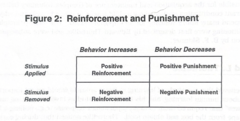
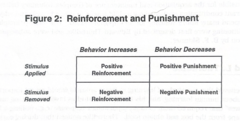
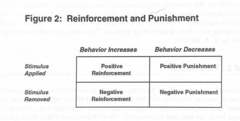
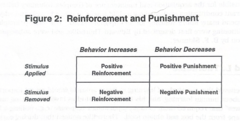
Reinforcement
A consequence that increases the likelihood that a behavior will recur.
Punishment
A consequence that decreases the likelihood that a behavior will recur.
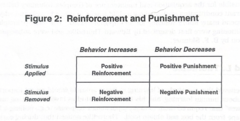
Positive Reinforcement
The application of a stimulus (consequence) following a behavior that increases the likelihood of that behavior recurring.
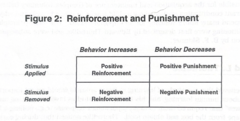
Negative Reinforcement
The withdrawal or termination of a stimulus (consequence) following a behavior that increases the likelihood of that behavior recurring.
Positive Punishment
The application of a stimulus (consequence) following a behavior that decreases the likelihood of that behavior recurring.
Negative Punishment
The withdrawal or termination of a stimulus (consequence) following a behavior that decreases the likelihood of that behavior recurring.
Operant Extinction
The elimination of a previously reinforced response through the consistent withholding of reinforcement following that response.
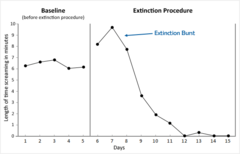
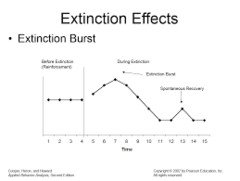
Extinction Burst
A temporary increase in the response that occurs during operant extinction.
Primary Reinforcers
Inherently desirable reinforcers that do not depend on experience to acquire their reinforcing value, such as food and water.
Secondary Reinforcers
Reinforcers that acquire their value only through repeated association with primary reinforcers, such as tokens, applause, and gold stars.
Generalized Secondary Reinforcer
A secondary reinforcer that is paired with several different primary reinforcers, such as money.
Schedules of Reinforcement
The effectiveness of positive reinforcement is impacted by the schedule on which it is delivered.
Continuous Schedule
A schedule where reinforcement is presented after each response, leading to fast acquisition of behavior.
Intermittent Schedule
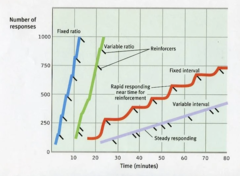
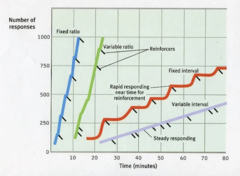
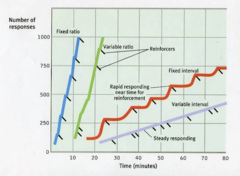
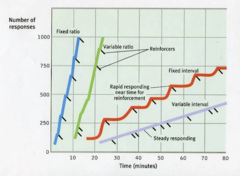
A schedule that is used to maintain behavior after it has been acquired, as it reduces satiation and rate of extinction.
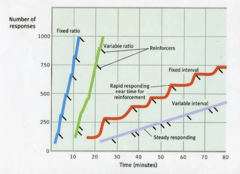
Fixed Interval (FI)
A schedule where reinforcement is delivered after a fixed period of time regardless of the number of responses made.
Variable Interval (VI)
A schedule where the interval of time between delivery of reinforcers varies in an unpredictable manner from interval to interval.
Fixed Ratio
A schedule where reinforcement is delivered after a fixed number of responses.
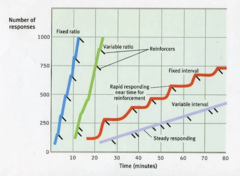
Variable Ratio
A schedule where reinforcement is delivered after a varying number of responses.
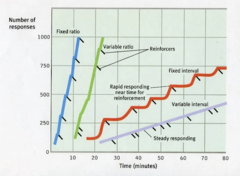
Scallop Effect
The pattern of responding that occurs in fixed interval schedules, where subjects stop responding after a reinforcer is delivered and then begin responding again toward the end of the reinforcement interval.
Example of FI-30 Schedule
A rat receives reinforcement every 30 seconds whether it makes only one response or 50 responses during the 30-second period.
Example of VI-30 Schedule
A rat might be reinforced after 15, 40, 30, 20, and 45 seconds as long as it presses the lever at least once during each interval.
FIXED RATIO (FR) SCHEDULE
a reinforcer is delivered each time the subject makes a specific number of responses.
FR-6 schedule
A pigeon would be reinforced with a food pellet after every sixth key peck.
VARIABLE RATIO (VR)
reinforcers are provided after a variable number of responses.
VR-20 schedule
the average number of responses receiving reinforcement will be 20, but the exact number will vary from reinforcer to reinforcer.
MATCHING LAW
in this situation, the organism will match its relative frequency of responding to the relative frequency of reinforcement for each response.
Ainslie-Rachlin model
is a theory of self-control choices that explains why an individual's preferences can shift from a larger, delayed reinforcer to a smaller, more immediate reinforcer as the time of delivery approaches.
stimulus control
is the process by which a behavior does or does not occur due to the presence of discriminative stimuli.
Trans-situationality
is the theory that once a stimulus is determined to be a reinforcer in one situation, it will also serve as a reinforcer in other situations.
delayed gratification paradigm
is the act of resisting an impulse to take an immediately available reward in the hope of obtaining a more valued reward in the future. The ability to delay gratification is essential to self-regulation or self-control.
Positive discriminative stimuli
signal that the behavior will be reinforced.
Negative discriminative stimuli (S-delta stimuli)
signal that the behavior will not be reinforced.
ESCAPE CONDITIONING
is an application of negative reinforcement in which the target behavior is an escape behavior.
AVOIDANCE CONDITIONING
combines classical conditioning with negative reinforcement.
cue in avoidance conditioning
A cue (positive discriminative stimulus) signals that the negative reinforcer is about to be applied.
EFFECTIVENESS OF REINFORCEMENT (FACTORS)
Factors include contingency, immediacy, schedule of reinforcement, magnitude, verbal clarification, and prompts.
REINFORCEMENT — ROLE OF CONTINGENCY
There must be a contingent relationship between the target behavior and the positive reinforcer.
REINFORCEMENT — ROLE OF IMMEDIACY
The reinforcer should be delivered immediately after the target behavior.