APK2105C exam 1
 Call Kai
 Learn
Learn Practice Test
 Spaced Repetition
 Match
Match Flashcards
 Knowt Play
1/131

There's no tags or description
Looks like no tags are added yet.
Name | Mastery | Learn | Test | Matching | Spaced | Call with Kai | Chat |
|---|
No analytics yet
Send a link to your students to track their progress
132 Terms
Anatomy
Study of body structures
Physiology
Study of body functions
Applied Physiology
How structure and function are related
Hierarchy of Structural Organization
Atoms - Molecule - Organelle - Tissue - Organ - Organ system - Organism
Cells
the basic living building blocks of the body; smallest libing units of the body
Tissue
groups of similar cells working together to perform a function
Tissue Types
Nervous, Muscle, Epithelium, Connective
Nervous Tissue made of…
neurons and neuroglia; neurons- send electrical signals through the body; neuroglia- support and protect nerve cells
How it works:
branches send and receive signals
helps with sensation, communication, and movement control
Muscle tissue main function is…
movement
Also helps with (secondary function):
body temperature regulation
stretching (extensibility)
elasticity
contracting
responding to stimuli (excitability)
Epithelial tissue
Layers of tightly packed cells, in a sheet-like arrangement
attached to a basement membrane and connective tissue
Epithelial tissue can be:
simple (one layer)
stratified (multiple layers)
Form glands
exocrine glands
endocrine glands

Connective tissue main function:
Support
most abundant and diverse tissue type
contains fewer cells and more extracellular material
includes bone and blood
Do organ systems overlap?
Yes
Skeletal system
bones
cartilage ligaments
bone marrow
Provides Support!
Muscular System
skeletal muscles and associated tendons
Provides movement and protection/support for other tissues
Nervous System
brain
spinal cord
peripheral nerves
sense organs
response to stimuli and movements
Endocrine System
pituitary gland
thyroid glan
pancreas
adrenal glands
gonads
endocrine tissue in other systems
metabolic activity and energy use
Cardiovascular System
heart
blood
blood vessels
Distribution
Epithelial tissue
one layer that separates the inside of the body from the outside environment
Semipermeable membranes
help separate fluid compartments in the body, helps with protection and selective movement of substance
Homeostasis
Maintenance of stable internal conditions in the body
How does homeostasis help to regulate the extracellular fluid (ECF)
composition of the ECF
temperature of the ECF
volume of the ECF
All organ systems help maintain homeostasis with the exception of…
reproductive system (reproductive function)
Negative feedback
most common type of feedback
reverses a stimulus to maintain stability
helps keep the body in balance
Think about it like lab, the making of one enzyme, trigger the previous enzyme to stop
Positive feedback
amplifies a stimulus to drive a process
continues until the process is complete
Ex: LH pathway
Polarity in terms of water
water has covalent bonds, electron sharing that completes its outer shell
water is polar: electrons don’t have an even distrbution around a molecule.
Oxygen has a higher EN, pulling electrons
polar molecules are hydrophilic
Non-polar molecules
Molecule that has an even distribution of electrical charge (aroms shared equally.
hydrophobic
4 main types of large biological macromolecules
Carbohydrates
Lipids
Proteins
Nucleic acids
Carbohydrates
called sugars/starches
polar and dissolve easily in water
polar because of hydroxyl group
Monosaccarides
Simple sugars; most common glucose
Glucose is
used by cells to generate ATP in cellular respiration
Disaccaride
two monosaccharides covalently bonded together
Sucrose (table sugar)
combines glucose and fructose
Lactose (milk sugar)
combines glucose and galactose
Polysaccharides
covalently bonded polymers of monosaccharide unites
Lipids
“fats”
nonpolar and insoluble (NP because they are made up mostly of long chains of C-H connected by nonpolar covalent bonds)
Hydrophobic (some lipids are amphipathic)
Phospholipids structure
is hydrophilic, polar head and hydrophobic, non-polar tails
Types of lipids
Triglyceride
phospholipids
Steroids
Triglyceride
considered fats
single glycerol molecule and three fatty acid molecules
most common lipid type
Phospholipids
amphipathic molecules: hydrophilic head and two hydrophobic tails
all cells have plasma membranes made up of these
Steroids
Cholesterol is the most common steroid and the starting point for the production of all steroids
Proteins
polymers of amino acids
Amino acid structure
composed of central C, amino group, carboxyl group, hydrogen group and an R-group (side chain)
R group affects the amino acid function
amino acids joined by peptide bonds and form polypeptides
all polypeptides are made up of the same 20 AA’s
Primary Structure
the sequence of amino acids linked by peptide bonds
Secondary structure
the initial folding of the sequence of amino acids, caused by hydrogen bonding
alpha helices and beta-pleated sheets
Tertiary structure
further folding caused by interactions between the R groups. 3D
Quaternary structure
the most complex structure that only exists in proteins with multiple polypeptide chains that interact with one another
Fibrous proteins
function in structure or contraction. Ex: collagen ; collagen fibers provide tensile strength to stop breakage when skin and other parts are pulled
Globular proteins
coiled, folded structures with many functions as enzymes, hormones, receptors and carrier proteins
Nucleotides function
transfer energy, provide intercellular signaling, and form genetic material
Nucleotide strucuture
nitrogenous base, 5- Carbon carbohydrate, and a phosphate group
What are the bonds between nucleotides?
Hydrogen bonds
Polar molecules contain
negative charged phosphate group and a sugar-phosphate backbone that interacts with water
Pyrimidine
One ring structure; Cystosine and thymine
Purine
Two ring structure; Adenine and guanine
mRNA (messenger RNA)
translated at the ribosome and determines the amino acid sequence in polypeptides
rRNA (ribosomal RNA)
component of ribosomes and catalyzes peptide bond formation
tRNA (Transfer RNA)
binds to mRNA sequences, brining specific amino acids ot the growing polypeptide chain
3 main components of a cell
Plasma Membrane, Cytosol, and Nucleus
What is the cytosol made of?
(intracellular fluid within the cell)
extracellular fluid - fluid outside the cell
cytoplasm - space inside the cell excluding the nucleus
cytosol - intracellular fluid
organelles - various functions carried out
Fluid mosaic model
Current theory of membrane structure:
fluid = dynamic/moving
mosaic = many parts
What are cell membranes made up of?
2 layers of phospholipids with proteins embedded
phospholipids are amphipathic
no polar molescules can move past the fatty acid tails
Cholesterol - function in the cell membrane
embedded in the core of the membrane
increase fluidity
decrease membrane permeability
Integral membrane protein - function
embedded and stuck into plasma membrane
permanent
function: receptors, pores (H2O) channels, enzymes
(transmembrane - span across the whole membrane and peripheral - not permanently associated)
Membrane Carbohydrates
covalently bond to integral proteins or phospholipids
important for cell recognition with immune cell
Glycolipids
amphipathic molecules with sugar molecule attached to phosphate group of phospholipid
Outer sufrace
used for cellular adhesion, recognition and growth
Rough ER
Ribosomes for protein synthesis
Smooth ER
Does not have ribosomes; calcium is stored and lipids, steroids, and triglycerides are made
Golgi apparatus
packing and shipping center; proteins travel through cisternae (received @ cis face and shipped off at trans face)
Mitochondria
produces ATP, with double membranes
folded inner membranes called cristae that increase SA and help produce more ATP
Lysosomes
contain digestive enzymes. Autophagy: cells digest their own components
Peroxisomes
digest toxic substances and produce hydrogen peroxide (H2O2). They contian catalase to break down hydrogen peroxide.
Microfilaments
smallest diameter
movement
actin and microvilli increase surface area
intermediate filaments
myosin nad keratin
anchoring
Microtubules
largest in diameter
hollow tube that form cilia and flagella for movement
Tight junctions
seal cells so no fluids leak between them
Desmosomes
Anchor cells like a zipper and resist stretching
cadherin proteins are major components
tissues that are constantly under stress like heart or skin
Gap junctions
provide tunnels between adjacent cells connected by membrane protein called connexons
Diffusion
nonpolar molecules driven by a concentration gradient
carrier proteins
large polar molecules
Channels
free passage of water and ions into and out of the cell
Vesicles
membrane - bound sacs that transport macromolecules. endo and exocytosis
Direct communication
gap junctions
indirect communication
chemcial messengers such as hormones
Gene
a segment of DNA with a specific order of linked nucleotides that code from a specific protein
Genome
the collection of genes in a given species
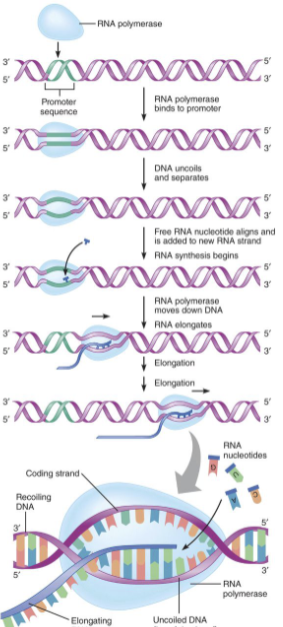
protein synthesis general steps
DNA is transcribed
mRNA moves from the nucleus to the cytoplasm
mRNA is translated by ribosomes
Transcription
mRNA is transcribed from its complementary strand
pre-mRNA undergoes post transcriptional modifications in the nucleus before it moves to the cytoplasm for translation
This includes the addition of poly-A tail, 5’ cap, and or splicing of exons
Translation steps
Process in which polypeptides are synthesized using mRNA codons in the ribosomes of the cytoplasm
1.Initiation: ribosomal subunits bind, initiation codon is
aligned in the A site
2. Elongation: start codon moves to the P site, additional
codon binds to the A site, peptide bond forms, codon
moves to the E site (repeat)
3. Termination: stop codon binds and protein synthesis ends

Start codon
AUG
Post-translational processing
cleavage of amino acids
packaging in the golgi body
addition of chemical groups (carbohydrates or lipids)
destination: vesicles, membrane, cytosol
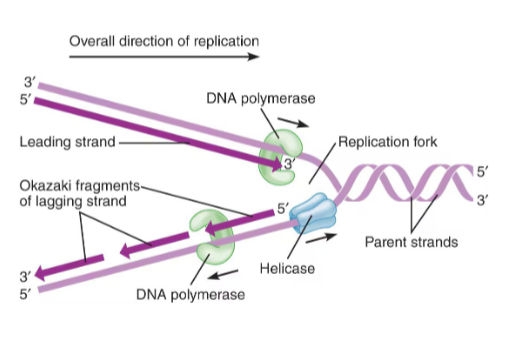
DNA replication
semi-conservative process
1.Helicase unwinds DNA
2. DNA Polymerase catalyzes the reaction
that adds complementary base pairs to the
strand
a. Leading Strand and Lagging Strand
3. DNA ligase links fragments together on the
lagging strand
Cell life cycle
Interphase: G0, G1, S, G2
M-phase: cell division
a. Mitosis
b. Meiosis

Metabolism
sum of all chemical reactions that occur in cells
mass of reactants = mass of products
Catabolism
Breaks down
ex: proteins - amino acids
Anabolism
produce larger molecules
nucleotides - nucleic acid
Hydrolysis
split larger molecules with water into smaller molecules
catabolic
water reactant
condensation
anabolic
water product
Phosphorylation
add phosphate (Pi)
Dephosphorylation
remove phosphate (Pi)