CH 1: Accounting in Business
 Call Kai
 Learn
Learn Practice Test
 Spaced Repetition
 Match
Match Flashcards
 Knowt Play
1/51

Earn XP
Description and Tags
ACT 111 Fall 2026 Chapter 1
Name | Mastery | Learn | Test | Matching | Spaced | Call with Kai | Chat |
|---|
No analytics yet
Send a link to your students to track their progress
52 Terms
Accounting
Information and measurement system that identifies, records, and communicates an organization’s business activities. Referred to as the language of business.
External users
Users who do not directly run the organization and have limited acces to its accounting information.
Internal Users
Users who directly manage the organization , focused on the needs of managerial and executive employees within the org.
What users if financial accounting geared towards?
External users
What users is managerial accounting geared towards?
Internal users
Examples of external users of accounting
Lenders/Creditors
Shareholders/Investors
Regulating Agencies
Nonexecutive employees
Suppliers
Customers
Examples of internal users of accounting
CEO (Chief executive officer)
Marketing managers
Purchasing managers
Research and Development managers
Service managers
What are the four majors areas of opportunities in accounting?
Financial, Managerial, Taxation, and Accounting-Related
Some of these amjor areas intersect on certain opportunities
Private accounting
Employees working for businesses. Where the majority of opportunities withtin accounting are founf
Public accounting
accoutnignservies such as auditing, taxation, and advisory services. Do not confuse as having to do with government or non-profits, that’s a separate area.
Data Analytics
Process of analyzing data to identy meaningful relations and trends
What are the four basic types of analytics?
Descriptive, Diagnostic, Predictive, and Prescriptive
Descriptive Analytics
Summarizes and describes events from the past
Diagnostic Analytics
Reveals causes of events from the past
Predictive Analytics
Predicts likely events for the future
Prescribtive Analytics
Creates action plans to achieve a desired future
Cognitive analytics
A risign fifth type of analytics. Aims to extract insigts and knowledge from data using AI and machine learning to analyze and understand it in a way that mimics human cognition.
Data Visualization
A graphical presentation of data to help people understand their significance. Most popular tool for this is a Tableu dashboard
What are the three factors of the fraud triangle that show what could push a person to commit fraud?
Opportunity - There’s a low risk of getting caught
Pressure - There’s an incentive that motivates the person to commit fraud
Rationalization - Person justifies fraud or does not see its criminal nature
Internal Controls
Procedures to protect assets, ensure reliable accounting, promote efficienty, and uphold copany policies. Auditors verify the effectiveness of internal controls. ULTIMATELY DEDICATED TO CLOSING THE WINDOW OF OPPORTUNITY FOR FRAUD.
GAAB
Generally Accepted Principles of Accounting. Financial accounting is governed by the concepts and rules of GAAP, which aims to uphold relevance and faithful/accurate representation of information.
GAAB PERTAINS TO FINANCIAL ACCOUNTING; EXTERNAL USERS. NOT MANAGERIAL ACCOUNTING; INTERNAL USERS
FASB
Financial Accounting Standard Board. In charge of setting up GAAP as directed by the Securities and Exchange Commision (SEC).
SEC
Securities and Exchange Commision. U.S Governement agency that oversees proper use of GAAP by companies that sell stock and debt to the public. An audit examnies whether financial statments are prepared using GAAP.
THE SEC ENFORCES AND OVERSEES GAAP
THE FASB SETS UP GAAB
IASB
International Accoutning Standards Board. In charge of issuing Internations Fincancial Reporting Standards (IFRS).
IASD - international equivalent of FASB
IFRS - international equiavalent of GAAB
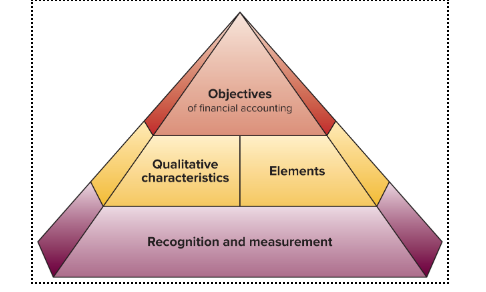
Conceptual Framework of FASB
What the FASB thinks are the goals and needs of accounting
Objectives - to provide information useful to investors, creditors, and others.
NOTE THAT ONLY EXTERNAL USERS ARE LISTED, CAUSE GAAB PERTAINS TO FINANCIAL ACCOUNTING ONLY
Qualitative characteristics - to require information that has relevance and faithful representation
Elements - to identify items in financial statements
Recognition and Measurement - to set criteria for an item to be recognized as an element; and how to measure it
Measurement/cost principle of accounting
Accounting information is based on actual cost. Cost is measured on a cash or equal-to-cash basis. The value of any service is measure in the cash paid for it or the cash value of whatever was exchanged for it.
Cost = Cash Value
Revenue recognition principle of accounting
Revenue is the amount received from selling products and/or services, it can also be a customer’s promise to pay at a future date, called credit sales.
Revenue is recognized AKA recorded when goods and/or services are provided to a customer AND at the amount expected to be received from the customer.
REVENUE DOES NOT = PROFIT
REVENUE RECORDED WHEN THE WORK IS DONE
Expense/matching recognition priciple of accounting
Expenses are recognized in the same perid as the revenue they help generate.
EX. sales salaries expense recorded at the same time as the sales revenue it helped produce.
WHAT I SPEND (EXPENSE) AND WHAT I EXPECT TO EARN (REVENUE) MUST BE RECOGNIZED AT THE SAME TIME
Full disclosure principle of accounting
A company reports the details behind the financial statements that would impact users’ decisions. These disclosures are often in notes/footnotes to the statements.
Going-concern assumption of accounting
Accounting information presumes that the business will continue operating instead of being closed or sold.
Ex. Property is reported at cost instead of at liquidation value
Monetary unit assumption of accounting
Transactions and events are expressed in monetary, or money, units.
Ex. U.S dollar and Mexican peso
*Given the fact that according to the measurement/cost principle accounting info is based on actual cost AKA cash value.
Time period assumption of accounting
The life of a company can be divided into time periods, such as months and years, and useful reports can be prepared for those periods.
Business entity assumption of accounting
A business is accounted for separately from other business entities and its owner(s).
What are the four common business entities?
Sole Proprietorship, Partnership, Corporation, Limited Liability Company (LLC)
Cost-benefit constraint of accounting
Information disclosed by an entity must have benefits to the user that are greater than the costs of providing it.
Accounting has to be worth paying for
Other constraints include: materiality, conservatism, and industry practices
General Principles of Accounting
The concepts, guidelines, and assumptions for preparing financial statements. They serve as the building blocks of GAAB as designed by the FASB.
These principles govern the amount, timing, and/or method of reporting information in financial statements
Sole proprietorship
Only 1 owner
No additional business income tax
Unlitimed liability
Not a separate legal entity
Business ends with owner death or choice
Partnership
Two or more owners called partners
No additional business income tax
Unlimited liability
Not a separate legal entity
Business ends with a partner death or choice
Corporation
One or more owners called shareholders
Additional corporate income tax
Limited liability; shareholders not liable for corporate acts and debts
Separate legal entity with the same responsabilities as a person
Indefinite business life
Limited Liability Company (LLC)
One or more owners called members
No additional business income tax
Limited liability
Separate legal entity with the same rights as a person
Indefinite business life
Materiality Constrant of Accounting
Materiality is the ability of information to influence decisions.
Information included on the financial statements must be relevant enough to be included.
Example of materiality constraint
After financial statement is finalized, the company loses a factory in a fire. This information is important to the decisions of investors, shareholders, etc. Financial statement is revisited to include this information .
Example of cost-benefit constraint
A one hundred dollar invoice is left out of the financial statement. Given that revising the statement would cost more than the benefit it would provide this invoice is left out as it is not significant enough.
Assets
Resources a company owns or controls
Assets include cash, supplies, equipment, land, and account receivables
Liability
Claims on a company’s assets by non-owners
Company obligations to provided assets, products, or services to others
*Liabilities are considered part of a company’s assets
Equity
Claims on a company’s assets made by the owner
Also called net assets or residual equity
Account payables
Liabilities that promise a future outflow of resources
Account receivables
Assets that promise a future inflow of resources