Biology midterm potential FRQs
 Studied by 0 people
 Call Kai
 Learn
Learn Practice Test
 Spaced Repetition
 Match
Match Flashcards
 Knowt Play
1/73

There's no tags or description
Looks like no tags are added yet.
Name | Mastery | Learn | Test | Matching | Spaced |
|---|
No study sessions yet.
74 Terms
Specialization
Cells evolve to perform specific functions, increasing efficiency in multicellular organisms
Compartmentalization
Use of membrane-bound organelles to isolate cellular processes, increasing efficiency.
Prokaryote
Unicellular organism lacking nucleus and membrane-bound organelles.
Eukaryote
Organism with nucleus and membrane-bound organelles.
Unicellular vs Colonial vs Multicellular
One cell / independent cluster of similar cells / many interdependent, specialized cells.
Explain endosymbiosis.
Eukaryotic mitochondria and chloroplasts originated when ancestral prokaryotes were engulfed and formed a mutualistic relationship inside a host cell.
How does compartmentalization support specialization?
by having Organelles isolate incompatible reactions, it allows cells to evolve specialized biochemical pathways.
what is the connection between all this: specialization, compartmentalization, endosymbiosis, prokaryote, eukaryote, unicellular, colonial, multicellular
Life began with simple Unicellular organisms, starting with Prokaryotes. A major leap occurred via Endosymbiosis, leading to the more complex Eukaryotes, whose structure is defined by internal Compartmentalization (organelles). Eukaryotes then formed aggregates, progressing through Colonial stages, eventually evolving into truly Multicellular organisms. This final, complex state is defined by the high degree of cellular Specialization required for coordinated function.
what is oxygen’s role in cell respiration
final electron acceptor in ETC, forms water
what are the 3 similarities between aerobic and anaerobic respiration in animal tissues
primary goal is to make ATP, both use glucose as initial fuel source, both begin with glycolysis
what is the oxygen requirement difference between aerobic and anaerobic respiration
aerobic respiration requires oxygen as the final electron acceptor, anaerobic does not
what is the process location difference between aerobic and anaerobic respiration
aerobic has multiple processes from glycolysis in the cytosol, to krebs cycle in mitochondrial matrix, to oxidative phosphorylation in the inner mitochondrial membrane, while anaerobic only does glycolysis and lactate fermentation in the cytosol
what is the atp yield difference (per glucose) between aerobic and anaerobic respiration
aerobic can make up to 32 atp, but anaerobic makes a net 2 atp from glycolysis only
what is the fate of pyruvate difference between aerobic and anaerobic respiration
in aerobic, pyruvate enters the mitochondrian and is completely oxidized to co2 and h2o, while anaerobic keeps pyruvate in the cytosol and converts it to lactate
what is the purpose of final step difference between aerobic and anaerobic respiration
aerobic wants to generate a ton of atp, while anaerobic regenerates nad+ so glycolysis can go again
what is the duration/sustainability difference between aerobic and anaerobic respiration
aerobic is highly efficient and long term, anaerobic is for short term emergencies
what are the byproducts difference between aerobic and anaerobic respiration
aerobic makes carbon dioxide and water, anaerobic makes lactate
what is the independent variable in the resrveratrol experiment: Researchers hypothesize that the plant compound reveratrol improves mitochondrial function.
To test this hypothesis, researchers dissolve reveratrol in dimethyly sulfoxide (DMSO). The solution readily passes through cell membranes. They add resveratrol solution to mammalian muscle cells growing in a nutrient rich solution (culture medium that contains glucose). They measure ATP at several points after the addition of reveratrol sólution and record an increase in ATP production by the muscle cells.
resveratrol
what is the dependent variable in the resveratrol experiment: Researchers hypothesize that the plant compound reveratrol improves mitochondrial function.
To test this hypothesis, researchers dissolve reveratrol in dimethyly sulfoxide (DMSO). The solution readily passes through cell membranes. They add resveratrol solution to mammalian muscle cells growing in a nutrient rich solution (culture medium that contains glucose). They measure ATP at several points after the addition of reveratrol sólution and record an increase in ATP production by the muscle cells.
ATP production
in the resveratrol experiment, describe a control group they should use: Researchers hypothesize that the plant compound reveratrol improves mitochondrial function.
To test this hypothesis, researchers dissolve reveratrol in dimethyly sulfoxide (DMSO). The solution readily passes through cell membranes. They add resveratrol solution to mammalian muscle cells growing in a nutrient rich solution (culture medium that contains glucose). They measure ATP at several points after the addition of reveratrol sólution and record an increase in ATP production by the muscle cells.
use a DMSO only control group
Predict ATP production with resveratrol but no glucose.
ATP decreases because glucose is required for glycolysis and as a substrate for mitochondrial respiration.
if glucose is not limiting during the resveratrol experiment, Why would O₂ consumption increase? Researchers hypothesize that the plant compound reveratrol improves mitochondrial function.
To test this hypothesis, researchers dissolve reveratrol in dimethyly sulfoxide (DMSO). The solution readily passes through cell membranes. They add resveratrol solution to mammalian muscle cells growing in a nutrient rich solution (culture medium that contains glucose). They measure ATP at several points after the addition of reveratrol sólution and record an increase in ATP production by the muscle cells. The researchers find that reveratrol appears to stimulate aspects of the electron transport chain.
The researchers predict that resveratrol treatment will increase oxygen consumption by the cells if glucose is not limiting. Provide a justification for the researcher's claim.
 |
Stimulating ETC increases electron flow; more O₂ is required as the final electron acceptor.
Main trigger for breathing rate
increased carbon dioxide, which lowers blood pH.
Where CO₂ is mostly carried
Bicarbonate ions (HCO₃⁻).
Respiratory control center
Medulla oblongata.
Connection between CO₂, pH, hemoglobin.
Higher CO₂ lowers pH, shifting hemoglobin right (Bohr shift), increasing O₂ unloading to tissues.
Where would PDC be most active? The pyruvate dehydrogenase complex (PDC) catalyzes the conversion of pyruvate to Acetyl-CoA, a substrate for the Krebs (citric acid) cycle. Thę rate of pyruvate conversion is greatly reduced in individuals with PDC deficiency, a rare disorder.
mitochodrial matrix
Effect of PDC deficiency on NADH.
Krebs cycle NADH decreases due to less acetyl-CoA; glycolysis NADH unaffected.
effect on ATP from ETC
lower NADH and fadh2 reduce electron flow, lowering production
where does glycolysis occur
cytosol
what 3 things does glycolysis produce
2 pyruvate, 2 net atp, 2 nadh
what 3 things does pyruvate oxidation produce
acetyl-coa, nadh, co2
where does pyruvate oxidation and krebs cycle occur
mitochondrial matrix
what 4 things does krebs cycle make
nadh, fadh2, co2, atp
what is the role of the proton gradient in ETC/oxidative phosphorylation
it drives atp synthase
what do glycolysis and pyruvate oxidation contribute to atp synthesis (what do they do to the glucose, and what two other things do they produce)
They break down glucose into pyruvate and then Acetyl-CoA, producing a small amount of ATP and generating NADH, which carries high-energy electrons to the ETC for major ATP production.
what 3 things does krebs cycle contribute to atp synthesis
oxidizes Acetyl-CoA
produces large amounts of NADH and FADH₂,( the electron carriers that fuel the ETC)
makes small amount of ATP directly through substrate-level phosphorylation.
What is the contribution of the electron transport chain (ETC) to ATP synthesis?
The ETC uses electrons from NADH and FADH₂ to pump H⁺ ions across the inner mitochondrial membrane, creating a proton gradient that drives ATP synthase to produce most of the cell’s ATP through oxidative phosphorylation.
How does the fact that nearly all existing organisms perform glycolysis support the claim that glycolysis evolved in a common ancestor?
Because glycolysis is shared across bacteria, archaea, and eukaryotes, the most logical explanation is that the pathway originated before these lineages diverged, meaning it was present in the earliest common ancestor of all life.
How does the fact that glycolysis occurs under anaerobic conditions support early evolutionary origins?
Early Earth had little to no oxygen, so organisms needed a metabolic pathway that worked without oxygen. Glycolysis fits this requirement, suggesting it evolved in ancient, anaerobic environments and was passed down to all later life forms.
How does the fact that glycolysis occurs only in the cytosol support its presence in a common ancestor?
The cytosol is the simplest, most primitive cell compartment. Because glycolysis does not require specialized organelles or membranes, it likely evolved before complex cell structures existed, indicating it originated in the earliest cells.
what happens to the excess energy from glucose metaboism that is not captured in ATP?
released as heat to help maintain body temp or lose to environment
why is cellular respiration not 100% efficient
because energy is lost as heat during metabolic reactions and electron transport, and some energy is unavailable because of thermodynamic limits
the enzymes for the krebs are found in the ctyoplasm of bacteria, but in the mitochondria of eukaryotes. briefly explain this evolutioanry connection
bacteria perform krebs in cytoplasm because they lack membrane bound organelles. eukaryotes perform it in mitochnodria because mitohoncdria evolved from ancestral bacteria through endosymbiosis, and their metabolic pathways including krebs became localized inside the mitochondrion
descibre how the lock and key model for enzyme action explains the ability of enzymes to catayze either hydroylsis or dehydration syntehesis reactions
in the model the enzyme’s active site fits the substrate exactly. because of that correct orientation, the enzme can either stress and weaken bonds or hold two substrates together, the specific shape ensuring only the correct reaction occurs with the correct substrate
why doe enzymes have different ph optima
ph affects the ionic interactions that stabilize an enzyme’s shape and active site, so each enzyme works best at a specific ph
give an example of an enzyme starting with a p adapted to acidic ph
pepsin, which works best in stomach at abotu ph 2
give an example of an enzyme adapted to neutral ph starting with a c
chymotrypsin, which functions in the small intestine at ph 7
how do ph and temp. differences relate to orgnaism distribution
different organisms and tissues evolve enzymes sutied to their environments, allowing survival in acidic, neutral, basic, hot, or cold conditions
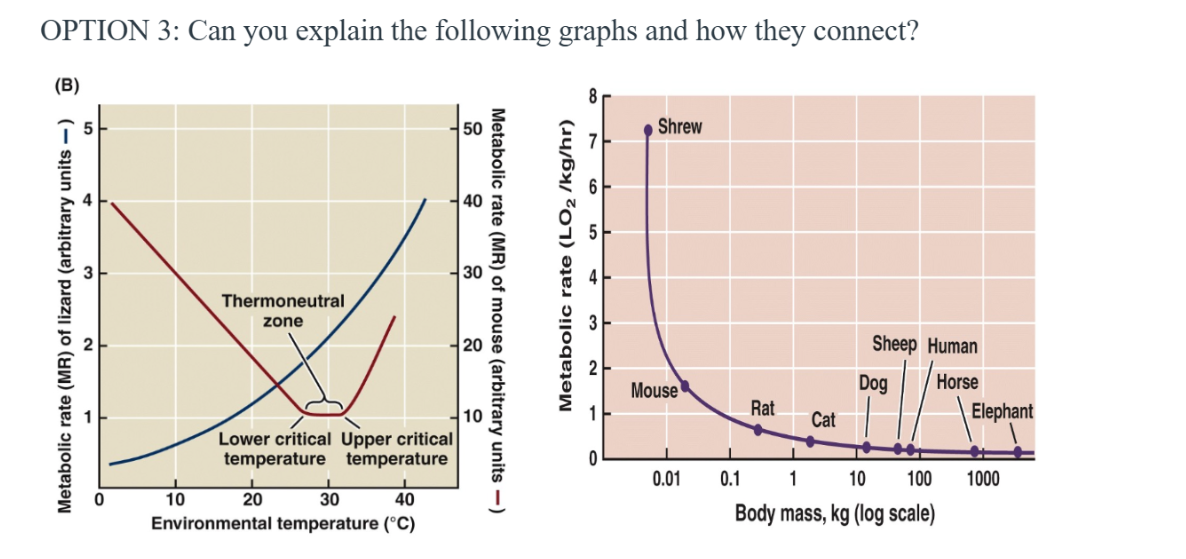
they show that metabolic rate is tied to temperature regulation, as endotherms use metabolism to maintain internal temperature, and smaller animals burn more energy to resist heat loss
how would temperatures above 35 celsius impact the structure and function of starch synthase specifically
the active site partially unfolds, lowering enyzme activity and slwoing or preventing the ocnversion of glucose into starch
what digestion begins in the mouth?
carb digestion through salivary amylase which breaks starch into maltose
what process moves food thorugh the esophagus
peristalsis, wavelike muscle contractions
what molecuels are digested in the stomach and by which enzyme
proteins are digested by pepsin
what stomach conditions activate pepsin
highly acidic ph of 2
what structural adpatation helps stomach digestiong
folds increase surface area and allow expansion
where does most chemical digestion occur
duodenum of small intestine
what 4 things are digested in small intestine
carbs, proteins, lipids, nucleic acids
what enzymes come from the pancreas
trypsin, chymotrypsin, pancreatic amylase, lipase, nucleases
what does bile do
breaks large fat globules into smallero nes
what structural adaptation increases absoprtion in the small intestine
villi and microvilli create massive surface area
how are nutrients absorbed in small intestine
through active transport, diffusion or co transport into blood or lymph for fats
main function of large intestine?
water absorption and the formation of feces
role of liver in digestion
makes bile and processes absorbed nutrients
role of gallbladder in digetsion?
stores and concentrates bile
role of pancreas in digestion?
makes digestive enzymes and bicarbonate to neutralize stomach acid
what is the correct order of digestion from ingestion to elimination MESSLRA
mouth, esophagus, stomach, small intestine, large intestine, rectum, anus
why do herbivores have logner digestive tracts
plant material like cellulose is harder to digest
where and how are carbs digested (2 places, two enzymes)
the mouth by salivary amylase and the small intestine by pancreatic amylase
where and how are proteins digested (2 places, 4 ways total)
in the stomach by pepsin, the small intestine by trypsin, chymotrypsin, and peptidases
where and how are lipids digested
in small intestine by bile
where and how are nucleic acids digested
in small intestine by nucleases from pancreas
why is the stomach acidic?
the acid denatures proteins and activates pepsinogen to pepsin
why do villli help with absorption
they drastically increase surface area, maximizing nutrient uptake