Glandular Epithelia
 Call Kai
 Learn
Learn Practice Test
 Spaced Repetition
 Match
Match Flashcards
 Knowt Play
1/7

There's no tags or description
Looks like no tags are added yet.
Name | Mastery | Learn | Test | Matching | Spaced | Call with Kai | Chat |
|---|
No analytics yet
Send a link to your students to track their progress
8 Terms
Gland
Structure that makes and secretes a product; Arise from epithelial tissue that grow inward into underlying connective tissue rather than remaining on the surface
Glands release their product by 2 mechanisms: exocrine glands and endocrine glands
Exocrine Glands
Release their secretions to the apical surface of the epithelium through a duct lined with epithelial cells
Have local actions only
Vary in complexity from single-celled glands to large glands with branching ducts and many secretory units
ex. Unicellular Glands include the Goblet Cell, which is found in the epithelial lining of the digestive and respiratory tracts and secretes mucus

Endocrine Glands
Secrete hormones directly into the blood
Lack ducts
Reach distant target cells
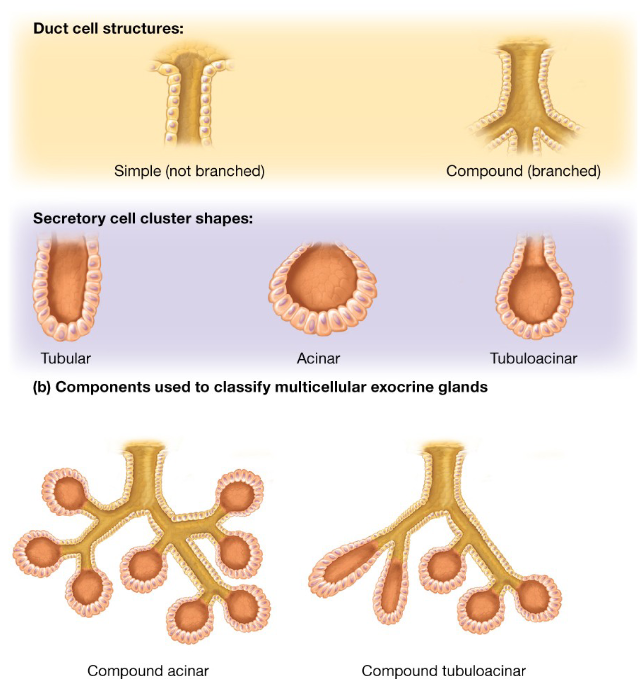
Multicellular Glands
classified by the structure of their ducts and the shape of their secretory cell clusters:
Duct structure
-Simple Glands- ducts do not have branch
-Compound gland- ducts do have branches
Shape of Secretory Cell Clusters
-Tubular- long or straight or coiled
-Acinar- Spherical
-Tubuloacinar- both tubular and acinar portions
3 types of exocrine secretion
merocrine, holocrine, apocrine
Merocrine
Glands package products into secretory vesicles for release by exocytosis
most glands secrete this way
Salivary and sweat glands

Holocrine
Secretory cells accumulate product in the cytosol, which is released when the cell ruptures and dies
Sebaceous (oil) glands of the skin

Apocrine
Portions of cytoplasm are pinched off with the secreted product
Lipid droplets in milk from mammary glands