Decision Trees
 Studied by 0 people
 Call with Kai
 Learn
Learn Practice Test
 Spaced Repetition
 Match
Match Flashcards
 Knowt Play
1/6

There's no tags or description
Looks like no tags are added yet.
Name | Mastery | Learn | Test | Matching | Spaced | Call with Kai |
|---|
No study sessions yet.
7 Terms
What is a decision tree?
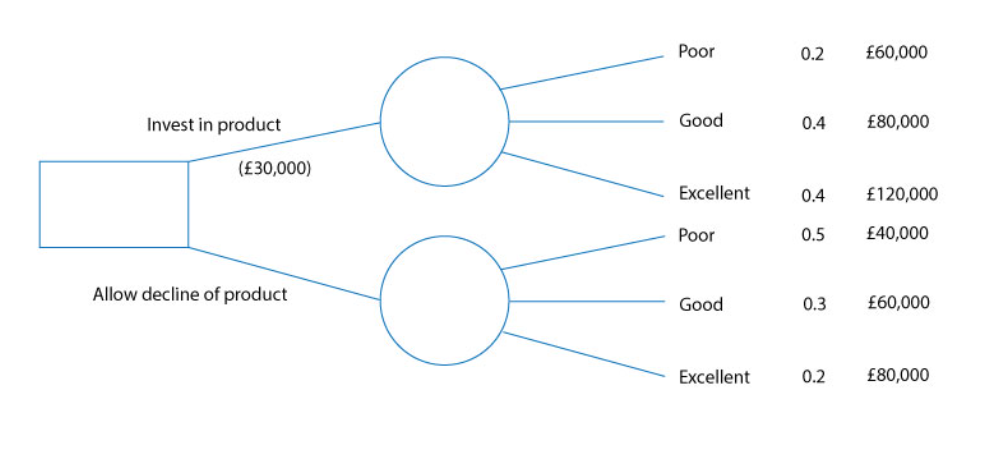
Decision trees are a form of diagrammatic analysis, used to help businesses with making decisions where there are several different options from which to select.
How do decision trees work?
Decision trees build the probability of success and failure into the decision-making process. This helps to provide an effective and clear structure for presenting options using ‘expected values’.
Expected values are the financial returns that can be gained for each option, taking into account both success and failure of each course of action.
How do you calculate the expected values?
Financial result x probability
Squares represent…
Decision nodes.
Circles represent…
Chance nodes.
What are the benefits of using decision trees?
Clearly lays out the problem so that all options can be considered.
Allows managers to fully analyse the possible consequences and risks of a decision.
What are the limitations of using decision trees?
Uses probabilities which only give an estimate- may be inaccurate.
Does not take into account qualitative factors.
Can be time consuming to construct and may be interpreted with bias.
Remember: decision trees cannot be used in isolation; it should only aid decision making but other qualitative factors should be accounted for.