Lecture 3: Chromosomes and Chromosome Biology
 Note
Note Call Kai
 Learn
Learn Practice Test
 Spaced Repetition
 Match
Match Flashcards
 Knowt Play
1/20

Earn XP
Description and Tags
Vocabulary flashcards covering DNA storage and sorting, chromatin levels, chromosome structural elements, and common chromosomal mutations based on Lecture 3.
Name | Mastery | Learn | Test | Matching | Spaced | Call with Kai | Chat |
|---|
No analytics yet
Send a link to your students to track their progress
21 Terms

Supercoiling
A mechanism used by bacteria where proteins form DNA loops that twist, reducing the physical space required to store the genome.
Chromatin
A complex of DNA packaged with proteins that forms multiple levels of organization to solve cellular DNA storage and sorting problems.

Nucleosome
The structural unit of chromatin composed of a histone octamer wrapped in DNA with a histone H1 clamp.
Heterochromatin
Closed, tightly packed chromatin that exhibits slow replication and low gene expression.
Euchromatin
Open, loosely packed chromatin that exhibits faster replication and higher gene expression.
Diploid
An organism or cell possessing two copies of each chromosome, such as humans who have 22 pairs of autosomes and 2 sex chromosomes.

Allele
One of two or more alternative versions of a gene located at a specific locus on homologous chromosomes that impact the same trait.
G-bands
Chromosome banding patterns created by Giemsa staining that correspond to regions of heterochromatin and aid in structural identification.
Telomeres
Stable DNA-protein complexes located at the ends of linear chromosomes that protect them from unraveling and chemical reactivity.

Shelterin complex
A multiprotein complex (comprising TRF1, TRF2, TIN2, TPP1, POT1, and RAP1) that binds to telomeres to protect chromosome ends.

Centromere
A constricted region of a chromosome where sister chromatids join and where the kinetochore forms to attach spindle microtubules.
Kinetochore
A protein structure that forms at the centromere during cell division, associating with both chromosomal DNA and microtubules to facilitate sorting.
Segregation
The process of chromosome separation during cell division.
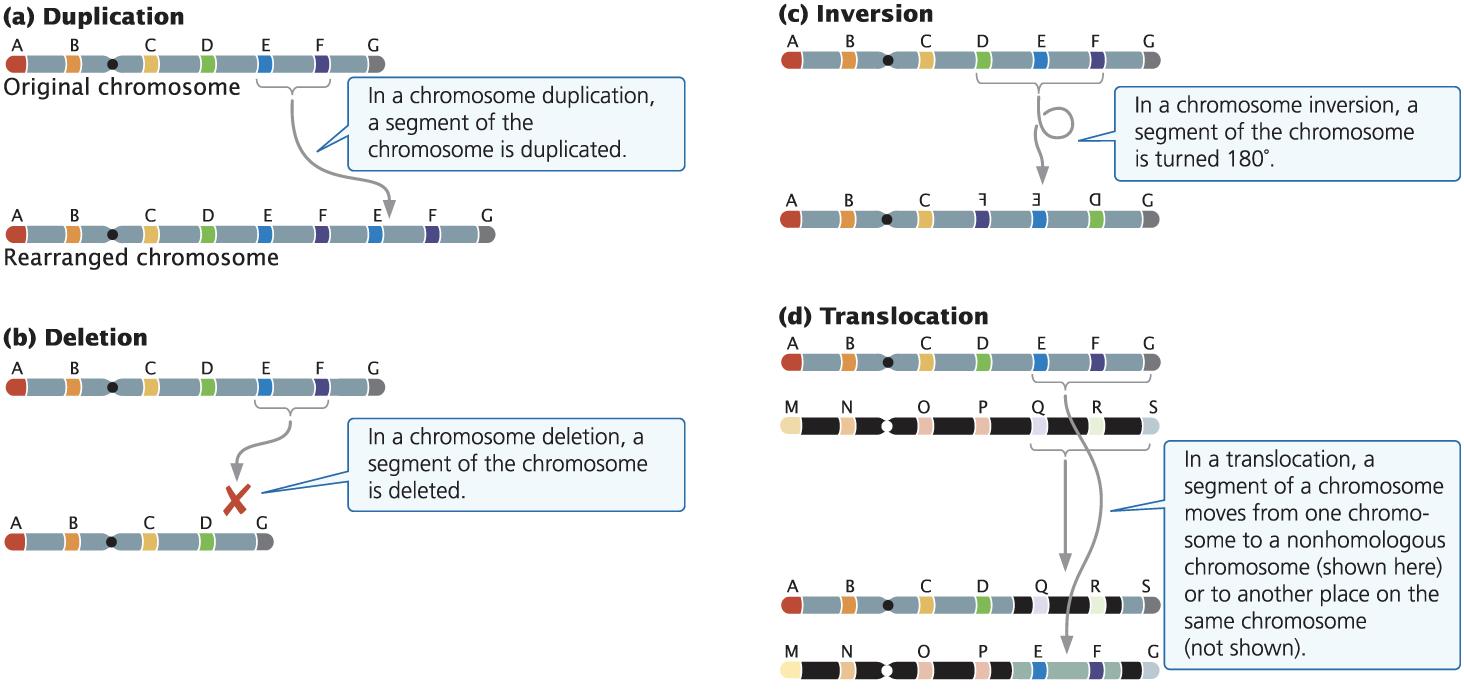
Chromosome Rearrangements
Large structural changes in chromosomes that include duplications, deletions, inversions, and translocations.
Aneuploidy
A chromosomal abnormality characterized by the loss or gain of an individual chromosome (e.g., 2n+1 or 2n−1).
Polyploidy
A chromosomal condition defined by the loss or gain of an entire set of chromosomes.

Non-disjunction
A failure in proper chromosome segregation during mitosis or meiosis that results in aneuploidy.

Trisomy 21
The most common autosomal aneuploidy in humans, altering gene dosage across approximately 250 protein-coding genes on Chromosome 21.
Inversion
A chromosome rearrangement in which a segment of the chromosome is turned 180∘.
Translocation
A chromosome rearrangement in which a segment moves from one chromosome to a nonhomologous chromosome or to a different locus on the same chromosome.

Unequal Crossing Over
A meiotic recombination error caused by improper alignment of chromosomes, generating a duplication on one chromosome and a deletion on the other.