VCE PE Unit 1 Exam revision
 Call Kai
 Learn
Learn Practice Test
 Spaced Repetition
 Match
Match Flashcards
 Knowt Play
1/71

There's no tags or description
Looks like no tags are added yet.
Name | Mastery | Learn | Test | Matching | Spaced | Call with Kai | Chat |
|---|
No analytics yet
Send a link to your students to track their progress
72 Terms
Creatine Supplementation
Creatine supplementation is a permitted nutritional compound that increases phosphocreatine (PC) stores in the muscles, extending the capacity of the ATP‑PC energy system. This allows an athlete to maintain maximal power output for slightly longer during short, explosive movements..
Resistance Training
Resistance training is a structured training method (e.g., weightlifting) that promotes chronic muscle hypertrophy, increases tendon strength, and improves bone density in a safe, natural, and legal way, enhancing strength and power performance.
Superior
Refers to a body part that is closer to the head than another part.
Inferior
Refers to a body part that is closer to the feet than another part.
Anterior
A body part that is towards the front of the body
Posterior (Dorsal)
A body part towards the back of the body
Medial
Towards the midline of the body
Lateral
A body part that moves away from the midline of the body.
Proximal
Refers to a body part that is closer to the trunk.
Distal
A body part that is further away from the trunk.
Flexion
A joint movement that decreases the angle between two bones.
Extension
A joint movement that increases the angle between two bones.
Abduction
When a body part is taken away from the midline of the body
Adduction
A joint movement when a part of the body is brought towards the midline.
Rotation
Turning a bone around its own longitudinal axis.
Circumduction
Refers to circular movement that combines flexion, extension, adduction, and abduction. This allows the limb to move in a cone like shape.
Skeletal System Functions
The five primary functions of the skeletal system are support, protection, movement, mineral storage, and blood cell production.
Axial Skeleton
Refers to the central axis of the body, providing protection to vital organs and the central nervous system and provides the structural framework for posture.
Appendicular Skeleton
Refers to the bones of the upper and lower limbs, and the shoulder and pelvic girdles, facilitating movement and locomotion.
Types of Bones
Long (e.g., femur)
short (e.g., carpals)
flat (e.g., sternum)
irregular (e.g., vertebrae)
sesamoid (e.g., patella)
Synovial Joint
A freely movable joint where the articulating bones are separated by a cavity filled with synovial fluid.
Types of Synovial Joints
Hinge (elbow)
ball-and-socket (shoulder)
pivot (neck)
saddle (thumb)
condyloid (wrist)
gliding (tarsals)
Skeletal Muscle
Voluntary, striated muscle attached to bones via tendons that contracts to create movement.
Agonist
The prime mover muscle that contracts concentrically to create the desired movement.
Antagonist
The muscle that relaxes and lengthens as the agonist contracts to allow the desired movement.
Reciprocal Inhibition
The simultaneous contraction of the agonist muscle and the relaxation and lengthening of the antagonist muscle to facilitate movement.
Concentric Contraction
Where the muscle shortens while contracting, creating tension to overcome a resistance and produce movement.
Eccentric Contraction
Muscle lengthens under tension to control or resist a movement.
Isometric Contraction
A muscle contraction where the muscle generates force without changing length, resulting in no movement at the joint.
First-Class Lever (Effort.Fulcrum.Resistance)
A lever system where the fulcrum is located between the effort and the resistance.
Second-Class Lever (Fulcrum-Resistance-Effort)
A lever system where the resistance is located between the fulcrum and the effort.
Third-Class Lever (F-E-R)
A lever system where the effort is located between the fulcrum and the resistance.
Acute Injury
An injury that occurs suddenly and has a clear, identifiable cause, such as a bone fracture, sprain, or muscle tear.
Chronic (Overuse) Injury
An injury that develops gradually over time due to repetitive stress or trauma, such as tendinitis or shin splints.
Direct Injury
An injury caused by an external force making direct contact with the body, such as a collision, strike, or blow.
Indirect Injury
An injury caused by internal forces within the body, resulting from uncoordinated movement, overstretching, or excessive strain, rather than direct contact.
Sprain
An injury involving the stretching or tearing of ligaments.
Strain
An injury involving the stretching or tearing of muscle fibres or tendons.

Strategies for Injury Prevention
Key strategies for preventing injury include completing an adequate warm‑up, using proper protective equipment, applying correct technique, and ensuring appropriate surface conditioning.
Performance Enhancement
Methods or substances used to improve physiological or psychological performance in sport, including legal strategies and illegal performance‑enhancing drugs.
Permitted Performance Enhancement
Legal training methods or nutritional strategies used to improve performance, such as resistance training or carbohydrate loading.
Prohibited Performance Enhancement
Illegal methods or substances banned by WADA because they pose significant health risks or provide an unfair advantage in sport.
Anabolic Steroids
Prohibited synthetic variants of testosterone used to accelerate muscle growth, strength, and recovery. They are banned due to serious health risks and unfair performance advantages.
Growth Hormone (GH)
A prohibited hormone used to stimulate muscle mass growth and tissue repair, providing athletes with an unfair performance advantage and posing significant health risks.
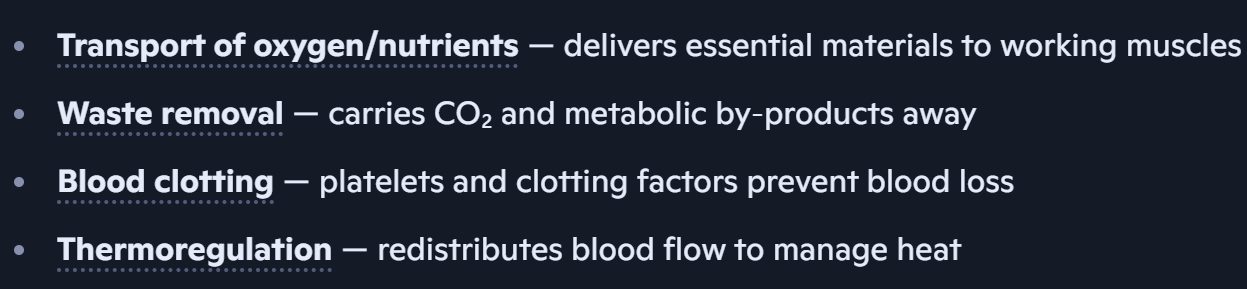
Cardiovascular System Functions
The cardiovascular system transports oxygen and nutrients, removes waste products such as carbon dioxide, clots blood to prevent bleeding, and regulates body temperature through heat distribution and control.
Atria
The two upper chambers of the heart that receive blood entering the heart, where the right atrium receives deoxygenated blood, and the left atrium receives oxygenated blood.
Ventricles
The two lower chambers of the heart that pump blood out to the lungs and body. The right ventricle pumps deoxygenated blood to the lungs, and the left ventricle pumps oxygenated blood to the body.
Arteries
Thick‑walled blood vessels that carry oxygenated blood away from the heart, with the pulmonary artery being the exception because it carries deoxygenated blood to the lungs.
Capillaries
Tiny, thin walled blood vessels where the exchange of nutrients, gases, and wastes occurs between blood and tissues.
Veins
Thin-walled vessels with valves that return deoxygenated blood back to the heart.
Heart Rate (HR)
The number of times the heart beats per minute.
Stroke Volume (SV)
The amount of blood pumped out of the left ventricle of the heart per beat.
Cardiac Output (Q)
The volume of blood pumped by the heart per minute.
Vasodilation
The widening of blood vessels to increase blood flow to the working muscles or skin during exercise.
Vasoconstriction
The narrowing of blood vessels to decrease blood flow to non-essential organs during exercise, helping redirect blood to working muscles and maintain blood pressure.
Thermoregulation
The process of maintaining a stable core body temperature by sweating and redirecting blood flow to the skin, allowing excess heat to be released during exercise.
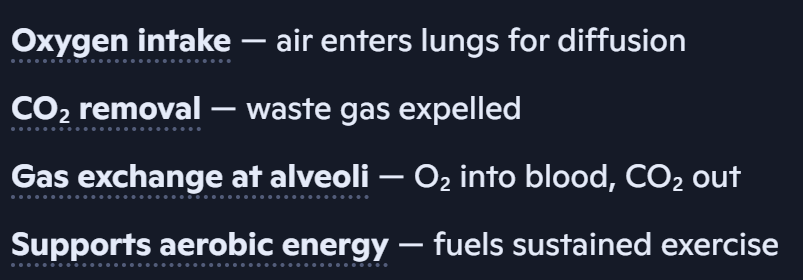
Functions of the Respiratory System
The respiratory system brings oxygen into the body, removes carbon dioxide, and allows gas exchange to support energy production during exercise.
Alveoli
Tiny air sacs in the lungs where gaseous exchange takes place.
Gaseous Exchange
Gaseous exchange is the diffusion of oxygen into the blood and carbon dioxide out of the blood across a thin membrane, moving from areas of high concentration to low concentration.
Pulmonary Diffusion
The gaseous exchange that occurs at the alveolar–capillary interface in the lungs, where oxygen diffuses into the blood and carbon dioxide diffuses out.
Arteriovenous Oxygen Difference (a-vO2 diff)
The difference in oxygen content between arterial and venous blood, indicating how much oxygen the muscles utilise.
Respiratory Rate (RR)
The number of breaths taken per minute.
Tidal Volume (TV)
The volume of air inhaled and exhaled per breath.
Ventilation (V) (V = RR x TV)
The total volume of air inspired or expired per minute.
Chronic Aerobic Adaptations
Long‑term physiological changes that occur from consistent aerobic training, such as increased stroke volume, greater capillary density, and improved lung and oxygen‑delivery efficiency.
Altitude Training
A legal training method performed at high elevations, where the reduced oxygen levels stimulate the body to naturally increase red blood cell production, improving oxygen‑carrying capacity.
EPO (Erythropoietin)
A prohibited polypeptide hormone naturally produced in the kidney or produced synthetically that increases red blood cell production, boosting the blood’s oxygen‑carrying capacity. It gives athletes an unfair aerobic performance advantage.
Blood Doping
A prohibited method where red blood cells are transfused into an athlete to artificially increase oxygen‑carrying capacity, boosting aerobic endurance and providing an unfair performance advantage.
Stabiliser Muscles
A muscle contracts isometrically to hold a body part steady so the agonist can produce movement.
Anabolic Steroids (Prohibited Method)
Anabolic steroids are prohibited muscle‑enhancing hormones that increase protein synthesis, leading to rapid gains in muscle mass, strength, and recovery. They allow an athlete to train harder and more frequently, giving an unfair performance advantage.
3 Sociocultural factors
Family
Cultural norms
Peers