Digestion of carbohydrates, proteins and lipids in the small intestine
 Call Kai
 Learn
Learn Practice Test
 Spaced Repetition
 Match
Match Flashcards
 Knowt Play
1/5

Earn XP
Description and Tags
Digestion of carbohydrates, proteins and lipids in the small intestine
Name | Mastery | Learn | Test | Matching | Spaced | Call with Kai | Chat |
|---|
No analytics yet
Send a link to your students to track their progress
6 Terms
Pancreas
Secretes pancreatic amylase, trypsin and lipase into the duodenum through the pancreatic duct
Liver
Produces bile
Gallbladder stores bile
Bile flows into the duodenum through the bile duct
Bile
Neutralise the acidic chyme
Prepare an alkali condition (pH 7.6-8.6) for enzyme action in the duodenum
Emulsify lipids into tiny droplets to increase surface area for lipase activity.
Duodenum
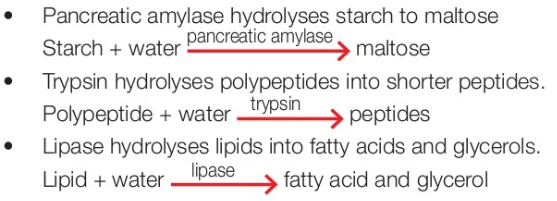
Pancreatic amylase hydrolyses starch into maltose
Trypsin hydrolyses polypeptides into shorter peptides
Lipase hydrolyses lipids into fatty acids and glycerols
Glands on the ileum wall
Secrete mucus and intestinal juice that contains maltase, sucrase, lactase, lipase and erepsin
Ileum
Maltase hydrolyses maltose into glucose.
Sucrase hydrolyses sucrose into glucose and fructose.
Lactase hydrolyses lactose into glucose and galactose.
Lipase hydrolyses lipids into fatty acids and glycerols.
Erepsin hydrolyses peptides into amino acids.