Chemistry revision for resit
 Call Kai
 Learn
Learn Practice Test
 Spaced Repetition
 Match
Match Flashcards
 Knowt Play
1/22

There's no tags or description
Looks like no tags are added yet.
Name | Mastery | Learn | Test | Matching | Spaced | Call with Kai | Chat |
|---|
No analytics yet
Send a link to your students to track their progress
23 Terms
What brown gas is released when a solid salt is heated (thermal decomposition), and what anion does it indicate?
Brown gas: Nitrogen dioxide (NO2).
Anion: Nitrate (NO3-).
(Note: Solid halides like bromides only melt and do not thermally decompose to release Br2).
Describe how peroxyacetyl nitrate (PAN) forms from NO2 in the atmosphere [1 mark].
NO2 reacts with unburned hydrocarbons (or VOCs) in the presence of sunlight.
State the balanced equation and reaction type for nitric acid reacting with calcium oxide.
Equation: 2HNO3 + CaO -> Ca(NO3)2 + H2O
Reaction type: Neutralisation (Acid + Base -> Salt + Water).
State the shape and bond angle for molecules with 4 electron pairs:
- 4 BP, 0 LP
- 3 BP, 1 LP
- 2 BP, 2 LP
- 4 BP, 0 LP: Tetrahedral (109.5°)
- 3 BP, 1 LP: Trigonal pyramidal (107°)
- 2 BP, 2 LP: Non-linear / Bent (104.5°)
State the shape and bond angle for:
- 2 BP, 0 LP
- 3 BP, 0 LP
- 6 BP, 0 LP
- 2 BP, 0 LP: Linear (180°)
- 3 BP, 0 LP: Trigonal planar (120°)
- 6 BP, 0 LP: Octahedral (90°)
How do you identify Giant Metallic and Giant Ionic structures from a chemical formula?
- Metal only (e.g., Na, Mg, Fe) -> Giant Metallic
- Metal + Non-metal (e.g., NaCl, CaO, MgSO4) -> Giant Ionic
How do you distinguish Giant Covalent from Simple Molecular structures?
- Giant Covalent: Diamond, Graphite, Graphene, Silicon (Si), SiO2.
- Simple Molecular: All other non-metal compounds/elements (e.g., H2O, CO2, NH3, I2, P4, S8).
Which orbitals form the σ bond in:
1. P2 or N2?
2. C=C / C≡C?
3. C-H or H-Cl?
1. P2 / N2: Head-on overlap of p orbitals.
2. C=C / C≡C: Head-on overlap of hybrid orbitals (sp2 or sp).
3. C-H / H-Cl: Head-on overlap involving an s orbital from H.
Describe how NO2 directly causes acid rain (+ equation) [2 marks].
- Reacts with atmospheric water and O2 to form dilute nitric acid (HNO3).
- 4NO2 + 2H2O + O2 -> 4HNO3
What are the two structural conditions required for a molecule to show geometrical (cis/trans) isomerism?
1. Restricted rotation around a C=C double bond.
2. Two different atoms or groups attached to each carbon atom of the double bond.
What structural feature is required for a molecule to show optical isomerism?
A chiral center (a carbon atom bonded to four completely different atoms or groups).
What is the product and reaction type when an alkene (e.g. but-2-ene) reacts with a hydrogen halide (e.g. HBr)?
Product: Halogenoalkane (e.g. 2-bromobutane, CH3CH(Br)CH2CH3)
Reaction type: Electrophilic addition (the C=C pi bond attacks the H-Br dipole).
What is the mechanism name, reagent, and conditions for converting a halogenoalkane into a nitrile?
Mechanism: Nucleophilic substitution
Reagent & Conditions: Ethanolic KCN (or ethanolic NaCN), heated under reflux
Role: The cyanide ion (:CN-) acts as a nucleophile, donating an electron pair to the delta-positive carbon atom and displacing the halide leaving group.
What is the precise definition of an electrophile?
An electron-deficient species that can accept a pair of electrons.
What is the precise definition of a nucleophile?
An electron-rich species (with a lone pair of electrons or a negative charge) that can donate a pair of electrons.
What is the formula to calculate the number of carbon atoms (n) in an organic molecule using mass spectrometry peak heights, and why does this peak exist?

What are the exact colours and physical states of chlorine, bromine, and iodine at room temperature?
Chlorine (Cl2): Pale green / yellow-green gas
Bromine (Br2): Red-brown / orange-brown liquid (forms dense orange-brown vapour)
Iodine (I2): Grey-black / dark grey solid (sublimes to purple vapour when warmed)
What is the trend in oxidising power down Group 17 from chlorine to iodine, and what is the explanation?
Trend: Oxidising ability decreases down Group 17 (Cl2 > Br2 > I2).
Explanation: Down the group, atomic radius increases and electron shielding increases. This reduces the nuclear attraction for incoming electrons.
What is the trend in thermal stability of the hydrogen halides down Group 17, and what is the explanation?
Trend: Thermal stability decreases down the group>
Explanation: Down the group, halogen atomic radius increases, so the H-X bond length increases. This makes the H-X covalent bond weaker (lower bond energy/enthalpy), requiring less heat energy to break.
What is the definition of a free radical, and what condition is essential for initiating free-radical substitution of alkanes with chlorine?
Definition: A species with one or more unpaired electrons.
Essential Condition: Ultraviolet (UV) light / UV radiation (provides the energy needed for homolytic fission of the Cl-Cl bond).
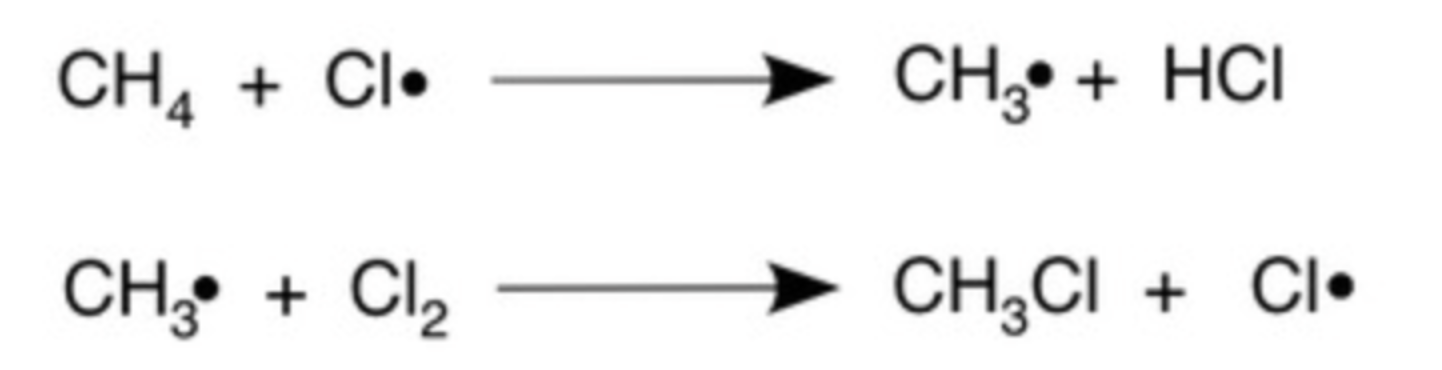
What are the two general propagation equations in the free-radical substitution reaction of an alkane with chlorine?
R⋅+Cl2→RCl+Cl⋅R⋅+Cl2→RCl+Cl⋅
R⋅+Cl⋅→RClR⋅+Cl⋅→RCl
What is the definition of disproportionation ?
reaction where a species is both oxidized and reduced at the same time