Stats Review Exam 1
 View linked note
 Call Kai
 Learn
Learn Practice Test
 Spaced Repetition
 Match
Match Flashcards
 Knowt Play
1/49

There's no tags or description
Looks like no tags are added yet.
Name | Mastery | Learn | Test | Matching | Spaced | Call with Kai |
|---|
No analytics yet
Send a link to your students to track their progress
50 Terms
Research Producer
Important for coursework in psychology, graduate school, and working in a research laboratory.
Research Consumer
Important for psychology courses and future careers, especially in understanding evidence-based treatments.
Empiricism
Using evidence from the senses or instruments as the basis for conclusions.
Aim of Empiricists
To be systematic, rigorous, and make their work independently verifiable.
Theory
A set of statements describing general principles about how variables relate to one another.
Hypothesis
The specific outcome a researcher expects to observe if the theory is accurate.
Data
A set of observations.
Good Scientific Theories
Supported, falsifiable, parsimonious, and do not prove anything.
Basic Research
Aimed at enhancing the general body of knowledge about a particular topic.
Translational Research
Bridges basic to applied research, using findings from basic research to develop applications.
Applied Research
Conducted to solve practical or real-world problems.
Comparison Group
Enables comparison of outcomes with and without the factor of interest.
Confounds
Alternative explanations for an outcome in research.
Research vs
Research is better than experience due to its structured approach.
Probabilistic
Findings are not expected to explain all cases all the time.
Availability Heuristic
Being persuaded by what easily comes to mind, leading to overestimation of frequency.
Present/Present Bias
Failing to consider what we cannot see, influenced by vivid or memorable instances.
Confirmation Bias
Focusing on evidence that supports pre-existing beliefs.
Bias Blind Spot
The belief that one is unlikely to be biased.
Empirical Journal Abstract Components
Introduction, Method, Results, Discussion, References.
Variable
Something that changes or varies, requiring at least two levels or values.
Constant
A factor that does not vary and remains the same.
Measured Variable
Observed and recorded in research.
Manipulated Variable
Controlled by the researcher.
Conceptual Variables
Abstract concepts that cannot be measured directly.
Operationalized Variables
Conceptual definitions turned into measurable or manipulable variables.
Claim
An argument someone is trying to make.
Frequency Claim
Describes a particular rate or degree of a single variable.
Association Claim
Argues that one variable is likely associated with another.
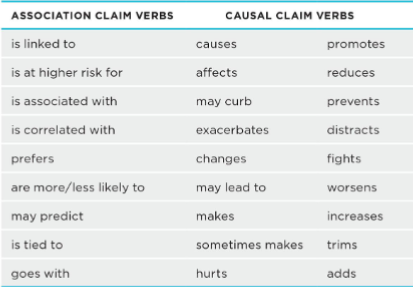
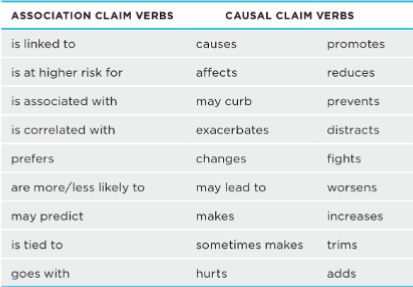
Causal Claim
Suggests a cause-and-effect relationship between variables.
Construct Validity
How accurately a researcher operationalizes each variable.
External Validity
How well study participants represent the intended population.
Statistical Validity
How well the statistics support the claim.
Internal Validity
How well the study eliminates alternative explanations.
Random Assignment
Increases internal validity by controlling for alternative explanations.
Self-Report
Asking people questions about themselves in a questionnaire or interview.
Observational
Recording observable behaviors.
Physiological Measures
Recording biological data.
Scales of Measurement
Different levels of measurement including nominal, ordinal, interval, and ratio.
Reliability
Consistency of results from a measure.
Test-Retest Reliability
Consistent scores every time a measure is used.
Interrater Reliability
Consistent scores regardless of who measures or codes.
Internal Reliability
Consistent response patterns from participants.
Validity
Whether the operationalization measures what it’s supposed to measure.
Face Validity
The measure appears to measure what it claims.
Content Validity
The measure includes all parts that the theory suggests.
Criterion Validity
Relation of a self-report measure to a concrete outcome.
Convergent Validity
Strong correlation with other self-report measures of the same construct.
Discriminant Validity
Weaker correlation with self-report measures of different constructs.
Relationship between Reliability and Validity
A measure can be less valid than reliable, but not more valid than reliable.