Stats Review Exam 1
Chapter 1
Research producer- Important for coursework in psychology, for graduate school and for working in a research laboratory.
Research consumer- Important for psychology courses; when reading printed or online news stories based on research; For your future career (Evidence-based treatments)
Empiricism- Using evidence from the senses or from instruments that assist the senses as the basis for conclusions
Aim of empiricists- To be systematic, rigorous, and to make their work independently verifiable by other observers or scientists.
Theory-a set of statements that describes general principles about how variables relate to one another
Hypothesis- The specific outcome the researcher expects to observe in a study if the theory is accurate
Data- A set of observations
Good scientific theories? - supported, falsifiable, parsimony, don’t prove anything(weight of evidence)
Supported by data-
Falsifiable-
Have parsimony-
Basic Research- The goal is to enhance the general body of knowledge about a particular topic
Basic Research Example-
Translational Research- A bridge from basic to applied research in which findings from basic research are then used to develop applications
Translational Research Example-
Applied Research-conducted in order to solve practical/real-world problems
Applied Research Example-
/
Chapter 2
• Research vs. Experience
Experience has no comparison group.
A comparison group- enables us to compare what would happen both with and without the thing we are interested in
Experience is confounded (Confounds)
Confounds- here are usually several possible explanations for an outcome, and these alternative explanations are called __________.
What can be done about confounds- n a research setting, scientists are able to change one factor at a time
Research- _________ is better than experience.
Research is probabilistic (not expected to explain all case).
Probabilistic- Its findings are not expected to explain all the cases all the time (i.e., there are exceptions)
Trusting authorities on the subject (peer review)ts findings are not expected to explain all the
cases all the time (i.e., there are exceptions)
• Intuition is Biased
o Availability heuristic- Being persuaded by what easily comes to mind
When events or memories are vivid, recent, or memorable, they come to mind more easily, leading us to overestimate how often things happen
o Present/Present bias-
Failing to think about what we cannot see
The availability heuristic plays a role in the present/present bias because instances in the “present/present” cell of a comparison stand out.
o Confirmation bias- Focusing on the evidence we like best
We “cherry-pick” the information we take in— seeking and accepting only the evidence that supports what we already think.
o Bias Blind Spot- Biased about being biased
the belief that we are unlikely to fall prey to the other biases previously described
Finding and reading the research
Components of an Empirical Journal Abstract:
Introduction
Method
Results
Discussion
References
Chapter 3
Variables vs Constants
Variable- something that changes or varies, so it needs to have at least two levels or values (but it can have more)
Constant- Does not vary(stays the same)
Measured vs manipulated
Measured Variable- Observed and recorded
Manipulated Variable- Controlled
o Conceptual vs Operational
Conceptual variables- are abstract, theoretical concepts that we cannot measure directly
Operationalized Variables- Conceptual definition turned into a measured or manipulated variable
Three Claims
Claim- An argument someone is trying to make
Frequency- describes a particular rate or degree of a single variable.
Only one measure variable
Association- argues that one level of a variable is likely to be associated with a particular level of another variable
Underlying most association claims are correlational studies
Help us make predictions
Zero association claims cannot
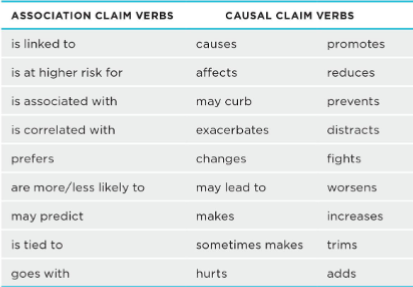
Association Verbage
Causal
Causal verbage
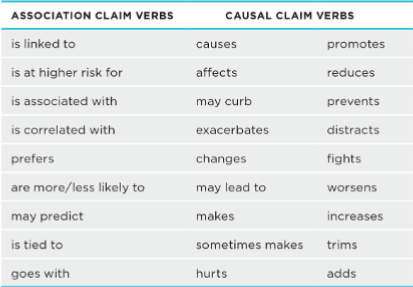
A causal claim that contains tentative language (could, may, seem, suggest) is still a causal claim
Not all claims are based on research
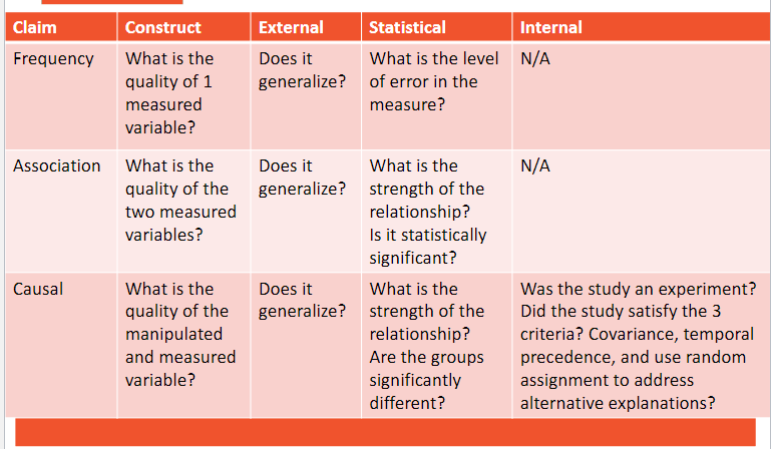
Four Validities
o Construct-How accurately/appropriately did a researcher operationalize each variable
o External- How the researchers chose the study’s participants, and how well did those participants represent the intended population
o Statistical- How well did the numbers and statistics used in the research support the claim
o Internal-How well did the study eliminate alternative explanations
• Interrogating Claims
Interrogating Frequency Claims
Construct validity
How was _________ operationally defined?
External validity
Who did they survey, and how did they choose their participants?
Statistical validity (maybe)
The margin of error?
Interrogating Association Claims
Claim: “People who multitask are the worst at it.”
Construct validity
How were the frequency and ability to multitask measured?
Pay attention to how BOTH variables are operationalized.
External validity
Does the association claim generalize to other populations, contexts, times, or places?
Statistical validity
To what extent are the statistical conclusions accurate and reasonable?
Criteria for causal claims
To move from the language of association to the language of causality, a study must satisfy three criteria:
Establish that the two variables are correlated
Demonstrate that the causal variable occurred first and the outcome occurred afterwards
Establish that no other explanations exist for the relationship between the variables
Random assignment increased internal validity
Increases internal validity by controlling for potential alternative explanations
Prioritizing Validities
Internal validity is typically a top priority when making causal claims but not when making frequency or association claims
Chapter 5
Variables and Operational Definitions
Self-Report- Ask people questions about themselves in a questionnaire or interview
Observational- recording observable behaviors
Physiological measures- Record biological data
Scales of Measurement
Nominal- levels are qualitatively distinct categories
Ordinal-Ranked order
Interval- Numerals represent equal distances between levels and there is notrue zero
Ratio- Numerals represent equal intervals and there is a true zero
Reliability-how consistent the results of a measure are
Test-retest Reliability- Consistent scores every time the measure is used
Interrater Reliability- Consistent scores no matter who does the measuring or coding
Internal Reliability- A participant provides a consistent pattern of responses, regardless of how the researcher has phrased the question
Validity-Whether the operationalization is measuring what it’s supposed to measure.
Face Validity- It looks like what you want to measure.
Content-The measure contains all the parts that your theory says it should contain
Criterion Validity-whether a self-report measure is related to a concrete outcome that it should be related to (objective)
Convergent Validity- A self-report measure should correlate strongly with other self-report measures of the same construction
Discriminant Validity- A self-report measure should correlate less strongly with self-report measures of different constructs.
• Relationship between reliability and validity
A measure can be less valid than it is reliable, but it cannot be more valid than it is reliable.
Reliability is necessary but not sufficient for validity.