Case 2: Hair on my Chinny, Chin Chin
 Call Kai
 Learn
Learn Practice Test
 Spaced Repetition
 Match
Match Flashcards
 Knowt Play
1/33

There's no tags or description
Looks like no tags are added yet.
Name | Mastery | Learn | Test | Matching | Spaced | Call with Kai | Chat |
|---|
No analytics yet
Send a link to your students to track their progress
34 Terms
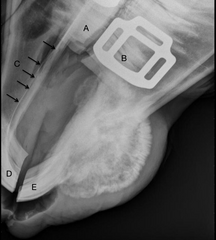
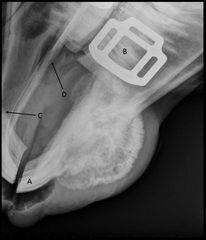
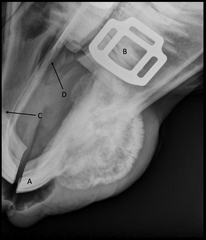
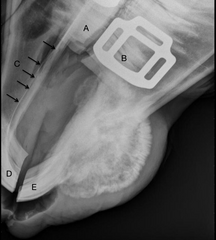
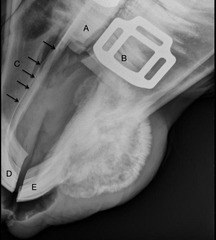
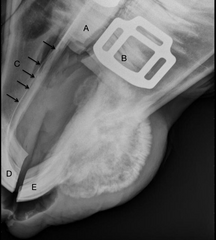
Superimposed lower incisors
Letter A is positioned over what anatomic structure?
d. All of the above
When evaluating bone margins, what are the questions you should be asking yourself?
a. Is the margin in question smooth or irregular?
b. Is the margin in question continuous or disrupted?
c. Is the margin in question thinner than normal?
d. All of the above
As Low As Reasonably Achievable
What does ALARA stand for?
Premaxilla
Letter C is pointing to what bone (the bone where the upper incisors live)?
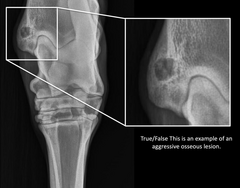
False (lesion does not extend into the cortex and has a distinct transition from abnormal bone to normal bone)
This is an example of an aggressive osseous lesion.
TRUE OR FALSE
xx
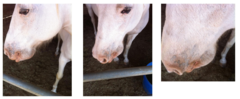
Just so you have an idea of what the horse looked like from the outside.. firm, not easily moved mass on horse's jaw
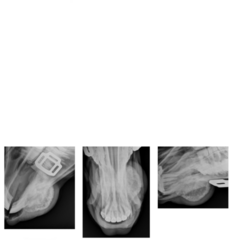
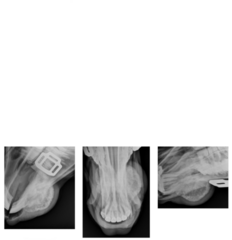
Equine Lateral, oblique and DV projections are available for review.
Describe the study you are seeing here
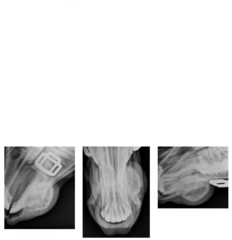
Patient positioning is adequate for interpretation.
Study technique is adequate for interpretation
Describe patient positioning and technique
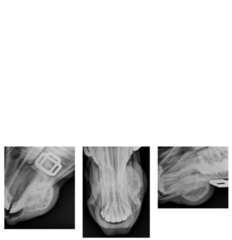
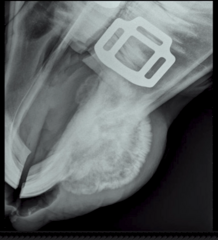
An expansile, mixed lytic and proliferative mass with rough, spiculated and irregular margins extends the entire left interalveolar space from the lower incisors to the first premolar. The cortical margins of the mandible in the region of the mass are not clearly identified. There is an ill-defined, wide zone of transition between normal and abnormal bone. Mild soft tissue thickening adjacent to the mass is present.
note: the "rough spiculated irregular margins" is defining the periosteal reaction
Describe your findings (roentgen signs)
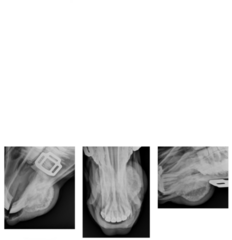
Aggressive, monostotic mass in the interalveolar space is most consistent with a primary bone neoplasia. Given the location of the mass (mandibular) osteosarcoma is considered likely, but other primary bone tumor types like fibrosarcoma cannot be ruled out. Other differential considerations also include neoplasia of dental origin or squamous cell sarcoma.
Describe Conclusions: Give your radiographic diagnosis and list possible differential diagnoses for all your findings
Biopsy is required for definitive diagnosis. Alternatively, a fine needle aspirate could also be tried in order to get a diagnostic sample.
Describe Next Steps: Are there any additional imaging suggestions that would help clarify your findings? Are there critical next steps to take from a stabilization/management/treatment plan standpoint?
Interalveolar space between incisors and premolars
What is the location of this mass in this horse?
1. what does cortex look like
2. what is happening at transition from abnormal bone to normal bone (is there a clear demarcation?)
3. what is the periosteal reaction like
= only need ONE of these things for a bone lesion to be considered aggressive
What 3 questions help you to determine if this is an aggressive or nonaggressive lesion?
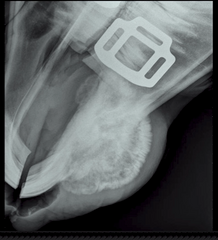
Spiculated, Sunburst, Irregular
These are the several types of periosteal reactions that can occur with bone lesions. Which of these periosteal reactions would be characterized as more aggressive because the lesion is growing SO fast it will not be "regular"?
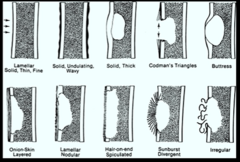
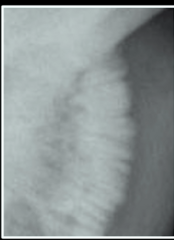
Spiculated = more aggressive reaction
How would you describe this periosteal reaction pattern?
There is only one BONE lesion
What does "monoastotic" mean?
Osteosarcoma
note: osteosarcoma is RARE in the horse, but if it IS in horses, it will be in the mandible
Given the location of a bony lesion mass in the mandible of a horse, which primary neoplasia is most likely?
False
Osteosarcoma is a very common diagnosis in equine patients
TRUE OR FALSE
ALL OF THE ABOVE
a. cortical destruction with a short zone of transition
b. long zone of transition with a lamellar periosteal reaction
c. cortical disruption, a long zone of transition and an irregular periosteal reaction
Which factors must be present in order to classify an osseous lesion aggressive? (select all that apply)
a. cortical destruction with a short zone of transition
b. long zone of transition with a lamellar periosteal reaction
c. cortical disruption, a long zone of transition and an irregular periosteal reaction
False
If a bony lesion appears aggressive on the radiographs, it will also likely be very aggressive biologically.
TRUE OR FALSE
True
If a lesion does not have any characteristics of aggressiveness, it is likely that the lesion is not biologically aggressive.
TRUE OR FALSE
c. Lysis and/or proliferation alone are not adequate to classify
Which is more aggressive?
a. lytic lesion
b. a proliferative lesion
c. Lysis and/or proliferation alone are not adequate to classify
FALSE: in this case, you can see an ungloved finger on the left side of the image
In the DV view in this case, the technician assisting with taking this radiograph was following ALARA principles.
TRUE OR FALSE
False
It is very easy to distinguish bone neoplasia from osteomyelitis by just looking at the radiographs.
TRUE OR FALSE
First Premolar
What is A?
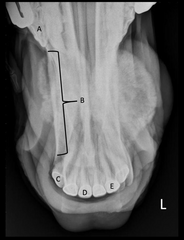
Interalveolar space
What is B?
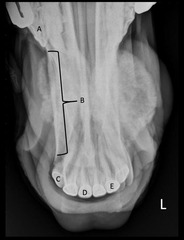
403
What is C?
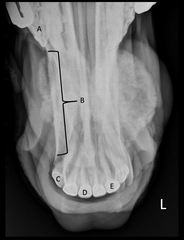
401
What is D?
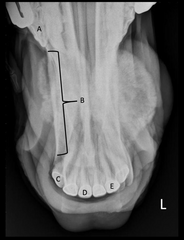
302
What is E?
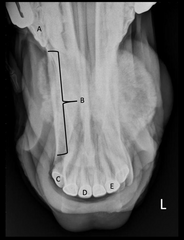
Upper premolars
What is A?
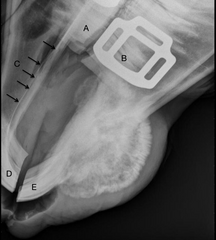
Lower premolars
What is B?
Palatine bone
What is C?
Superimposed upper incisors
What is D?
Superimposed lower incisors
What is E?