Nife Aero Ch. 4
 Call Kai
 Learn
Learn Practice Test
 Spaced Repetition
 Match
Match Flashcards
 Knowt Play
1/14

There's no tags or description
Looks like no tags are added yet.
Name | Mastery | Learn | Test | Matching | Spaced | Call with Kai | Chat |
|---|
No analytics yet
Send a link to your students to track their progress
15 Terms
Describe a slipping turn
A slip is caused by opposite or insufficient rudder in the desired direction of turn. The yawing movement is toward the outside of the turn, and the balance ball is deflected toward the inside, due to gravitational pull.
Turn radius increases and turn rate decreases
Describe a skidding turn
A skid is caused by using too much rudder int he desired direction of turn. The yawing movement is toward the inside of the turn and the balance ball is deflected toward the outside due to centrifugal force.
Turn Radius decreases and turn rate increases
Describe the effects of low speed P-factor, slipstream, swirl and what the pilot must do to compensate for it
Low speed, at high AOA, or while on the ground, the nose will tend to move left, so right rudder and lateral stick must be used to compensate
Describe the relationship between load factor and angle of bank for a level, constant airspeed-turn
As angle of bank increases, the load factor required to maintain level flight increases
Define limit load, ultimate load, and elastic limit
Limit Load: the greatest load factor an airplane can sustain without any risk of permanent deformation
ultimate load: the maximum load factor that the airplane can withstand without structural failure. Permanent deformation will occur but no actual failure of load carrying members. If exceeded, failure is imminent.
elastic limit: the maximum load that may be applied to a component without permanent deformation (limit load factor < elastic limit)
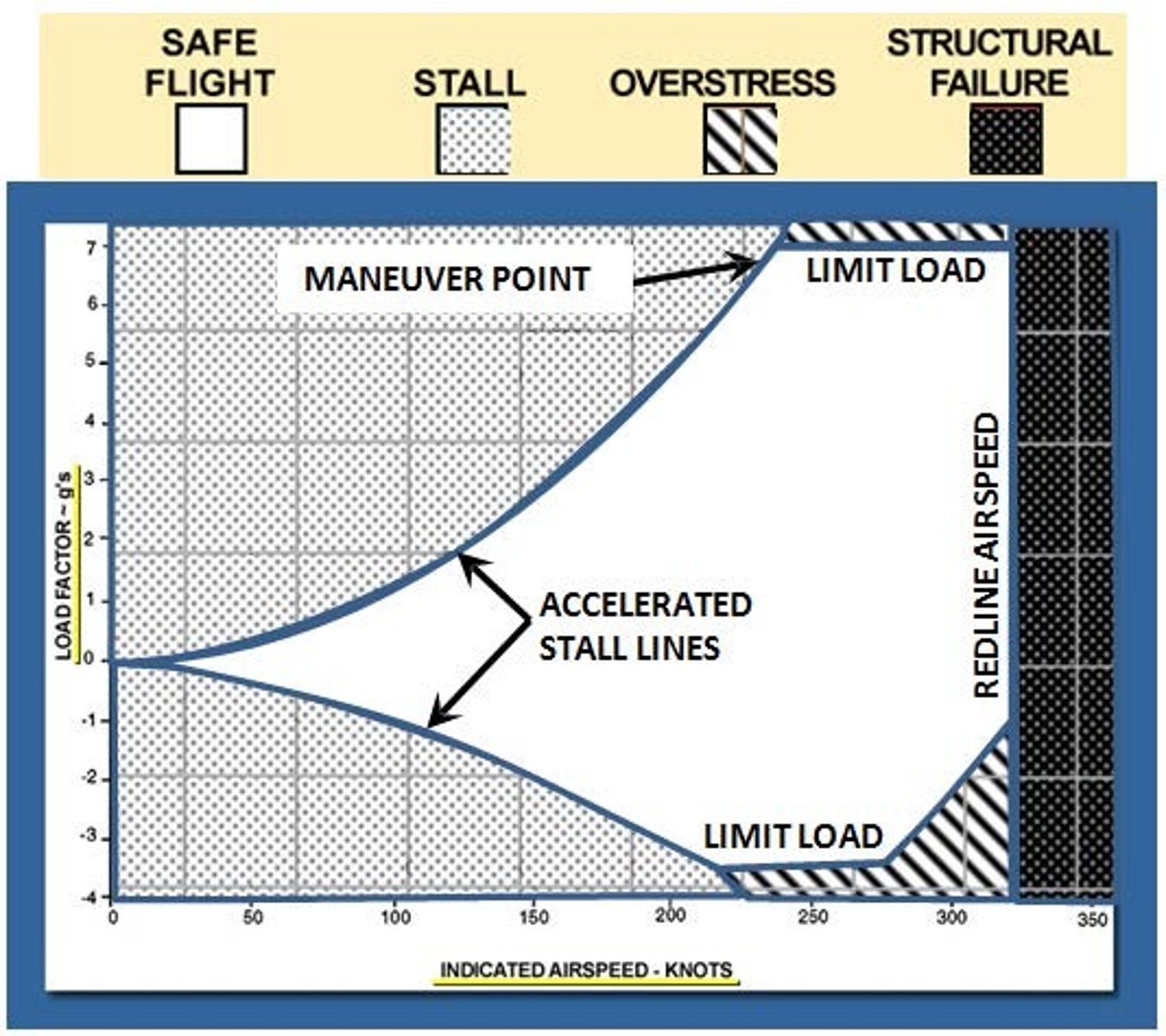
Describe the boundaries of the safe flight envelope, including accelerated stall lines, limit load factor, maneuver point, and redline airspeed
Accelerated stall lines - aka. lines of maximum lift. They represent the maximum load factor that an airplane can produce based on airspeed and are determined by Clmax AOA.
Limit Load Factor - represents the manufacturer's and military's structural limitations. Any G load above this line will over stress the airplane. Aircraft have both positive and negative limit load factors
Maneuver Point - The point where the accelerated stall line and the limit load factor line intersect. This point correlates to the maneuvering speed or cornering velocity (the lowest airspeed at which the limit load factor can be reached).
Redline airspeed - (VNE) is the vertical line on the right of the V-N diagram. It is the highest airspeed that the airplane is allowed to fly. Above this airspeed, the plane could experience structural damage. Sets limits to ensure critical mach is not met by the plane or prop as well as temp limitations are not exceeded.
Describe wake turbulence and characteristics that create the greatest vortex strength
Greatest vortex strength occurs when the aircraft is heavy, slow, and clean.
Describe procedures to avoid wake turbulence during takeoff or landing profiles of other traffic
- certain distance between aircraft must be kept depending on the aircraft's weight category
- a 2 min interval should be used if ATC passes the risk to the pilot by saying "caution wake turbulence"
- Pilots should adjust their rotation and landing points to avoid wake turbulence and maintain above the previous aircraft's flight path during TO or LDG
Define wind shear
A sudden change in wind direction and/or speed over a short distance in the atmosphere.
Describe how wind shear can be a hazard during the landing environment
If the dynamic pressure over the wing changes rapidly, altering the amount of lift the airplane is producing, it can be very dangerous while low to the ground due to stalling and insufficient time, altitude, or airspeed to recover.
P-factor
Yawing moment caused by one propeller blade creating more thrust than it's opposing blade. At high AOA, the downgoing blade produces more thrust and the aircraft yaws to the left.
Slipstream swirl
causes left yaw. strongest at high power/low airspeed. air swirling around fuselage into vert. stab.
compensate with right rudder and lateral control stick
Load Factor
the ratio of total lift to the airplane's weight (N = L/W)
Limit Load Factor
The greatest load factor an airplane can sustain without any risk of permanent deformation.
Overstress/Over-G
The condition of possible permanent deformation or damage that results from exceeding the limit load factor.
- wing will not fly off from meeting limit load factor, but there could be other internal damage if it is passed