Secondary Protein Structure
 Call Kai
 Learn
Learn Practice Test
 Spaced Repetition
 Match
Match Flashcards
 Knowt Play
1/21

There's no tags or description
Looks like no tags are added yet.
Name | Mastery | Learn | Test | Matching | Spaced | Call with Kai | Chat |
|---|
No analytics yet
Send a link to your students to track their progress
22 Terms
Secondary Protein Structure (Definition)
Secondary protein structure is the arrangement of the peptide chain backbone in a relatively short stretch of amino acids.
three common types
three common types of secondary structure
alpha-helix formed by the repeated rotation of the peptide backbone.
There are three beta strands, which are extended regions of amino acids. Beta strands can interact with other beta strands to form a beta sheet.
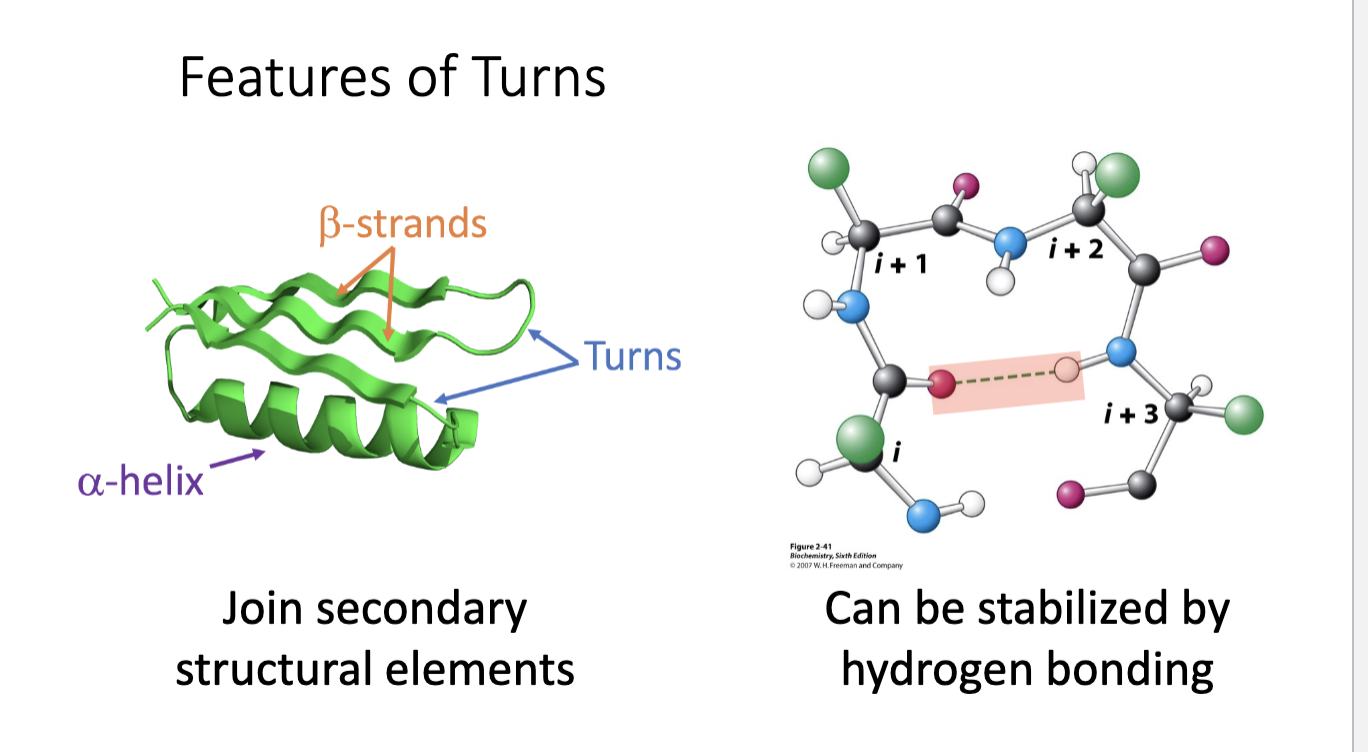
Turns are regions in between beta strands and alpha helices that enable the different regions of the protein to come together.
alpha-helix
formed by the repeated rotation of the peptide backbone.
beta strands
which are extended regions of amino acids. Beta strands can interact with other beta strands to form a beta sheet.
turns
Turns are regions in between beta strands and alpha helices that enable the different regions of the protein to come together.
Alpha-Helix Structure
Alpha-helices are very regular structures with consistent features.
R groups or side chains are arranged so that they point away from the helix.
The height of one turn of the helix, called the pitch, is 5.4 angstroms. There are 3.6 amino acid residues per turn.
Alpha-helical structures are stabilized by the formation of hydrogen bonds between backbone atoms.
In this linear depiction of a peptide, there are 5 amino acids labeled by convention, starting with residue i on the end terminal and left side, and ending with i + 5 on the C-terminal and right side.
Two of the hydrogen bonds that would form if this region made an alpha-helix are indicated by the red arrows.
On the bottom, the oxygen of the carbonyl group from residue i, and the hydrogen of the amide-group from residue i + 4 form a hydrogen bond.
On the top, the oxygen of the carbonyl group from residue i + 1, and the hydrogen of the amide-group from residue i + 5 form a hydrogen bond. An alpha-helix is formed by a consistent pattern of hydrogen bonding between residues that are 4 amino acid the way creating this regular structure.
Alpha-Helix Structure features
Alpha-helices are very regular structures with consistent features.
R groups or side chains are arranged so that they point away from the helix.
alpha helix turn
The height of one turn of the helix, called the pitch, is 5.4 angstroms. There are 3.6 amino acid residues per turn.
alpha helix stabilization
Alpha-helical structures are stabilized by the formation of hydrogen bonds between backbone atoms.
alpha helix bonding
In this linear depiction of a peptide, there are 5 amino acids labeled by convention, starting with residue i on the end terminal and left side, and ending with i + 5 on the C-terminal and right side.
Two of the hydrogen bonds that would form if this region made an alpha-helix are indicated by the red arrows.
On the bottom, the oxygen of the carbonyl group from residue i, and the hydrogen of the amide-group from residue i + 4 form a hydrogen bond.
On the top, the oxygen of the carbonyl group from residue i + 1, and the hydrogen of the amide-group from residue i + 5 form a hydrogen bond. An alpha-helix is formed by a consistent pattern of hydrogen bonding between residues that are 4 amino acid the way creating this regular structure.

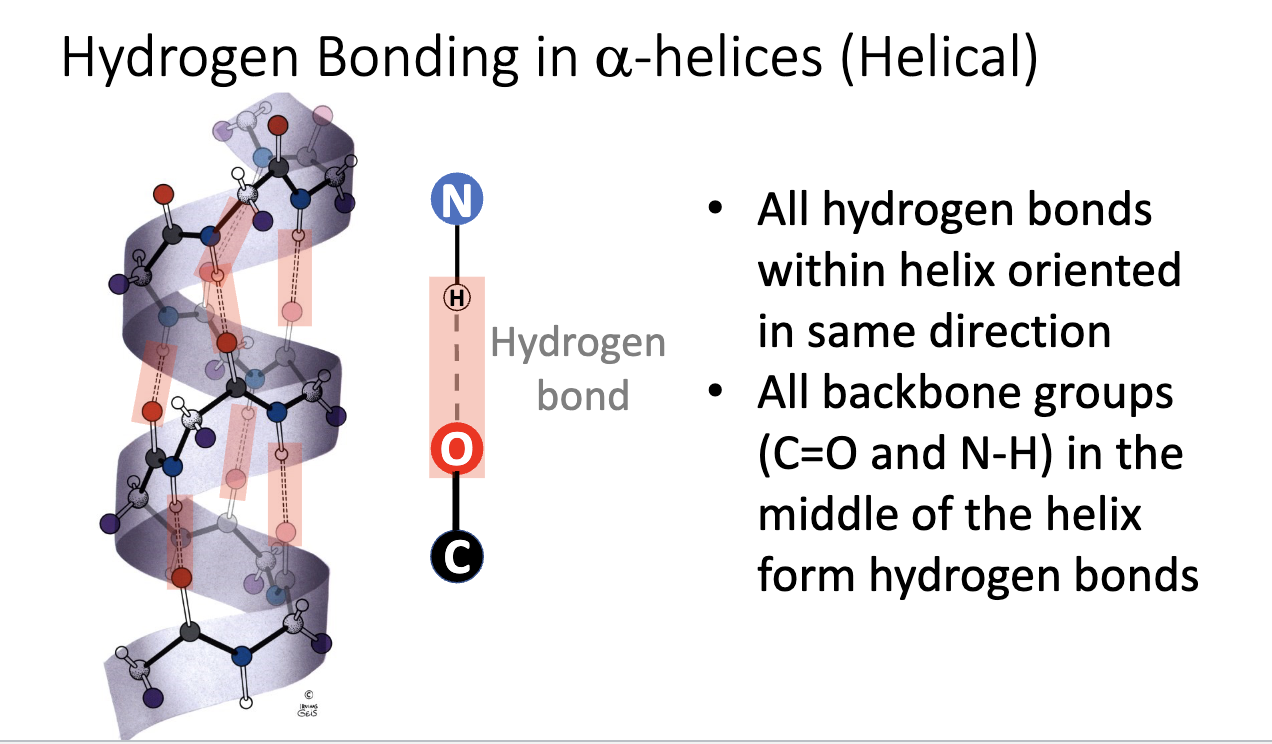
Alpha-Helix Hydrogen Bonding (3D)
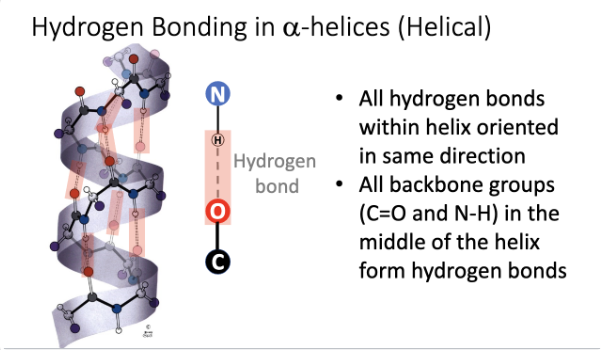
This representation of an alpha-helix helps to visualize the hydrogen bonding occurring in the context of a three-dimensional helix.
All hydrogen bonds between oxygen and hydrogen atoms in the helix are highlighted in red.
Note that all of the hydrogen bonds are oriented in the same way with the hydrogen from the NH at the top and the oxygen from the CO at the bottom.
All backbone groups in the middle of the helix form hydrogen bonds. And there are no available hydrogen bond receptors or hydrogen bond donors.
Beta Strand Structure
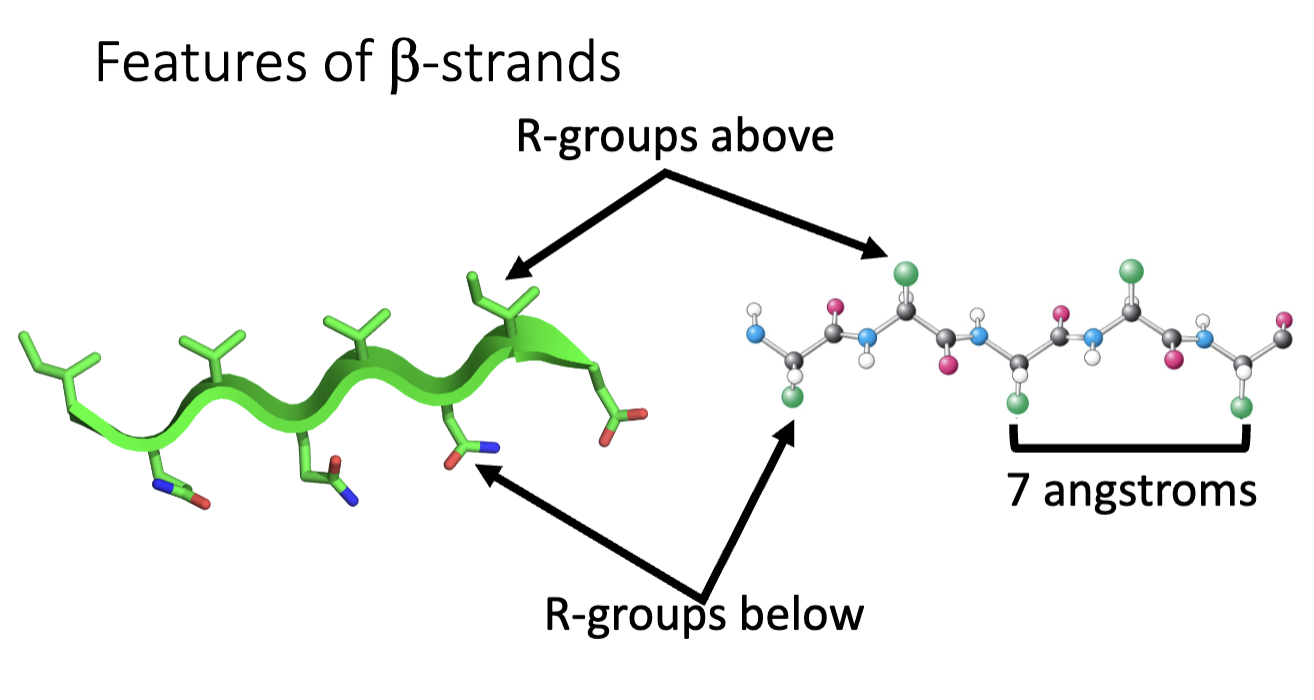
In a beta strand, the R-groups are oriented perpendicular to the plane formed by the backbone atoms. In these diagrams, the R-groups are located above and below the backbone.
Notice that adjacent R-groups are positioned on opposite sides of the peptide backbone.
The distance between two R-groups on the same side is 7 angstrom.
Beta Sheet Formation
This diagram shows three beta strands interacting through hydrogen bonds to form a beta sheet. The hydrogen bonds are highlighted in red.

In three dimensions, the R-groups in green would be oriented pointing towards you or away from you.
The top two strands are both oriented with the N terminus on the left side and the C-terminus on the right side forming a parallel strand-strand interaction. The bottom two strands are in opposite orientations, which forms an anti parallel strand-strand interaction.
Turns and Loops
Turns are regions of the peptide chain that join secondary structural elements.
Secondary structural elements can also be connected by loops, which are larger and more varied in structure.
Turns can be stabilized by the formation of hydrogen bonds, like the example shown here, where the oxygen of the carbonyl group in residue i forms a hydrogen bond with the hydrogen of the amide group in residue i + 3.

Diversity of Secondary Structures
Different proteins have different amounts and arrangements of secondary structures. These representations of protein structures illustrate the diversity observed in different proteins. Alpha-helical regions are colored pink. Beta strands are colored yellow. And connecting regions, including turns and loops, are colored in blue
Types of Secondary Structure

Features of an alpha-helix
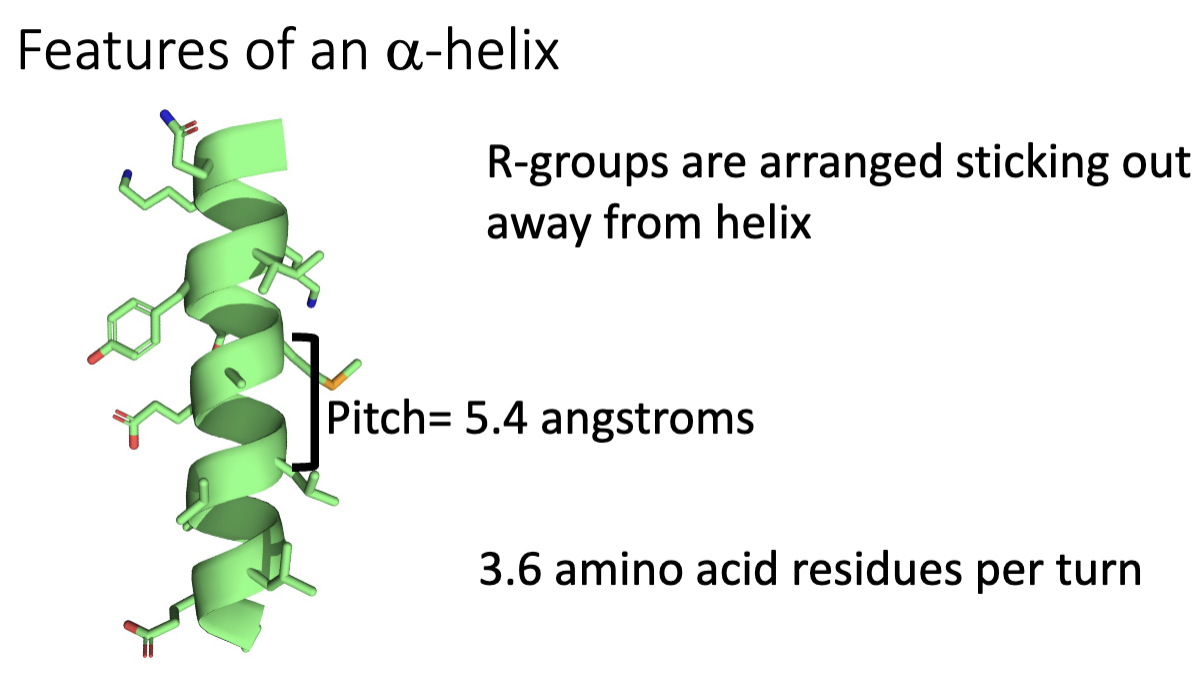
R-groups are arranged sticking out away from helix
Pitch= 5.4 angstroms
3.6 amino acid residues per turn
Hydrogen Bonding in a-helices (Linear)
+4
Hydrogen Bonding in a-helices (Helical)
All hydrogen bonds within helix oriented in same direction
All backbone groups (C=O and N-H) in the middle of the helix form hydrogen bonds
Features of beta-strands
Hydrogen Bonding between beta-strands forms beta-sheets

Features of Turns
Join secondary structural elements
Can be stabilized by hydrogen bonding