Lecture 22: Equine Neurologic Examination
 Call Kai
 Learn
Learn Practice Test
 Spaced Repetition
 Match
Match Flashcards
 Knowt Play
1/35

There's no tags or description
Looks like no tags are added yet.
Name | Mastery | Learn | Test | Matching | Spaced | Call with Kai | Chat |
|---|
No analytics yet
Send a link to your students to track their progress
36 Terms
What are the 5 components used in an equine neuro exam?
1.Sensorium and mental attitude
2.Gait and posture
3.Postural reactions
4.Muscle tone & size, spinal reflexes
5.Cranial nerves
What is examined in the head region on a neuro exam?
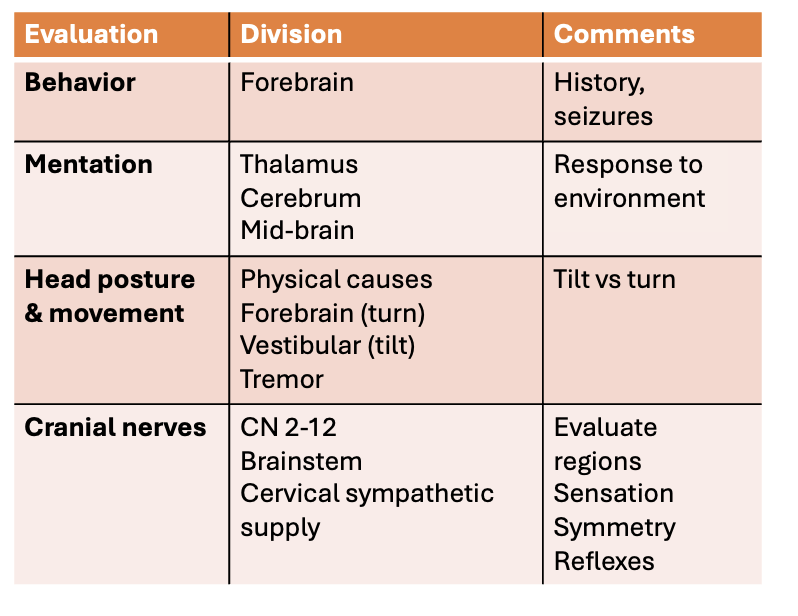
What are signs of decreased alertness?
Lethargy: blank facial expression, drooping ears and eyelid, sluggish responsiveness to stimuli, reduced voluntary activity
Stupor: stands in one place, head held low, only responds to strong stimuli
Coma: semi-comatose = recumbent, responds; comatose = recumbent, unresponsive
What behaviors are you looking for on a neuro exam?
•Self-mutilation
•Head pressing
•Compulsive walking
•Yawning
•Head pressing
•Aggression
•Timidity
•Loss of affection
What postures are you looking for on a neuro exam?
•Wide/narrow based stance
•Tilt (peripheral vestibular = towards)
•Turn/circling (central = towards)
•Leaning
•Recumbency
•Opisthotonos
What are the 12 CN and what are their major functions?

How do you assess the first 6 CN?
olfactory → difficult to assess
optic → menace, PLR
oculomotor → PLR, medial movement globe
trochlear → ventrolateral rotation globe
trigeminal → sensory: ear, eyelid, lip (facial) reflexes and pain/perception; motor: chewing, jaw tone, muscle mass
abducens → eyeball retraction (corneal reflex), lateral movement globe
How do you assess the last 6 CN?
facial → ear, eyelid, lip (facial) tone, reflexes, movements, symmetry
vestibular/cochlear → head posture, induced eyeball movement, normal gait, blind fold test, response to noise, normal vestibular nystagmus
glossopharyngeal → swallowing (observation, palpation), endoscopy, slap test
vagus → ““
accessory → ““
hypoglossal → tongue size and symmetry
How is equine vision evaluated?
•Menace (temporal, nasal field)
•Vision in unfamiliar environment and different light
•Fundus exam
How are equine eyes evaluated for straismus, nystagmus, pupillary size, and pain?
•Move head up/down
•Move head side to side
•Eye position, strabismus
•PLR: Direct, Swinging light
•Look at angle upper eye lashes
How is the trigeminal nerve tested?
observe facial symmetry
test facial sensation
if motor issue → atrophy of temporalis, masseter, pterygoid mm.
What are the signs of facial nerve issues?
issues with muscle of facial expression and motor issues
ear droopy
upper eyelid droopy
upper lip deviated
lower lip droopy
How is tongue tone evaluated?
pull tongue through interdental space and see how long it takes for them to pull it back in, repeat on both sides
How do you evaluate the body for neurologic function?

What is the first thing you do on a neuro exam when evaluating the neck and thoracic limbs?
distance exam with a 360 degree view and compare
observe → palpate → manipulate
look for atrophy, asymmetry, trembling, sweating
Where can you palpate C6-C7?
deep in front of shoulder
What reflexes and manipulations are performed on the neck and thoracic limbs during a neuro exam?
Neck flexion (use food)
• “eat food at side of chest”
• Lifts/lowers head/neck adequately
Reflexes
• Slap test
• Cervicofacial reflex
• Cutaneous trunci (panniculus)
Limb strength & sensation, gait, posture
How is the slap test: thoraco laryngeal adductor reflex (TLAR) performed?
• “Hook” highest point of larynx
• Slap wither opposite side
• Feel discrete movement
• Test both sides
gentle slap behind withers triggers ascending pathway of reflex arc → fibers cross over with motor (efferent) pathway to larynx
What are you palpating for in the trunk and pelvic limbs during a neuro exam?
• Back extension
• Back flexion
• Cutaneous trunci
What are you examining on the rectum, bladder, anus, and tail during a neuro exam?
•Anal reflex
•Perineal sensation
•Tail tone
•Signs of incontinence
How are spinal lesions localized based on gait/posture?

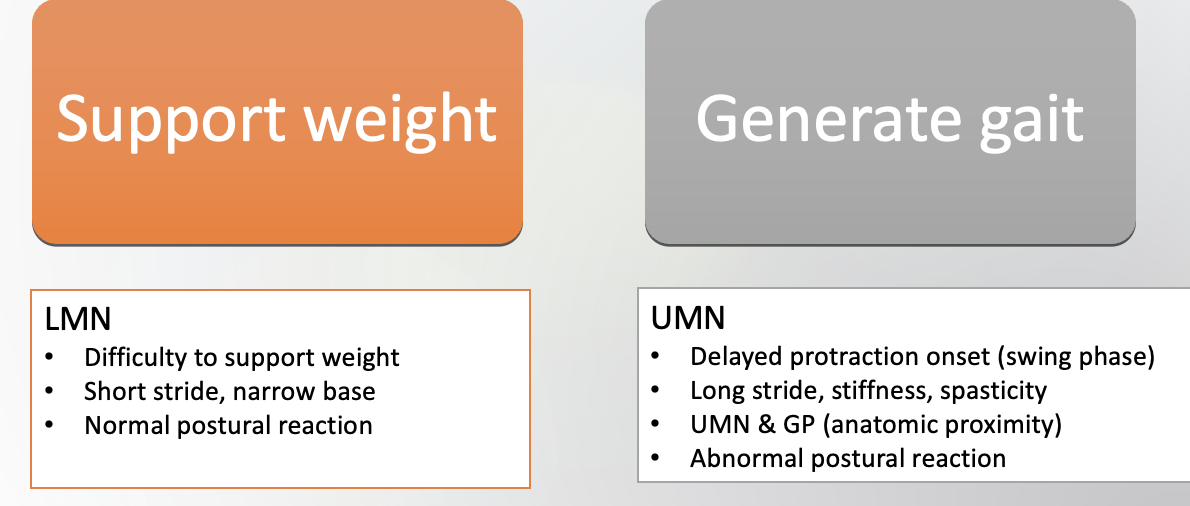
What is paresis in clinical neurology?
deficiency to support weight or generate gait
What causes the inability to support weight vs generate gait?
If suspecting paresis, how do you test limb strength?
PALPATION & MANIPULATIOn:
• Hopping (front)
• Tail pull (hind)
• Standing (L3-L5)
• Walking (Cervical)
What are the three types of ataxia?

What are signs of ataxia?
Scuffing, dragging
Delayed protraction, knuckling
Crossing over
Stepping on other foot
Pivoting, circumduction
Elongated stride
What is dysmetria, hypermetria, and hypometria?
• Dysmetria - lack of coordination of movement (distance, speed, range)
• Hypermetria - overshoot intended position
• Hypometria - undershooting intended position
How do you differentiate ataxia from lameness?
lames horses are regularly irregular (predictable)
ataxic horses are irregularly irregular (unpredictable)
What are the maneuvers used to test limb strength and gait during a neuro exam?
LIMB STRENGTH
• Tail pull
• Hopping
GAIT
• Walk straight (observe front, back, side)
• Trotting away and towards observer
• Serpentine
• Elevate head
• Blind fold
• Up/down curb
• Circle large, small, both directions
• Backing
• Up and down hill
What does tail pull or sway evaluate for?
• Resistance assesses strength
• Letting go looks at balance
What are the abnormal findings associated with a neurologic horse walking in a small circle?
Awkwardness
Pivoting (inside leg held in place)
Circumduction (outside leg abducts excessively)
Steps on itself
What are the abnormal findings associated with a neurologic horse backing up?
Reluctance/refusal
Dragging feet
Collapsing
Dog sitting
How is ataxia graded?
0 | Normal strength and coordination |
1 | Subtle deficits, observed with testing |
2 | Deficits apparent to inexperienced clinician at walk |
3 | Deficits noted at rest and walk, may fall with test |
4 | Severe deficits, may fall spontaneously |
5 | Recumbent patient |
What are the signs of UMN damage vs LMN?

How do you localize the lesion in a recumbent horse?
can lift head → proximal cervical spine
can roll up to sternal → distal cervical spine
can dog sit → > T2
How do you perform a neuro exam in the recumbent horse?
